Parental alienation syndrome describes a deeply painful dynamic where a child, influenced by one parent, begins to unjustifiably reject the other. For international families in Italy, this crisis is often amplified by unique stressors such as language barriers, navigating an unfamiliar legal system, and differing cultural norms around family life. This guide offers psychological insight into this challenge and outlines a path toward healing, specifically for the expat community.
Understanding Parental Alienation in an Intercultural Context
Problem: Following a separation, a child's relationship with one parent deteriorates dramatically without a valid reason, driven by the subtle or overt influence of the other parent.
Insight: While children naturally go through an adjustment period after a parental separation, parental alienation syndrome is a distinct and harmful process. It involves a systematic campaign of psychological manipulation, whether intentional or not, designed to sever one of the most fundamental bonds in a child's life. This moves beyond typical co-parenting disagreements into the realm of emotional harm.
For expat families in Italy, the isolation from home country support networks can intensify this dynamic. The alienating parent may exploit the situation by:
- Using language differences to create communication barriers.
- Misrepresenting the targeted parent's actions to new social circles.
- Leveraging their superior knowledge of Italian culture or legal processes.
The True Cost of a Fractured Bond
This dynamic creates a profound crisis for everyone involved. The child is caught in a loyalty conflict, often feeling forced to choose a side, which can lead to severe psychological distress like anxiety, depression, and identity issues. The targeted parent experiences a unique form of grief and trauma, feeling helpless and erased from their child's life.
At its core, parental alienation is a deeply personal crisis that creates immense emotional turmoil for both the child and the targeted parent. It moves beyond typical co-parenting challenges into the realm of psychological harm.
A Widespread but Often Hidden Issue
While the term "parental alienation syndrome" is debated in some clinical and legal circles, the underlying behaviors are widely recognized as damaging. This is not a rare occurrence but a significant mental health issue affecting families globally, including those within Italy's international community.
For instance, a retrospective study of 739 adults in Chieti, Italy, found that approximately 15% confirmed one parent actively "tried to turn me against the other parent" during their childhood. These experiences were often linked to significant psychological issues that persisted into adulthood. You can read the full research about these findings.
Navigating this issue requires a compassionate, informed approach that understands the unique pressures expat families face. The mental health challenges for expats can be complex, and finding the right support is the first crucial step toward healing. Therapsy specializes in providing this support, with licensed multilingual therapists who bridge the gap between local Italian life and global mental health standards.
Recognizing the Warning Signs of Parental Alienation
Problem: Identifying parental alienation is difficult, especially for expats managing the stress and isolation of living abroad. The signs can be subtle and easily confused with a child's normal post-separation adjustment.
Insight: The warning signs of parental alienation manifest in two key areas: the child's behavior and the alienating parent's actions. Understanding both is essential to see the complete picture of this painful dynamic.
Red Flags in a Child’s Behaviour
A child experiencing parental alienation often exhibits behaviors that are inconsistent with their personality and age. This is not a fleeting mood but a deep-seated rejection that feels programmed by an external source.
Key behavioral shifts to watch for include:
- Unjustified Criticism: The child relentlessly criticizes one parent for minor, exaggerated, or fabricated flaws, often sounding rehearsed.
- Lack of Ambivalence: They adopt a black-and-white perspective. One parent is idealized as perfect, while the targeted parent is demonized. They are often unable to recall any positive memories of the rejected parent.
- Borrowed Scenarios: The child may use adult language or describe negative events they could not have witnessed or understood, indicating they are repeating what they have been told.
- Absence of Guilt: They show no remorse for their cruelty toward the targeted parent, believing the harsh treatment is entirely justified.
One of the most telling signs of potential alienation is when a child’s rejection of a parent lacks a legitimate, firsthand reason. Their justifications often ring hollow or feel borrowed, pointing to an outside influence rather than their own experiences.
The diagram below illustrates how these dynamics can unfold, especially when compounded by the unique stressors faced by expat families in Italy.
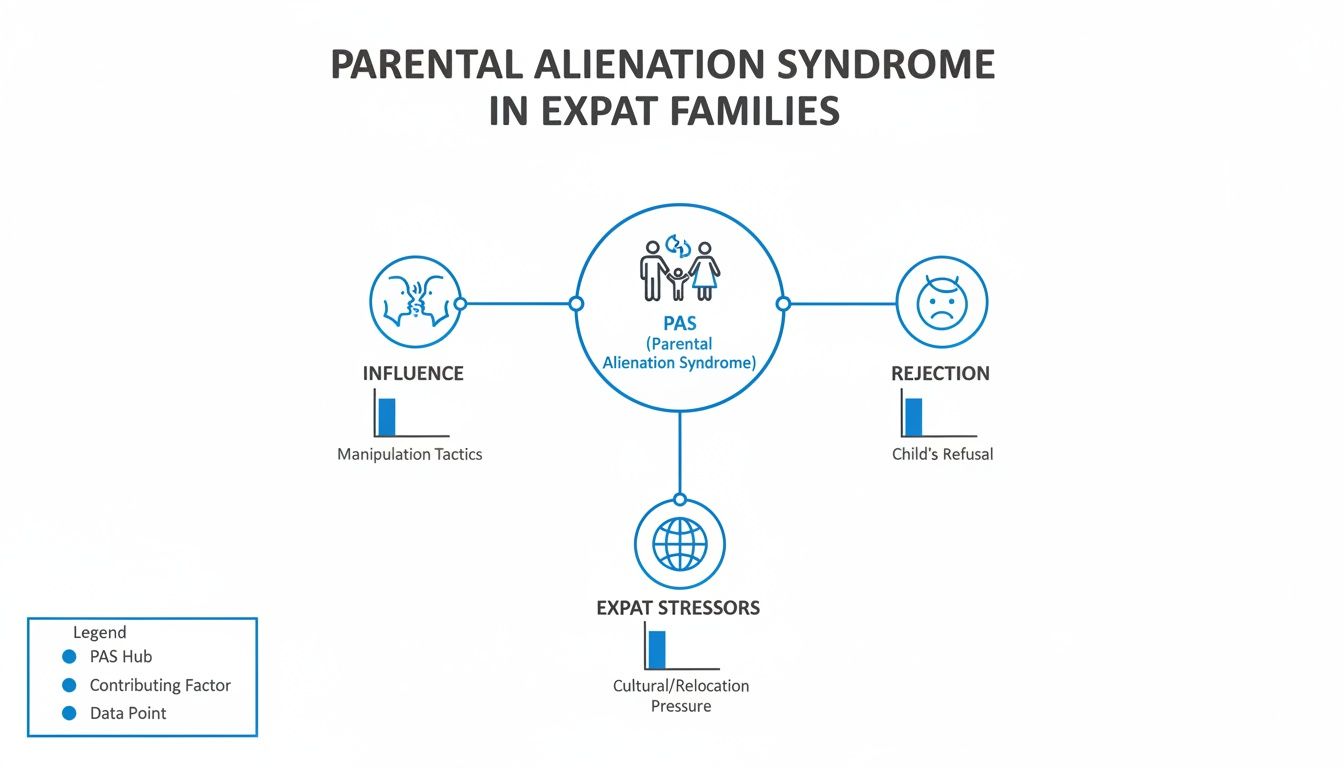
As shown, alienation is not a single act but a toxic combination of manipulative influence, the child's resulting rejection, and the added weight of expat stressors like cultural isolation and language barriers.
Common Tactics of an Alienating Parent
While the child's behavior is the visible symptom, the root cause is almost always the consistent, manipulative actions of the other parent. Their goal, conscious or not, is to systematically undermine and destroy the child's relationship with the targeted parent.
In an expat context, these tactics can be particularly effective. A parent might use their fluency in Italian or their deeper understanding of the local culture to exclude the other parent from school events, social gatherings, or other important aspects of the child's life.
This table illustrates how a child’s behavior often directly mirrors the tactics used by the alienating parent.
Behavioral Indicators in Children and Alienating Parents
| Indicator in Child | Tactic by Alienating Parent | Example in an Expat Context |
|---|---|---|
| Sudden fear or hostility | Sharing inappropriate information: Disclosing adult details of the divorce, portraying the other parent as dangerous or uncaring. | The parent tells the child, "We can't afford our apartment in Milan because your father isn't sending enough money," creating anxiety and resentment. |
| Refusal to visit or speak | Limiting contact: Blocking calls, fabricating excuses for missed visits ("they're too busy," "they don't want to see you"), or scheduling desirable activities during the other parent's time. | An alienating parent might "forget" to charge the child's phone right before a scheduled video call with the parent who lives back in their home country. |
| Loss of positive memories | Erasing the other parent: Removing photos, forbidding the child from speaking about the other parent, and acting as if they no longer exist. | After moving to Rome, one parent packs away all family photos that include the other parent, saying, "We're starting a new life here." |
| Extreme loyalty to one parent | Creating loyalty binds: Making the child feel that loving the targeted parent is a betrayal. They might say, "Why would you want to talk to them after what they did to us?" | A parent might tell the child, "If you go visit your mother for the holidays, you'll miss out on our special Italian Christmas traditions here with me." |
Recognizing these patterns is the first step toward taking action. If this dynamic feels familiar, professional support is available. For families caught in this difficult situation, exploring expert guidance through co-parenting issues therapy can open a path to healthier communication and help rebuild vital family bonds.
The Deep Psychological Impact on Families
Problem: Parental alienation is not just a disagreement; it inflicts profound, often invisible psychological wounds that fracture a family's core, leaving lasting scars on both children and the rejected parent.
Insight: This process is so destructive because it manipulates the most fundamental human bonds. It transforms a relationship built on love and trust into one of conflict and pain, creating a toxic and unnatural family dynamic.

The Child’s Fractured World
For a child, being systematically turned against a parent is akin to being forced to amputate a part of themselves. Children instinctively identify with both parents. When one is relentlessly vilified, the child learns to reject the parts of themselves they associate with that parent, leading to a fragmented sense of self.
This internal conflict often manifests in serious emotional and behavioral issues. Children caught in the crossfire of parental alienation may develop:
- Depression and Anxiety: The constant loyalty binds and the grief of losing a living parent can trigger significant mental health struggles.
- Low Self-Esteem: A child may internalize the toxic belief that they are unlovable or that something is inherently wrong with them for being connected to the targeted parent.
- Future Relationship Difficulties: The distorted model of love and trust they experience can make it incredibly difficult to form healthy, stable relationships later in life.
Parental alienation forces a child into a psychological split. To survive emotionally, they must align with one parent, which means suppressing their authentic feelings for the other. This process is profoundly damaging to their emotional development.
To fully grasp this damage, it is helpful to begin by understanding attachment theory. The syndrome actively severs this critical bond, which forms the bedrock of a child’s sense of safety and security.
The Targeted Parent’s Unseen Trauma
For the rejected parent, the experience is a uniquely devastating form of trauma. It is a specific type of grief—mourning a child who is alive but has been emotionally stolen. This ambiguous loss creates a constant state of confusion, helplessness, and crushing sadness.
Many targeted parents describe an intense form of emotional loneliness, a pain difficult to articulate. They often feel powerless, watching as their relationship with their child is systematically dismantled.
The sense of injustice, combined with the acute pain of rejection from their own child, can lead to severe stress, anxiety, and even symptoms consistent with Post-Traumatic Stress Disorder (PTSD). These intense emotions are not a sign of weakness but a natural response to an unnatural and abusive situation. The psychological impact is real and requires professional support to process the trauma and develop coping strategies. If these feelings resonate, exploring how to combat emotional loneliness with therapy can be a vital first step.
Navigating Italian Legal and Clinical Complexities
Problem: For expat families in high-conflict separations in Italy, understanding how parental alienation is viewed by the legal and clinical systems is crucial but confusing, especially since the term Parental Alienation Syndrome (PAS) is not a formal diagnosis.
Insight: It is essential to understand that "Parental Alienation Syndrome" is not a recognized diagnosis in the Diagnostic and Statistical Manual of Mental Disorders (DSM-5). This is a critical distinction for both therapeutic and legal contexts.
However, the absence of a formal diagnosis does not mean the behaviors are ignored. The manipulative tactics and the devastating harm they cause are widely recognized by clinicians and courts as a serious form of psychological and emotional abuse. The focus, therefore, is not on debating a label but on identifying and addressing the damaging behaviors themselves.
The Italian Legal Perspective
Family courts in Italy are increasingly adept at recognizing these destructive dynamics. While the specific term "Parental Alienation Syndrome" may not be used, judges and court-appointed experts (Consulente Tecnico d'Ufficio or CTU) are trained to identify the patterns of behavior.
The guiding principle is always the child's best interest (superiore interesse del minore).
Any evidence of one parent systematically sabotaging the child's relationship with the other is taken very seriously. Courts look for clear patterns, such as:
- Consistently blocking communication between the child and the other parent.
- Making false or exaggerated allegations against the other parent.
- Actively pressuring the child to reject the other parent.
- Sharing inappropriate adult details about the separation with the child.
These actions are viewed as psychological harm. When a court identifies these patterns, it can order therapeutic interventions, modify custody arrangements, or appoint social services to monitor the family.
While the clinical term 'Parental Alienation Syndrome' is contested, Italian courts focus on the tangible, abusive behaviours that damage a child's right to a healthy relationship with both parents. The impact, not the label, is what matters most.
Recognised Patterns in Italian Custody Cases
Local research provides a clearer picture of how these situations are handled in the Italian system. For example, a study of 12 Italian court-appointed evaluations where Parental Alienation Syndrome was diagnosed revealed a distinct pattern: the alienating parents were consistently the ones who held custody.
The study also found that the affected children were often only children who showed signs of identity confusion and manipulative behaviors themselves. You can read the full research about these findings to better understand these recognized dynamics. This data highlights how courts connect specific family structures and psychological profiles to these harmful situations. For an expat parent, awareness of these indicators is key to building a fact-based case.
How Therapsy Can Support Your Family
Solution: Navigating the Italian legal system is a significant challenge, especially without fluency in the language or procedures. While Therapsy does not provide legal advice, our role is to offer the vital clinical support that complements your legal strategy. As a trusted resource for the international community, we bridge the gap between local Italian life and global mental health standards.
Our licensed, multilingual therapists provide:
- Psychological Assessments: We conduct in-depth evaluations to understand the family dynamics and the psychological well-being of all involved.
- Therapeutic Support: We offer individual therapy for the targeted parent to cope with the trauma and stress, alongside specialized therapy for the child in a safe, neutral space.
- Expert Reports: When necessary, our clinical findings can be documented in a professional report for your legal team, providing a qualified psychological perspective on the situation.
If you are beginning this difficult journey, our guide on how to start therapy in Italy offers practical first steps. Having a qualified, culturally-aware therapist provides not just emotional support but also credible, professional insight that is invaluable in these complex cases.
Therapeutic Pathways Toward Healing and Reunification
Problem: Recognizing parental alienation syndrome is the first step, but the path to healing and reunification is complex and requires specialized intervention. Time alone cannot fix the damage caused by manipulation and loyalty conflicts.
Insight: Healing demands specialized therapeutic interventions designed to carefully unravel the psychological manipulation that has damaged the family. The goal is not to assign blame but to rebuild bridges and restore a child's fundamental right to a healthy relationship with both parents.

Standard therapy often falls short because it fails to address the unique power dynamics at play. Healing depends on a multi-pronged strategy focused on creating safety, fostering critical thinking, and facilitating a gradual, healthy reconnection.
Creating a Safe Space for the Child
The immediate therapeutic goal for the child is to create a safe, neutral environment where they can begin to think for themselves again, free from the alienating parent's pressure. Therapy aims to help them rediscover their own authentic feelings and memories, which have often been suppressed or replaced by a false narrative.
A therapist’s role is not to force a reunion but to empower the child to see the situation with their own eyes. This involves:
- Developing Critical Thinking: Gently helping the child question the black-and-white thinking that alienation fosters.
- Navigating Conflicted Loyalties: Acknowledging the immense pressure they feel and validating their confusion without judgment.
- Rebuilding an Authentic Narrative: Carefully reintroducing positive memories and experiences with the targeted parent that have been systematically erased.
The therapeutic process for an alienated child is about restoring their emotional autonomy. It’s a delicate process of helping them reclaim their own voice and perspective, separate from the one that has been imposed upon them.
Supporting the Targeted Parent
For the rejected parent, therapy is a lifeline. Being systematically erased from a child's life is a uniquely devastating form of trauma and grief. Individual therapy provides a crucial space to process feelings of loss, helplessness, and injustice. It also equips the targeted parent with resilient communication strategies to manage interactions constructively, preventing further damage and creating openings for positive connection.
The Role of Specialised Family Interventions
Solution: While individual therapy is essential, true reunification often requires specialized programs that bring the family together in a structured, therapeutic setting. Exploring interventions like family therapy is a critical step. These are not standard family sessions; they are carefully managed by therapists trained in high-conflict dynamics.
Common approaches include:
- Reunification Therapy: A specific form of family therapy designed to repair the parent-child relationship, starting with individual sessions and progressing to structured joint meetings.
- Co-Parenting Counselling: In less severe cases, structured counseling helps parents develop healthier communication patterns and establish firm boundaries to shield the child from conflict.
- Psychoeducation for the Family: Helping the alienating parent understand the long-term psychological damage their behavior is causing can sometimes spark change, though this is often the most challenging component.
The Importance of Multilingual Support in Intercultural Cases
For expat families in Italy, language barriers add another layer of complexity. Our most vulnerable emotions are tied to our native language. This is where Therapsy's multilingual team becomes indispensable. We ensure every family member can speak with a licensed professional in the language they are most comfortable with—be it English, Italian, or another language. This linguistic and cultural fluency is fundamental to building the trust and safety needed for genuine healing. Our therapists understand the unique pressures expats face, providing support that is not only evidence-based but also culturally sensitive and deeply empathetic.
How Therapsy Provides Specialised Support in Italy
Problem: For an international family in Italy, facing parental alienation syndrome is incredibly isolating due to cultural divides, language barriers, and distance from support networks.
Solution: At Therapsy, we have designed our services specifically for this reality. We offer more than just therapy; we provide a space where you feel genuinely understood. Our entire process, from the first contact, is designed to make you feel heard, supported, and confident.
Your First Step: A Confidential Conversation
Your journey with Therapsy begins with a free, confidential assessment call with our Clinical Director. This is a real conversation with an experienced professional, not an automated system. Here, you can share your family's situation without fear of judgment.
This initial call is crucial for two reasons:
- To Understand Your Situation: We listen carefully to the details of your family's struggles, including the specific signs of parental alienation and the context of your life as an expat in Italy.
- To Explain Our Approach: We will outline how our specialized therapeutic services can help, answer your questions, and ensure you feel informed and comfortable with the path forward. This call is your natural, risk-free next step.
A Thoughtful and Personalised Match
Following the initial call, our Clinical Director personally matches your family with a licensed therapist from our team. This is not a random assignment. We meticulously consider the clinical expertise required for parental alienation cases, along with crucial linguistic and cultural compatibility.
We believe the right therapeutic relationship is the foundation of healing. Our matching process ensures you connect with a professional who not only has the right skills but also truly understands the emotional and cultural landscape your family is navigating.
Our team consists of carefully selected, highly qualified, multilingual professionals with experience in high-conflict family dynamics and intercultural psychology. Whether you need a therapist who speaks fluent English, Italian, French, or another language, we ensure every family member can express themselves in their native tongue. This is critical for effective therapeutic work. Learn more about our commitment to multilingual psychotherapy for expats in Italy and how it facilitates healing.
Flexible and Accessible Care Across Italy
We understand the logistical challenges of life abroad. That's why we offer both online and in-person sessions in major Italian cities. This flexibility ensures you receive consistent, high-quality care that fits your family's needs. Our mission is to provide expert mental healthcare that is accessible, culturally sensitive, and designed to help your family find a way forward, one step at a time.
Your Questions About Parental Alienation, Answered
Navigating the painful confusion of parental alienation brings many questions. Here are clear, direct answers to some of the most common concerns.
Isn't This Just a Case of a Child Preferring One Parent?
No. It is natural for a child to have temporary preferences for one parent. Those phases are based on the child's own genuine feelings. Parental alienation is a destructive process involving a systematic campaign by one parent to manipulate a child into unjustifiably rejecting the other parent. The hostility is manufactured, not rooted in the child’s own direct experiences. That is the critical difference.
Can Our Family Truly Heal From This?
Yes, healing is possible, but it requires specialized, professional intervention from a therapist who understands these complex family dynamics. Success depends on factors like the child's age, the severity of the alienation, and timely support. An experienced family therapist can create a safe space to untangle the manipulation and help rebuild the authentic, loving bond between a parent and child.
Healing is a journey, not a quick fix. It takes patience, resilience, and expert guidance to help a child safely reconnect with a rejected parent and for the family to establish healthier dynamics.
I Suspect This Is Happening. What Is the Very First Thing I Should Do?
Your most critical first step is to seek professional advice from a mental health expert with specific experience in high-conflict family situations and parental alienation. An expert can provide an accurate assessment of the dynamics and map out an effective therapeutic strategy tailored to your family's unique situation. This ensures you act on informed advice, which is vital for a positive outcome.
At Therapsy, we understand the immense pain this causes, especially for international families navigating the Italian system. Our team of licensed, multilingual therapists is here to provide clarity and a path forward.
Book your first free assessment call.
Built with Outrank app