You may be living in Italy for reasons that once felt exciting. A job in Milan. A partner in Rome. A degree programme in Bologna. A slower life in Tuscany. On paper, it can look like the dream. In your nervous system, it can feel very different.
Many American expats notice the strain in ordinary moments. You can order coffee, manage the pharmacy, and smile through aperitivo, yet still feel detached, irritable, lonely, or oddly fragile. Administrative tasks take twice the effort. Family support is far away. Small misunderstandings can feel bigger because you're managing them in a second culture, and sometimes in a second language.
That’s often the moment people start searching for an english-speaking therapist in italy for american expats. Not because something is “wrong” with them, but because relocation changes how stress works. It affects identity, routine, belonging, and the sense that life is manageable.
The Search for Support as an American in Italy
A common pattern looks like this. You moved to Italy wanting a fuller life, but instead you’re waking up tense, overthinking simple interactions, and feeling guilty because you “should” be grateful. That guilt can keep people stuck for months.
The difficulty isn’t only emotional. It’s practical. Finding mental health support in a country that runs on different professional titles, different systems, and different expectations can feel exhausting when you already don’t have much bandwidth left.

Why expat distress often hides in plain sight
Living abroad can produce a strange split. Your external life may seem beautiful or impressive to other people, while your internal world feels overstretched. That mismatch is one reason expats delay therapy. They minimise what they’re carrying because it doesn’t match the image others see.
American clients in Italy often describe a cluster of pressures rather than one single problem:
- Language fatigue: Even strong English speakers can feel depleted when they spend all day translating themselves.
- Decision overload: Residency paperwork, housing, tax questions, and healthcare systems all demand mental energy.
- Relationship strain: Couples often absorb relocation stress differently, which creates friction at home.
- Loss of ease: You no longer move through daily life automatically. Everything requires more conscious effort.
You don’t need to wait for a crisis to seek therapy. Expat stress is easier to treat when you address it early.
Sometimes the emotional load shows up through practical frustration. You cry after a post office visit. You avoid making medical appointments. You become more reactive with your partner. You feel homesick at unexpected times, then criticise yourself for it.
Even language learning can become emotionally charged. If you’re trying to function in Italian while under stress, it helps to keep a small bank of essential Italian phrases available for everyday situations. That won’t solve anxiety, but it can reduce some of the pressure that builds around routine interactions.
Why the search itself feels so hard
Part of the problem is access. In major Italian cities like Milan, Bologna, and Rome, the network of English-speaking therapists has grown, with directories listing professionals to reduce barriers for Americans facing cultural adjustment.
That growth helps, but it doesn’t remove the core challenge. A list of names isn’t the same as a clinically good match. If you’re already anxious, the search can become one more decision spiral. You compare profiles, wonder who is licensed, worry about whether they’ll understand American cultural references, and then postpone booking anything at all.
An effective search needs more than language. It needs clinical fit, cultural fit, and a process that lowers overwhelm instead of adding to it.
Where to Begin Your Search for a Therapist
The first mistake many expats make is treating all search methods as equal. They aren’t. Some are useful for gathering names. Others are better for checking credentials. A few are better for finding someone who fits your needs.
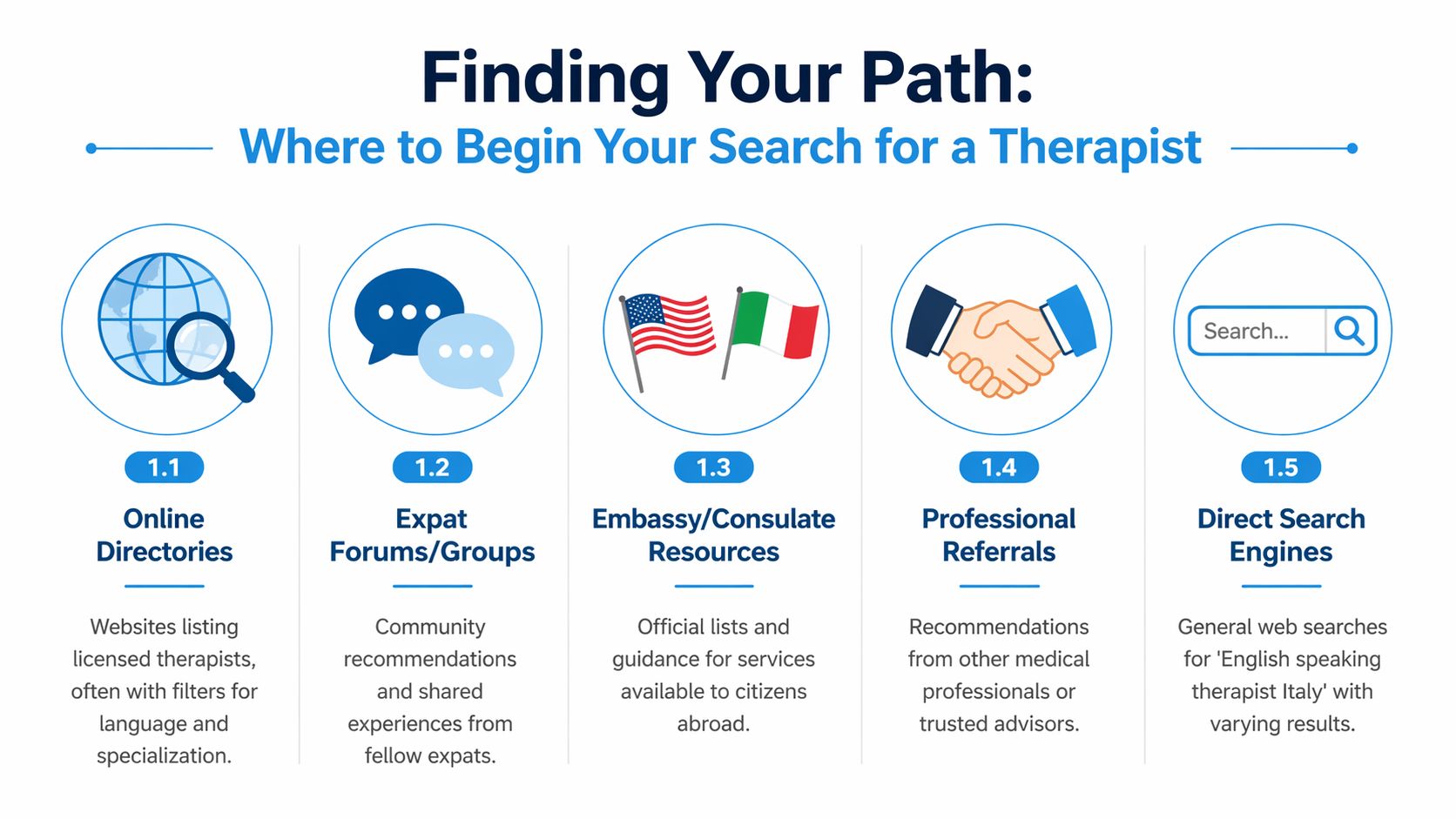
What each search path does well
Here’s a practical comparison of the main ways American expats look for therapy in Italy.
| Search method | What it helps with | Main limitation |
|---|---|---|
| Online directories | Quick overview of therapists by city, language, and sometimes specialty | You still do the vetting yourself |
| Expat forums and groups | Real-world impressions from people living nearby | Recommendations are often informal and clinically inconsistent |
| Embassy or consulate lists | A more official starting point | Usually limited, not tailored, and not always updated in depth |
| Professional referrals | Can be useful if a GP or other clinician knows the local network | Access depends on who you already know |
| Search engines | Broad reach and immediate results | Results vary widely in quality and can be hard to assess |
The distinction between finding a therapist and finding the right therapist is significant. The former is a search problem; the latter is a clinical one.
Directories can help, but they have limits
Directories are often the most efficient place to start in major cities. As noted earlier, the urban network of English-speaking therapists has expanded in places such as Milan, Bologna, and Rome. That means you’re more likely to find profiles, specialties, and contact details than you would have a few years ago.
Still, directories ask a lot from the client. You have to decide whether a therapist’s training fits your issue, whether their English is clinically fluent rather than conversational, and whether their style suits you. If you’re dealing with anxiety or burnout, too many options can make you shut the browser and do nothing.
One practical way to narrow choices is to use a curated local search that already focuses on accessibility and therapy availability, such as this guide to finding a therapist near me in Italy. A tool like that is most useful when you want to reduce random searching and move towards a shortlist.
Community recommendations are comforting, but not enough
Expat groups can be a relief because they replace isolation with shared experience. Someone may tell you which neighbourhood clinic feels welcoming or which city has the strongest English-speaking network.
That said, community recommendations often overvalue personal chemistry and undervalue clinical fit. A therapist who helped one expat process homesickness may not be the right person for trauma, OCD, severe burnout, or intercultural relationship conflict.
Practical rule: Use forums to gather leads, not to outsource your judgment.
Matching services reduce hidden risks
The safest route for many expats is a service that screens clinicians, understands relocation stress, and makes a personalised match after an initial assessment. That model is different from a static directory because someone reviews your needs before you book.
What tends to work well in practice is a process that checks several variables at once: your symptoms, your schedule, your preference for online or in-person sessions, and whether you need someone familiar with American expat life rather than “someone who speaks English”.
That doesn’t mean every client needs a matching service. Some people know exactly what modality they want and can assess a therapist well on their own. But if you feel flooded by the search, a guided process usually saves time and lowers the chance of a poor first fit.
How to Evaluate a Potential Therapist A Clinician's Checklist
Once you have a few names, don’t book blindly. The right first conversation can spare you weeks of frustration.
In Italy, professional labels can be confusing to American clients. A therapist may be warm, articulate, and well-meaning, yet still not be the right level of clinician for what you need. For such situations, a structured checklist helps.
Start with licensure and role clarity
When you speak to a prospective therapist, ask direct questions:
- What is your professional qualification in Italy? You want clarity on whether the person is a psychologist, psychotherapist, or psychiatrist.
- Are you licensed to practise? The answer should be clear, not vague.
- Do you have experience with American expats or internationally mobile clients? English alone isn’t enough.
If you need a clearer sense of professional roles before you book, this explanation of psychologist vs psychiatrist in Italy can help you understand who does what.
Ask about experience, not just language
A therapist can be excellent with local clients and still miss the psychology of relocation. American expats often need someone who recognises themes such as identity disruption, long-distance family stress, bicultural relationships, work permit anxiety, and the odd grief that comes with building a life in a place you also love.
Useful questions include:
- Have you worked with clients adjusting to life between the US and Italy?
- How do you approach culture shock, loneliness, or burnout linked to relocation?
- Are you comfortable working with couples or family stress if that becomes relevant later?
Listen for specificity. A strong answer usually includes examples of themes they commonly treat, not just a generic “yes”.
Check the therapeutic approach
Not every problem needs the same kind of therapy. If your main difficulty is panic, spiralling thoughts, insomnia, or avoidance, structured approaches may be especially useful. If your distress centres on identity, grief, or repeated relationship patterns, you may want a clinician who works more relationally or integratively.
Ask:
- What approach do you use most often?
- How structured are sessions?
- How do you usually work with anxiety, depression, or adjustment issues?
The first available English speaker isn’t always the right therapist. A good match depends on training, style, and cultural understanding.
Notice how you feel in the consultation
The first call isn’t a final judgment, but it gives you good data. You should leave with more clarity, not more confusion. You don’t need instant comfort, but you do need a sense that the therapist can hold complexity without rushing or flattening your experience.
A few signs to watch for:
- Clear communication: They answer directly and explain their process.
- Cultural curiosity: They don’t assume all expats have the same experience.
- Respect for language: They understand that emotional nuance matters in English.
- Appropriate boundaries: Warmth is good. Vagueness is not.
If something feels off, trust that signal and keep looking.
Online vs In-Person Therapy The Modern Expat's Choice
You finally decide to get help. Then a practical question stalls everything. Do you need an office in Rome or Milan, or do you need a therapist you can reliably meet from your apartment in Bologna, a hotel during work travel, or your parents’ house during a trip back to the US?
For American expats in Italy, format is a clinical decision, not just a convenience preference. The right choice affects privacy, consistency, emotional focus, and whether treatment survives the realities of expat life.

When in-person therapy is the better fit
In-person work often helps people who feel psychologically scattered. The trip to the office creates a boundary. You leave home, step out of work mode, and enter a room designed for reflection. For some clients, that structure lowers avoidance and makes it easier to talk about grief, panic, anger, or relationship strain without feeling split between therapy and daily life.
It may suit you better if you:
- Need stronger separation between therapy and home
- Do not have a private place to talk
- Feel emotionally flat or detached on video calls
- Benefit from a regular routine that gets you physically out the door
There are trade-offs. In-person care can become difficult if you live outside a major city, rely on public transport, or travel often for work. A format that feels ideal in theory can fail in practice if attending every week becomes exhausting.
Why online therapy often works well for expats
Online therapy solves a different clinical problem. It protects continuity.
That matters more than people expect. Expats often deal with shifting schedules, temporary housing, family visits, business travel, and sudden administrative tasks. If treatment only works when life is calm, it may stop right when support is most needed.
Remote care is often the stronger option if you:
- Live in a smaller town or rural area
- Travel between regions or back to the US
- Need evening appointments around work
- Want access to a therapist whose language and clinical style fit, even if they are not nearby
If you want a practical sense of how remote sessions are structured, this overview of online psychotherapy in Italy is useful.
Online work does require a few conditions. You need a private space, a stable internet connection, and enough comfort with screens to stay emotionally present. If your housing situation is chaotic or you are constantly worried someone will overhear you, online therapy can become guarded and less effective.
A short overview can make the decision easier:
The clinical question to ask
The most useful question is simple. In which setting are you more likely to speak openly, attend regularly, and keep going when life gets busy?
That answer usually points in the right direction.
For some American expats, in-person therapy offers steadiness and depth. For others, online care is safer because it is realistic. I often encourage people to choose the format they can reliably maintain for the next two months, then reassess. Good therapy depends on continuity more than idealized plans.
Understanding Costs Insurance and Visa Questions
You finally decide to get help, then the practical questions hit all at once. How much will this cost each month. Will insurance reimburse anything. Do you need Italian paperwork for invoices, residency, or visa files. For many American expats, this is the point where treatment gets delayed, not because therapy feels unimportant, but because the process feels harder than it should.
I encourage clients to treat the financial and administrative side as part of the clinical decision. If the fee, reimbursement process, or paperwork burden is unrealistic, even a good therapist may not be sustainable. Steady care usually works better than starting with an ideal plan you cannot maintain.
What therapy usually costs
English-speaking therapy in Italy is commonly accessed through private care, so session fees matter from the start. Fees vary depending on the clinician’s training, location, and whether the work is online or in person.
The better question is not only “What is the fee?” It is “Can I keep this going for at least eight to twelve weeks if I need to?” That time frame gives enough continuity to assess fit, notice patterns, and decide whether the work is helping.
Before you book, decide three things:
- Session frequency: Weekly care is often more effective for acute stress, anxiety, grief, or relationship strain. Fortnightly sessions may be more realistic for maintenance or budget limits.
- Expected duration: Some expats want focused support around relocation, identity strain, or a family transition. Others need longer-term therapy because the move has activated older depression, trauma, or burnout patterns.
- Total monthly cost: Include transport, missed-work time, and cancellation policies, not only the listed session fee.
A therapist with a slightly higher fee but clear structure, consistent scheduling, and strong clinical fit can be less expensive than restarting the search after a poor match.
What insurance may and may not cover
Insurance is often the least clear part of the process. Coverage varies widely by plan, provider network, diagnosis requirements, and whether the clinician’s credentials match your insurer’s rules. Public Italian healthcare may also be limited or unavailable if your residency status is uncertain, and private plans for American expats often require reimbursement paperwork rather than direct billing.
Ask these questions before the first appointment:
- Do you issue invoices that my insurer can use for claims?
- Will the invoice list your licensure or professional registration clearly?
- Does my plan reimburse only certain professions, such as psychologists or psychotherapists?
- Are online sessions reimbursed at the same rate as in-person sessions?
- Do I need a referral, diagnosis code, or pre-authorization before care starts?
This part matters clinically. If reimbursement depends on paperwork the therapist does not provide, treatment can become financially stressful very quickly.
Therapsy’s role can help here in a practical way. Matching is not only about language. It also helps screen for clinicians who can explain fees, invoices, and administrative expectations clearly before therapy begins, which lowers the risk of an avoidable mismatch.
Public support, residency, and visa paperwork
Some expats assume visa status and therapy are completely separate. In practice, they often overlap through invoices, tax records, residency registration, or requests for translated documents.
If you are trying to sort out whether any public subsidy may apply, the guide to the Bonus Psicologo for expats in Italy is a useful place to start.
The standard I recommend is simple. Before the first session, you should know the fee, the cancellation policy, what kind of invoice you will receive, and whether your residency or insurance situation creates any extra steps. If a provider cannot answer those questions clearly, keep looking. Clear administration is part of safe care, especially when you are already carrying the strain of living abroad.
Navigating Cultural and Clinical Expectations in Therapy
American expats sometimes assume that once they find an English-speaking therapist, the hard part is over. Often, the next challenge is subtler. Therapy may still feel unfamiliar because the cultural expectations inside the room aren’t exactly what you expected.
American expectations often prioritise clarity and momentum
Many American clients arrive wanting a clear plan. They expect the therapist to explain the framework, define goals, and show how the work will proceed. They often feel reassured by structure.
In Italy, some clinicians work in that style. Others place more emphasis on the therapeutic relationship unfolding gradually. That doesn’t mean they’re less skilled. It means the experience may feel less immediately linear than some Americans are used to.
A client might think, “Why aren’t we getting to the point?” when the therapist is assessing relational patterns, emotional language, and context with care.
Communication style matters more than people expect
Cultural differences can shape how direct or reflective a therapist sounds. Some American expats prefer very explicit feedback. Some Italian-trained clinicians may offer more exploratory responses before naming a conclusion.
Neither style is necessarily better. Problems arise when clients interpret difference as incompetence.
A few examples help:
- Session pacing: You may want rapid insight. The therapist may work more slowly to build trust.
- Emotional language: You may describe stress in practical terms. The therapist may invite you into deeper feeling states sooner than expected.
- Boundaries and formality: Some therapists feel warmer and more personal in style. Others are quite contained.
Cultural mismatch in therapy doesn’t always mean poor therapy. Sometimes it means expectations haven’t been named yet.
What actually improves the fit
The strongest therapeutic relationships with expats usually include explicit conversation about culture itself. Not as a side topic, but as part of the treatment. That includes how you communicate, how you understand privacy, what support looked like in the US, and what now feels missing in Italy.
A therapist with intercultural experience is often more likely to ask the right questions early. They won’t assume your homesickness is simple nostalgia or that your relationship conflict is only about communication. They’re more likely to see how relocation pressure, identity strain, and unfamiliar systems combine.
If something about the process feels confusing, say so directly. Good therapy can hold that conversation. In fact, the ability to discuss the therapy itself is often one of the best indicators that the relationship can work.
Your First Step The Therapsy Matching Process
Many expats don’t need more names. They need a process that turns uncertainty into a clinically sensible next step.
That’s where structured matching becomes useful. Instead of asking you to sort through profiles alone, the process starts with a conversation that clarifies what’s going on. Symptoms matter, but so do your cultural context, your preferred format, and the kind of therapist you’re likely to trust.

What the matching process looks like
For American expats in Italy, one structured option is Therapsy’s intake pathway. It begins with a free assessment call with the Clinical Director, followed by a human-overseen match with one of 50+ licensed English-fluent therapists. For how that matching works in practice, see finding the right therapist for expats in Italy and the underlying therapy for American expats in Italy process.
Matching works when someone evaluates more than availability.
The English-speaking therapists we work with in Italy
Therapy in English is the starting point, but for many people it is still a second language. Therapsy works in 14 languages, and these are some of the therapists behind the rarer ones. All of them also work online, wherever in Italy you live.
Dr. Tehreem Qureshi offers sessions in Urdu and Hindi (Naples).
Dr. Alexandra Kraslavski offers sessions in Hebrew (Milan).
Dr. Alia Jasim offers sessions in Arabic (Milan).
Dr. Eleni Karliampa offers sessions in Greek (Milan).
Dr. Thieny Ribeiro offers sessions in Portuguese and Spanish (Padua).
Dr. Svetlana Loginova offers sessions in Russian, her first language (Milan and Bergamo).
Dr. Vincenzo Frauneder offers sessions in German (Salerno).
Dr. Stéphane Courtois is a native French speaker with over 25 years of practice (Rimini).
Dr. Ludovica Bosetti offers sessions in four languages: Italian, English, Spanish and German (Genoa).
You can see the full network on our therapists page. You do not have to work out who fits: you tell Therapsy what you are looking for, a member of our clinical team reads your request, and they introduce you. The first call is free.
Why this approach is safer than random booking
A thoughtful intake usually considers:
- Presenting concerns: anxiety, depression, burnout, relationship strain, trauma, adjustment stress
- Language needs: not only English fluency, but emotional fluency
- Format preferences: online, in-person, or hybrid
- Personal factors: schedule, location, previous therapy experience, and cultural background
That’s especially useful for expats because poor fit often happens for reasons that don’t show on a profile page. A therapist may be technically qualified but not attuned to relocation grief, bicultural identity tension, or the way American and Italian norms can collide in daily life.
The result is a lower-friction start. You don’t need to become your own case manager while already overwhelmed.
Good matching reduces one of the most common reasons expats stop therapy early. They never felt properly understood from the beginning.
If you’ve been delaying the search because it feels too messy, start smaller than you think. You do not need to decide on your whole treatment plan today. You only need a first conversation that helps you choose well.
If you’re looking for an english-speaking therapist in italy for american expats, the most useful next step is a calm, informed assessment rather than another evening of scrolling through profiles. Book your first free assessment call with THERAPSY.