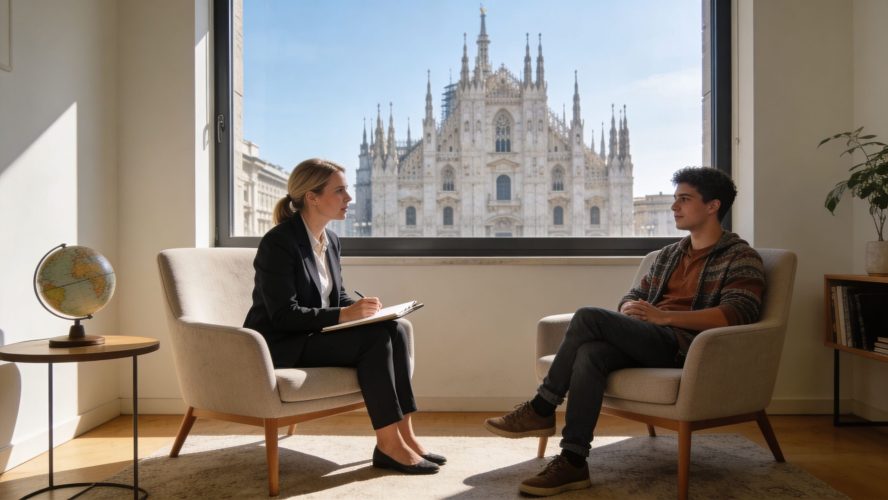
You might be reading this late at night after another long day in Milan, searching for an english speaking psychologist milan because something feels heavier than it should. From the outside, life may look enviable. A beautiful city, an international job, a degree abroad, a relationship that crossed borders. On the inside, you may be dealing with anxiety, loneliness, cultural fatigue, homesickness, or the strain of trying to function in a language that still doesn’t fully feel like yours.
For the full picture of therapy options in the city – approaches, costs and how to start – see our guide to finding an english speaking therapist in Milan.
That tension is common among expats. The hard part is that finding the right support in Milan isn’t just about locating someone who speaks English. It’s about finding a clinician who is properly qualified, ethically accountable, culturally aware, and clear about costs and format from the start.
Many online lists don’t help enough. They give names, maybe a photo, perhaps a short bio. They rarely show you how to check whether the person is licensed in Italy, how to judge whether their approach fits expat life, or what questions to ask before booking.
A good search should lower stress, not add to it. That’s why it helps to treat this process the way a clinician would. Start with safety. Then fit. Then practicality.
The Expat’s Dilemma Finding Mental Health Support in Milan
Milan can be stimulating and isolating at the same time. Expats often tell me that they can manage work meetings, rent contracts, train delays, and social niceties in Italian, but when they need to speak about panic, grief, identity, or relationship pain, they suddenly feel how far from home they are.
That’s why the search for an english speaking psychologist milan often begins with urgency. You want relief, but you also want confidence that the person you choose understands migration stress, bicultural relationships, and the subtle exhaustion that comes from living between worlds.

Why this feels harder than it should
Language is only one layer. The deeper challenge is that expats must make mental health decisions inside a system they didn’t grow up with. Titles differ. Regulation differs. Payment structures differ. Even the style of therapy can feel unfamiliar.
Three problems usually arrive together:
- Emotional overload. When you’re already anxious or low, researching clinicians can feel impossible.
- System confusion. Italian professional titles and registration bodies aren’t always obvious to non-Italians.
- Fit uncertainty. A therapist can be legitimate and still not be the right match for your cultural context.
The right therapist should help you feel more understood, not more foreign.
Some readers find it useful to compare how therapy is explained across different countries before booking. For example, this essential guide for Vancouver CBT therapy gives a clear picture of how structured, evidence-based therapy is presented in another international setting. That kind of comparison can sharpen your questions when looking in Milan.
What usually works
The most effective searches are rarely random. They are deliberate and grounded in a few practical checks:
- Confirm the clinician is licensed in Italy
- Check whether they work regularly with expats or intercultural couples
- Clarify fees, format, and cancellation policy before the first session
- Notice how you feel in the first contact
Warmth matters. So does competence. You shouldn’t have to choose between them.
Where to Begin Your Search for a Milan Therapist
Many begin in one of four places. None is useless. None is sufficient on its own.
Directories and Google searches
A simple search for english speaking psychologist milan will usually bring up directories, private practice websites, and platform profiles. This is the fastest way to see who offers sessions in English and whether they work online, in person, or both.
The weakness is obvious once you look closely. Profiles are often self-written, not independently verified, and sometimes too vague to tell you how the therapist works. “Anxiety, stress, relationships” appears everywhere. That doesn’t tell you whether the person understands relocation grief, intercultural conflict, or the pressure of rebuilding a social identity abroad.
Embassy lists and international school referrals
Embassies, consulates, and international communities sometimes keep referral lists. These can be useful because they’re practical and often created for foreigners who need English-speaking care quickly.
Still, a referral list is not the same as a clinical recommendation. It may tell you who is available, not who is the best fit for your needs. It also may not explain whether the clinician’s registration is current, what therapeutic model they use, or how they approach issues like trauma, burnout, or couples work.
Expat forums and community groups
Facebook groups, WhatsApp chats, Reddit threads, and word-of-mouth recommendations can feel reassuring because they come from people who live where you live. Sometimes that’s exactly what you need. A person who says, “I saw someone who understood my visa stress and family distance,” can point you in a promising direction.
But peer recommendations have limits.
- Experiences are subjective. A therapist one person loved may not suit your communication style.
- Information dates quickly. People move, stop practising, change fees, or stop seeing new clients.
- Credentials may not be checked. A friendly recommendation isn’t the same as professional verification.
Practical rule: Use community recommendations to create a shortlist, not to make the final decision.
Curated matching services
A curated service can remove much of the risk if the clinicians are screened, licensed, and matched according to language, issue, and preference. One example is english-speaking therapist support across Italy, where clients begin with a free assessment and are matched with a licensed professional rather than being left to sort through profiles alone.
This model tends to work well for expats because the search burden is lower. Instead of trying to decode titles, modalities, and availability by yourself, you begin with a structured conversation that narrows the field.
A better way to use all these channels
Rather than asking, “Where can I find a therapist?”, ask:
| Search channel | Best use | Main limitation |
|---|---|---|
| Google and directories | Build an initial shortlist | Easy to confuse marketing with qualification |
| Embassy or school lists | Find English-speaking options quickly | Clinical fit may be unclear |
| Expat communities | Gather lived experience | Advice is personal, not formal vetting |
| Curated matching services | Reduce time and uncertainty | You still need to ask about fit and logistics |
That shift makes the search calmer. You stop hunting for the perfect profile and start filtering for safety and fit.
How to Verify a Psychologist's Credentials in Italy
This is the step many expats skip because they assume a polished website means the person is qualified. It doesn’t. In Milan, credential checking is not bureaucracy for its own sake. It’s basic protection.
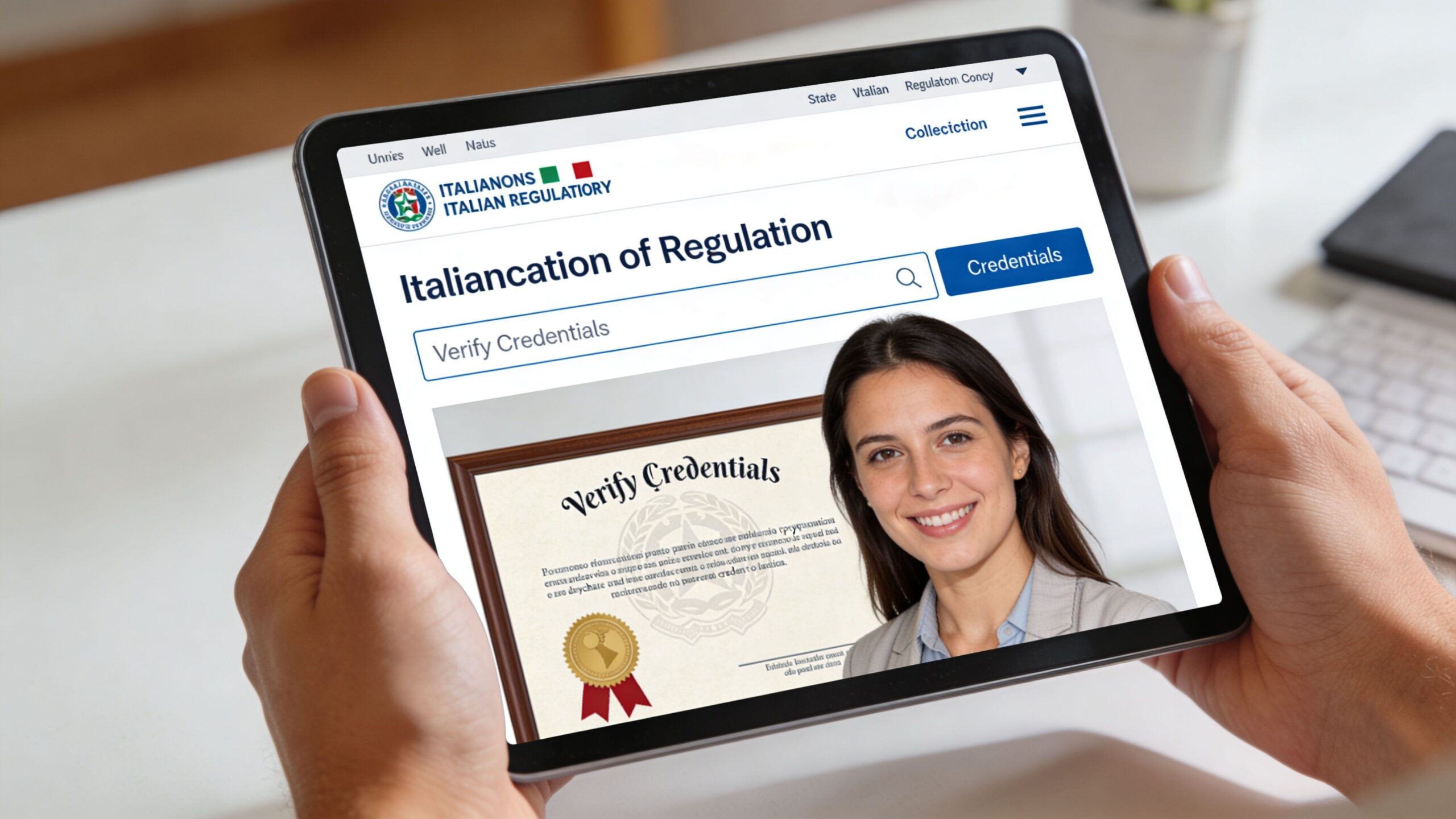
Existing content on English-speaking psychologists in Milan often fails to address licensing verification.
The titles matter
Italian mental health titles aren’t interchangeable.
- Psicologo. A psychologist registered with the professional order.
- Psicoterapeuta. A psychologist or medical doctor with additional psychotherapy training.
- Psichiatra. A medical doctor specialising in psychiatry, able to prescribe medication.
If you’re unsure which professional fits your needs, this overview of psychologist versus psychiatrist differences can help you separate therapy needs from medication needs.
How to check properly
Ask for the person’s full name and registration details. A legitimate professional should not be offended by this. It’s a normal question.
Then verify them through the Albo Nazionale Psicologi or the relevant regional professional order. You’re checking that the person is registered and that their professional identity matches what they present publicly.
Look for consistency across:
- Full legal name
- Professional title
- Registration number
- Region of registration
- Declared specialisation
If a profile is vague, avoids listing credentials, or uses broad wellness language instead of clear professional language, pause.
Red flags expats often miss
Many expats come from countries where “therapist”, “counsellor”, and “coach” are used loosely in everyday speech. In Italy, that can create confusion.
A coach may offer support around habits, motivation, or transitions, and for some readers this explanation of how mental health coaches can help is useful for understanding the distinction. But coaching is not psychotherapy, and it should not be presented as a substitute for licensed psychological treatment when someone is dealing with anxiety disorders, depression, trauma, or complex relational patterns.
Watch out for:
- No registration number listed
- Unclear training pathway
- Promises that sound oversized or simplistic
- A refusal to explain qualifications plainly
- Language that blurs coaching, healing, and psychotherapy
If you have to work hard to figure out whether someone is qualified, that uncertainty is already part of the problem.
Why this step comes first
Before style, before personality, before convenience, there must be accountability. A licensed clinician is answerable to professional standards. That matters when therapy becomes emotionally intense, when confidentiality matters, or when risk needs proper clinical judgement.
For expats, this is even more important because it’s easier to be misled when you don’t know the local system. Verification doesn’t guarantee a perfect fit, but it does create a safe starting point.
Choosing Between Online and In-Person Therapy
For many expats, this decision isn’t philosophical. It’s logistical. Your work hours, commute, neighbourhood, privacy at home, and emotional needs all shape what will be sustainable.
Some people do their best work online because they can speak from a familiar room, avoid travel across the city, and fit therapy around a demanding schedule. Others need the physical boundary of an office because it helps them switch out of work mode and into reflection.
The practical trade-off
Online therapy often suits:
- people with long commutes or unpredictable workdays
- clients who travel often
- students sharing accommodation who can still find private space
- expats who feel calmer speaking from home
In-person therapy often suits:
- people who struggle to create privacy where they live
- clients who feel more grounded in face-to-face contact
- those who want a stronger ritual around attending therapy
- situations where the physical setting helps emotional focus
If you’re considering remote care, this page on online psychotherapy in Italy is a useful practical starting point.
Online vs. In-Person Therapy for Expats in Milan
| Factor | Online Therapy | In-Person Therapy |
|---|---|---|
| Convenience | Easier to fit around work, study, and travel | Requires commute and more schedule planning |
| Privacy | Depends on your home environment | Usually easier to protect in a private office |
| Emotional comfort | Can feel safer for some clients | Can feel more containing and focused |
| Access | Broader choice of English-speaking clinicians | Better for people who value physical presence |
| Routine | Flexible, but easier to postpone mentally | Stronger weekly structure for many people |
Choose the format you’re most likely to keep attending. Consistency usually matters more than the idealised version of therapy in your head.
What doesn’t work well
Problems usually appear when people choose based on image rather than reality. Some insist on in-person therapy but then cancel repeatedly because life in Milan is too busy. Others choose online sessions but don’t have a private room, stable connection, or emotional space to speak freely.
The best format is the one that removes friction and supports honesty.
Navigating Costs and Insurance for Therapy in Milan
Cost is often the moment when the search becomes more stressful. People can accept that they need support, then freeze when they realise pricing is inconsistent and insurance rules are unclear.
The local picture helps. The average cost for a therapy session in Lombardy is €80-120, only 12% of private psychologists accept public SSN reimbursement, expat mental health needs in Milan rose by 28% post-2025, and 62% of young professionals cite affordability as a barrier.
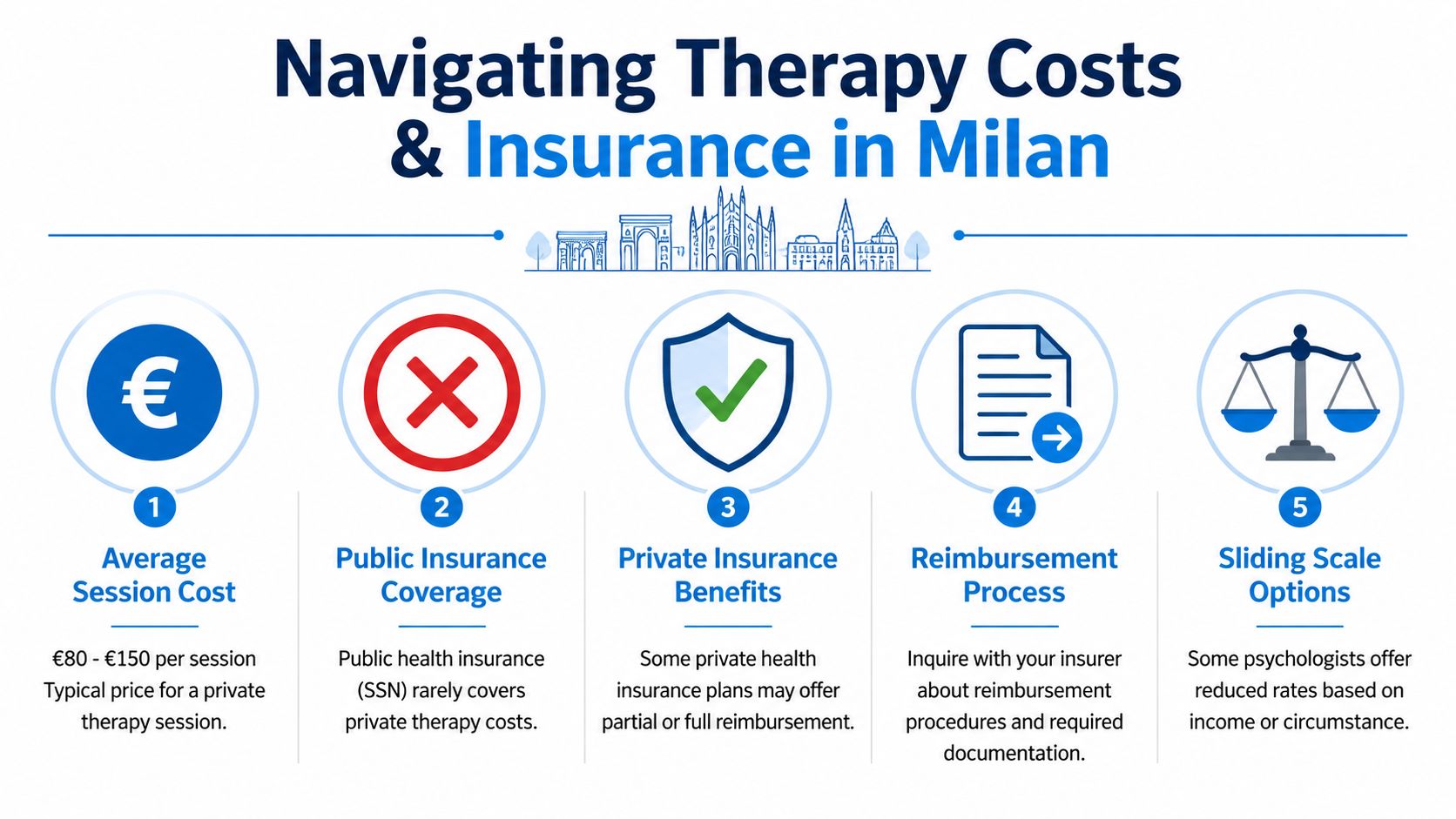
What those numbers mean in practice
Private therapy in Milan usually sits above what many newcomers expect, especially if they are comparing with public systems elsewhere. The cost isn’t just the session itself. It includes the predictability of private scheduling, language accessibility, and often shorter waits.
The difficulty is that SSN reimbursement is uncommon in private practice, so many expats end up paying directly and then checking whether private insurance will reimburse part of the fee.
How to approach insurance without confusion
Start by asking your insurer very specific questions. Don’t ask only, “Do you cover therapy?” Ask what kind of professional must issue the invoice, whether online sessions are accepted, and whether authorisation is needed before treatment begins.
Use this checklist:
- Provider type. Must the session be with a psychologist, psychotherapist, or psychiatrist?
- Documentation. What should appear on the invoice?
- Modality. Are online sessions reimbursable?
- Limits. Is there a cap on sessions or total amount?
- Claims process. Do you pay first and reclaim later?
Some expats assume private insurance will “probably cover it” and only discover the exclusions after several sessions. It’s better to confirm in writing before you begin.
Cost transparency matters
A reliable service should tell you what the fee is, whether it varies by clinician, and how payments work. Hidden pricing creates unnecessary tension before therapy has even started.
For readers who want to understand whether any public support may apply to their situation, this page on the Bonus Psicologo and expat eligibility may be useful.
One practical option in Milan is Therapsy, which offers multilingual therapy online and in person in Italy, starts with a free assessment call, and states transparent pricing from €70 per session in the publisher information provided for this article. For expats, that kind of clarity can make the first step easier.
Preparing for Your First Consultation
The first consultation doesn’t need to be a performance. You don’t need a polished life story or a neat explanation of what’s wrong. You only need enough clarity to describe what’s been difficult and what you hope will change.
Many people feel relieved when they arrive with a few questions prepared. It shifts the first meeting from passive hope to active evaluation.
Questions worth asking
You’re not being demanding if you ask direct questions. You’re checking fit.
Consider asking:
- What experience do you have working with expats or intercultural couples?
- How do you work when cultural identity is part of the problem?
- What does a first phase of therapy with you usually look like?
- How do we know whether therapy is helping?
- Do you work better with short-term focused goals or open-ended therapy?
- What happens if I feel we’re not the right fit?
The answers matter less for sounding impressive than for revealing style. Some clinicians answer concretely. Others stay abstract. That difference can tell you a lot.
A good first consultation should leave you feeling clearer, not dazzled.
A local approach you may encounter
Because you’re in Milan, you may come across Milan Systemic Family Therapy and related systemic approaches. This model originated in the city and remains relevant for couples, families, and situations where symptoms are tied to relationship patterns rather than one isolated individual problem.
According to this research review on the Milan systemic model, effect sizes across 10 investigations ranged from d = 0.82 to d = 1.29, and the average treated client outperformed 79% to 90% of control group clients on principal and composite goal indices. The same source notes 86% successful outcomes when Milan-style work is customized through language-adapted sessions.
That matters for expats because therapy often needs to hold more than one context at once. A symptom may involve migration stress, a couple dynamic, family expectations from home, and the practical strain of adapting to life in Italy.
What to bring into the room
You don’t need to prepare extensively. A short note on your phone is enough.
Helpful points to jot down:
- What pushed you to seek help now
- The main symptoms or patterns you notice
- Any previous therapy experience
- What kind of therapist communication helps you feel safe
- Whether you prefer online or in-person work
If you’d like a sense of what that first meeting may feel like, this guide to the first psychological session gives a practical overview.
FAQ Finding Mental Health Support in Milan
Do I need a doctor’s referral to see a private psychologist in Milan
Usually, no. Private psychological care is commonly accessed directly. The practical issue is less referral and more verifying that the clinician is appropriately qualified.
What’s the difference between a psychologist and a psychotherapist in Italy
A psicologo is a licensed psychologist. A psicoterapeuta has additional psychotherapy training beyond the base professional qualification. If you’re looking for ongoing psychotherapy, it’s worth checking which of the two titles the professional holds.
Is therapy in English common in Milan
It’s available, but quality varies. Some clinicians speak excellent English yet have limited intercultural experience. Others work regularly with international clients and understand migration, belonging, and identity stress much more thoroughly. Language fluency and cultural competence are not the same thing.
Is online therapy less effective than in-person therapy
Not necessarily. What matters most is whether the format supports consistency, privacy, and a strong therapeutic alliance. For many expats, online sessions are the option they can realistically sustain.
The English-speaking therapists we work with in Milan
Therapsy works with seventeen therapists who receive in person in Milan and also see patients online. These are some of them, chosen to show the range of languages and specialisms available in the city.
Dr. Alexandra Kraslavski offers sessions in Hebrew as well as English and Italian, and works with a difficult relationship with food, weight and addiction.
Dr. Alina Charnavusava offers sessions in Russian. A Gestalt psychotherapist, she works on anxiety, sleep difficulties and relational difficulties, and has extensive experience with managers in international companies.
Dr. Eleni Karliampa offers sessions in Greek. She is Greek and lives in Italy as an expat herself, and works specifically on cultural identity and migration difficulties.
Dr. Maria Luisa Vampa works in French as well as English and Italian. A doctor before becoming a psychotherapist, she works with couples of every kind: intercultural, adoptive, blended and LGBTQ+ families.
Dr. Eleonora Montorfano offers sessions in German. She specialises in addiction, personality disorders, ADHD and burnout.
Dr. Matteo Innocenti is a psychiatrist and psychotherapist, so diagnosis, medication and the therapeutic work can be held by one clinician. He is a recognised expert in eco-anxiety.
Dr. Svetlana Loginova offers sessions in Russian and specialises in eating disorders and body image and in international couples.
This is a selection, not the full list: you can see everyone on our therapists page. You do not have to choose yourself. You tell Therapsy what you are looking for, a member of our clinical team reads your request, and they introduce you to whoever fits. The first call is free.
How does the free assessment call work
The free assessment call is a pre-therapy conversation where your needs, language preference, goals, and practical constraints are clarified before you are matched with a clinician. That can be especially helpful if you’re overwhelmed and don’t want to vet multiple profiles alone.
If you're looking for an english speaking psychologist milan and want a calmer, more structured way to begin, THERAPSY offers a free first assessment call with a licensed, multilingual care pathway for expats, students, couples, and adults in Italy. Book your first free assessment call.