By Dr. Francesca Adriana Boccalari, Clinical Director at Therapsy
You arrive in Rome, spend the day doing what should feel exciting, sign a lease, test your Italian over coffee, send photos home, then find yourself lying awake with a tight chest and a sense that you are not fully in your own life. That is a familiar starting point for many people who begin looking for an english speaking therapist in rome.
I see this pattern often. The problem is not that Rome is disappointing. The problem is that major life changes put pressure on the nervous system, even when the move was wanted. People come for work, study, a relationship, or a fresh start, and still find themselves tense, flat, lonely, irritable, or emotionally overextended.
An international city creates a specific kind of strain. Daily tasks take more effort. Social cues are harder to read. Support systems are thinner. Even people who function well in other settings can start to feel less confident, less settled, and less like themselves.
That is also why evaluation matters as much as the search itself. A therapist who speaks English is only the first filter. You also need someone who can work well with expat stress, assess whether your difficulties reflect adjustment, anxiety, burnout, relationship strain, or something deeper, and offer treatment that fits your circumstances. For a shorter route, support for internationals in Rome can help you start with clinicians already screened for that context.
Finding Your Footing in the Eternal City

A newly arrived expat often tells the same story in different words. “I should be happy here.” “I wanted this move.” “Nothing is objectively wrong, but I don’t feel like myself.” That’s a common starting point for anyone looking for an english speaking therapist in rome.
The stress rarely comes from one dramatic event. More often, it’s the pile-up. You’re navigating a new language, paperwork, housing pressure, unfamiliar work culture, distance from family, and the subtle fatigue of having to explain yourself all day. Even practical tasks can start to feel heavier than they should.
What distress can look like in Rome
Sometimes the issue presents as anxiety. Sometimes it looks like emotional numbness, burnout, relationship friction, or a sudden drop in confidence. For students and young professionals, Rome’s intensity can sharpen that feeling. The city is stimulating, but adjustment still takes a psychological toll.
Seeking therapy in your own language is not avoidance. It’s often the clearest route to honest, precise emotional work.
A good first step is recognising that support doesn’t need to wait until things become unmanageable. If you want a starting point for local options, therapy support in Rome gives a city-specific overview.
What usually helps first
Three things tend to help early on:
- Name the actual problem: “I’m anxious” is a start, but “I dread social situations because I feel clumsy in Italian” is more useful.
- Reduce shame: relocation stress is not a personal weakness.
- Get support before crisis mode: therapy works better when you don’t wait until every area of life is affected.
Rome can still become home. Many people just need the right support structure while that happens.
Clarifying Your Needs Before You Search
Typing “english speaking therapist in rome” into a search bar is easy. Knowing what kind of help you need is harder, and more important.
People often begin with a broad label such as anxiety, sadness, stress, or overthinking. Those words are valid, but they don’t always tell you what is driving the distress. The more clearly you define the problem, the easier it is to identify the right kind of therapist.
Start with the pattern, not the label
Ask yourself what has changed since the move, or what the move has intensified.
- If your mind never switches off: you may be dealing with adjustment anxiety, workplace stress, or chronic uncertainty.
- If you feel drained and detached: burnout, loneliness, or low mood may be closer to the core issue.
- If conflict has increased at home: the move may be straining a couple dynamic that previously felt manageable.
- If old memories or past wounds are resurfacing: a major transition can lower your usual coping capacity and bring unresolved material to the surface.
- If becoming a parent abroad feels emotionally overwhelming: it helps to learn the early signs of postpartum depression, especially when your usual support network is far away.
A useful self-check is to finish this sentence in three ways: “I need therapy because lately I keep…”
That often produces much better information than a diagnostic label. “I keep cancelling plans.” “I keep crying after work.” “I keep picking fights with my partner.” “I keep feeling like I made a mistake moving here.”
Decide what kind of help you want
Not everyone wants the same thing from therapy, and that matters.
Some people want structure, coping tools, and a practical plan. Others want space to understand repeating relationship patterns, identity tension, or long-standing emotional reactions. Some need trauma-focused work. Some need a place where cultural adaptation itself can be discussed without lengthy explanation.
A simple way to organise your thoughts is this:
| What you’re looking for | What to ask about |
|---|---|
| Practical strategies for anxiety or burnout | Ask whether the therapist uses CBT |
| Processing a distressing past event | Ask whether they work with EMDR |
| Repeating emotional or relationship patterns | Ask about Schema Therapy |
| Cross-cultural relationship strain | Ask how they work with intercultural dynamics |
| A space to speak freely in English | Ask how often they work with international clients |
Practical rule: Don’t look for the “best therapist” in the abstract. Look for the therapist who fits the problem you’re actually living with.
Clarify your non-negotiables
Before you contact anyone, write down your practical filters.
- Language comfort: Do you want native-level English, or is fluent professional English enough?
- Session format: In person, online, or both?
- Timing: Do you need evening appointments because of work or study?
- Budget: What feels sustainable, not just possible once?
- Therapist style: More direct and structured, or more exploratory and reflective?
People often feel guilty having preferences. Don’t. Therapy works better when the setup is realistic and the relationship feels usable.
Mapping Your Search Channels in Rome
You arrive in Rome, open three browser tabs, ask in an expat group, and end up with fifteen names that all look plausible. That is a common starting point. The primary task is choosing a search route that gives you enough information to judge fit without turning the process into another source of stress.
Rome has no shortage of places to look. The difficulty is that each channel filters information differently. Some give you volume. Some give you reassurance. Some give you speed. Very few give you a clinically useful picture of who is likely to suit your needs.
The main routes people use
Here is the practical comparison.
| Search channel | What works | What often doesn’t |
|---|---|---|
| Directories | Broad choice, fast browsing, useful for comparing profiles | You still have to verify credentials, clinical approach, and language confidence yourself |
| Embassy or international community lists | Familiar starting point for newcomers, sometimes easier to trust at first | Inclusion on a list does not tell you much about therapeutic style, depth of experience, or fit |
| Expat groups and forums | Personal recommendations can reduce hesitation | Feedback is subjective, privacy can be limited, and clinical detail is usually thin |
| Direct services with a local presence | Intake is often more guided, with some pre-screening before you book | The quality of the matching process varies, so ask how therapists are selected and assigned |
If you want to start with local options rather than scroll through broad directory results, finding a therapist near you in Italy is a useful first filter.
What each channel is actually good for
Directories work well for people who already know what they are screening for. If you need a therapist in Prati, want online sessions after work, or want someone who explicitly mentions trauma, couples work, or anxiety treatment, a directory can save time.
They work less well when every profile starts to sound the same. “Integrative,” “person-centred,” and “international experience” may all be true, but those labels do not tell you how a therapist thinks, how structured sessions are, or whether they can work well with the kind of difficulty you are facing.
Community recommendations help in a different way. They lower the threshold for first contact. That matters, especially if you are newly arrived, tired, and unsure how the Italian system works. Still, a recommendation is only a starting point. Good therapy depends on the match between your problem, the therapist’s training, and the working relationship you build together.
Cultural competence also needs a closer look than people often give it. Fluent English is useful. It is not the whole picture. A therapist may speak clearly and still miss the strain of migration, the loss of social reference points, or the pressure of living between cultures.
The shortcut that actually saves energy
The fastest search channel is usually the one that reduces how much vetting you have to do alone.
That is why guided services can be helpful for expats in Rome. The benefit is not just convenience. It is the presence of a screening process before you ever book the first session. If a service has already checked licensing, clinical focus, and ability to work with international clients, you start from a shorter and safer list.
Used well, search channels are not just places to collect names. They are filters. Choose the filter that gives you enough detail to make a sound decision, not just enough options to feel busy.
How to Assess a Therapist's Credentials and Fit
Finding a profile is simple. Assessing whether that person is qualified, appropriate, and psychologically safe for you is the primary task.
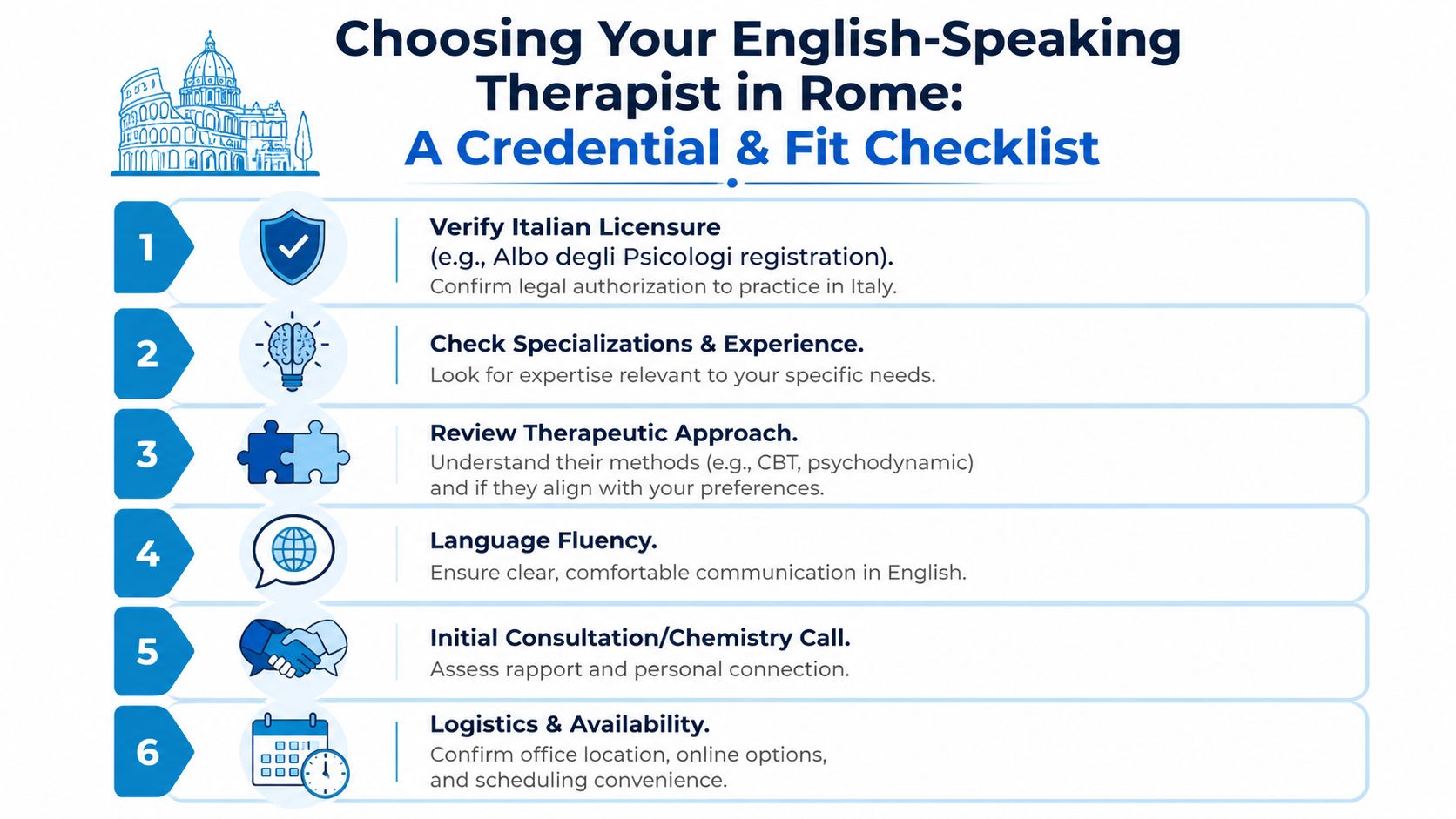
Check legal and professional standing
In Italy, titles matter. A psicologo and a psicoterapeuta are not interchangeable in everyday practice, even if both may appear in search results. For an expat, the key point is straightforward. You want someone who is properly licensed to practise in Italy and clear about their role, training, and scope.
When reviewing a therapist, look for:
- Official registration: ask whether they are registered with the Albo degli Psicologi
- Professional title: do they identify as psychologist, psychotherapist, or psychiatrist
- Approach: do they say how they work, such as CBT, EMDR, or Schema Therapy
- Experience with international clients: this is not a cosmetic detail. It affects how much you’ll need to translate your life context
- Clear boundaries: confidentiality, cancellation policy, format, and fees should be explained plainly
If basic information is vague, missing, or evasive, treat that as useful information.
Look beyond fluent English
Language is not the same as cultural competence. A therapist may conduct a session in English and still misunderstand the emotional experience of relocation, mixed cultural identity, or the strain of functioning between systems.
For expats, students, and intercultural couples, I usually suggest paying attention to whether the therapist can grasp:
- the fatigue of living outside your first culture
- the pressure of bureaucracy and administrative uncertainty
- the difference between homesickness and depression
- how migration affects identity, confidence, and attachment
- why a relationship can become more fragile after a move
“Healing begins when we feel truly seen and supported.”
Dr. Francesca Adriana Boccalari
That isn’t a slogan. It’s a clinical point. If you spend the first month of therapy explaining your context rather than working on your distress, fit may be off.
For a deeper guide to this process, finding the right therapist for expats in Italy can help you frame what to ask.
Questions worth asking in a first consultation
Many people freeze during an initial call because they don’t want to sound demanding. You are allowed to ask direct questions. In fact, you should.
Try questions like these:
- What experience do you have working with expats or international clients in Rome?
- How do you usually work with anxiety, burnout, or adjustment difficulties?
- Do you offer a structured approach, or is your style more open-ended?
- If trauma or past experiences are part of the picture, how do you assess that?
- How do you think about cultural identity, language, and belonging in therapy?
- What should I expect from the first few sessions?
- If it doesn’t feel like a good fit, how do you handle that?
What fit feels like in practice
You do not need instant emotional closeness. First-session chemistry is often overstated. What matters more is whether you feel able to speak, whether the therapist listens carefully, and whether their responses make sense to you.
A promising early fit often sounds like this:
- you don’t feel rushed
- the therapist can hold complexity without oversimplifying
- they ask useful questions rather than making quick assumptions
- their explanation of how therapy might help feels grounded
- you leave with more clarity, not more confusion
The right therapist won’t only have credentials. They’ll create conditions where change becomes possible.
Understanding Pricing, Locations, and Session Formats
You find a therapist who sounds thoughtful, experienced, and easy to talk to. Then the practical reality sets in. Their office is across the city, the fee stretches your budget, and the only available slot clashes with work. Good therapy still has to fit real life.

This part of the decision is not secondary. If the arrangement is hard to sustain, people cancel, postpone, or stop just as the work begins to help. In practice, affordability means more than the session fee. It includes travel time, scheduling friction, cancellation terms, and whether the format makes regular attendance realistic.
Therapsy publishes clear starting fees and offers a free first assessment call, which gives you a concrete reference point while comparing options. If you are considering remote support, their page on online psychotherapy for clients in Italy explains how online sessions are typically set up.
What cost actually tells you
A lower fee can be a good option. It is not automatically better value.
I advise clients to assess price in context. A session that fits your budget but leaves you repeatedly commuting for an hour each way, struggling to reschedule, or questioning the therapist’s relevance to your problem may cost more in the long run. The better question is whether this setup is workable for the next three to six months, not just this week.
Useful questions include:
- Can I afford this consistently, not just during a stressful month?
- What is the cancellation policy, and is it realistic for my work and family life?
- Does the therapist’s experience match the issue I want help with?
- Will I be more likely to attend regularly online or in person?
Consistency usually matters more than finding the lowest advertised fee.
Online versus in person in Rome
Both formats can work well. The stronger choice is usually the one you can keep.
In-person sessions often help people who feel steadier in a dedicated space, want a clear break from home and work, or find face-to-face contact easier for trust and focus.
Online sessions often work better for expats with long commutes, shifting schedules, frequent travel, or limited local options in English. They also widen your choice of therapist, which matters if you are looking for a specific clinical style or cultural sensitivity.
Here is the practical trade-off:
| Format | Often helpful when | Potential drawback |
|---|---|---|
| In person | You value routine, place, and physical presence | Travel time can become a barrier |
| Online | You need flexibility and easier access | Home privacy can be harder to manage |
If getting to therapy feels like another weekly strain, the format deserves a second look.
A first session checklist
Preparation helps, but it does not need to be polished. The goal of a first session is to test whether the setup supports useful work.
- Bring one recent example: something concrete that shows what has been difficult lately
- Name one short-term aim: sleep more steadily, feel less panicked, stop withdrawing, argue less at home
- Notice the practical details: was booking clear, was the session punctual, did the format feel manageable
- Listen for precision: does the therapist respond to your situation specifically, or stay broad and vague
- Check your reaction afterward: more settled, more understood, more organised in your thinking, or still confused
A workable therapy arrangement is one you can return to without repeated friction. That is often the difference between a promising first contact and treatment that has room to work.
Your Guided Path to Support with Therapsy
You arrive in Rome, decide you should finally speak to someone, open three tabs, and quickly run into the same problem. Everyone sounds plausible. Very little helps you judge who is a good clinical fit for your situation.

That is the part a guided service is meant to reduce. Therapsy does not merely present a directory and leave you to interpret credentials, style, and cross-cultural fit on your own. It uses a clinician-led matching process, and its first-match retention rate is 92% based on internal data from more than 1,000 clients. In practice, that matters because a poor first match often delays treatment, increases doubt, and makes people question therapy when the actual issue was selection.
How the process works in practice
The process is built to lower decision fatigue and improve the quality of the first referral.
You submit a short form
A concise description is enough. The useful information is usually simple: what feels difficult, how long it has been going on, and whether you want support online or in person.You speak with someone about your situation
This step adds clinical judgement early. Instead of sorting through profiles alone, you can clarify language needs, previous therapy experience, scheduling limits, and whether you want a therapist who is more structured, exploratory, or trauma-informed.A therapist is suggested based on fit
The match is shaped by both clinical and practical factors. That includes the presenting problem, communication style, availability, and whether the therapist is likely to understand the strain of relocation, isolation, or life between cultures.You start with a free assessment call
This is your chance to evaluate the match before beginning regular sessions. If the conversation feels off, the process can be adjusted.
If you want to start that process, the best place is Therapsy’s contact page for an initial consultation.
Why this tends to work well for expats
Expats often need more than fluent English. They need a therapist who can follow the clinical problem and the context around it.
A therapist may be well trained and still miss the meaning of a move that disrupted identity, support systems, work confidence, or a relationship. Another may understand international life well but not have the right experience for panic, burnout, grief, or longstanding family patterns. Good matching tries to account for both.
That saves time.
It also reduces a common mistake. People often assume that if the first conversation feels flat or misattuned, therapy itself may not be for them. A better interpretation is usually narrower. The fit was not right yet.
Who usually benefits most from this route
This approach is often useful if:
- You feel stuck comparing profiles and cannot tell the difference between them
- You are unsure what type of therapy fits your problem
- You want support in English with less need to translate your life context
- You prefer some professional guidance before committing to a first full session
- You have already tried therapy before and want a better match this time
Finding an english speaking therapist in rome is easier when the search includes clinical judgement, not just availability. For many newly arrived clients, that is what turns an overwhelming task into one clear next step.