A small argument in your Milan kitchen can suddenly feel much bigger than it is. One of you is upset about who forgot to call the landlord, the other is already carrying stress about work, paperwork, family back home, and the quiet disappointment that life abroad doesn't always feel as exciting as it looked from the outside. The fight isn't really about the landlord. It's about pressure, distance, adaptation, and feeling alone together.
That's where expat couples therapy in Milan can help. This isn't generic relationship counselling delivered in English. It's a focused form of support for couples whose relationship is being shaped by relocation, cultural difference, language imbalance, and the emotional demands of building a life in Italy.
As a psychotherapist working with international clients in Milan, I see how often couples blame themselves for patterns that are very understandable in an expat context. A move can expose old vulnerabilities, create new inequalities, and strip away the routines that once kept a relationship steady. None of that means your relationship is failing. It means the context has changed, and the relationship needs new tools.
Navigating Love and Life Abroad in Milan

Milan attracts couples for many reasons. Work. Study. Fashion. Design. A partner's family. A long-imagined Italian chapter. Yet settling here can feel very different from the fantasy. Fast schedules, high living costs, social comparison, bureaucracy, and the constant effort of adapting can put even a solid couple under strain.
For some people, the emotional shock comes from the gap between dream and daily life. That gap doesn't just affect mood. It affects the relationship. One partner may still feel energised by the move while the other feels disoriented, homesick, or is regretful. Those mixed experiences can create guilt and distance.
The deeper challenge is how a couple adapts when expectations, identity, and practical life all change at once.
What expat couples therapy actually means
Expat couples therapy in Milan is relationship therapy adapted to cross-cultural life. It looks at the couple's bond, but also at the pressures surrounding it.
That usually includes questions such as:
- How has relocation changed your roles? One partner may suddenly manage paperwork, transport, schools, or family communication.
- Where does stress go? Many couples discharge stress at home because home is the only safe place to let it out.
- What has become unequal? Income, social confidence, language ability, and legal security can all shift after a move.
- What is being grieved? Old friendships, career identity, family closeness, and a former version of the relationship may all be missed.
A healthy relationship can start to feel fragile after relocation, not because the love is gone, but because the structure around the couple has changed.
Couples often arrive feeling embarrassed that they “should be coping better.” I don't see it that way. I see a relationship trying to adjust to a new system.
For readers navigating marriage in a bicultural context, I often suggest reading more about the particular challenges of being married to an Italian, because many relationship tensions make more sense when viewed through family culture, expectations, and communication style.
Why Milan changes the emotional equation
Milan isn't just another city. It tends to reward speed, competence, presentation, and self-sufficiency. For expat couples, that can create a hidden rule: keep functioning, keep producing, keep smiling. The relationship then becomes the one place where exhaustion shows up.
That's why support matters. Not because something is broken, but because couples living abroad often need a space where both people can slow down enough to understand what's really happening.
Why Expat Relationships Face Unique Pressures
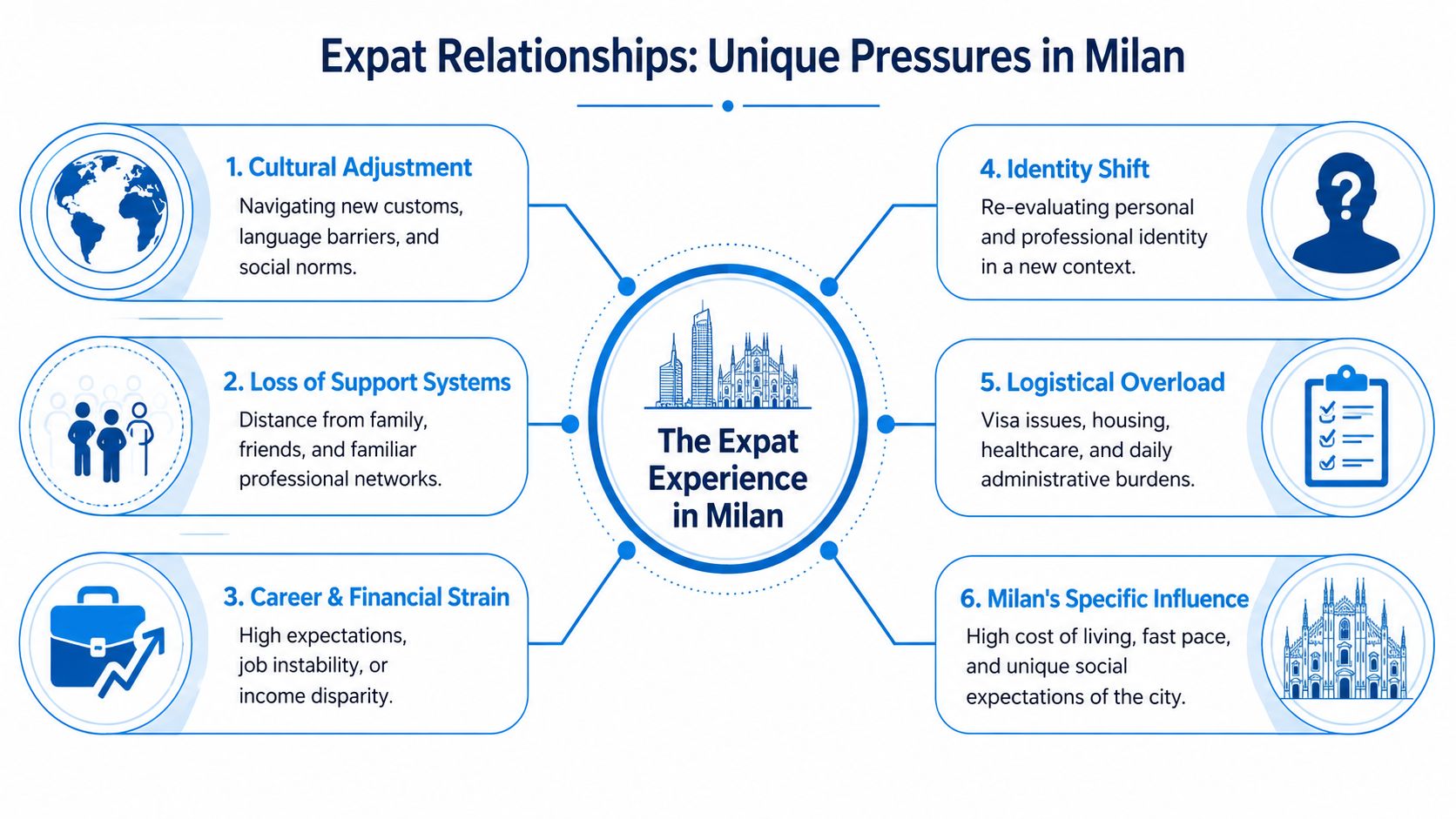
Expat relationships don't only deal with ordinary couple stress. They also carry the psychological load of adaptation. In clinical terms, one of the most useful concepts here is acculturative stress. This describes the strain that comes from adjusting to a new culture, language, system, and social environment.
A Milan-based counselling overview notes that couples therapy has evidence-based, durable effects on relationship functioning, with meta-analytic findings showing improvements in relationship satisfaction, communication, and emotional intimacy.
How stress gets amplified inside a couple
Relocation acts like an amplifier. It rarely creates every problem from scratch. More often, it intensifies differences that were manageable before.
A few patterns appear often:
Different adaptation speeds
One partner learns the city quickly, builds friendships, and feels stimulated. The other may feel slower, more anxious, or excluded. This can create a painful dynamic where one person feels burdened and the other feels left behind.Career asymmetry
Sometimes one move is clearly “for” one partner's job or study path. The accompanying partner may lose professional confidence, financial independence, or a sense of purpose.Isolation disguised as togetherness
Couples abroad often spend a lot of time together but still feel emotionally unsupported. Without familiar friends and family nearby, the relationship is asked to do too much.Chronic administrative pressure
Housing, visas, healthcare, taxes, contracts, schools, transport, and daily logistics can keep the nervous system in a constant state of alert.
What this looks like in real life
The issue may sound like communication, but underneath it there is often overload.
For example, couples may argue about:
- Who carries the practical burden of translation, appointments, and daily organisation.
- Whether the move was “worth it”, especially when one person sacrificed more.
- How much contact to maintain with home, including family boundaries and holiday decisions.
- What success abroad should look like, particularly in a city as image-conscious as Milan.
When couples are under relocation stress, they often stop reacting to the present moment and start reacting to accumulated strain.
Financial tension can make this worse, particularly when a household is adapting to new costs and uncertain routines. In those moments, practical planning helps. Couples who need a non-clinical starting point sometimes benefit from simple external tools, such as these tips for saving money as a household, because reducing daily money friction can lower one major source of conflict.
Why this isn't a personal failure
Many couples interpret these pressures as proof that they are incompatible. Usually, that conclusion comes too early.
A more accurate formulation is often this:
| Pressure | Common interpretation | More useful clinical reading |
|---|---|---|
| One partner is withdrawing | “They don't care” | They may be overwhelmed or ashamed |
| One partner is irritable | “They've changed” | They may be carrying hidden stress |
| The same argument repeats | “We'll never fix this” | The couple is stuck in a pattern |
| Social life has shrunk | “We only have each other” | The relationship needs more support around it |
For broader context on how relocation affects emotional life, couples often find it helpful to understand the wider range of mental health support for expats in Italy. Relationship strain rarely exists in isolation from identity strain, loneliness, or burnout.
When You Argue in Two Different Languages
One of the most overlooked issues in cross-cultural relationships is this: language isn't just a communication tool. It shapes power.
Many articles say “cross-cultural couples need better communication.” That's too vague to be useful. In Milan, especially in mixed-nationality couples where one partner is Italian, a more precise question is often needed. Who has more authority in the language of daily life?
A practical summary for expats in Italy points to an underserved issue: bilingual power dynamics in mixed-nationality couples. It notes that when one partner has weaker local-language skills, they can become dependent in bureaucratic and social settings, which may amplify resentment and reduce perceived equality, as discussed in this expat therapy guide on English-speaking therapy in Italy.
Fluency can quietly shape the relationship
The partner who speaks better Italian may end up doing more. They may call the doctor, speak to the landlord, handle the school, manage official letters, or mediate with in-laws. That labour is real.
At the same time, the partner with less Italian may feel infantilised, excluded, or misrepresented. They may rely on the other person, then resent that dependence. Both people suffer, but not in the same way.
This creates specific tensions:
- Conflict becomes uneven when one person can express subtle emotions more precisely.
- Social confidence becomes unequal when one partner feels witty, capable, and spontaneous, while the other feels reduced.
- Emotional authority gets distorted when fluency is mistaken for maturity, logic, or correctness.
The hidden question in many sessions
Often, the key question isn't “Should we do therapy in English or Italian?”
It's this:
If therapy happens mainly in one partner's strongest language, will the other person still feel fully represented?
That matters. Some people can discuss work and errands in a second language but can't access grief, shame, fear, jealousy, or attachment pain in the same way. Others can function socially in Italian yet still fight in English because that is the language in which the relationship was formed.
What works better than forcing one language
In practice, a few approaches tend to help more than a simplistic “just pick one language” rule.
Name the hierarchy openly
If one partner is the translator of life, that role needs to be discussed, not normalised.Separate fluency from legitimacy
Speaking more clearly does not mean feeling more intensely. Therapy should protect both partners from this confusion.Decide what each language is for
Some couples use one language for emotional processing and another for practical discussion. That can reduce misunderstanding.Track the burden of interpreting
If one person always explains culture, social cues, or family expectations, that unpaid labour can become a source of anger.
A therapist with intercultural experience will usually listen for what happens beneath the words. Who interrupts less because they are searching for vocabulary? Who gives up first? Who sounds “calm” but is emotionally trapped by language limitations?
For couples facing this kind of asymmetry, intercultural couples therapy can provide a more neutral space than everyday life does. The goal isn't to decide which partner is right. It's to create conditions where both can speak with equal dignity.
How to Find a Culturally Competent Therapist in Milan
Finding support in Milan can feel confusing because many profiles look similar at first glance. “English-speaking” appears everywhere. But speaking English and understanding expat couple dynamics are not the same thing.
A therapist may be warm, qualified, and helpful, yet still miss the specific realities of migration, identity shift, and bicultural negotiation. Cultural competence is not a marketing phrase. It's a clinical skill.
What to look for beyond language
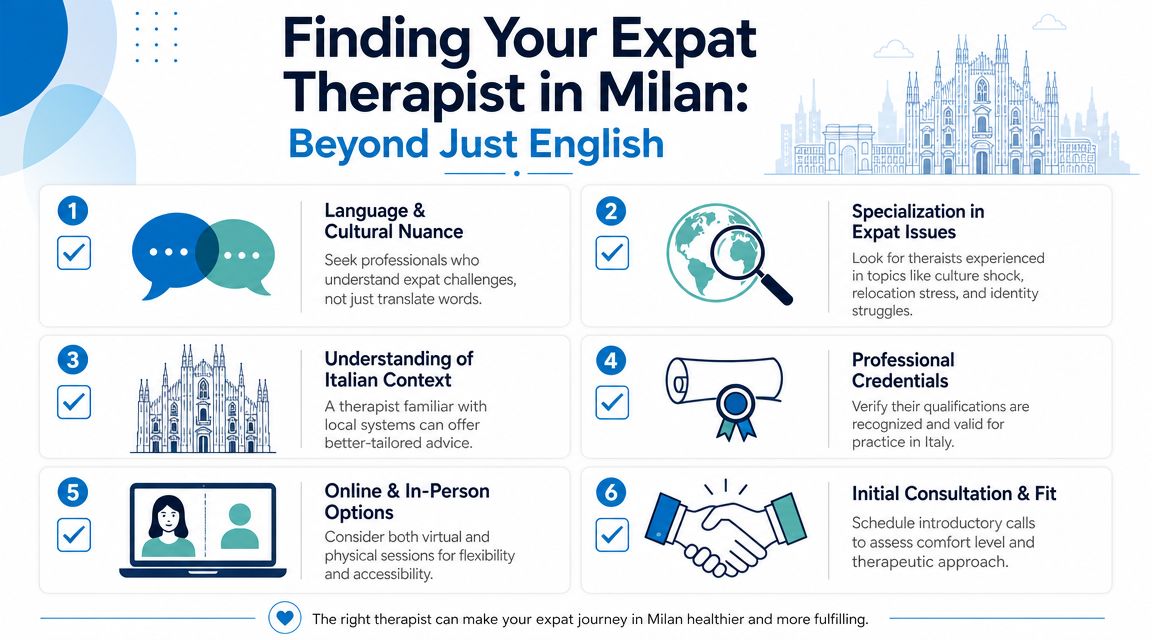
A useful therapist for expat couples in Milan should be able to work with more than surface communication issues.
Look for signs that they understand:
Relocation as a psychological event
Moving country affects identity, attachment, and self-esteem. It isn't just “stress”.Cross-cultural conflict patterns
Family loyalty, emotional expression, privacy, money, gender roles, and social expectations may differ sharply.Language choice inside therapy
The therapist should be able to discuss whether English, Italian, or a bilingual format makes the most sense for your specific couple.Structured work
Especially at the beginning, it helps when therapy includes clear goals, identified triggers, and an observable plan.
Online or in person in Milan
For many couples, this isn't an either-or decision. It's a continuity decision.
That has practical value for expat couples. Work travel, changing schedules, family visits, and administrative demands can easily interrupt care. A flexible format often protects consistency.
Here's a simple comparison:
| Format | Often works well when | Main trade-off |
|---|---|---|
| In person | You want a strong ritual and physical separation from home stress | Less flexible with commuting and scheduling |
| Online | You need continuity across work, travel, or family obligations | Privacy at home must be managed carefully |
| Hybrid | Your week changes often and you want both stability and flexibility | Requires good planning and agreement |
Questions worth asking before you start
A good first conversation should help you assess fit quickly.
Consider asking:
- Do you have experience with intercultural or expat couples?
- How do you handle sessions when partners have different first languages?
- How structured are the first sessions?
- Can we work online if travel or work makes attendance difficult?
- How do you approach recurring conflict that includes cultural misunderstanding?
One practical option in Milan is English-speaking psychologist support, especially when couples need language flexibility and a clinician familiar with the Italian context. In my work as Clinical Director, I also see how helpful human matching can be. A couple often doesn't need an endless directory. They need a thoughtful recommendation based on language, clinical style, and the kind of tension they're living with.
That's one reason some couples choose Therapsy, where multilingual matching is done by a clinician rather than an automated tool. It can reduce the trial-and-error stage that many expat couples find exhausting.
Your First Steps A Practical Guide to Starting Therapy
Starting therapy often feels bigger in your head than it is in practice. Couples postpone it because they think they need certainty first. They don't. They need enough clarity to begin one conversation.
In Milan, cost is understandably part of that calculation. The same Milan-facing summary notes that 70% of couples who complete Emotionally Focused Therapy can be symptom-free at the end of treatment, which is one reason many couples look for an evidence-based approach rather than unstructured support.
A simple way to begin
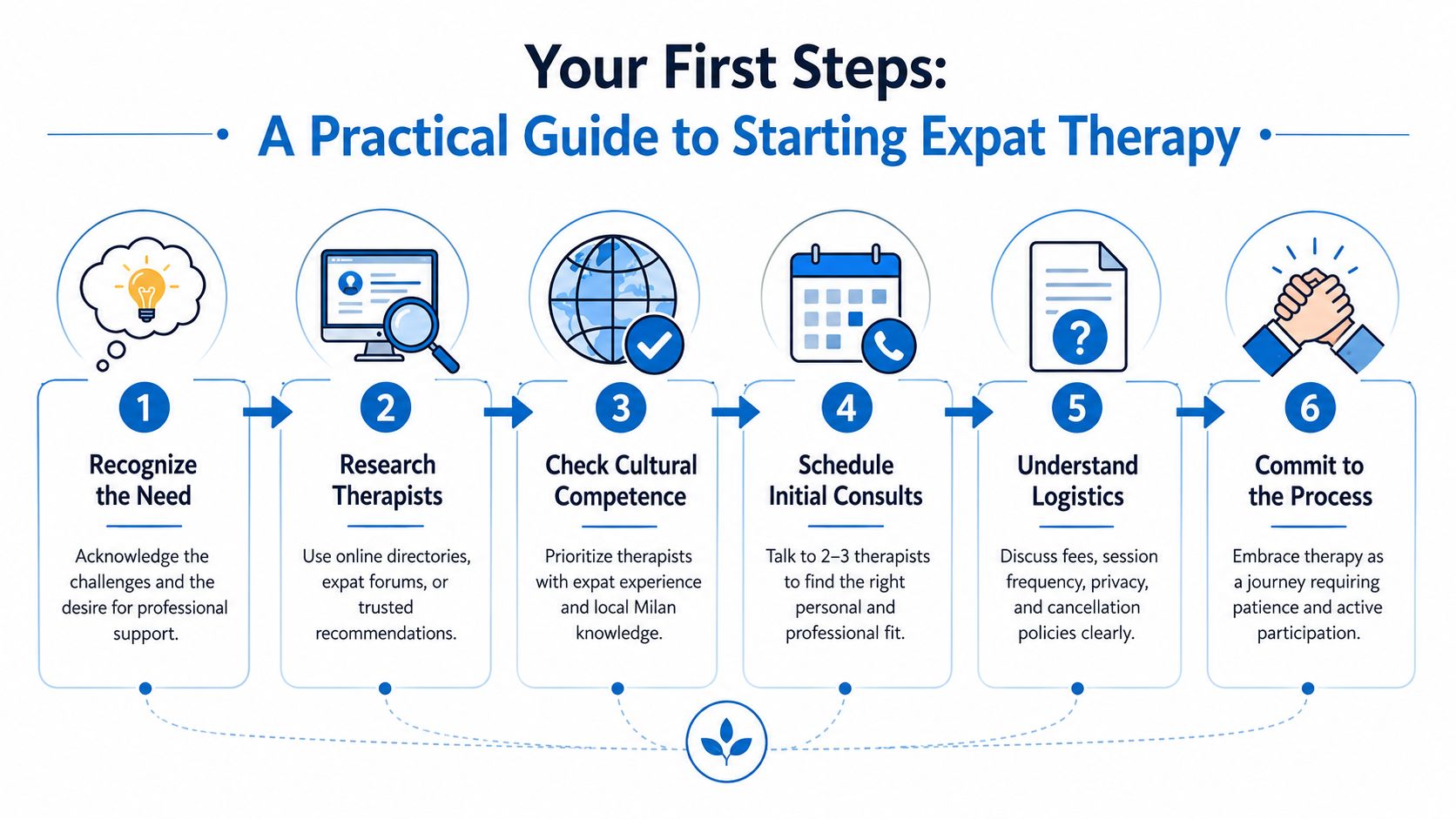
If you're feeling overwhelmed, reduce the process to decisions you can make one at a time.
Acknowledge the pattern
You don't need a crisis to seek help. Repeated tension, emotional distance, or conflict around relocation is enough reason.Choose the practical format first
Decide whether online, in person, or hybrid is more realistic for your current life.Check for intercultural competence
Don't only ask whether the therapist speaks English. Ask whether they understand bicultural relationships and migration stress.Use the first contact well
A first call is for fit. Bring the actual questions that matter to you: language, style, structure, cost, availability.
What the process can look like
At Therapsy, the pathway is designed to remove uncertainty rather than add to it.
It typically works like this:
- Initial contact through the website
- A free conversation with the Clinical Director to understand the couple's needs
- Careful matching with a therapist based on language, presenting issue, and style
- A first assessment session where goals and difficulties are clarified
- Regular sessions online or in person, with rematching possible if needed
For couples, pricing starts from €100 per session. What matters most is not finding the cheapest or most polished profile. It's finding someone who can understand the relationship in context.
Therapy works better when the first phase is used to map the cycle clearly: what triggers conflict, how each partner protects themselves, and what both are longing for underneath the pattern.
If beginning still feels abstract, this guide on how to start therapy in Italy can make the process feel more concrete and less intimidating.
What helps in the first month
The earliest stage of couples work is often less dramatic than people expect, but more useful.
What usually helps is:
Consistency over intensity
One steady session pattern is more effective than rushed crisis appointments.A shared frame
Both partners need to understand what therapy is for. Not winning. Not proving. Understanding and change.Clear expectations
Couples often feel relief at knowing what the process is and what the next step will be.
What to Expect From Your Therapy Sessions
Many couples worry that therapy will turn into a courtroom. It shouldn't. A couples therapist is not there to decide who is right. The work is to understand the pattern the two of you create together, especially under stress.
That often comes as a relief. Instead of replaying the same argument with a witness present, therapy slows the sequence down. Who feels criticised first. Who withdraws. Who escalates. What each person is trying to protect. What each person is longing for but struggling to ask for directly.
The first sessions are usually more structured than people expect
In good expat couples work, the beginning is often a focused assessment. That means identifying:
- the couple's goals
- recurring conflict triggers
- how arguments typically unfold
- what role relocation, language, family, work, or identity strain is playing
- what each partner experiences privately during conflict
This structure matters. Open-ended talking can feel supportive in the moment, but it doesn't always create change. A stronger process gives the couple a map.
Different approaches you may encounter
You don't need to become an expert in therapy models, but it helps to know the basics.
CBT focuses on the connection between thoughts, emotions, and behaviours. In couples work, it can help identify assumptions, reactions, and habits that keep conflict going.
Schema Therapy explores deeper emotional patterns that often come from earlier life experiences. A partner may react strongly to exclusion, criticism, abandonment, or loss of control because old vulnerabilities are being activated in the present.
Systemic-relational therapy looks at the relationship as a system. It asks how the couple functions together, how family and culture shape interactions, and how each person's behaviour influences the other.
EMDR is better known for trauma work, but trauma-informed thinking can be very important when one or both partners are carrying unresolved stress, previous relational injury, or a sense of instability linked to relocation.
What tends to work and what usually doesn't
A few realities are worth saying plainly.
What helps:
- Specific examples from real life, not only general complaints
- Honest naming of resentment before it hardens into contempt
- Curiosity about cultural difference instead of using culture as a weapon
- Small behavioural experiments between sessions, such as changing how repair attempts happen after conflict
What usually doesn't help:
- arriving only to prove the other person is the problem
- hiding major issues because you want to look reasonable
- expecting immediate relief without practice between sessions
- treating the therapist as translator, referee, or ally against your partner
Therapy is often most effective when both partners become more accurate about themselves, not only more critical of each other.
For expat couples, one especially important shift is moving from blame to context. “You never support me” becomes “I feel alone in this city and I don't know how to ask without sounding angry.” That kind of translation can change the tone of a relationship.
What progress often feels like
Progress doesn't always begin with fewer arguments. Sometimes it begins with a different quality of argument.
You may notice that:
- conflicts end faster
- both partners feel less flooded
- the same trigger becomes easier to recognise
- apologies become more meaningful
- difficult topics feel discussable rather than explosive
- the relationship starts to feel like a team again
That is not about perfection. It's about building a more secure and workable way of being together in a demanding environment.
FAQ
Is expat couples therapy in Milan only for couples in crisis
No. Expat couples therapy in Milan is often most useful before a relationship reaches crisis point. Many couples seek support when they notice repeated conflict, emotional distance, or strain linked to relocation, not when they are on the verge of separation. Early therapy can help prevent stress from becoming entrenched.
Should our couples therapist be bilingual or is English enough
It depends on how your relationship functions across languages. English may be enough if both partners can express emotional nuance comfortably in it, but that is not always the case. If one partner loses precision, confidence, or equality in English or Italian, a bilingual or culturally flexible therapist can make the work feel fairer and deeper.
Can online couples therapy work if we both live in Milan
Yes. Online couples therapy can work well for Milan-based couples when privacy, consistency, and scheduling are managed properly. It can be especially helpful for busy professionals, couples who travel, or partners with unpredictable routines. The key is not the format alone, but whether the sessions stay regular and focused.
What if one partner wants therapy and the other is sceptical
That's common. A sceptical partner doesn't automatically mean therapy won't help. It often helps to frame the first conversation as an assessment rather than a commitment to a long process. Many people feel more open once they understand that the therapist is not there to assign blame.
How long does couples therapy usually take
There isn't one fixed timeline. The length depends on the couple's goals, the severity of the pattern, and how consistently both partners engage. Some couples want help with a specific transition, while others are addressing deeper relational injuries or long-standing cross-cultural misunderstandings.
What if our problem is not culture but resentment
Resentment is still a valid reason to seek help. In expat couples, resentment often becomes the visible surface of deeper issues such as inequality, exhaustion, dependence, or disappointment. Therapy can help identify what the resentment is protecting and what changes would reduce it.
Is it normal to feel guilty for not being happier in Milan
Yes. Many expats feel guilty when life in Milan doesn't match the version they hoped for. That guilt can make people minimise their distress or hide it from their partner. Naming the disappointment is often the first step toward reconnecting as a couple.
What if we are not sure we want to stay together
Therapy can still be useful. Couples therapy is not only for saving a relationship. It can also help two people understand their pattern, clarify what is still possible, and make decisions with more honesty and less damage.
If you're looking for thoughtful support in English or another language, book your first free assessment call with THERAPSY. There's no commitment, just a conversation with our Clinical Director to understand what you need and help match you with the right therapist.