You wake up already tense. Your jaw is tight. Your heart speeds up before a work call. A simple task, replying to an email in Italian, booking a medical appointment, asking your landlord a question, suddenly feels heavier than it should.
For many people living abroad, anxiety symptoms in adults don't begin as obvious panic. They often arrive subtly. You become more irritable, less patient, more tired, more avoidant. You tell yourself you're just stressed, just adjusting, just busy. Then your body keeps sounding the alarm.
If you're an expat in Italy, that confusion can deepen. Is this ordinary stress from relocation? Is it burnout? Is it culture shock? Or is it anxiety that deserves proper attention? The answer matters, because anxiety is highly treatable when it's recognised accurately, in language that fits your life and not just a checklist.
Recognizing Anxiety Beyond Just Worry
Anxiety isn't only "thinking too much". In adults, it often shows up as a mix of body symptoms, mental overload, emotional strain, and behavioural changes that can start to reshape daily life.

In practice, many expats first notice anxiety in ordinary moments. They dread opening official letters. They rehearse simple conversations. They feel disproportionately shaken by delays, misunderstandings, or social uncertainty. Their mind says, "This shouldn't be hard." Their nervous system says otherwise.
A useful visual way to think about social unease and withdrawal is this illustration related to social anxiety. It captures something many adults miss. Anxiety often looks less like drama and more like retreat.
National survey data in Italy found that 24.7% of adults experienced clinically relevant anxiety symptoms in the previous two weeks, and the rate was even higher in the 18 to 34 age group at 32.1% (Crownview Psych summary of Italian survey data). That age range includes many expats, international students, and early-career professionals.
Anxiety becomes easier to miss when it still allows you to function. You may keep working, studying, and socialising while feeling internally overwhelmed.
What anxiety often feels like day to day
Some people describe it as constant inner pressure. Others feel a restless, scanning state, as if their mind never fully powers down. For expats, the feeling may sharpen in situations where language, belonging, and uncertainty overlap.
Common early signs include:
- Persistent mental rehearsal before conversations, appointments, or meetings
- Difficulty switching off after small mistakes or awkward interactions
- Body tension that lingers even when nothing is obviously wrong
- Avoidance of emails, calls, forms, invitations, or unfamiliar places
- Sleep disruption caused by worry, alertness, or racing thoughts
The important distinction is this. Worry is a normal human response. Anxiety symptoms in adults become clinically important when they are persistent, distressing, or disruptive enough that life starts shrinking around them.
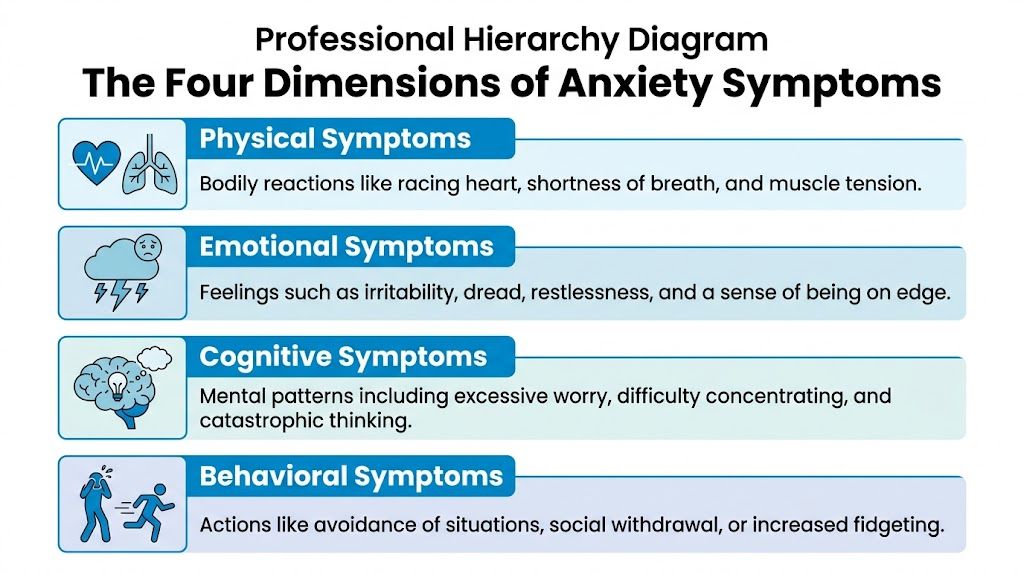
The Four Dimensions of Anxiety Symptoms
When adults say "I feel anxious", they may be describing very different experiences. One person feels chest tightness and nausea. Another can't stop catastrophising. Another goes numb and avoids everything. Anxiety makes more sense when you sort it into four dimensions.
If you want a grounding complement to this framework, this mindfulness and meditation visual reflects a skill many therapists use to help people separate symptoms from identity.
Physical symptoms
The body often reacts before the mind has words for what's happening. Anxiety activates a threat response. Even when the "threat" is an inbox, a networking event, or a conversation in a second language, the body can respond as if danger is present.
Physical symptoms can include:
- Racing heart that appears during stress or without a clear trigger
- Shortness of breath or the feeling that you can't get a satisfying breath
- Muscle tension in the jaw, shoulders, neck, chest, or stomach
- Sweating or trembling during social or performance situations
- Digestive upset such as nausea, knots in the stomach, or loss of appetite
- Restlessness that makes sitting still feel difficult
- Fatigue after long periods of internal alertness
- Sleep problems including difficulty falling asleep or waking with dread
For expats, these symptoms are often misread. People assume they have only a sleep issue, a work issue, or a language confidence problem. Sometimes those factors are involved. But anxiety is what ties the pattern together.
Cognitive symptoms
This is the thought side of anxiety. It isn't just "negative thinking". It usually involves repetitive, threat-focused mental loops that feel compelling and hard to stop.
Typical cognitive symptoms include:
- Excessive worry about work, health, money, relationships, or the future
- Catastrophic thinking such as jumping quickly to worst-case scenarios
- Difficulty concentrating because the mind keeps scanning for risk
- Indecision caused by overanalysing every option
- Mental rehearsal of conversations, mistakes, or possible conflicts
- Hypervigilance to tone, facial expressions, delays, or signs of rejection
A common expat version of this is interpretive overload. You don't just wonder whether something went badly. You wonder whether it went badly because of your accent, your foreignness, your visa situation, your social position, or your misunderstanding of local norms.
Clinical clue: When the mind treats uncertainty as danger, anxiety grows quickly.
Emotional symptoms
Many adults expect anxiety to feel like fear. Often it doesn't. It may feel like irritability, dread, fragility, or a constant sense of being close to overwhelm.
Emotional symptoms often include:
- Irritability that seems out of proportion to the situation
- A sense of dread without a single clear reason
- Feeling on edge even during objectively safe moments
- Low frustration tolerance for delays, noise, admin, or social ambiguity
- Shame about not coping "well enough"
- Fear of losing control in public or high-pressure settings
This emotional layer is where many high-functioning adults get stuck. They know they aren't "falling apart", so they minimise the problem. Meanwhile, the emotional cost keeps accumulating.
Behavioural symptoms
Behaviour tells you how anxiety is shaping your choices. This dimension matters because it's often what keeps anxiety going.
Common behavioural symptoms include:
- Avoiding situations that might trigger discomfort or scrutiny
- Leaving tasks unfinished because starting feels too activating
- Seeking excessive reassurance from partners, friends, or colleagues
- Withdrawing socially even when loneliness gets worse
- Checking repeatedly for mistakes, messages, signs, or symptoms
- Fidgeting or pacing when tension rises
- Overpreparing as an attempt to control uncertainty
Some behaviours look productive from the outside. Perfectionism, overresearching, and constant planning can seem responsible. In anxiety, they often function as safety behaviours. They reduce discomfort briefly but keep the nervous system convinced that ordinary situations are dangerous.
A simple way to read the pattern
| Dimension | What you notice first | What it can lead to |
|---|---|---|
| Physical | Tight chest, poor sleep, tension | Fear that something is medically wrong |
| Cognitive | Worry loops, overthinking, mental noise | Decision paralysis and exhaustion |
| Emotional | Irritability, dread, overwhelm | Shame and self-criticism |
| Behavioural | Avoidance, checking, withdrawal | A smaller, more restricted life |
Anxiety symptoms in adults rarely stay in one box. They interact. A racing heart triggers catastrophic thoughts. Catastrophic thoughts increase dread. Dread leads to avoidance. Avoidance brings temporary relief, then makes the next situation feel even harder.
How Symptoms Form Patterns in Anxiety Disorders
Anxiety disorders are defined less by whether someone worries and more by the pattern the symptoms create over time. In practice, that pattern matters. It shapes what the person fears, what they avoid, how their body reacts, and which treatment is most likely to help.
For adults living abroad, pattern recognition matters even more. An expat in Italy may describe chest tightness, insomnia, dread before appointments, or fear in crowded public spaces. Those symptoms can be misread as "stress from the move" when they fit a treatable anxiety disorder. If the assessment happens in the wrong language, that distinction is easier to miss.
Generalised anxiety disorder
Generalised Anxiety Disorder, or GAD, usually shows up as persistent worry spread across several parts of life rather than one specific feared situation. The subject changes. The mental process stays the same.
A person with GAD may worry about work, health, money, family, paperwork, housing, or whether they have made a mistake they have not yet discovered. Relief is brief. The mind quickly finds the next problem to monitor.
Common features include:
- Worry that feels difficult to control
- Restlessness or feeling keyed up
- Mental fatigue from constant scanning
- Poor concentration
- Irritability
- Muscle tension
- Sleep disruption
Clinicians often use the GAD-7 as a screening tool. A score of 10 or above suggests symptoms are no longer mild background stress, as noted earlier. Screening is not diagnosis, but it helps identify when proper evaluation is needed.
Among expats in Italy, GAD often attaches itself to unresolved uncertainty. Permesso di soggiorno delays, freelance income swings, housing contracts, tax questions, school decisions, and family concerns back home can keep the alarm system active all day. The trade-off is important to name clearly. Some concern is realistic. GAD turns realistic concern into constant internal overwork.
Past experience can intensify that pattern. Someone with a history of trauma, criticism, instability, or burnout may react more strongly to present uncertainty. A visual resource some readers find helpful is this EMDR mental health image. It reflects a clinical point I often discuss with clients. Current anxiety is sometimes amplified by an older nervous system template, not only by current events.
Panic disorder
Panic follows a different pattern. The symptoms rise quickly, feel overwhelming, and are often interpreted as immediate danger.
During a panic episode, adults may experience:
- Heart pounding
- Shortness of breath
- Dizziness
- Sweating
- Shaking
- Chest discomfort
- Feeling detached or unreal
- Fear of fainting, losing control, or dying
The core problem in panic disorder is not one isolated episode. It is the learned fear of the next episode. People start monitoring their body closely, reacting to normal sensations as warning signs, and avoiding places where escape feels difficult or embarrassing.
I see this become particularly disruptive for internationals in Italy. A panic episode on a train, in a crowded market, at the Questura, or during a medical visit can leave a strong imprint. If the person also worries they will not find the right Italian words in the moment, the fear often grows faster. The body becomes the trigger, then the place becomes the trigger, then daily life starts shrinking around both.
Social anxiety disorder
Social Anxiety Disorder, or SAD, centres on fear of negative evaluation. The person expects scrutiny, embarrassment, rejection, or visible signs of anxiety in front of other people.
That pattern often includes:
- fear before meetings, introductions, or group settings
- worry about blushing, shaking, sweating, or sounding incompetent
- replaying conversations afterwards
- avoiding speaking up, eating, presenting, or asking for help in public
- cancelling plans for relief, then feeling ashamed or isolated
As noted earlier, social anxiety is common and often untreated for years. In expat life, it is easy to mislabel it as a language problem and stop there. Language can be part of the picture, but the clinical pattern is broader. The fear starts to appear even in manageable interactions. Ordering coffee becomes stressful. Sending a voice note feels exposing. A work meeting can trigger hours of anticipatory dread.
That distinction matters in treatment. Someone may improve their Italian and still remain trapped by fear of judgment. Language practice can reduce one layer of strain, and practical tools such as Italian conversation for beginners can help with everyday confidence. If the anxiety persists across settings, therapy needs to address the fear pattern itself, not only vocabulary.
Why patterns matter
Accurate treatment starts with accurate formulation.
Broad chronic worry, panic about body sensations, and fear of scrutiny can all be called "anxiety," but they do not respond best to the same focus. Reassurance usually feeds GAD. Controlling or escaping sensations tends to maintain panic. Avoidance strengthens social anxiety. Good therapy identifies the maintaining cycle, then works on that cycle directly.
For expats, multilingual therapy is not a convenience feature. It affects diagnostic accuracy. People describe internal experience differently depending on the language they are using, especially when they are talking about shame, fear, trauma, or physical symptoms. A therapist who can assess anxiety in the language that fits you best is more likely to catch the pattern and less likely to mistake a disorder for "adjustment issues."
That is one reason Therapsy is often the clearest next step for internationals in Italy. The goal is not to talk about stress. The goal is to identify the pattern correctly, in a language you can think and feel in, and then treat it with methods that fit how your anxiety works.
Anxiety and The Expat Experience in Italy
Relocating to Italy can be exciting, beautiful, and profoundly unsettling at the same time. Anxiety often grows in the gap between how life looks from the outside and how hard it feels from the inside.

Why expat anxiety can feel sharper
In adults living abroad, anxiety doesn't only come from internal vulnerability. It is often fuelled by real friction.
You may be dealing with:
- Language pressure in medical, legal, housing, or work settings
- Bureaucratic uncertainty that leaves important questions unresolved
- Reduced support because family and old friends aren't nearby
- Identity strain when you feel less competent than you were at home
- Social ambiguity around humour, politeness, belonging, and group norms
- Performance pressure to prove the move was worth it
Each of these can activate the same symptom systems described earlier. A delayed document can trigger catastrophic thinking. A misunderstood conversation can lead to shame. Repeated friction can build into hypervigilance.
For some people, practical language support reduces part of the load. If everyday conversation is one source of stress, resources like Italian conversation for beginners can help lower anticipatory anxiety around simple interactions. It won't treat an anxiety disorder on its own, but it can remove one layer of daily threat.
Young adults, burnout, and digital anxiety
Emerging data indicates anxiety symptom prevalence is highest in young adults aged 18 to 35, with a 22% rate in expat-heavy regions like Lombardy. The same verified data links this with remote work burnout and digital anxiety, and notes that irritability and concentration problems spike 35% in this group (Mayo Clinic page used in the verified dataset).
That rings true clinically. Many expats aren't only adapting to a new country. They're doing it while working across time zones, managing unstable routines, spending too much time online, and comparing themselves constantly.
Expat anxiety is often a compound problem. Part relocation stress, part loneliness, part perfectionism, part nervous system overload.
A lot of adults in this position don't look unwell. They look accomplished. They keep delivering. They answer messages. They show up socially enough to appear fine. But inside, their attention is fragmented and their threshold for stress gets lower each week.
This online therapy visual speaks to a practical reality for expats. Flexible support matters when your schedule, city, or comfort level changes.
The hidden problem of translation
One of the most overlooked issues in expat mental health is diagnostic accuracy across languages.
If you can't describe your internal experience precisely, therapy can become less effective. The difference between "nervous", "on edge", "ashamed", "panicky", "unsettled", and "disconnected" matters clinically. So does the difference between avoiding because you're tired, avoiding because you're culturally uncertain, and avoiding because your nervous system has learned to fear exposure.
A short reflection on how anxiety can surface in modern life is worth watching here:
Adults often feel relief when someone understands both the clinical pattern and the intercultural context. Without that, it's easy to mislabel anxiety as weakness, oversensitivity, or a failure to adjust.
When Symptoms Become a Signal to Seek Help
You might be getting through the day in Florence, Milan, or a smaller town in Italy, answering emails, paying bills, and speaking enough Italian to manage. Then your body starts setting limits before your mind does. You avoid phone calls in Italian because your chest tightens. You postpone a medical appointment because explaining symptoms feels too hard. You stay home more often because ordinary tasks now cost too much energy.
That is often the point where anxiety stops being something to push through privately and starts deserving proper care.
Signs that it's time to stop self-managing
Anxiety needs attention when it begins to shape your choices, shrink your world, or keep returning despite rest, self-help tools, or support from people close to you. For expats, this line can be easy to miss because relocation already asks so much of your attention. Many people assume they are tired, overstretched, or still adjusting. Sometimes that is true. Sometimes anxiety has become the pattern underneath.
Clear signals include:
- Work is affected because focus, deadlines, meetings, or decisions feel harder to manage
- Sleep stays disrupted and rest no longer resets you
- Relationships feel strained because you're more irritable, withdrawn, or reassurance-seeking
- Avoidance is increasing around travel, calls, paperwork, social situations, or health appointments
- Body symptoms scare you and you keep monitoring or checking them
- You feel stuck in loops of overthinking, doom-scrolling, or post-event replaying
A practical rule I use in clinical work is simple. If anxiety keeps changing your behaviour, not just your feelings, it is time to get an assessment.
What often keeps anxiety going
Some coping strategies bring quick relief but make anxiety more persistent over time. This matters even more for expats, because avoidance can hide inside reasonable-sounding explanations such as "my Italian isn't good enough yet" or "I'll deal with it once life settles down."
Common examples include:
- Waiting for certainty before acting
- Seeking constant reassurance from friends or partners
- Avoiding triggering situations whenever possible
- Overpreparing every detail so nothing can go wrong
- Reducing the problem to stress only when the pattern is persistent
Plenty of adults continue to function while suffering heavily. Productivity can hide a lot.
What professional help can clarify
A good assessment does more than reduce symptoms. It helps identify what you are dealing with, which is especially important when anxiety overlaps with culture shock, loneliness, language fatigue, trauma history, or burnout from starting over in another country.
A clinician can help distinguish between:
| Experience | Often looks like | Why distinction matters |
|---|---|---|
| Adjustment stress | Distress linked to a recent change | May settle with support and adaptation |
| Burnout | Exhaustion, cynicism, reduced capacity | Needs workload and recovery work |
| Clinical anxiety | Persistent fear, avoidance, body activation | Benefits from targeted therapy |
| Mixed picture | Anxiety plus low mood, trauma, or isolation | Needs a more integrated plan |
Language matters here. If a therapist misses the difference between panic, shame, homesickness, social fear, or confusion linked to living in another culture, treatment can miss the mark. Multilingual therapy is not just more comfortable. It supports more accurate diagnosis and a treatment plan that fits your experience.
For some people, understanding the difference between therapy and medication support is also useful. This psychologist vs psychiatrist visual reflects a question many adults have when deciding what kind of care they need first.
If you want a plain-language sense of how structured care can be mapped out, these various treatment plan examples offer a helpful overview.
Seeking help is a measured response when anxiety starts taking too much space in your life. Therapsy gives expats in Italy a way to speak clearly, be understood accurately, and start treatment without adding another language barrier to an already overloaded nervous system.
Your Path to Feeling Better with Therapy in Italy
Anxiety improves when treatment matches the pattern and when the person feels safe enough to be honest. Those two conditions matter more than people realise.

What good therapy for anxiety usually includes
Effective therapy doesn't only teach you to calm down. It helps you understand the loop that keeps anxiety going, then change your relationship to thoughts, sensations, and behaviours.
Depending on the pattern, treatment may include:
- CBT to identify worry loops, reduce avoidance, and test feared predictions
- Exposure-based work to help the nervous system learn that discomfort isn't danger
- EMDR when past experiences are amplifying present threat responses
- Skills for regulation such as grounding, breathing, pacing, and attention training
- Intercultural formulation to separate anxiety from language strain, identity conflict, or adaptation stress
A structured plan often helps adults feel less lost. If you'd like a plain-language example of how care planning can be organised, these various treatment plan examples offer a helpful overview. In therapy, the plan is personalised. But the principle is the same. Clear goals reduce confusion.
What tends to work better than generic advice
Generic self-help advice often fails because it's too broad. "Try to relax" isn't a treatment. Neither is "think positively".
What works better:
- Naming the pattern accurately so interventions fit the problem
- Reducing safety behaviours instead of building life around them
- Practising skills repeatedly between sessions, not only understanding them intellectually
- Working in your strongest language when emotion is nuanced or firmly rooted
- Reviewing progress thoroughly so treatment stays active and specific
What usually works poorly:
- trying to reason your way out of every anxious thought
- waiting until you feel brave before taking action
- relying on social media tips that ignore your history
- staying with support that doesn't understand intercultural stress
Why language matters clinically
For expats, multilingual therapy isn't a luxury. In many cases, it's necessary for accurate formulation.
A person may speak Italian well at work and still need their native language to describe fear, shame, grief, anger, or trauma. That's not a failure of adaptation. It's how emotional memory and meaning work.
The closer therapy gets to your internal language, the more precise the work can become.
When therapy is offered online or in person across Italy, another barrier drops. You don't have to choose between quality care and logistical reality. That matters if you move cities, travel often, or feel more comfortable beginning from home.
What starting often looks like
Beginning therapy for anxiety usually involves a few practical steps:
Describe the main problem clearly
Not "I'm a mess", but "I can't stop worrying", "I avoid calls", "I panic on public transport", or "I dread speaking in groups".Map the triggers and the loop
A therapist helps identify what happens before, during, and after anxious episodes.Set one or two functional goals
Better sleep. Fewer panic responses. Less avoidance. More confidence in daily life.Use a treatment style that fits
Some adults need structured CBT tools. Others need trauma-informed work. Many need both practical skills and deeper formulation.Review what changes in real life
Progress isn't only insight. It's emailing back, attending the meeting, taking the train, sleeping more reliably, or feeling less captive to fear.
The right support should feel grounded, clear, and human. Not abstract. Not performative. Not like you are being told to cope better.
FAQ Understanding Anxiety as an Expat in Italy
Is this just culture shock, or could it be anxiety?
Culture shock can involve confusion, homesickness, fatigue, and frustration. Anxiety becomes more likely when fear, avoidance, body activation, or relentless worry start recurring across situations. If your world is getting smaller, or your nervous system feels constantly activated, it's worth getting a clinical opinion.
Can anxiety look physical even if the cause is psychological?
Yes. Many anxiety symptoms in adults are physical first. Racing heart, stomach upset, shakiness, poor sleep, chest tightness, and muscle tension are common. That doesn't mean symptoms should be dismissed. It means body and mind need to be assessed together.
Why does anxiety feel worse in another language?
Because language affects control, confidence, and self-expression. In a second language, you may feel slower, less precise, and more exposed. That can intensify fear of scrutiny, misunderstanding, or making mistakes. For some adults, this amplifies an existing anxiety pattern. For others, it helps trigger one.
Do I need therapy if I'm still functioning?
Possibly. Many adults with anxiety continue working, studying, parenting, and socialising while struggling heavily inside. The better question is whether anxiety is costing you peace, sleep, confidence, connection, or freedom.
What kind of therapy helps most with anxiety?
That depends on the pattern. Broad worry often responds well to CBT-based work. Panic usually improves when people learn not to fear body sensations and stop organising life around them. Social anxiety often needs exposure and work on self-focused attention, shame, and avoidance. Trauma-related anxiety may need a more integrated approach.
Is online therapy enough, or should I look for in-person support?
Both can work well. Online therapy suits many expats because it reduces travel stress, fits changing schedules, and allows continuity if you relocate. In-person support can feel grounding for people who prefer face-to-face contact. The best choice is the one you will use consistently.
What should I look for in a therapist as an expat?
Look for clinical competence, of course, but also for intercultural understanding. You want someone who can tell the difference between ordinary adaptation strain and an anxiety disorder, and who understands how language, migration, identity, and belonging shape symptoms.
If you're living in Italy and anxiety has started to colour your work, sleep, relationships, or sense of self, support can be both expert and accessible. THERAPSY offers multilingual psychotherapy with licensed clinicians, available online and in person across Italy, with a free first assessment call to help you find the right fit. Book your first free assessment call.