Meta Title: Do I Need A Psychologist? Expat Guide to Support in Italy
Meta Description: Wondering do i need a psychologist? This guide helps expats and international students in Italy recognise the signs, understand their options, and take a first step with confidence.
Slug: do-i-need-a-psychologist-expats-guide-italy
Tags: expat mental health, psychologist in Italy, therapy for expats, international students Italy, multilingual therapy, anxiety support, burnout, couples therapy, mental health Italy
Some people ask, “Do i need a psychologist?” in the middle of a crisis.
Many more ask it to themselves. On a Tuesday evening. After another day of smiling through Italian class, replying “all good” to friends back home, and feeling strangely flat in a country they once felt excited to move to.
If that sounds familiar, you are not overreacting. You are noticing something important.
For expats and international students in Italy, emotional strain can hide behind ordinary-looking problems. A visa issue starts to feel unbearable. A small misunderstanding in another language leaves you in tears. A beautiful city feels lonely. A relationship becomes tense under the pressure of relocation, work, money, and homesickness. You may still be functioning. You may still be going to lectures, logging into work, meeting people, and posting photos. But inside, something feels off.
That is often where the question begins. Not “Am I ill enough?” but “Why does everything feel harder than it should?”
As a psychologist working with internationals in Italy, I want to say this clearly. Asking whether you need support is not a sign of weakness. It is often a sign of good self-awareness. It means one part of you has started paying attention.
That Lingering Question You Can't Seem to Shake
You moved for a reason. Study. Work. Love. Adventure. A fresh start.
At first, the stress may have seemed temporary. You told yourself it was just culture shock, just a busy month, just the language barrier, just the normal discomfort of starting over. That explanation can be true for a while. Then weeks pass, sometimes months, and the feeling does not lift.

When life looks fine from the outside
An expat professional in Milan may still hit deadlines but cry after work for reasons they cannot explain. An international student in Turin may go to class every day yet feel detached from everyone around them. Someone in Rome may have built a life they wanted, but still wake up with dread and a constant sense of pressure.
None of these people necessarily look like they are “in crisis”. That is why this question can linger for so long.
If you keep asking yourself whether something is wrong, that question itself is worth taking seriously.
Many readers hesitate because they think therapy is only for severe cases. It is not. Psychologists do not only help when life falls apart. We also help when a person feels stuck, emotionally overloaded, unusually reactive, persistently numb, or unable to understand what is changing inside them.
Why expat life can blur the signals
Living abroad adds layers. You may miss home, but also feel guilty for missing it. You may struggle socially, but tell yourself you need to try harder. You may feel exhausted by speaking Italian all day, managing bureaucracy, and adapting to social norms that once seemed charming and now feel draining.
These experiences are real. They can also mask anxiety, depression, burnout, grief, or relationship stress.
So if you are asking, “Do i need a psychologist?”, the most useful response is not a harsh yes-or-no verdict. It is a calmer question. What have you been carrying alone, and how much is it costing you?
Common Signs It Might Be Time to Talk to Someone
Sometimes people wait for one dramatic sign. More often, the pattern is quieter.
In Italy, a 2023 ISTAT survey reported that 28.9% of people aged 15 and over experienced at least one mental health symptom in the previous two weeks, with anxiety affecting 15.2%, depressive symptoms reported by 10.4%, and prevalence reaching 36.7% among young adults aged 18 to 24. Yet only 5.2% of adults sought professional psychological help in the past year. Many people struggle for longer than they need to.
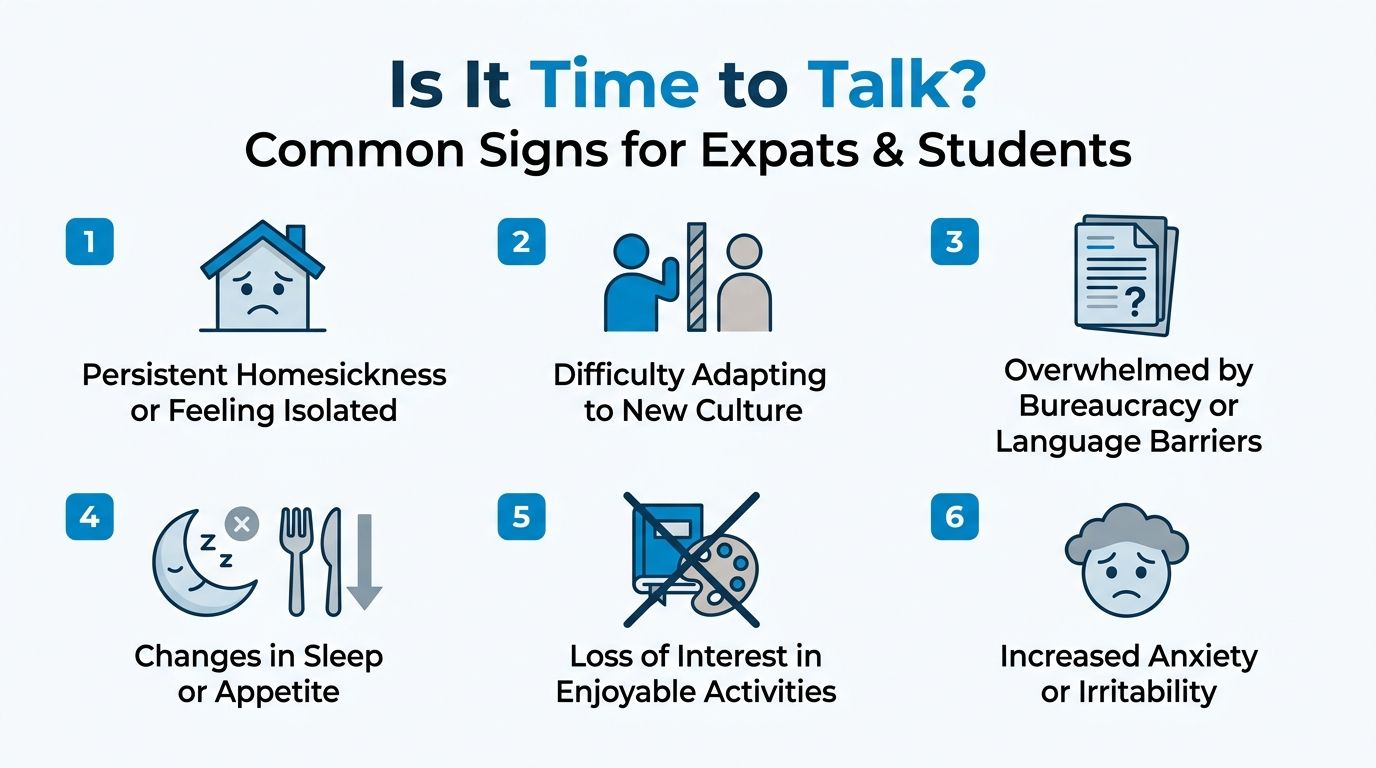
Emotional changes
- You feel anxious more days than not. This may show up as overthinking texts, dread before simple errands, panic around official paperwork, or constant worry that you are “doing Italy wrong”.
- Your mood has narrowed. You feel flat, irritable, tearful, or emotionally tired. Even good moments do not land fully.
- Homesickness has become heavier. Missing home is normal. Feeling emotionally stranded for a long period is different.
- You no longer recognise your usual self. Friends might describe you as outgoing, calm, or resilient, but lately you feel unlike yourself.
Behavioural shifts
- You withdraw more than you mean to. You stop replying, cancel plans, skip classes, or avoid meeting new people because everything feels effortful.
- You start organising life around stress. You avoid phone calls in Italian, postpone important appointments, or stay very busy so you do not have to feel.
- Your coping habits are getting rigid. You may scroll late into the night, overwork, isolate, or rely on food, alcohol, or distractions to get through the day.
- You keep searching for reassurance. Articles, quizzes, voice notes to friends, and self-diagnosis start replacing real support.
A more general checklist like 8 signs you need a therapist can help some readers put words to what they are experiencing. If you want a guide focused more specifically on readiness for support, this piece on https://therapsy.it/ready-for-therapy-signs/ is also useful.
Physical and cognitive clues
- Your sleep has changed. You struggle to fall asleep, wake early with racing thoughts, or sleep more but feel less restored.
- Your body is carrying the stress. Headaches, stomach discomfort, chest tightness, restlessness, and fatigue often show up before people label what they feel as emotional distress.
- Concentration is harder. You reread the same email, cannot retain information in class, or find simple decisions unusually draining.
- Enjoyment has dropped. Places you wanted to explore, hobbies you once loved, or conversations you used to seek out now feel distant or dull.
Signs in relationships
- Small conflicts become big ones. Misunderstandings with a partner, housemate, or colleague feel sharper than they used to.
- You feel unseen because of language or culture. You cannot explain yourself fully, and that gap increases frustration and loneliness.
- You are more reactive or more shut down. Either response can be a sign that your system is under strain.
A good rule is simple. If the problem keeps returning, spreading into different parts of life, or making you feel less like yourself, it is worth talking to someone.
Distinguishing a Bad Month from a Deeper Issue
Many people delay support because they keep asking one question in the wrong way.
They ask, “Is this serious enough?” A better question is, “How long has this been affecting me, how strongly, and what is it changing in my life?”
The Check Engine Light Analogy
Emotional symptoms often work like a dashboard warning. The light does not tell you exactly what the problem is. It tells you something needs attention.
You do not need a total breakdown to check the engine. The same principle applies here.
Three things to look at
Duration
A stressful week after moving cities is one thing. Feeling persistently overwhelmed, low, anxious, or detached over a longer stretch is different.
If the feeling keeps lingering beyond the event that triggered it, that matters. Culture shock usually shifts over time. Depression, anxiety, and burnout often stay put unless you actively address them.
Intensity
Ask yourself how strong the experience feels.
Are you occasionally stressed, or are you spending large parts of the day in survival mode? Are you upset by a problem, or do you feel consumed by it? Are you tired, or do you feel emotionally scraped thin?
Impact
This is often the clearest marker.
Is it affecting your work, degree, sleep, appetite, concentration, sex life, motivation, or relationships? Are you becoming less available to the life you want to live?
Burnout is not “just being busy”
This is a common point of confusion, especially for young adults and professionals abroad. In a similar Mediterranean context, 55% of people aged 18 to 35 were reported to experience burnout, while only 15% sought psychologists because many were unsure whether it was normal stress or something more clinical. The same source noted that early psychologist triage for burnout reduced symptoms 45% faster than self-help.
That matters because burnout and depression can overlap. So can anxiety and adaptation stress. The label is less important than the pattern. If functioning is shrinking and recovery is not happening, support is reasonable.
If low mood has become part of daily life, this guide on https://therapsy.it/finding-your-way-through-depression-in-italy-for-expats/ may help you recognise the difference between feeling worn down and feeling depressed.
You do not need to prove you are suffering enough. You only need to notice that what you are carrying is becoming harder to carry alone.
Navigating Your Options Psychologist vs Psychiatrist vs Counsellor
People often know they need support before they know who to contact. That uncertainty stops many good first steps.
The simplest way to reduce confusion is to compare roles directly.
Mental Health Professionals at a Glance
| Professional | Primary Focus | Typical Training | Can Prescribe Medication? | Best For |
|---|---|---|---|---|
| Psychologist | Emotional difficulties, patterns, coping, assessment, therapy | Formal psychology training and clinical qualification according to local regulation | No | Anxiety, depression, stress, adjustment issues, relationship patterns, identity questions |
| Psychiatrist | Mental health assessment with medical oversight | Medical training with psychiatric specialisation | Yes | Cases where medication may help, complex symptoms, integrated treatment needs |
| Counsellor | Supportive conversation around life challenges | Varies by country and professional background | Usually no | Short-term support, transitions, practical emotional guidance |
| Coach | Goals, performance, habits, accountability | Varies widely | No | Non-clinical goals such as career direction, routines, productivity |
When a psychologist is usually the right first step
If you are asking, “Do i need a psychologist?”, a psychologist is often the most suitable place to begin when your main concern is emotional distress, recurring patterns, adjustment strain, relationship difficulties, or uncertainty about what is happening.
A psychologist helps you make sense of symptoms, identify underlying patterns, and work toward change. That work may be short-term and focused, or deeper and more exploratory.
When a psychiatrist may be helpful
A psychiatrist can be important when symptoms feel severe, medication might be useful, sleep is badly disrupted, or you want a medical opinion as part of your care.
Some people need only psychotherapy. Others benefit from an integrated approach. That is not a sign that something is “worse” about them. It is one possible treatment path.
Where counsellors and coaches fit
Counsellors can be helpful for supportive work around specific life situations. Coaches can be useful for structure and goals. But if you suspect anxiety, depression, trauma, panic, burnout, or significant relational distress, those options may not be enough on their own.
For a fuller explanation of how these roles differ, this comparison on https://therapsy.it/psychotherapy-vs-psychiatry/ is a clear starting point.
A practical way to choose
If you feel confused, ask yourself:
- Do I need help understanding what I feel? Start with a psychologist.
- Do I want to discuss medication as part of care? A psychiatrist may need to be involved.
- Is this mainly a practical life decision, not a mental health problem? Coaching might fit.
- Am I not sure at all? Begin with a clinically informed assessment rather than trying to diagnose yourself.
The best first step is often not finding the perfect label. It is finding a qualified person who can help you decide what kind of support best fits.
Your First Conversation What to Expect from an Assessment
The unknown stops many people more than the therapy itself.
They worry they will be judged, pressured, or expected to explain their whole life perfectly in one sitting. In reality, a good assessment feels more like a careful first conversation than an exam.

What happens in an initial assessment
An assessment usually focuses on a few core areas:
- Why you are reaching out now. What changed, what feels difficult, and what pushed this question to the surface.
- What daily life looks like. Sleep, work, study, stress, relationships, functioning, and coping.
- What kind of support may fit best. A psychologist may be appropriate. In some cases, a psychiatric opinion or more specialised care may also help.
- What you need to feel safe enough to begin. Language, pace, cultural understanding, and practical concerns matter.
You do not need perfect words. “I’m not sure, but I don’t feel like myself” is enough to begin.
What the first session is really for
The first therapy session usually has two tasks.
The first is understanding. The psychologist asks questions to get a clearer picture of your experience. The second is fit. You are also noticing how it feels to speak with this person.
That fit matters, especially for expats and international students. A therapist may be highly trained, but if you cannot express your humour, grief, frustration, or cultural references naturally, the work can feel limited.
That point is supported by evidence. A post-COVID report described a 25% surge in adolescent depression referrals in Italy since 2019. A 2023 longitudinal study found that 88% of affected youth improved with timely therapy, and a 2022 EU migrant health study found multilingual therapy increased engagement by 60%.
A brief overview can make the first session feel less mysterious:
What you do not need to do
You do not need to arrive with a diagnosis. You do not need to justify why your pain counts. You do not need to be in total crisis.
You only need enough honesty to say, “Something is not working, and I’d like help understanding it.”
If you want a more detailed walkthrough, this page on https://therapsy.it/first-psychological-session/ explains what many people can expect from a first psychological session.
The first conversation is not about proving anything. It is about finding out whether support could help, and what kind of support makes sense.
How to Access Multilingual Support with Therapsy
For many internationals in Italy, the biggest barrier is not recognising distress. It is knowing where to go with it.
Local services can be difficult to access when you are new to the system, unsure of the language, or worried about whether the professional will understand your background. That is one reason multilingual care matters so much.
What makes the process easier
A practical support path works best when it is simple, human, and clear.
Therapsy offers psychotherapy for expats, international students, adults, young adults, and couples in Italy, with a free first assessment call, online sessions from anywhere, and in-person sessions across major Italian cities. Sessions are available in multiple languages, including English, Italian, French, Spanish, German, Portuguese, Russian, Ukrainian, Greek, and Hebrew. Clients are matched with a licensed psychologist or psychotherapist, and integrated psychiatric consultations are available when appropriate.
Why multilingual matching matters
When people can speak in their most natural language, they usually explain themselves with more precision and less strain. This is especially important when discussing shame, grief, panic, identity, conflict, or trauma.
For expats, culturally aware support also helps with issues that generic therapy content often misses, such as relocation guilt, bureaucracy stress, mixed cultural relationships, identity shifts, and the loneliness of functioning well on the outside while feeling disoriented inside.
How to take the next step
The process is straightforward:
- Request the free assessment call. This creates a low-pressure first contact.
- Share your main concerns. You do not need a polished story.
- Discuss preferences. Language, format, availability, and goals all matter.
- Get matched thoughtfully. Good therapy starts with a good fit.
- Choose online or in person. Flexibility helps therapy fit real life.
If you want to explore multilingual care designed for internationals, visit https://therapsy.it/multilingual-therapy-for-expats-worldwide/.
Transparent pricing also helps reduce uncertainty. Therapsy states pricing from €70 per session, with secure payments via Stripe.
Frequently Asked Questions About Starting Therapy
Do I need to be in crisis to see a psychologist?
No. Many people start therapy before things become unmanageable. That is often wise. Support can help you understand patterns early, rather than waiting until distress affects every part of life.
Is online therapy effective if I live in Italy but move around a lot?
For many expats and students, yes. Online therapy can make continuity easier during travel, moves, academic breaks, or demanding work periods. The quality of the relationship, the therapist’s skill, and the consistency of the work matter more than whether you are sitting in the same room.
What if language is part of the problem?
That does not only affect comfort. It affects whether people start at all.
What if I try therapy and the fit feels wrong?
That can happen. A poor fit does not mean therapy is not for you. It usually means you need a different therapist, approach, or communication style.
This is one reason good matching at the start matters so much.
Will the therapist tell me exactly what to do?
Usually not in a simplistic way. Therapy is more collaborative than directive. A psychologist helps you understand patterns, build insight, develop tools, and make choices with more clarity.
If you are curious about how therapists structure goals and progress, examples like these treatment plan example templates can make the process feel more concrete.
I am high-functioning. Can I still benefit?
Absolutely. High-functioning distress is common among expats, students, and professionals. You may still be productive while privately struggling with anxiety, numbness, burnout, or relationship strain.
Therapy is not reserved for collapse. It is for understanding, relief, and change.
If you have been asking yourself “Do i need a psychologist?” for a while, you do not need to settle that question alone. Therapsy offers a confidential, multilingual, clinically guided way to begin, with online and in-person psychotherapy across Italy, careful therapist matching, and a free first assessment call that helps you understand what kind of support fits your needs. Book your first free assessment call.
Suggested 16:9 image: Thoughtful expat sitting by a window in an Italian city apartment, looking reflective but calm, natural light, urban European background.
SEO Alt Text: Expat in Italy wondering if they need a psychologist while reflecting by a city window
LinkedIn post in English:
Many expats and international students in Italy ask the same quiet question: “Do I need a psychologist?”
Usually not because everything has collapsed, but because life feels heavier, flatter, or harder to manage than it should.
I wrote this guide to help readers understand:
- common signs that support may help
- the difference between a bad month and a deeper issue
- how psychologists, psychiatrists, and counsellors differ
- what to expect from a first assessment
- why multilingual therapy matters for expats
If you work with international communities, study abroad services, HR teams, or student wellbeing, this is a useful resource to share.
Read the guide and, if needed, take the next step with compassion. Book your first free assessment call at Therapsy.