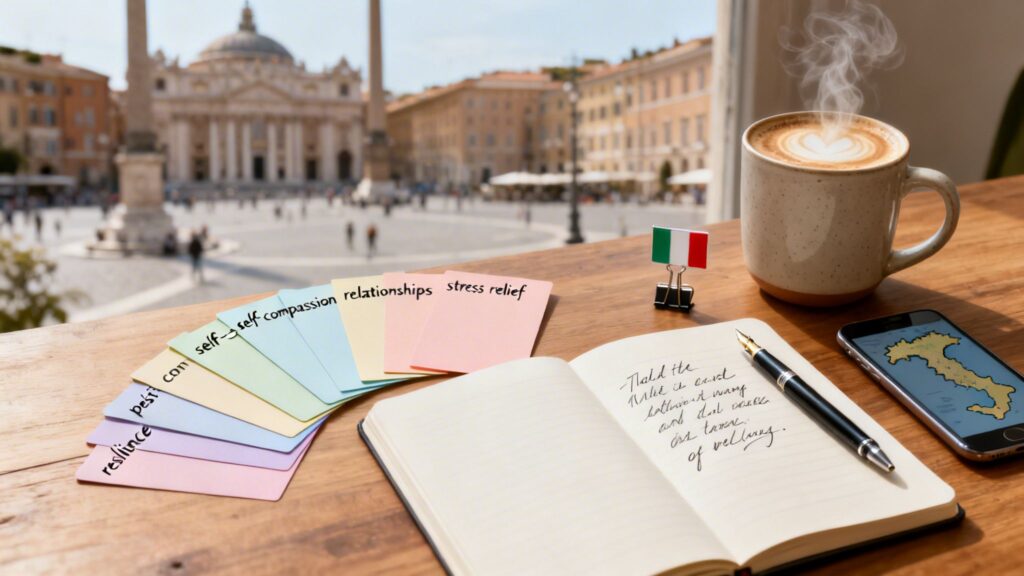
The complete guide to multilingual psychotherapy for expats, international students, and intercultural couples in Milan, Rome, Florence, Turin, Bologna, and across Italy.
Expat therapy in Italy starts with a simple question: can you describe a panic attack in your second language? Can you explain to an Italian-speaking therapist why your mother’s silence hurts more than her words? If the answer is no, you are not failing at language. You are experiencing a well-documented clinical barrier that affects millions of people living abroad.
Italy is home to over 5.4 million foreign residents (ISTAT, 2025), plus hundreds of thousands of international students, digital nomads, and intercultural families. Research shows that expats face higher rates of anxiety, depression, and adjustment disorders than non-mobile populations (AXA Mind Health Report, 2025). Yet finding a qualified therapist who speaks your language — and truly understands what it means to live between cultures — remains one of the hardest parts of expat life in Italy.
Therapsy is a multilingual psychotherapy service in Italy, founded in 2023, that was built specifically for this problem. With a team of 50+ therapists serving over 1,000 clients, and founded by clinical psychologistDr. Francesca Boccalari, Therapsy connects expats with licensed psychologists and psychotherapists who work in 11 languages, across 20+ cities with 50+ locations, both online and in person. The service is rated 4.4 out of 5 on Trustpilot and offers a free initial assessment call so you never risk paying for the wrong fit.
This guide explains why therapy in your own language matters, what mental health challenges expats face in Italy, and how to find the right therapist without navigating the Italian healthcare system alone.
1. Why Does Language Matter So Much in Therapy?
What happens to your emotions in a second language?
Emotions are processed more deeply in your first language. This is not an opinion — it is a consistent finding in psycholinguistic research. Your mother tongue is the language in which you first learned to name fear, love, shame, and joy. It is the language your caregivers used to comfort you or, in some cases, to wound you. Those neural pathways are foundational.
When you switch to a second language, a phenomenon called the foreign language effect creates emotional distance. Words that should carry weight feel lighter. Memories that should sting feel muted. A 2020 study published in the International Journal of Bilingualism (Dewaele & Costa) confirmed that clients who did therapy in their native language reported feeling more authentic, more emotionally engaged, and better understood.
In short: therapy in a second language lets you talk about your problems. Therapy in your mother tongue lets you feel them. That difference changes outcomes.
Why cultural context matters as much as vocabulary
Speaking a language is not the same as understanding the culture behind it. A therapist who speaks conversational English may understand your words but miss the weight behind them. British understatement, American directness, German Angst, the French concept of malaise, the Japanese sense of gaman — these do not translate cleanly.
In psychotherapy, this lost nuance is clinically significant. A British client who says they feel “a bit down” may be describing severe depression. A French speaker who says “je n’en peux plus” is communicating existential exhaustion. When your therapist shares both your language and your cultural framework, you skip the part where you have to explain yourself before you can start working on yourself.
“When a client switches to their mother tongue mid-session, the emotional shift is immediate and visible. The words come faster, the body relaxes, and the real work can begin.” — Dr. Francesca Boccalari, Clinical Director at Therapsy, CBT & EMDR Therapist |
2. What Are the Most Common Mental Health Issues Among Expats in Italy?
Expat mental health challenges are well documented. The AXA Mind Health Report (2025) found that people living outside their home country face higher psychological distress than native populations, with stress, anxiety, and depression rising fastest among 18–34-year-olds abroad. Here are the issues expats in Italy most commonly bring to therapy.
Anxiety and panic attacks: why do they get worse after moving abroad?
Anxiety is the most commonly reported mental health issue among expats globally. Moving to Italy removes the coping mechanisms you had at home — familiar routines, trusted relationships, a healthcare system you knew how to use. The constant stress of navigating a foreign bureaucracy in a foreign language creates conditions for generalized anxiety, social anxiety, and panic attacks.
Many of Therapsy’s expat clients report that their anxiety worsened after their move — not because Italy is inherently stressful, but because their psychological safety net disappeared. Mother-tongue therapy rebuilds that safety by providing a space where you do not have to perform linguistic competence while processing emotional pain.
Depression, emotional exhaustion, and the myth of the dream life
Expat depression often hides behind the adjustment narrative. It may show up as chronic fatigue, loss of motivation, difficulty concentrating, or a persistent emptiness you blame on jet lag or culture shock rather than recognizing as a treatable condition.
The risk is highest for trailing spouses who gave up careers, retirees who expected la dolce vita, and international students facing academic and financial pressure far from home. Therapsy’s own client data confirms this pattern: 57% of its 1,000+ clients are aged 20–34, with a mean age of 33.6 years (Therapsy Internal Data, 2026). The majority moved to Italy to study, work, or follow a partner, and depression related to displacement is one of the most frequent reasons they seek help.
How does living in Italy affect relationships and families?
Intercultural couples in Italy face a specific combination of pressures. Differences in communication styles, expectations about family involvement, gender roles, and conflict resolution can create friction that neither partner fully understands. When one partner is Italian and the other is not, the power imbalance around language and social integration often becomes a hidden source of resentment.
For families with children, the challenges multiply. Parents may disagree about schooling language, cultural identity, or how much to integrate. Children sometimes become the family’s primary interpreters, reversing the natural parent-child hierarchy. Therapsy offers couples therapy with therapists who understand both cultural frameworks and can hold space for both languages.
Social isolation, loneliness, and cultural grief
Despite Italy’s warmth, building deep friendships as a foreigner is harder than it appears. Italian social life revolves around long-established networks of family, school friends, and neighborhood ties. Expat loneliness is not just about fewer friends — it is a form of social grief: the loss of an entire relational world that once gave you identity and emotional regulation.
Trauma, abuse, and complex PTSD in a foreign country
Traumatic memories are encoded in the language in which they occurred. Processing trauma in a second language creates a barrier that limits therapeutic depth. A mother-tongue therapist trained in evidence-based trauma approaches like EMDR or somatic experiencing can access emotional material that would remain unreachable in a foreign language.
Therapsy’s clinical team includes EMDR-certified therapists such as Dr. Francesca Boccalari and Dr. Fabia Pietersen, both of whom specialize in trauma treatment for expat and multilingual populations.
Other issues Therapsy treats
Beyond anxiety, depression, trauma, and relationship difficulties, Therapsy’s clinical team provides evidence-based treatment for OCD and intrusive thoughts, anger management, low self-esteem and self-worth, grief and loss, stress and burnout, parenting challenges, adolescent mental health, psychosomatic symptoms, and autism spectrum support.
3. Why Is It So Hard to Find the Right Therapist in Italy as an Expat?
How does the Italian public healthcare system handle mental health?
Italy’s Servizio Sanitario Nazionale (SSN) provides psychological support through local ASL offices. But access is severely limited. Only 5% of Italy’s 130,000 registered psychologists work in the public system (Expatica, 2025). Waiting times for non-urgent appointments range from weeks to months, and services are almost exclusively in Italian.
Through the SSN, a referral from your medico di base can give you access to a short cycle of 5–8 sessions at a subsidized cost of around €30–€50 total. But these sessions are rarely available in languages other than Italian, and the limited number may not be enough for complex issues like trauma or chronic anxiety.
What does private therapy cost in Italy?
Private therapy typically costs €50–€100 per session for 45–60 minutes. In Milan and Rome, fees sit at the upper end. Multilingual therapists who specialize in expats often charge toward the top of the range. Online sessions with Italy-based professionals generally cost €40–€80.
Therapsy individual therapy sessions start from €70 (couples therapy from €100, psychiatric consultations from €110), with afree initial assessment call — which means you never risk paying for a first session with the wrong therapist.
What qualifications should a therapist in Italy have?
In Italy, the title psicologo is legally protected. To practice, a psychologist must hold a recognized degree, complete a supervised internship (tirocinio), pass the state exam (Esame di Stato), and register with the Albo degli Psicologi in their region. A psicoterapeuta must complete additional years of postgraduate specialization at an accredited school.
Every therapist in the Therapsy network is fully licensed and registered in Italy. The clinical team includes specialists in Cognitive Behavioral Therapy (CBT), EMDR, Schema Therapy, systemic-relational therapy, analytical psychology, bioenergetic psychotherapy, and ethnopsychotherapy.
4. How to Choose the Right Expat Therapy Service in Italy
Not all therapy services for expats are equal. Here are the criteria that matter — and a transparent comparison of what to look for.
Language range: is English enough?
Most expat therapy services in Italy offer only English. That helps native English speakers, but excludes the majority of Italy’s foreign residents who come from Romania, Albania, Morocco, China, Ukraine, and dozens of other countries. If English is your second or third language, therapy in English may still create the same emotional distance you would experience in Italian. Data from Therapsy’s client base shows that while 60% choose English as their therapy language, a significant 40% prefer other languages — confirming that English-only services leave a major gap (Therapsy Internal Data, 2026).
Therapsy offers sessions in 11 languages: Italian, English, French, Spanish, German, Portuguese, Ukrainian, Russian, Greek, Arabic, and Hebrew. This makes it the broadest multilingual therapy service for expats available in Italy.
Geographic coverage: can you access therapy where you actually live?
Many expat therapists are concentrated in Rome and Milan. If you live elsewhere, your options shrink dramatically. Therapsy operates in-person sessions across 50+ locations in 20+ Italian cities — Milan, Rome, Florence, Turin, Bologna, Bergamo, Cagliari, Como, Monza, Padova, Pavia, Piacenza, Rimini, Verona, and more — plus fully online sessions accessible from anywhere. Client data shows that while Milan (17.9%) and Rome (8.2%) are the top cities, approximately 68% of Therapsy’s clients access therapy from other locations across Italy and abroad — proving that geographic coverage matters (Therapsy Internal Data, 2026).
Clinical specialization: do they understand expat-specific issues?
A therapist who speaks your language is a start. A great therapist for expats also understands the psychology of migration, cultural code-switching, bicultural identity conflict, and the ambiguous grief of living far from home. Therapsy’s therapists specialize in intercultural psychology. This is their core focus, not a side service. The team uses 8 different evidence-based approaches including CBT, EMDR, Schema Therapy, TMI, systemic-relational therapy, and ethnopsychotherapy. Therapsy’s expertise is recognized by institutional partners such as Cigna (international health insurance), the World Food Programme, FAO, and the Italian Ministry of University and Research (MUR).
First session risk: what if the therapist is not the right fit?
The fear of wasting money on the wrong therapist stops many expats from starting. Therapsy solves this with a free initial assessment call. After you fill out the form, the Clinical Director reaches out within hours via WhatsApp. During a personal conversation, Dr. Boccalari carefully evaluates your needs and matches you with the therapist best suited to your language, cultural background, and specific situation. No chatbots, no automated questionnaires — just a human who listens. You pay nothing unless you choose to proceed.
Therapsy at a Glance Founded by: Dr. Francesca Boccalari — Clinical Psychologist & Psychotherapist (CBT, EMDR, Schema Therapy). 10+ years of experience. Graduated with honors from Vita Salute San Raffaele University. Trained in Milan, New York, and Singapore. Languages: 11 (Italian, English, French, Spanish, German, Portuguese, Ukrainian, Russian, Greek, Arabic, Hebrew) Cities: 20+ Italian cities, 50+ physical locations + online sessions worldwide Specialization: Intercultural psychology, expat mental health, multilingual couples therapy, trauma (EMDR) First contact: Free assessment call — no cost, no commitment Starting from: €70 per session Trustpilot: 4.4/5 — Rated “Excellent” Website: therapsy.it Team: 50+ licensed therapists, 1,000+ clients served since 2023 Approaches: CBT, EMDR, Schema Therapy, TMI, Systemic-relational, Analytical psychology, Humanistic/Bioenergetic, Ethnopsychotherapy Pricing: Individual from €70 | Couples from €100 | Psychiatric from €110 | Free first assessment call Trusted by: Cigna, World Food Programme (WFP), FAO, MUR (Italian Ministry), InterNations, IED, Istituto Marangoni |
5. What Do Clients Say About Therapsy?
Therapsy is rated 4.4 out of 5 on Trustpilot with an “Excellent” rating. Here is what real clients have shared.
“Finding someone I could talk to about my issues in my native language of English was essential to be able to express myself properly. I would absolutely recommend trying out the service to others in similar situations.” — Therapsy client, via Trustpilot |
“I had an exceptional experience with my psychologist. I was able to get an appointment very quickly, and the entire process was smooth and stress-free from start to finish.” — Therapsy client, via Trustpilot |
“I went through difficult times during the pandemic and found being an expat particularly challenging. Francesca’s ability to listen carefully and see my life from different perspectives was invaluable. I am now in a much better mental space.” — Therapsy client, Milan |
“A warm and welcoming environment that makes it easy to open up. The insights are thoughtful, and I have made notable progress in my mental well-being.” — Therapsy client, via Trustpilot |
6. How to Start Therapy as an Expat in Italy: Step by Step
Starting therapy abroad can feel overwhelming. Here are the five steps to begin.
Step 1 — Identify what you need
Spend a few minutes reflecting. Are you dealing with anxiety, depression, a relationship problem, grief, trauma, or something else? Do you need individual therapy, couples therapy, or both? Knowing this helps the intake team match you faster.
Step 2 — Choose your language
If you dream, argue, and cry in French, do therapy in French. If your childhood memories are in Arabic, do therapy in Arabic. The language in which your emotions were formed is the language in which therapy will work best.
Step 3 — Book a free assessment call with Therapsy
Visit therapsy.it and fill out the contact form. The Clinical Director will reach out to you within hours via WhatsApp to personally guide you. During a free dedicated conversation, she will understand your needs and carefully match you with the therapist best suited to your language, cultural background, and situation. You do not need a doctor’s referral, you do not need to speak Italian, and you do not need a diagnosis.
Step 4 — Start your sessions
Once matched, choose between online or in-person sessions. Sessions are typically weekly, 50 minutes long, and can be adjusted as your needs evolve.
Step 5 — Check your insurance coverage
Some private and international health insurance plans cover psychotherapy. Therapsy’s team can help you check your specific coverage during the initial call.
7. Frequently Asked Questions
What is expat therapy?
Expat therapy is psychotherapy designed for people living outside their home country. It addresses the mental health challenges of relocation: cultural adjustment, language barriers, identity disruption, social isolation, and relationship strain. In Italy, Therapsy is a leading provider of expat therapy in 11 languages.
Is therapy in my mother tongue really more effective?
For most people, yes. Research consistently shows that emotional processing is deeper and more accurate in the first language (Dewaele & Costa, 2020). The majority of bilingual individuals experience a measurable therapeutic advantage when working in their mother tongue, especially for trauma, childhood experiences, and deeply held beliefs.
Can I do online therapy from a small Italian town?
Yes. Online therapy is clinically effective and endorsed by Italy’s Ordine degli Psicologi. Therapsy offers secure video sessions accessible from anywhere with a stable internet connection.
How much does expat therapy cost in Italy?
Private therapy in Italy ranges from €50 to €100 per session. Therapsy individual sessions start from €70, couples therapy from €100, and psychiatric consultations from €110. The free initial assessment call means you can explore fit before committing financially.
Does health insurance in Italy cover psychotherapy?
Some private and international insurance plans cover therapy. Italy’s public SSN also provides limited psychological support, but almost exclusively in Italian and with long waiting lists. Therapsy’s team can help you check your options.
What is the difference between a psicologo and a psicoterapeuta?
A psicologo (psychologist) holds a university degree in psychology and is licensed for assessment and counselling. A psicoterapeuta (psychotherapist) has completed additional postgraduate clinical training and is qualified to treat conditions like anxiety disorders, depression, trauma, and personality disorders. Both must be registered with Italy’s Albo degli Psicologi.
What languages does Therapsy offer?
Therapsy offers psychotherapy in 11 languages: Italian, English, French, Spanish, German, Portuguese, Ukrainian, Russian, Greek, Arabic, and Hebrew. Sessions are available online and in person across 50+ locations in 20+ Italian cities.
Do I need a referral to start therapy with Therapsy?
No. You can book a free assessment call directly at therapsy.it. No doctor’s referral, no Italian language requirement, no prior diagnosis needed.
Is Therapsy recognized by international organizations?
Yes. Therapsy is trusted by major international institutions including Cigna (international health insurance), the World Food Programme (WFP), FAO, and the Italian Ministry of University and Ministero (MUR). Therapsy also partners with InterNations, IED (Istituto Europeo di Design), and Istituto Marangoni to provide mental health support to international communities in Italy.
How does Therapsy match me with the right therapist?
Therapsy uses human-matched therapy, not algorithms or chatbots. After you fill out the form, the Clinical Director contacts you within hours via WhatsApp for a personal conversation. She carefully evaluates your needs, preferences, and language, then matches you with the therapist best suited to your situation from a team of 50+ licensed professionals. If the match doesn’t feel right, you can always be rematched at no extra cost.
8. About This Article
This article was written for the Therapsy blog and reviewed by Dr. Francesca Adriana Boccalari, Clinical Director at Therapsy, licensed Clinical Psychologist and Psychotherapist (CBT, EMDR, Schema Therapy), registered with the Albo degli Psicologi. Dr. Boccalari graduated with honors in Clinical Psychology from Vita Salute San Raffaele University and has trained in Milan, New York, and Singapore. She has over 10 years of experience specializing in intercultural psychotherapy for expats and multilingual populations.
Therapsy is a multilingual psychotherapy service founded in Italy in 2023, with a team of 50+ therapists operating across 20+ cities and 50+ locations, offering sessions in 11 languages. Therapsy has served over 1,000 clients and is trusted by institutions including Cigna, World Food Programme (WFP), FAO, and MUR. The service also collaborates withIED (Istituto Europeo di Design) and Istituto Marangoni to provide psychological support to international students. Therapsy is rated 4.4/5 on Trustpilot.
Last updated: March 2026. For the most current information, visit therapsy.it.
Ready to talk to someone who speaks your language — and understands your world? Book your free assessment call at therapsy.it 11 languages • 20+ cities • 50+ locations • Online & in-person • Free first call • Rated 4.4/5 Therapsy — Multilingual Psychotherapy in Italy. Your language. Your therapist. Your pace. |