Meta Title: How to Deal with Social Anxiety in Italy for Expats and International Students
Meta Description: Learn how to deal with social anxiety as an expat in Italy with practical CBT-based strategies, exposure tools, and guidance on when to seek multilingual therapy.
Slug: how-to-deal-with-social-anxiety-expats-italy
Tags: social anxiety, expat mental health, therapy in Italy, CBT, international students, multilingual therapy, anxiety support, intercultural psychology
You arrive at the aperitivo already tense.
The terrace is full. People are talking fast. Someone smiles at you and asks a casual question in Italian that you only half catch. You start planning your answer, then second-guess the grammar, then notice how stiff your body feels, then decide it might be easier to look at your phone and wait for the evening to pass.
Many expats and international students know this feeling well. They want connection, but the social setting feels loaded. Every pause seems meaningful. Every word feels exposed. Even ordinary moments, ordering a drink, joining a group, introducing yourself to a colleague, can start to feel like tests you might fail.
If you're searching for how to deal with social anxiety, it helps to start with one reassuring truth. Social anxiety isn't just shyness. It's a pattern of fear centred on judgment, embarrassment, rejection, or doing something "wrong" in front of other people. In a new country, that fear often becomes sharper because language, culture, and belonging are all in the room with you.
This struggle is common. Social anxiety disorder affects approximately 1 in 10 teens and adults, the median age of onset is 13, and only about half of those affected seek help, often after years of silence, according to the American Psychiatric Association.
That gap matters. People often wait because they think they should "push through", become more confident on their own, or adapt with time. Sometimes time helps. Often, avoidance grows.
If you're living abroad, social anxiety can also hide behind adjustment language. You may tell yourself you're "still settling in" when you're avoiding the very experiences that would help you feel at home. That's one reason many people looking for mental health support for expats in Italy don't realise how much strain they've been carrying until their world has become smaller.
Introduction The Silent Struggle at the Aperitivo
It often looks manageable from the outside
Social anxiety is easy to miss because people can look composed while feeling overwhelmed.
They may still go to the event. They may smile, nod, and make it through dinner. Then they replay every sentence afterwards, criticise themselves for hours, and avoid the next invitation.
Social anxiety isn't defined by how sociable you look. It's defined by how much fear, avoidance, and self-monitoring shape your life.
For expats in Italy, the distress often shows up in familiar places:
- At university events when everyone seems to already know the social code.
- At work when speaking up in meetings feels riskier in a second language.
- In everyday errands when even brief exchanges feel exposing.
- In friendships and dating when fear of awkwardness leads to silence, delay, or withdrawal.
What helps
People usually want a quick fix. They want the right script, the right breathing trick, the right confidence hack.
Some short-term tools help, and you'll find them below. But lasting change usually comes from learning three things at once:
- How to calm the body enough to stay present
- How to challenge the thoughts that predict social disaster
- How to stop avoiding and start practising contact in gradual, structured ways
That's the practical heart of how to deal with social anxiety. Not becoming fearless. Becoming able to function, connect, and speak even when some anxiety is still there.
Why Social Anxiety Feels Different as an Expat in Italy

Moving abroad changes the meaning of ordinary social moments.
Back home, you usually know the rhythm of conversation, the expected level of warmth, how direct to be, when to interrupt, how to join a group, and what counts as polite distance. In Italy, even pleasant, lively social life can feel hard to read if you didn't grow up inside it.
The pressure isn't only social
An expat with social anxiety isn't just managing nerves. They're often managing interpretation.
A simple exchange can trigger several worries at once:
| Situation | What the mind may fear |
|---|---|
| Ordering at a bar | "I'll mispronounce something and hold everyone up." |
| Joining colleagues for lunch | "I'll miss the joke and look cold or strange." |
| Meeting locals through friends | "They'll think I'm boring because I can't express myself well." |
| Bureaucratic interactions | "If I ask again, I'll look incompetent." |
This is one reason the experience can feel more intense than social discomfort at home. The brain doesn't only ask, "Do they like me?" It also asks, "Do I understand the rules well enough to be safe here?"
Language barriers can amplify self-consciousness
When your language skills aren't fully automatic, your attention shifts inward.
Instead of listening freely, you monitor yourself. You search for words. You edit grammar. You predict misunderstandings. That internal load makes it harder to be spontaneous, and spontaneity is often what socially anxious people already fear they've "lost".
The more attention you place on monitoring yourself, the less attention you can place on the conversation.
That inward focus tends to increase physical symptoms too. You notice your face getting warm. You hear your own voice. You become aware of pauses that other people may not even register.
Cultural uncertainty can look like personal inadequacy
Many expats interpret a cultural mismatch as a personal flaw.
Maybe you're used to more reserved introductions. Maybe local conversation feels faster, more overlapping, or more expressive than what feels natural to you. That doesn't mean you're bad socially. It means your nervous system is working hard in an unfamiliar code.
Self-criticism fuels avoidance. If you keep telling yourself, "I'm awkward", you'll approach less, rehearse more, and withdraw sooner.
For many foreign residents, this strain is not minor. A 2023 ISTAT report found that foreign residents in Italy face heightened mental health risks, with 28% reporting anxiety disorders linked to social integration challenges, while only 15% access support, largely because of language mismatches, as summarised in this piece on social anxiety disorder treatments and tips for managing this challenging condition.
Social anxiety is not the same as introversion
This distinction matters.
- Introversion means you may prefer lower-stimulation settings or fewer social interactions.
- Adjustment stress means a move has temporarily stretched your coping resources.
- Social anxiety means fear of judgment starts controlling what you do, avoid, say, rehearse, or recover from.
An introverted person may leave a party because they're tired. A socially anxious person may leave because they feel exposed, ashamed, or convinced they made a bad impression.
If you've also been struggling with everyday adaptation, it can help to read more about cultural differences in Italy for expats. Sometimes understanding the context reduces the amount of blame you place on yourself.
In-the-Moment Strategies to Manage Acute Social Fear

When anxiety spikes in the middle of a social situation, your first job isn't to become calm. It's to become steady enough to stay.
That shift matters. If your goal is "I must stop feeling anxious", you'll usually get more anxious. If your goal is "I need to get through the next two minutes without fleeing", you give yourself something realistic.
Use a discreet body-based reset
Try one of these without leaving the room.
Box breathing
Breathe in gently, pause, breathe out, pause. Keep the rhythm even. The aim isn't dramatic relaxation. It's slowing the escalation.Ground your feet
Press both feet into the floor and notice the contact points. This gives the body a clear signal of orientation.Release hidden tension
Unclench your jaw, drop your shoulders, soften your hands. Many people don't realise they're bracing until they deliberately stop.
Shift attention outward
Social anxiety narrows attention onto the self. You start scanning for signs that you're blushing, sounding strange, or being judged.
Interrupt that loop with a simple sensory check:
- Five things you can see
- Four things you can feel
- Three things you can hear
- Two things you can smell
- One thing you can taste
This isn't magic. It's attentional training. You're teaching your brain that the room contains more than your fear.
Practical rule: Don't ask, "How anxious am I right now?" Ask, "What is happening around me right now?"
Give yourself a useful internal sentence
A good coping sentence is brief, believable, and non-dramatic.
Examples:
- "I'm anxious, not unsafe."
- "I don't need to perform. I only need to participate."
- "A pause in conversation is normal."
- "I can feel awkward and still stay."
That tone matters. Harsh coaching rarely helps. Calm, matter-of-fact language usually works better.
Pick one social action, not ten
When you're overwhelmed, don't aim to "be confident". Choose one concrete move.
For example:
| If you're at… | Try this one action |
|---|---|
| A work event | Ask one person one question |
| A university gathering | Stay for ten more minutes |
| A café or bar | Order without rehearsing the sentence repeatedly |
| A dinner | Speak once before the meal ends |
Small actions reduce the all-or-nothing trap.
If mindfulness techniques help you regulate, you might also find these resources on mindfulness useful for building a more stable daily practice outside high-stress moments.
Core Cognitive and Behavioural Exercises for Lasting Change
Lasting improvement usually begins when you stop treating anxious thoughts as facts.
People with social anxiety often know, intellectually, that they may be overthinking. But in the moment, the thought still lands like truth: "They think I'm dull." "My accent sounds ridiculous." "Everyone noticed I was nervous."
CBT works because it targets the cycle directly
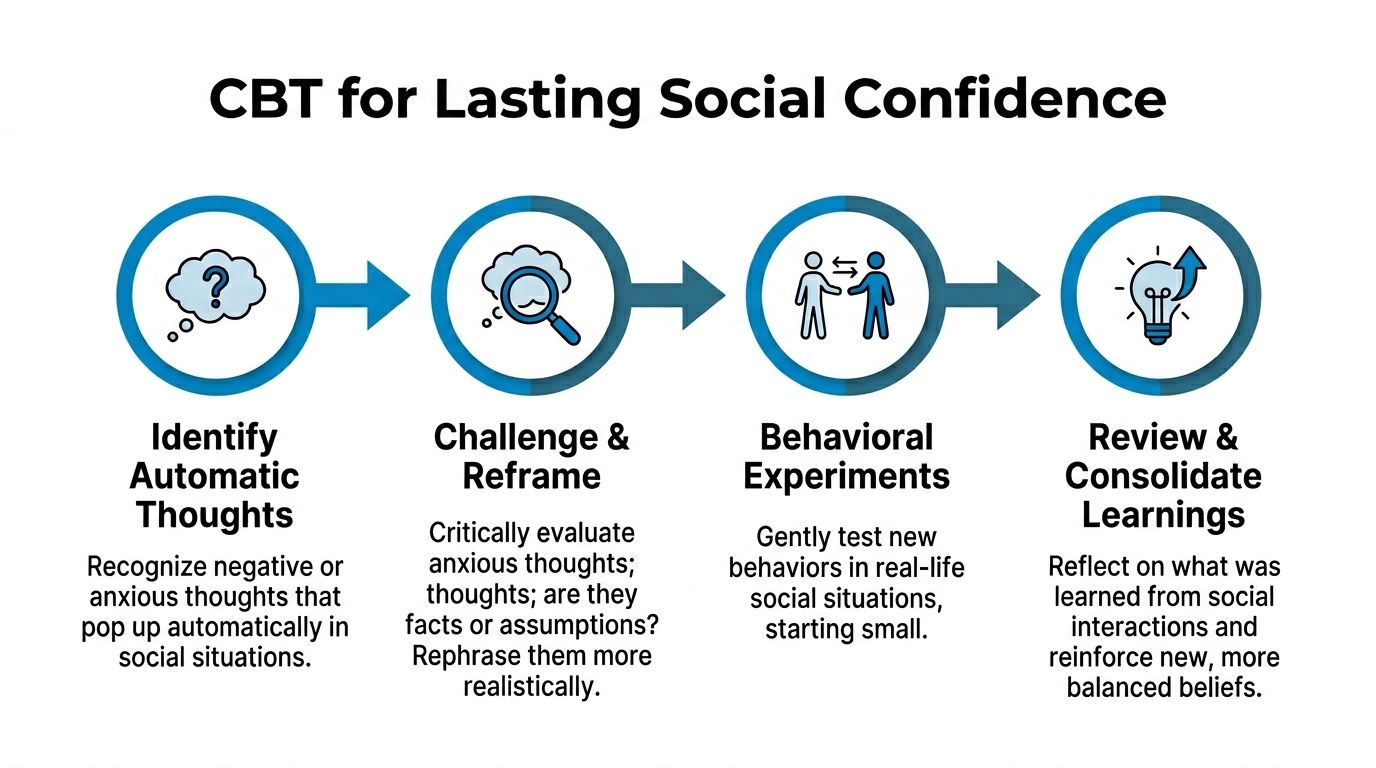
Cognitive Behavioural Therapy, or CBT, is the strongest evidence-based framework for social anxiety. A major meta-analysis covering 101 clinical trials found CBT to be the most effective treatment for social anxiety disorder, superior even to antidepressants, with 48% to 74% of patients showing reliable positive change and benefits that last after treatment ends, according to Time's summary of the research on CBT for social anxiety.
CBT is practical. It looks at the interaction between:
- Situation
- Thought
- Emotion
- Behaviour
A short example:
| Part of the cycle | Example |
|---|---|
| Situation | You join colleagues for coffee |
| Thought | "I'll say something awkward" |
| Emotion | Anxiety, dread, shame |
| Behaviour | You stay quiet, check your phone, leave early |
The problem isn't only the thought. The behaviour keeps the thought untested.
Become a thought detective
You don't need to argue with every anxious thought. You need to examine it.
Use a simple thought record after a difficult social moment.
Write the situation clearly
"I met two classmates before a seminar."Name the automatic thought
"They could tell I was nervous and found me strange."Rate the emotion in words
Anxiety, embarrassment, self-consciousness.List evidence that seems to support the thought
"I paused before answering."List evidence against it
"They kept talking to me." "One asked me a follow-up question." "No one reacted negatively."Write a more balanced alternative
"I was nervous, but that doesn't mean they judged me harshly."
Reframing isn't fake positivity
Many people resist this step because they think it means lying to themselves.
It doesn't. You're not replacing "Everyone hates me" with "Everyone loved me". You're moving from certainty to accuracy.
Most socially anxious predictions are not impossible. They're just treated as guaranteed.
A realistic reframe sounds like this:
- "Some people may notice I'm anxious. Most won't care much."
- "I may not sound perfect in Italian, but I can still communicate."
- "Not every awkward moment becomes a lasting impression."
Behavioural experiments matter more than reassurance
The mind changes fastest when experience contradicts the fear. That means testing predictions in real settings. If your fear says, "If I ask a question in class, everyone will think it's stupid", the useful next step isn't endless analysis. It's asking one genuine question and observing what happens.
Useful experiments include:
- Starting a brief conversation without rehearsing every line
- Making a small request in Italian
- Letting a pause happen instead of filling it urgently
- Sharing an opinion even if it isn't polished
If you like structured self-study, these anxiety learning resources can complement therapy work by helping you understand how anxious patterns operate.
For a deeper explanation of the therapeutic model itself, this guide to cognitive behavioral therapy is a helpful starting point.
Building Your Exposure Hierarchy for Social Confidence

If CBT gives you the map, exposure is the walking.
Avoidance teaches the brain that social situations are dangerous. Exposure teaches the brain that discomfort can be tolerated, and feared outcomes often don't unfold the way anxiety predicts.
Build a ladder, not a leap
The graded exposure approach is considered a gold standard in CBT for social anxiety, with response rates of 49.5% to 70% post-treatment, and success can exceed 70% when engagement is high and safety behaviours are reduced, according to this overview of therapy success rates for anxiety.
A good exposure hierarchy starts small enough that you'll do it.
Create a list of situations from least to most difficult. For an expat in Italy, a ladder might look like this:
| Step | Social task |
|---|---|
| 1 | Make eye contact and say hello to the barista |
| 2 | Order coffee in Italian without over-rehearsing |
| 3 | Ask one follow-up question during a class or work break |
| 4 | Stay at a social event longer than your usual escape point |
| 5 | Join a group conversation for a few minutes |
| 6 | Attend a language exchange and introduce yourself |
| 7 | Invite one person for coffee |
| 8 | Share an opinion in a meeting or seminar |
| 9 | Go alone to a local event and speak to someone new |
| 10 | Give a short presentation or speak in front of a group |
Stay in the situation long enough to learn
The aim isn't to white-knuckle your way through misery. The aim is to remain long enough for new information to register.
Before each exposure, write down:
- What you predict will happen
- What you fear others will think
- What you plan to do instead of avoiding
Afterwards, write what happened.
That review is where learning consolidates. Without it, many people complete the task but still tell themselves it "doesn't count".
Drop safety behaviours one by one
Safety behaviours are subtle manoeuvres used to prevent embarrassment. They reduce short-term fear, but they block long-term progress.
Common examples:
- Rehearsing every sentence repeatedly
- Checking your phone to avoid eye contact
- Speaking very fast to "get it over with"
- Leaving early before anxiety has a chance to settle
- Over-apologising for minor mistakes
If you use them, don't shame yourself. Just identify them.
Then choose one to reduce during a planned exposure. That gives your brain a fair test. You learn what happens when you participate more openly, not when you hide more efficiently.
Confidence usually grows after action, not before it.
When Self-Help Is Not Enough Seeking Professional Support
Self-help can take you far. It can help you understand the pattern, reduce panic in the moment, and begin practising new behaviours.
But there are clear signs that it may be time for professional support.
Signs you shouldn't ignore
Consider seeking therapy if any of these apply:
Your life is getting smaller
You avoid invitations, dating, work opportunities, presentations, or everyday tasks because the fear feels too costly.Your mood is dropping as well
Social anxiety often brings loneliness, hopelessness, or harsh self-criticism.You keep trying, but the same loop returns
You prepare, avoid, ruminate, recover, and repeat.Relationships are affected
You want closeness, but anxiety keeps blocking honesty, spontaneity, or repair after misunderstandings.
Why structured therapy can work better
A therapist doesn't just give advice. A good therapist helps you identify what is maintaining the anxiety.
Sometimes the issue is distorted prediction. Sometimes it's avoidance. Sometimes it's missed social skills practice. Sometimes it's all three.
For social anxiety, one valuable option is Social Effectiveness Therapy, or SET, which combines exposure with social skills training. In a landmark study, 67% of SET patients no longer met diagnostic criteria for social anxiety disorder after treatment, showing the benefit of combining skill-building with real-world exposure, according to the research published at PMC on Social Effectiveness Therapy.
That combination can matter for expats because some fears are anxiety-driven, while others involve genuine uncertainty about communication style, assertiveness, or conversational rhythm in a new culture.
Therapy is not a last resort
For many people, therapy becomes useful long before things look dramatic from the outside.
You don't have to wait until you're in crisis. You don't have to prove you're struggling "enough". If social fear is repeatedly interfering with work, studies, friendships, or your sense of freedom, that's enough.
If you're unsure whether your situation has reached that point, this short guide on do I need a psychologist can help you think it through more clearly.
Your Next Step How to Book Your Free Assessment in Italy
Reaching out can feel like another social test. It isn't.
A good first assessment should feel like a conversation that reduces uncertainty, not increases it. You don't need a perfect explanation of your problem. You only need to describe what has been hard lately.
What to do before you book
Take a few minutes to note:
- Which situations trigger the most fear
- What you avoid because of it
- Whether language or cultural mismatch makes it worse
- What kind of support would help you feel safer
That note doesn't need to be polished. It only needs to be honest.
If you've ever wondered whether social difficulties may overlap with something else, this guide on autism vs social anxiety may help you think more carefully about the differences. That's often useful when people have spent years mislabelling themselves.
What a good assessment should give you
By the end of an initial consultation, you should have more clarity on:
| Question | What you should leave knowing |
|---|---|
| What is happening? | Whether your pattern fits social anxiety, adjustment stress, or a related concern |
| What might help? | Whether CBT, exposure-based work, social skills work, couples support, or psychiatric input makes sense |
| Can I do this in my language? | Whether you can work in the language you express yourself best in |
| What happens next? | The practical next step, without pressure |
For expats and international students, that last point matters. The best therapy isn’t just clinically sound. It also fits the experience of living between cultures.
Small, steady action is what changes social anxiety. Reading helps. Insight helps. Practice helps more. The next useful step is often a human conversation with someone who understands both anxiety and the expat experience in Italy.
Therapsy offers multilingual, evidence-based psychotherapy for expats, international students, young adults, adults, and intercultural couples across Italy. You can speak with a licensed professional online or in person, and the process begins with a supportive conversation to understand your needs, preferences, and language. If social anxiety is making daily life smaller than it should be, you don’t have to work it out alone.