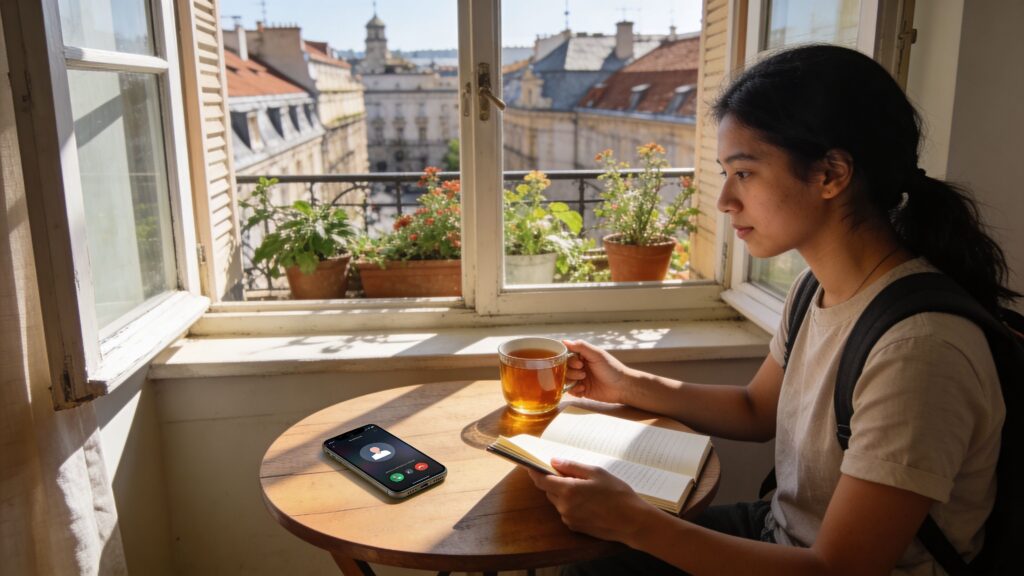
The first months in Italy can feel split in two. On one side, there’s the beauty people imagine before they move. Morning espresso at the bar. Sun on old stone buildings. A new language. A new identity. On the other, there’s the hidden strain. Paperwork you don’t fully understand. Friendships that stay pleasant but don’t become close. Calls home that leave you feeling more homesick, not less.
That mix often confuses people. They think, “My life looks good. Why do I feel so off?” The answer is simple. A meaningful move is still a stressor. Even a wanted change can overload your nervous system.
If you’ve been searching for how to improve mental health while living abroad, you probably don’t need vague encouragement. You need a practical plan that fits life in Italy. Not generic advice written for people who never had to explain their symptoms in a second language, decode local bureaucracy, or manage loneliness in a crowded city.
Many internationals also wait too long to ask for help. Only 20-30% of expats and international students in Italy seek professional support despite reporting 25% higher anxiety levels than nationals, according to a 2023 ISTAT survey (supporting reference). That gap matters because distress abroad often becomes easier to treat when addressed early, especially when care is culturally adapted and offered in your native language.
Mental health isn’t something you either have or don’t have. It’s something you maintain, rebuild, and strengthen through daily habits, evidence-based tools, and, when needed, skilled professional support. If you want a visual sense of what specialised support for internationals in Italy can look like, this overview of mental health services in Italy for expats captures that reality well.
Living abroad doesn’t just test coping skills. It tests identity, belonging, and emotional flexibility all at once.
Introduction Navigating Your Mental Wellbeing in Italy
The most useful way to think about mental wellbeing abroad is this. You don’t need to fix your whole life in one dramatic reset. You need to stabilise the basics first, then work on the patterns keeping you stuck.
That matters in Italy because the stressors are often layered. You may be dealing with one or more of these at the same time:
- Language fatigue from speaking, translating, and second-guessing yourself all day
- Social mismatch when local norms around friendship, dating, work, or family differ from what feels natural to you
- Administrative stress from visas, housing, university systems, tax codes, or healthcare navigation
- Identity strain when you no longer feel fully like your old self, but don’t yet feel settled in your new life
- Distance grief from missing ordinary moments back home, not just major events
Knowing how to improve mental health starts with recognising that these reactions are understandable. They’re not signs that you’re weak, ungrateful, or “bad at expat life”. They’re signs that your mind and body are trying to adapt to a demanding transition.
What helps
A workable mental health plan in Italy usually has three layers:
- Daily regulation
- Psychological tools
- Professional support when self-help stops being enough
People often skip the first layer because it looks too simple. Or they skip the second because they assume therapy techniques are only useful inside a therapy room. Both are mistakes.
Small habits regulate your baseline. Evidence-based tools help you interrupt spirals. Therapy helps when the pattern is deeper than a routine problem.
What usually doesn’t help
Some strategies feel productive but rarely solve the core issue:
- Waiting until you “adjust naturally”
- Using travel, food, or social plans to outrun anxiety
- Treating every bad day as proof you made the wrong move
- Trying to handle everything alone because your distress doesn’t seem serious enough
You don’t need a crisis to justify support. You need enough self-awareness to notice when your current strategy isn’t working.
Building Your Foundation Daily Habits for Mental Resilience
The strongest mental health plan is often built from ordinary actions repeated consistently. Not glamorous actions. Not perfectly optimised actions. Just stable ones.

Build rhythm before motivation
Many expats tell themselves they’ll feel better once they’re more settled. In practice, people usually settle faster once they create rhythm.
Start with anchors, not ambitious goals.
- Morning anchor. Wake at a reasonably consistent time, open the curtains, drink water, and step outside if possible.
- Midday anchor. Eat a real meal away from your laptop or study notes.
- Evening anchor. Slow the pace before bed instead of carrying the whole day into the night.
These anchors matter because an international move often disrupts internal predictability. New sounds, different meal times, less family contact, and changing work or study demands all make your nervous system feel less safe. Repetition tells the brain, “I know what happens next.”
Use Italian life instead of resisting it
One of the best ways to improve mental health in Italy is to borrow stabilising parts of local life.
The passeggiata is a good example. A walk in the early evening isn’t just charming. It lowers stimulation, creates transition between work and home, and gives your body movement without turning self-care into another performance task.
You don’t need to romanticise Italy to benefit from it. You just need to use what’s already there.
Try this:
- After work or classes. Take a short walk without headphones.
- At the café. Stay present for the whole drink instead of scrolling.
- During errands. Treat routine city walking as decompression, not dead time.
Practical rule: If your mind feels crowded, reduce intensity before you try to increase insight.
Don’t ignore sleep because your stress looks emotional
Many people ask how to improve mental health while overlooking the most basic amplifier of anxiety, irritability, and low mood. Poor sleep.
Sleep problems are common during international transitions. New noise levels, new flatmates, heat, travel, irregular work, and late social schedules can all throw off your rhythm. If your sleep has drifted, it helps to revisit the basics of understanding and practicing good sleep hygiene, especially if you’ve started treating exhaustion as normal.
A simple reset often includes:
- Light first, screens later. Get daylight early and reduce stimulating screen use before bed.
- One sleep window. Try to keep roughly the same sleep and wake times, even after a poor night.
- A wind-down cue. Reading, stretching, showering, or gentle music can signal that the day is ending.
- Less rescue behaviour. Long naps, doomscrolling in bed, and late caffeine often keep the cycle going.
Eat in a way that supports stability
Food doesn’t cure depression or anxiety, but unstable eating patterns can make both feel worse.
Expats often fall into one of two extremes. They either overcontrol food as a way to feel organised, or they lose structure altogether and eat reactively. Neither supports emotional resilience.
A steadier pattern looks like this:
| Situation | Common response | More helpful response |
|—|—|
| Busy study or work day | Skip meals, then overeat late | Eat something predictable earlier |
| Homesick evening | Order comfort food and isolate | Eat comfort food, but add contact or routine |
| Low-energy weekend | Graze all day | Choose two proper meals and one outside-the-home moment |
Italian food culture can help here. Regular meals, shared meals, and slower meals all support regulation if you let them.
Build connection on purpose
Loneliness abroad is rarely solved by being around more people. It’s solved by increasing meaningful contact.
That means moving beyond passive social exposure.
- Choose repeat settings. The same language exchange, gym class, library seat, or café can turn strangers into familiar faces.
- Lower the bar for contact. Not every interaction must become a friendship.
- Keep one tie from home active. Stable connection back home can support adjustment if it doesn’t become your only emotional world.
- Say yes selectively. Attend what aligns with your values, not every invitation that promises distraction.
A small but important distinction matters here. Social media gives updates. It rarely gives co-regulation. Your nervous system settles more through a real conversation, a shared walk, or a meal with one trustworthy person than through a hundred online impressions.
Journal for clarity, not perfection
Journalling works best when you stop treating it like a literary exercise.
Try these three prompts:
- What stressed me today
- What I needed but didn’t ask for
- What would make tomorrow feel 10% easier
That last question is powerful because it interrupts all-or-nothing thinking. You don’t need the perfect plan. You need the next helpful adjustment.
Evidence-Based Techniques You Can Start Using Today
The hard day often looks ordinary from the outside. You leave a government office in Italy after a conversation you only half understood, replay one sentence all afternoon, skip the errand you meant to do, and end the day convinced you are handling life abroad badly. That sequence is common among expats. It is also treatable.
Understand the thought feeling behaviour loop
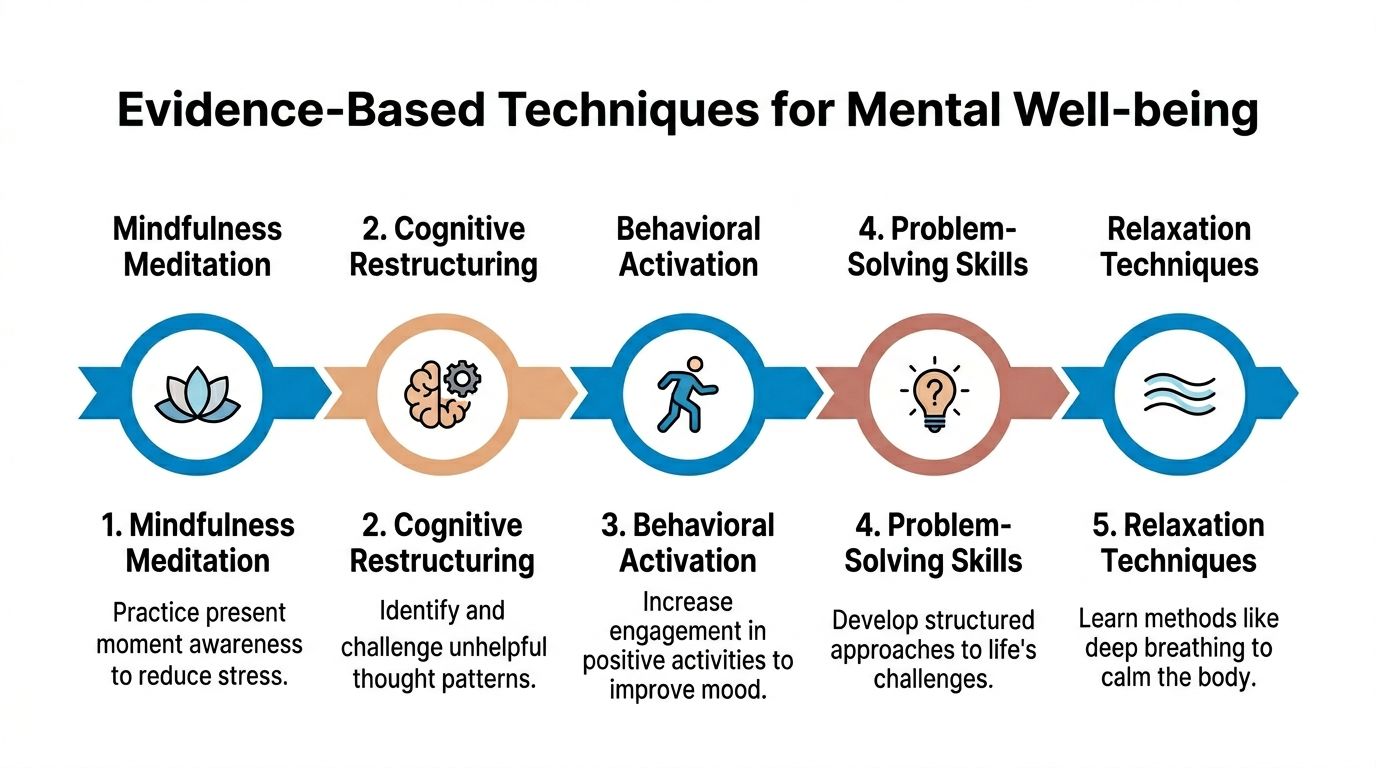
A core CBT principle is simple. Thoughts, feelings, and behaviours shape each other.
Take a familiar expat example. You have a difficult conversation in Italian at the pharmacy or the comune. Your mind lands on, “I sounded ridiculous.” Shame rises. Anxiety follows. Then you avoid speaking again that day, or you switch to silence and overprepare for every small interaction. The short-term relief feels useful, but your brain learns that speaking is risky.
That is how a temporary stress response turns into a repeating pattern.
Research consistently supports CBT for depression and anxiety, including in multicultural settings, as outlined by the American Psychological Association’s overview of cognitive behavioral therapy. In practice, I also see a second factor matter quickly for internationals in Italy. Therapy works better when the client does not have to translate their emotional life while trying to explain it.
Challenge thoughts with evidence, not forced positivity
Positive self-talk is often overrated, especially when your nervous system does not believe a word of it.
Use a more disciplined question. “What else could be true?”
If your mind says, “Everyone here thinks I’m awkward,” test it:
- What facts support that thought?
- What facts do not support it?
- Am I treating discomfort as proof of danger?
- What is a more accurate sentence than the one I’m using now?
A believable replacement helps more than an optimistic one.
| Automatic thought | More accurate alternative |
|---|---|
| “I’ll never fit in here.” | “I don’t feel settled yet.” |
| “If I make a mistake, people will judge me.” | “Some people may notice. Most will move on quickly.” |
| “I’m failing at this move.” | “This adjustment is harder than I expected.” |
That shift sounds small. It changes behaviour. People who move from catastrophic thoughts to accurate ones are more likely to keep practising the language, ask for help, and recover after awkward moments instead of building a whole identity around them.
Use behavioural activation to reverse withdrawal
Low mood shrinks daily life fast. Tasks pile up. Messages go unanswered. Pleasure disappears first, then structure, then confidence.
Behavioural activation interrupts that slide by focusing on action before motivation returns. This is one of the least glamorous and most effective tools I recommend. The trade-off is that it can feel mechanical at first. Many people living abroad want to feel better before they act. In reality, acting often has to come first.
Start with one concrete move:
- If you are shut down, shower and walk outside for ten minutes.
- If you are avoiding people, send one message and suggest one specific time to meet.
- If your flat feels unmanageable, clear one surface you can see from where you sit.
- If you have stopped doing meaningful things, schedule one valued activity for today, even if enjoyment is low.
Small actions restore traction. They also give useful feedback. If you cannot do even these steps for days at a time, that usually signals something more serious than “just stress.”
Use mindfulness to lower intensity, not to escape reality
Mindfulness helps with attention control and physiological settling. It does not remove grief, culture shock, or visa stress. Used well, it gives enough space to respond instead of react.
A large European trial on mindfulness training in schools and universities found mixed but meaningful benefits for emotional wellbeing, with outcomes depending heavily on how the intervention was delivered and to whom, as reported in Evidence-Based Mental Health (study summary). That fits real clinical work with internationals. Method matters. Fit matters. And language match matters.
One grounding exercise I give to expats before difficult appointments or after overwhelming social interactions is the 5-4-3-2-1 method:
- Name 5 things you can see.
- Name 4 things you can feel.
- Name 3 things you can hear.
- Name 2 things you can smell.
- Name 1 thing you can taste.
This does not solve the original problem. It lowers arousal enough for the thinking part of the brain to come back online.
For broader stress-management tools that work well alongside these practices, read How to Manage Stress: A Practical, Modern Guide.
If you are also trying to understand treatment options beyond self-help, this visual guide to EMDR and mental health approaches offers a useful reference point.
Separate emotional distress from practical problems
Expats in Italy often face two stressors at once. One is emotional. The other is administrative.
If you feel panicked about your permesso di soggiorno, housing contract, tax code, or university paperwork, part of that anxiety may come from uncertainty and part from the fact that there is a real task in front of you. Treating every problem as emotional overwhelm makes people feel helpless. Treating every problem as a simple task ignores the strain they are under.
Use a short sequence:
- Define the problem in one sentence
- List two or three possible responses
- Choose the next step
- Do that step before reviewing the whole situation again
“I’m overwhelmed about my visa” keeps the brain in alarm mode. “I need to email the office and ask which document is missing” creates a target.
Know when technique is no longer enough
Self-help tools work best when they reduce stress and help you return to function. If you understand the method but still cannot use it because anxiety, depression, trauma, or burnout keeps taking over, the problem is no longer a lack of discipline.
That is usually the point where guided support becomes the smarter option.
For internationals, the right support is not just any therapist with availability. It is someone who understands migration stress, identity strain, family distance, language fatigue, and the strange loneliness of managing daily life in a culture you may love but still not fully read. That is where Therapsy is different. Therapsy connects people in Italy with multilingual, culturally aware therapists who can work with the context of expat life, not a generic version of it.
When and How to Seek Professional Help in Italy
Recognising severe distress in others is often easier than recognising it in oneself.
They say it’s “just stress”. They say everyone feels like this after a move. They say they should wait until exams finish, until work calms down, until they improve their Italian, until they feel more certain.
That delay is common. It’s also costly.

Signs self-help may no longer be enough
You don’t need to hit a dramatic breaking point. Professional support becomes worth considering when your symptoms are persistent, repetitive, or increasingly disruptive.
Look at the pattern, not just today’s mood.
- Your distress keeps returning even when external stress briefly improves
- Work or studies are slipping because concentration, motivation, or emotional control are getting harder
- Relationships are changing because you’re withdrawing, snapping, over-reassuring, or feeling chronically misunderstood
- Your body is carrying the stress through sleep disruption, exhaustion, panic symptoms, appetite changes, or constant tension
- You feel stuck in the same loop and insight alone hasn’t changed it
A good guiding question is this: am I coping, or am I just enduring?
Common barriers for internationals in Italy
Expats and international students face specific obstacles that locals may not.
Language is the obvious one, but it’s not the only one. Many internationals also worry about whether a therapist will understand migration grief, identity confusion, intercultural family expectations, or the stress of navigating life without a familiar support system.
There’s also the practical uncertainty. People aren’t sure whether to use public or private care, whether online therapy is effective, whether they need a psychologist or psychiatrist, or whether their issue is “serious enough”.
This image on do I need a psychologist as a remote worker reflects a question many internationals ask in different forms.
If your mental effort goes mostly into appearing functional, you may already be past the point where support would help.
What therapy should feel like
Good therapy in an intercultural context should feel both clinically grounded and personally comprehensible.
That means your therapist should be able to:
| What you need | Why it matters |
|---|---|
| Language comfort | Emotional nuance is hard to access in a language that isn’t fully yours |
| Cultural awareness | Advice that ignores migration stress often misses the underlying problem |
| A clear method | You should understand the therapy's intended benefit |
| Practical continuity | Sessions need to fit travel, study, or work realities |
Therapy isn’t about being given generic encouragement. It should help you identify patterns, reduce symptoms, understand your emotional triggers, and make real-life change more likely.
How to seek help in Italy without overcomplicating it
If you think you may need support, keep the process simple:
- Identify the main issue. Anxiety, depression, burnout, relationship stress, trauma, or adjustment difficulty.
- Choose language first. If you can, seek support in the language where you can think and feel most freely.
- Decide on format. Online is often more consistent for people who travel, study intensively, or live outside major centres.
- Ask about clinical fit. If medication, trauma work, or complex mood symptoms may be involved, make sure the service can guide you appropriately.
The hardest step is often not therapy itself. It’s letting yourself move from “I should manage this alone” to “I’m allowed to get skilled support.”
Mental Health Strategies for Your Life in Italy
Life in Italy can look beautiful from the outside and still feel heavy in private. You finish aperitivo with colleagues, answer another email about missing documents, call home across time zones, and then wonder why your body is tense when nothing is technically “wrong.”
That pattern is common among internationals. Distress abroad often comes from an accumulation of small pressures. Language effort, unclear rules, social comparison, interrupted routines, and the strain of building a life without your usual support system.

A useful plan starts with one question. Where is the pressure coming from in your Italian life right now?
International students dealing with pressure and dislocation
Students often tell me they came to Italy expecting academic stress and were surprised by everything around it. Registering for exams, understanding informal university norms, building friendships in a second language, and missing home can drain attention before studying even begins.
Student distress abroad rarely shows up as a dramatic breakdown first. It often appears as procrastination, sleeping late, missing classes, obsessive revision, or pulling away from people. On the surface, it looks like poor discipline. Clinically, it often reflects overload.
Recent reporting on student wellbeing in Italy has highlighted high levels of anxiety among young adults, especially where uncertainty, performance pressure, and social disruption are involved. For internationals, acculturation stress adds another layer. The practical point is simple. If you are struggling, the problem may not be motivation. It may be adaptation strain.
What helps students most is usually structure with compassion, not stricter self-punishment.
- Split your stress into categories. Write down what belongs to study pressure, what belongs to bureaucracy or money, and what belongs to loneliness or emotional strain.
- Protect one repeating social anchor each week. A language exchange, shared lunch, sports class, or call with a trusted friend can steady the week.
- Treat perfectionism as avoidance when it delays action. Rewriting notes for hours may feel productive, but it often protects you from the discomfort of being evaluated.
- Watch homesickness carefully. Missing home does not mean the move was a mistake. It usually means you need familiarity, rest, or contact.
Students do better when they stop asking, “Why can’t I cope like everyone else?” and start asking, “What load am I carrying that other people cannot see?”
Expats and professionals facing burnout and uncertainty
Burnout abroad has its own texture. Work stress mixes with visa deadlines, freelance instability, housing pressure, family distance, and the constant effort of functioning well in a culture that may still feel half-familiar.
I often see one trade-off in expat life that goes unspoken. The same ambition that helped someone relocate and build a career can also make it hard to notice when they have crossed from dedication into depletion.
A short break helps tiredness. Burnout usually returns after the break because the underlying pattern is still there.
| If the issue is mostly tiredness | If the issue is burnout |
|---|---|
| A weekend restores some energy | Time off helps briefly, then the flatness returns |
| Sleep improves concentration | Sleep does not bring back interest or motivation |
| Stress is linked to a demanding period | Stress feels constant and personal |
| You still recognise yourself | You feel numb, cynical, detached, or irritable |
If the second column feels familiar, use a plan that addresses workload and identity, not rest alone.
- Count hidden labour. Translation, code-switching, explaining your background, chasing documents, and adapting to workplace norms all use energy.
- Schedule recovery before you feel you have earned it. If rest only happens after total exhaustion, recovery will stay inconsistent.
- Identify the fear under overwork. For many internationals, the driver is not passion. It is fear of losing income, status, belonging, or legal stability.
- Reduce coping habits that numb without restoring. Late-night scrolling, alcohol, and emotional eating can make the next day harder.
For many professionals, continuity matters as much as quality. Travel across cities, changing schedules, and heavy workloads can make in-person care hard to maintain. A clear overview of how online therapy can fit an expat routine can help you decide whether that format would support consistency.
This is one reason Therapsy works well for internationals in Italy. Support needs to fit real life, in the right language, with a clinician who understands migration stress rather than treating it as a side note.
Intercultural couples navigating two emotional systems
Couples under migration stress often argue about practical things. Paperwork. Holidays. Money. In-laws. Household roles. Which language to speak at dinner.
Those arguments matter, but they are often carrying a deeper conflict about fairness, safety, and whose reality gets treated as the default.
In intercultural relationships, one partner may be spending far more psychological energy than the other. They may be translating constantly, managing legal uncertainty, softening cultural misunderstandings, or living with the background stress of not fully belonging. If that asymmetry stays unnamed, resentment grows fast.
Useful couple strategies are usually concrete.
- Make cultural habits visible. Say what felt normal in your family, country, or community instead of assuming it should be obvious.
- Name asymmetry directly. One person may be carrying more of the language burden, social adaptation, or family diplomacy.
- Choose the language of emotional repair deliberately. The language that works for logistics may not be the one that allows vulnerability.
- Look below the repeated argument. If every conflict returns to dishes, lateness, money, or parents, ask what need is not being recognised.
Two people can care for each other and still misread each other if they learned different meanings of care, respect, and closeness.
That is why generic couple advice often falls short for internationals in Italy. The issue is not only communication skill. It is the meeting of two emotional cultures inside one shared life. Therapsy’s multilingual, culturally aware approach is designed for exactly that kind of complexity.
One question to ask yourself
Ask yourself this instead.
What part of my distress belongs to my current circumstances in Italy, and what part belongs to a pattern I keep repeating within those circumstances?
That question helps you avoid two dead ends. Blaming yourself for everything, or blaming the country for everything.
In practice, it is usually both. External pressure exposes internal patterns. Therapy works best when both are addressed together, with enough cultural understanding to tell the difference.
FAQ Your Questions About Therapy in Italy Answered
How can I find multilingual therapy in Italy
Start with the language you feel most emotionally fluent in. Many internationals can manage daily life in Italian but still struggle to talk about grief, panic, shame, trauma, or relationship pain with the same precision.
Look for a service that offers both online and in-person sessions, clear therapist matching, and clinicians who understand migration, identity shifts, and intercultural stress. That combination matters more than choosing the closest office.
If you’re also trying to understand the difference between forms of mental health care, this visual on psychologist vs psychiatrist in a medical office can help clarify the distinction.
How much does private therapy cost in Italy
Private therapy prices vary depending on the clinician, location, and format. The most helpful thing to look for is transparency. You should know the session price before you begin, understand whether online and in-person options differ, and know if psychiatric consultation is available when clinically appropriate.
For internationals, cost should be considered alongside fit. A cheaper service that leaves you struggling to express yourself may not be better value than a more suitable one.
What happens in a first assessment call
A good first assessment call shouldn’t feel like an exam.
It should help clarify what’s bringing you to therapy, what kind of support might fit, whether you’d feel more comfortable online or in person, and which therapist profile is likely to suit your needs. You don’t need to arrive with a perfect explanation. You only need enough willingness to describe what hasn’t been working.
If you’ve been hesitating because your situation feels “not bad enough”, remember this. Assessment is not a commitment to years of therapy. It’s a structured conversation to understand what kind of help, if any, makes sense now.
What if I need urgent help in Italy
If you’re in immediate danger, think you may act on suicidal thoughts, or feel unable to stay safe, don’t wait for a routine therapy appointment.
In Italy, call emergency services immediately or go to the nearest emergency department. If you’re with someone in crisis, stay with them where possible, reduce access to means of self-harm, and contact emergency support straight away. If your distress is urgent but not immediately life-threatening, contact a local doctor, out-of-hours medical service, or mental health service as soon as you can.
Therapy is important. Crisis care is different. In an emergency, prioritise safety first.
If you’ve been wondering how to improve mental health while living in Italy, you don’t need to solve everything alone. The right support can help you make sense of what you’re feeling, build steadier coping tools, and feel more at home in your life again. THERAPSY offers multilingual psychotherapy for expats, students, professionals, and intercultural couples, with online and in-person sessions across Italy, transparent pricing from €70 per session, and a free first assessment call to help you find the right fit. Book your first free assessment call.