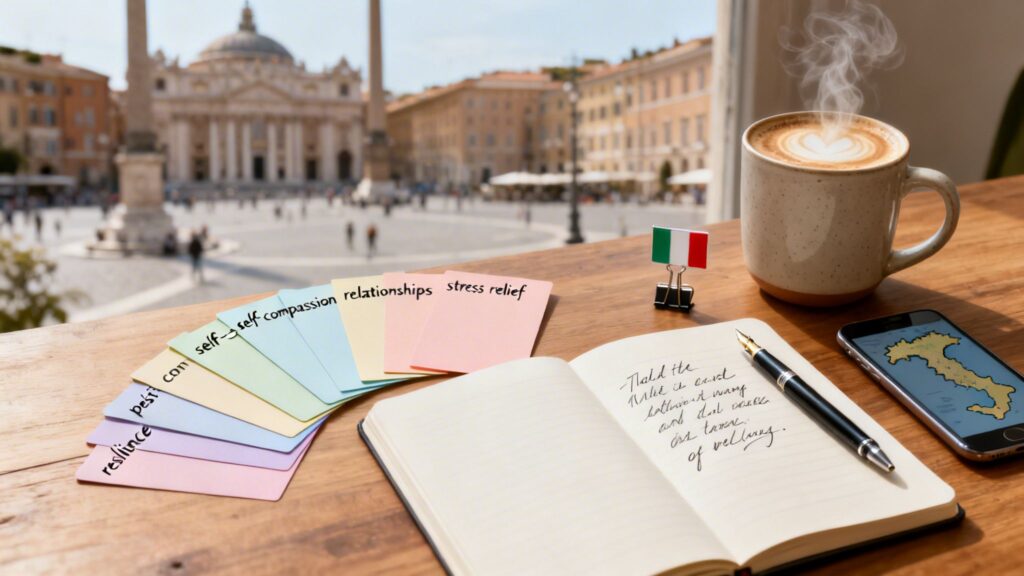
Living as an expat, international student, or young professional in Italy is an enriching experience, but it often comes with unique mental health challenges. The stress of cultural adaptation, feelings of loneliness, and moments of anxiety are common. In these times, words can be a powerful anchor, offering clarity and grounding. This collection of mental health quotes is structured as a practical toolkit to support your emotional well-being, especially within an intercultural context.
This article groups powerful phrases by themes relevant to the expat experience. You will find mental health quotes focused on:
- Navigating anxiety and depression while abroad.
- Building resilience and fostering hope during transitions.
- Practicing self-compassion and strengthening intercultural relationships.
Each quote is a touchstone for reflection, a prompt for journaling, or a caption that resonates with your experience. While these quotes offer immediate comfort, they are the start of a conversation. For deeper, personalized support, Therapsy’s multilingual therapists are here to help you translate these insights into lasting, meaningful change.
The Problem: Finding Relevant Support in a New Culture
Adjusting to life in a new country like Italy can trigger or amplify mental health challenges. Expats often struggle to find support that understands their specific context—the blend of personal struggles with the complexities of cultural shock, language barriers, and social isolation.
Psychological Insight: The Power of Validation
Words that accurately name an experience provide immense relief. For someone feeling overwhelmed, a quote that says "It's okay to not be okay" validates their struggle, reducing shame and self-blame. This psychological principle, known as "naming it to tame it," is the first step toward regaining control.
The Solution: Expert, Culturally-Sensitive Guidance
While quotes provide validation, lasting change comes from guided exploration. Therapsy provides access to licensed, multilingual therapists who specialize in supporting the international community in Italy. They help you move beyond the quote, offering strategies to manage your challenges and thrive in your new environment. The journey starts with a free, no-obligation assessment call.
Anxiety Management Quotes
When anxiety whispers doubts and fears, the right words can act as a powerful anchor. Anxiety management quotes are concise, memorable phrases designed to disrupt cycles of worry and panic. They function as cognitive tools, offering an immediate reframe when anxious thoughts take hold. For expatriates and young adults in Italy, who often face unique stressors like cultural adjustment, language barriers, and academic pressure, these quotes can be a vital first line of defence against overwhelming feelings.

These are not just feel-good platitudes; they are grounded in psychological principles. Phrases like “You are not your anxiety; you are the observer of it” draw directly from Acceptance and Commitment Therapy (ACT), encouraging a separation between self and feeling. This concept, known as cognitive defusion, helps you see anxious thoughts as temporary mental events rather than absolute truths. This selection of mental health quotes for anxiety is specifically curated to validate the experience while empowering you to reclaim your sense of control.
How to Use Anxiety Quotes Effectively
- In-the-Moment Support: Save your favourite quotes on your phone’s lock screen or as a note. In moments of rising panic or social anxiety, reading a phrase like, “This feeling is temporary,” can ground you in the present and reduce the intensity of the experience.
- Pair with Grounding Techniques: Combine a quote with a sensory exercise for maximum impact. As you repeat, “Anxiety is a visitor, not a resident,” engage in the 5-4-3-2-1 technique: name five things you see, four things you can touch, three things you hear, two things you smell, and one thing you can taste.
- Therapeutic Discussion Prompts: Bring a quote that resonates with you to your therapy session. It can serve as a powerful starting point to explore underlying fears and develop personalised coping strategies with your therapist.
- Journaling Catalyst: Use a quote as a writing prompt. For example, starting a journal entry with, “You have survived 100% of your worst days,” can help you process past challenges and recognise your own resilience.
Depression & Hopelessness Quotes
When grappling with depression, the world can feel drained of colour and possibility. Depression and hopelessness quotes serve as small points of light in the darkness, offering words that validate the profound weight of this experience. They are not meant to be a cure but a lifeline, providing recognition and a gentle nudge towards persistence. For expats and young adults in Italy, who may face heightened isolation or the stress of major life transitions, these phrases can be a critical tool for enduring moments of deep despair.
These carefully chosen mental health quotes are rooted in psychological understanding. A quote like Andrew Solomon's, “Depression is the inability to construct a future,” powerfully articulates the core feeling of hopelessness, making the person feel seen and understood. Other phrases, such as, "Depression is a liar," directly challenge the cognitive distortions that fuel worthlessness and despair. This collection is curated to acknowledge the reality of depression while providing a counter-narrative to its isolating and all-consuming nature.
How to Use Depression Quotes Effectively
- Integrate into a Safety Plan: Incorporate quotes that resonate into a personal crisis or safety plan. Having phrases like, “You are not alone in the darkness,” readily available can offer immediate comfort during a depressive episode.
- Pair with a Concrete Action: Use a quote to spur a small, manageable action. After reading, “Your brain is lying to you,” try to complete one simple task as an act of defiance, such as taking a short walk or reaching out to one friend. This links the cognitive shift to behavioural activation.
- Facilitate Communication: Share a quote with a trusted friend, family member, or therapist to help explain how you are feeling. It can act as a bridge when finding your own words feels impossible and helps others understand the support you need.
- Session Opening Prompts: Bring a quote to a therapy session to kickstart a conversation. Discussing why a particular phrase connected with you can help your therapist explore your current state of mind and tailor strategies for the session.
Self-Care & Wellness Quotes
In a culture that often glorifies constant productivity, self-care and wellness quotes serve as essential reminders to pause, rest, and prioritise personal needs. These phrases challenge the notion that self-care is a luxury, reframing it as a fundamental necessity for mental and emotional sustainability. For busy professionals, students facing academic pressure, or expatriates managing the stress of relocation in Italy, these quotes can dismantle the guilt associated with setting boundaries and taking time for oneself.

These are not just permissions to relax; they are declarations of self-worth grounded in psychological principles of burnout prevention and emotional regulation. Phrases like, “You cannot serve from an empty vessel,” directly address the unsustainability of constant giving without replenishment. This collection of mental health quotes about self-care is curated to normalise rest as a productive and rebellious act, empowering you to define wellness on your own terms.
How to Use Self-Care Quotes Effectively
- Boundary-Setting Affirmations: When you need to decline a request or protect your time, use a quote as an internal anchor. Silently repeating, “Taking care of yourself doesn't mean me first, it means me too,” can fortify your resolve to honour your limits without feeling selfish.
- Personalise Your Practice: Work with a therapist to explore what self-care truly means for you, considering cultural background and financial constraints. A quote like, “Rest is not a reward; it’s a requirement,” can start a conversation about building a personalised and realistic self-care plan.
- Combat Burnout Culture: Place a quote that resonates with you, such as one opposing "hustle culture," in your workspace. It acts as a visual cue to take scheduled breaks, step away from your desk, and resist the pressure of perpetual work.
- Journaling for Self-Discovery: Use a quote as a prompt to differentiate between genuine self-care and avoidance. A journal entry starting with, “What does my body need right now?” can help you identify whether you are truly resting or simply distracting yourself from a pressing issue.
Recovery & Resilience Quotes
The journey of recovery from trauma, loss, or mental illness is not about returning to a former self, but about growth and integration. Recovery and resilience quotes articulate this profound process, shifting the focus from simply “bouncing back” to post-traumatic growth. For young adults and expatriates in Italy facing major life transitions, relationship recovery, or identity reconstruction, these words offer a powerful framework for understanding and honouring their journey. They validate the difficulty of healing while celebrating the strength it builds.

These mental health quotes are far more than simple affirmations; they reflect deep psychological concepts popularised by experts like Bessel van der Kolk and Brené Brown. A phrase like, “Healing is not about going back to the way things were, but moving forward to create something new,” captures the essence of post-traumatic growth. The idea of “Recovery is an act of rebellion in a world designed to keep you broken” reframes the healing process as an act of empowerment. This selection is designed to honour your capacity to not only survive but to build a new, meaningful life from your experiences.
How to Use Recovery & Resilience Quotes Effectively
- Inflection Point Markers: In therapy, use a quote to mark a significant moment, like entering a new phase of recovery. Sharing a quote like, “Your resilience is not determined by your trauma, but by your capacity to befriend yourself through it,” with your therapist can open up conversations about self-compassion.
- Narrative Therapy Prompts: Combine these quotes with narrative therapy techniques. Use a quote as a starting point to write or discuss a new story of your life, one where you are the resilient protagonist of your own recovery journey.
- Acknowledge Past Strength: When facing a new challenge, reflect on a quote and recall a past situation you successfully navigated. This practice helps you access and recognise your own well-documented history of resilience, making current obstacles feel more manageable.
- Cultural Dialogue Starters: For expatriates, the concept of resilience can vary across cultures. Discussing a quote’s meaning with your therapist can be a valuable way to explore your cultural background and how it shapes your approach to overcoming adversity.
Mindfulness & Present-Moment Awareness Quotes
In a world that constantly pulls our attention towards the past or future, mindfulness quotes serve as gentle reminders to return to the here and now. These phrases champion present-moment awareness, acceptance, and a non-judgemental observation of our thoughts and feelings. For expats and students in Italy, whose minds might be preoccupied with visa paperwork, academic deadlines, or homesickness, these quotes offer a path back to the immediate richness of their current experience.
The wisdom in these mental health quotes is rooted in established therapeutic practices like Mindfulness-Based Stress Reduction (MBSR) and Acceptance and Commitment Therapy (ACT). A quote such as, "The mind is like water; when it is turbulent, it is difficult to see. When it is calm, everything becomes clear," provides a powerful metaphor for achieving clarity not by fighting our thoughts, but by allowing them to settle. This approach is fundamental for managing intrusive thoughts and difficult emotions without reactive behaviour, fostering a sense of inner peace amidst external chaos.
How to Use Mindfulness Quotes Effectively
- Anchor in the Present: Use a quote like Thich Nhat Hanh’s, “This moment is the only moment available to us, and it is the door to all moments,” as a cue. When you read it, deliberately engage your senses: notice the aroma of Italian coffee, the texture of a cobblestone street, or the sound of a nearby piazza.
- Start Small with Meditation: Pair a quote with a brief, 3-5 minute guided meditation. Before you begin, reflect on a phrase like, “Feelings are just visitors, let them come and go.” This sets an intention of non-attachment, making the practice more accessible.
- Trauma-Informed Adaptation: If traditional body-scan meditations feel overwhelming, adapt the practice. Use a quote to focus your awareness externally. For example, while reflecting on, "You cannot change what you are not aware of," you could mindfully observe the colours and shapes of objects in your room.
- Prompt for Relational Work: In couples therapy, a mindfulness quote can facilitate deeper connection. A couple could explore, “How can we be more present with each other, right now?” to shift from rehashing past arguments to focusing on their current shared experience.
Stigma-Reduction & Destigmatisation Quotes
Confronting the stigma that surrounds mental health is a crucial step toward healing. Stigma-reduction quotes are assertive, clear statements designed to challenge and dismantle harmful stereotypes about mental illness. They work by normalising the experience, validating it as a legitimate health concern, and reframing help-seeking as an act of courage. For Therapsy’s diverse international community in Italy, who may face intense cultural or familial pressure against discussing mental health, these quotes can be a source of validation and strength.
These phrases are far more than just slogans; they are condensed arguments rooted in advocacy and psychoeducation. A statement like, “Mental illness is not a personal failure; it is a health condition that requires and deserves treatment,” directly counters the pervasive myth that mental health struggles are a sign of weakness or a character flaw. This powerful reframe helps individuals internalise a more compassionate perspective, reducing self-blame and shame. This collection of mental health quotes for destigmatisation is selected to empower you to advocate for your own well-being and challenge outdated narratives.
How to Use Destigmatisation Quotes Effectively
- Normalise Your Experience: When feeling isolated by cultural stigma, repeat a quote like, “Your mental health is not a luxury; it is a necessity.” Use it as a personal mantra to reinforce the legitimacy of your needs and the importance of seeking care, regardless of external judgment.
- Facilitate Difficult Conversations: Sharing a quote with family or friends can open the door to a conversation. Sending a message like, “Seeking help is a sign of strength, not weakness,” can provide a framework for explaining your decision to start therapy, helping others to understand your perspective.
- Initial Therapy Discussions: Bring a quote that captures your feelings about stigma to your first assessment call. It can help your therapist understand the specific cultural or familial pressures you face, allowing for a more tailored and culturally sensitive approach to your care.
- Advocacy and Education: Use these quotes on social media or in personal blogs to educate others and contribute to a wider culture of acceptance. Pairing a quote with personal insights can create a powerful and relatable message that helps break down barriers for others in your community.
Therapist-Sourced & Evidence-Based Quotes
While many quotes offer comfort, those rooted in psychological theory provide a direct line to therapeutic principles. Therapist-sourced and evidence-based quotes are distilled wisdom from decades of clinical research and practice. They aren't just motivational; they are educational, offering a glimpse into frameworks like Cognitive Behavioural Therapy (CBT), Acceptance and Commitment Therapy (ACT), and humanistic psychology. For individuals engaged in therapy, these phrases reinforce concepts learned in sessions, solidifying their understanding and application.
These types of mental health quotes carry the weight of professional credibility. A phrase like, “Feelings are just visitors; let them come and go,” is a core tenet of acceptance-based therapies, teaching emotional regulation without suppression. Similarly, the humanistic principle from Carl Rogers, “The curious paradox is that when I accept myself just as I am, then I can change,” directly addresses the self-criticism that often stalls personal growth. Integrating these evidence-backed insights into your daily life can act as a powerful supplement to professional mental health support.
How to Use Evidence-Based Quotes Effectively
- Reinforce Therapeutic Concepts: If your therapist introduces a new idea, like cognitive defusion, find a quote that summarises it. Placing “You are not your thoughts” on a sticky note can serve as a constant reminder of the session’s key takeaway.
- Guide Self-Reflection: Use a quote from a specific therapeutic model as a lens for journaling. Reflecting on a psychodynamic idea about past influences or a CBT quote about cognitive distortions can lead to profound personal insights between sessions.
- Educate Yourself: When a quote from a figure like Dr. Bessel van der Kolk or Dr. Daniel Siegel resonates, use it as a starting point. Researching the underlying theory, such as interpersonal neurobiology, can deepen your understanding of your own mental processes.
- Prepare for Therapy: Bringing a specific evidence-based quote to your session can create a focused and productive conversation. It shows your therapist what concepts you are drawn to and helps them tailor their approach to what connects with you most.
Celebrity & Personal Story Quotes
When public figures share their mental health journeys, their words can resonate deeply, dismantling stigma and fostering a sense of shared humanity. Quotes from celebrities, athletes, and individuals with lived experience carry the power of personal disclosure and relatability. For young adults and expatriates in Italy, who are often influenced by global media and celebrity culture, hearing someone they admire speak openly about their struggles can make the idea of seeking help feel more accessible and less isolating.
These statements are more than just soundbites; they are acts of vulnerability that normalise conditions like depression and anxiety. Dwayne 'The Rock' Johnson's comment, “I take medication for my mental health the same way I take medication for my physical health,” directly challenges the shame often associated with psychiatric treatment by equating mental and physical well-being. This collection of mental health quotes from personal stories serves to validate struggles and inspire action, reminding you that even the most successful people face challenges and that recovery is possible.
How to Use Celebrity & Personal Story Quotes Effectively
- Conversation Starters: Use a quote as a gentle way to begin a conversation about mental health with friends, family, or a therapist. A phrase like Lady Gaga’s, “You don't have to struggle alone,” can open the door to discussing feelings of isolation and the importance of support systems.
- Journaling for Self-Acceptance: Reflect on a quote that challenges your perception of perfection. Writing about Brené Brown’s idea, “I am imperfect and I am enough,” can be a powerful exercise in practising self-compassion and accepting your whole self, flaws included.
- Destigmatising Help-Seeking: When the idea of therapy feels daunting, remembering that public figures like Michael Phelps or Oprah Winfrey have championed professional help can be encouraging. It reframes therapy not as a sign of weakness but as a proactive step towards strength and well-being.
- Social Media Advocacy: Sharing a verified quote from a public figure on your social media can contribute to a wider culture of openness. It can reach someone in your network who may be struggling silently, letting them know they are not alone in their experience.
Short-Form & Social Media Quotes
In the fast-paced, visually driven world of social media, concise and shareable quotes offer immediate moments of clarity and solidarity. Short-form mental health quotes are memorable phrases, often just a few words long, optimised for platforms like Instagram, TikTok, and Pinterest. For young adults and expatriates in Italy, who often use these platforms to stay connected and find community, these bite-sized affirmations can serve as a quick, accessible source of comfort and validation amidst daily stressors.
These are not superficial statements; they are distilled psychological truths designed for rapid consumption. A phrase like, “Your anxiety is lying to you,” acts as a swift cognitive challenge, while “Progress over perfection,” combats the all-or-nothing thinking common in burnout and academic pressure. This collection of mental health quotes for social media is designed to be easily shared, creating a ripple effect of support and normalising conversations about emotional well-being within online communities. They provide a vital, low-barrier entry point to mental health awareness.
How to Use Social Media Quotes Effectively
- Create a Digital Sanctuary: Save quotes that resonate with you to a dedicated album on your phone or a private Pinterest board. When you feel overwhelmed, scrolling through this personal collection can provide a quick dose of encouragement and shift your perspective.
- Share with Intention: When posting a quote, add a personal caption explaining why it’s meaningful to you. This adds context, fosters authentic connection, and can spark supportive dialogue in the comments, reminding you and others that you are not alone.
- Use as a Visual Reminder: Set a powerful quote like, “You are doing better than you think,” as your phone’s wallpaper or lock screen. This simple act turns your device into a source of gentle, consistent encouragement every time you look at it.
- Prompt for Community Dialogue: Engage with comments when you post a quote. Asking a simple question like, “How are you practising this today?” can turn a static post into a dynamic, supportive conversation, building a sense of community for yourself and your followers.
Relational & Couples-Centred Quotes
The quality of our closest bonds profoundly impacts our mental well-being. Relational and couples-centred quotes offer concise insights into the complexities of love, communication, and connection. For intercultural couples in Italy, these phrases can be especially powerful, providing a common language to discuss challenges like differing cultural expectations, distance from family, and the stress of life transitions. They serve as psychological anchors, helping partners reframe conflict and deepen their understanding of one another.
These are not simply romantic sayings; they are distillations of complex therapeutic concepts. Quotes from experts like Esther Perel and John Gottman can challenge our preconceived notions about relationships. A phrase such as, “Conflict is not a sign that love is failing; it is an opportunity for love to deepen,” reframes disagreements from a catastrophe into a chance for growth. This collection of mental health quotes for relationships is chosen to normalise challenges and inspire proactive, compassionate connection.
How to Use Relational Quotes Effectively
- Session Starters: Bring a quote to your couples therapy session. Using a phrase like, “Love is not about finding the perfect person; it is about seeing an imperfect person perfectly,” can open a safe dialogue about expectations and acceptance with your therapist’s guidance.
- Communication Aid: When words fail during a disagreement, share a quote that captures your feelings. It can de-escalate tension and shift the focus from blame to mutual understanding, creating a bridge back to constructive conversation.
- Shared Journaling: Choose a quote together and each write a private journal entry about what it means to you. Sharing your reflections can reveal deeper individual values and create new levels of intimacy and insight into each other’s perspectives.
- Goal-Setting Tool: Use quotes to establish shared relational goals. A quote about vulnerability from Brené Brown could inspire a mutual commitment to practise more open and honest communication, which can be a tangible objective in your therapeutic journey.
10-Category Mental Health Quotes Comparison
| Item | Implementation Complexity 🔄 | Resource Requirements ⚡ | Expected Outcomes 📊⭐ | Ideal Use Cases 💡 | Key Advantages ⭐ |
|---|---|---|---|---|---|
| Anxiety Management Quotes | Low — simple to deploy, requires sensitive wording | Low — text assets, app notifications, prints | Moderate — immediate coping, panic interruption; variable by person | Crisis reminders, panic management, CBT adjuncts | Highly relatable, quick grounding, reduces shame |
| Depression & Hopelessness Quotes | Medium — needs careful framing and safety planning | Low–Medium — paired with crisis resources and referrals | Moderate–High — validation and increased help-seeking; limited for severe cases | Session openers, crisis plans, outreach to isolated clients | Strong validation, encourages help-seeking |
| Self-Care & Wellness Quotes | Low — easy to create, requires cultural nuance | Low — lists, plans, low-cost resources | Moderate — promotes behavior change and burnout prevention | Burnout, prevention, treatment planning, homework | Actionable, normalizes rest, cross-cultural resonance |
| Recovery & Resilience Quotes | Medium — timing and context are important | Low — content library, milestone prompts | Moderate–High — fosters hope, normalizes non-linear progress | Recovery milestones, transitions, relapse prevention | Promotes growth perspective, supports long-term engagement |
| Mindfulness & Present-Moment Quotes | Medium — best with skills teaching and safeguards | Medium — guided recordings, practice supports | High — reduces rumination, improves emotion regulation with practice | Anxiety/depression, ACT/DBT integration, skills training | Evidence-based, teachable distress-tolerance skills |
| Stigma-Reduction & Destigmatization Quotes | Low–Medium — requires cultural tailoring | Low — educational materials, outreach campaigns | Moderate — lowers barriers and internalized shame | Intake materials, community outreach, multicultural clients | Increases help-seeking, builds community solidarity |
| Therapist-Sourced & Evidence-Based Quotes | Medium — needs curation and citation | Medium — sourcing, clinician review, translations | High — reinforces therapy concepts and credibility | Psychoeducation, treatment integration, branding | High clinical credibility, aligns with modalities |
| Celebrity & Personal Story Quotes | Low — easy to source but verify context | Low — social posts, testimonials, disclaimers | Moderate — inspires hope and reduces stigma; may lack nuance | Engagement with young adults, destigmatization campaigns, session starters | High relatability and media reach |
| Short-Form & Social Media Quotes | Low–Medium — design and moderation required | Medium — graphic design, scheduling, platform mgmt | High reach, low depth 📊 — awareness and reminders, limited nuance | Social strategy, mobile-first engagement, reminders | Highly shareable, drives engagement and traffic |
| Relational & Couples-Centered Quotes | Medium — needs sensitivity to dynamics | Low–Medium — handouts, session prompts, translations | Moderate–High — promotes empathy, repair, and communication | Couples therapy, relationship homework, cross-cultural couples | Facilitates vulnerable conversation, supports repair strategies |
From Words to Wellness: Your Next Step with Therapsy
We have explored a wide collection of mental health quotes, each a small vessel carrying a powerful message. From the raw honesty of celebrity stories to the concise wisdom of therapist-sourced insights, these words serve as anchors in the often-turbulent waters of our inner lives. We've seen how specific phrases can offer a lifeline during anxiety, provide hope amidst depression, and remind us of the importance of self-compassion.
The true value of these mental health quotes lies in their application. They are tools for introspection, prompts for journaling, and conversation starters that can help dismantle stigma. For expats, international students, and intercultural couples in Italy, these quotes can be especially poignant, articulating feelings of displacement, resilience, and the universal need for connection in a new cultural context.
Moving Beyond Inspiration to Integration
Inspiration is a powerful catalyst, but it is not a destination. A quote might illuminate a path, but walking it requires consistent effort and, often, expert guidance. The journey from recognizing a feeling in a quote to building lasting emotional wellness is where the real work begins.
This process involves several key steps:
- Active Reflection: Instead of passively consuming quotes, actively engage with them. Ask yourself: Why does this particular quote resonate with me right now? What specific situation in my life does it speak to?
- Intentional Application: Choose one quote a week and make it your focus. If it's about mindfulness, practise a one-minute breathing exercise when you feel overwhelmed. If it’s about self-compassion, consciously reframe a self-critical thought.
- Seeking Deeper Understanding: Words can point to a problem, but they don't always reveal its roots. Understanding the 'why' behind your anxiety, burnout, or relationship challenges is crucial for creating sustainable change. Exploring resources like our comprehensive mental health service playbook can deepen your understanding of support systems.
Your Dedicated Partner in Italy: Therapsy
For the international community in Italy, this journey can feel isolating. Navigating a new culture while dealing with personal challenges requires support that understands both your internal world and your external environment. This is precisely where Therapsy steps in. We are a dedicated support system built for you.
Our carefully selected, licensed professionals offer therapy in multiple languages, ensuring you can express your most complex thoughts and feelings without a language barrier. Whether you are a young adult managing academic pressure, a professional facing burnout, or a couple working through intercultural differences, our team is here to help. We bridge the gap between your life abroad and the highest standards of mental healthcare, offering a safe, confidential space for you to turn powerful words into meaningful, lasting wellness. These mental health quotes are a beautiful beginning. A conversation with a skilled, empathetic therapist is the next step.
Book your first free assessment call.