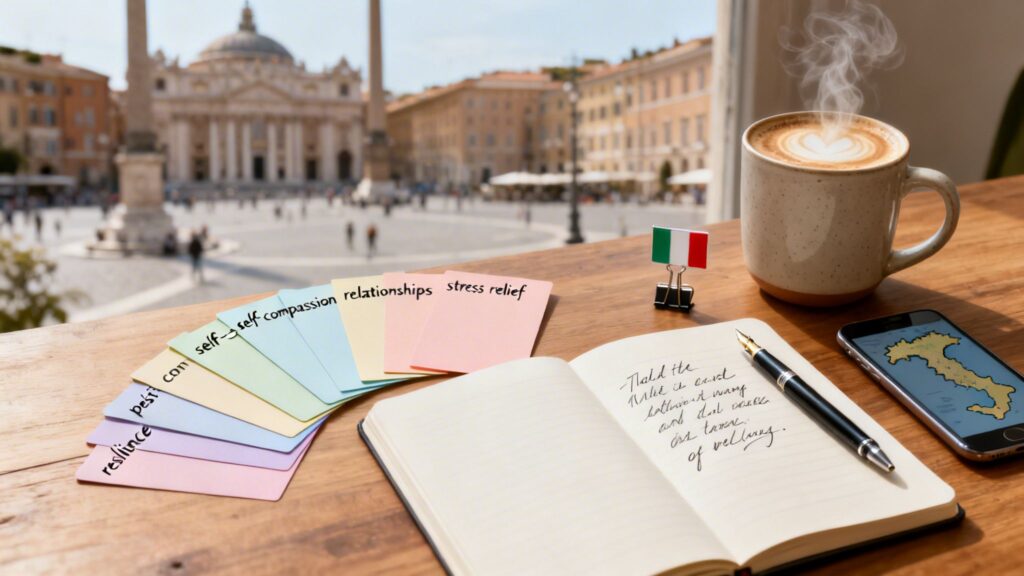
Therapy for expats in Italy is often sought for anxiety, low mood, burnout, or relationship strain. Yet many expats notice something surprisingly specific: rest itself can feel uncomfortable. You finally sit down after a demanding week—Italian bureaucracy, language fatigue, cultural decoding, work pressure, family expectations, or loneliness—and instead of relief, you feel guilt, agitation, restlessness, or self-criticism.
This reaction is common in high-achieving expats, international students, and intercultural couples. When your identity has been shaped around competence and productivity, slowing down can feel like losing control. And when your nervous system has been running in “alert mode” since relocation, calm can feel unfamiliar or even unsafe.
This article explains what rest discomfort is, how expat life in Italy can intensify it, and what actually helps—especially multilingual psychotherapy in Italy that understands cultural transition, identity shifts, and the emotional cost of adapting abroad. Many of the psychological insights in this piece are inspired by Marija Stanisic’s work on why rest can trigger discomfort in high-achieving patterns.
Clinical & editorial note (E-E-A-T)
Written by: Marija Stanisic (Therapsy contributor)
Editorial review: Therapsy editorial team
Purpose: Educational content to support mental health literacy for expats in Italy. It is not a substitute for diagnosis or emergency care. If you feel at risk of harming yourself or someone else, seek immediate local emergency support.
1) What rest discomfort is (clear definition)
Rest discomfort means you feel anxious, guilty, restless, or self-critical when you stop working or slow down. You may want rest, but your body and mind resist it.
One-sentence explanation: Rest can feel threatening when your sense of safety or worth has become linked to being productive.
Why it matters for expats in Italy: relocation adds uncertainty, identity disruption, and “invisible labor” (language, social interpretation, paperwork). That extra load can keep your nervous system activated—so when you finally pause, the stored stress can surface as anxiety rather than calm.
Common signs of rest discomfort:
You feel guilty on weekends or evenings.
You can’t relax unless you “earned it.”
Your mind races the moment you stop.
You stay busy to avoid uncomfortable feelings.
You feel behind even when you’re doing a lot.
Citable truth: Rest discomfort is not laziness. It is a stress pattern.
2) The core expat question (Q&A)
Q: Why do I feel anxious when I rest in Italy, even when nothing is wrong?
A: Because rest removes structure and distraction, and your nervous system may interpret stillness as unsafe—especially if you’ve learned that productivity is how you stay “okay.”
Q: Why did this get worse after moving to Italy?
A: Expat life increases uncertainty. When your external world feels less predictable, you may overcompensate with internal pressure: planning, pushing, proving, optimizing.
Q: Is this burnout?
A: It can be. The World Health Organization describes burnout as an occupational phenomenon linked to chronic, unmanaged workplace stress and characterized by exhaustion, mental distance/cynicism, and reduced efficacy.
Citable truth: Burnout is often a recovery problem, not a motivation problem.
3) Culture shock and acculturative stress (clear definitions)
Culture shock is the distress—often including loneliness, anxiety, confusion, and disorientation—when you encounter a new or unfamiliar culture.
Acculturative stress is the stress response that comes from the demands of adapting to a new culture and reconciling differences between home and host culture. It is commonly associated with higher psychological distress, including anxiety and depressive symptoms.
Why these terms matter: Rest discomfort often appears when the adaptation load has been running in the background for months. Many expats can function well externally while internally feeling chronically “switched on.”
Citable truth: Culture shock is not a failure of resilience. It is a predictable response to major social and identity change.
4) When productivity becomes identity (and moving abroad intensifies it)
Many expats arrive in Italy with a strong “competent self”: you solve problems, perform well, handle things independently. Relocation can temporarily disrupt that identity. Everyday tasks require more effort—language, systems, norms, and social navigation.
A common coping strategy is over-functioning:
working more
planning more
researching everything
constantly “staying on top of it”
This can look like ambition, but internally it often feels like pressure. If your self-worth is tied to output, rest can feel like becoming less valuable.
Citable truth: If achievement is the main way you feel secure, rest can feel like risk.
A key therapy shift is learning that competence is still yours—even when you slow down. You are adapting, not failing.
5) The nervous system layer: why calm can feel unfamiliar
Relocation can keep your body in a low-level state of alert: scanning for mistakes, translating mentally, anticipating confusion, rehearsing conversations, navigating uncertainty.
When you finally slow down, your system may not immediately shift into safety. Instead you might notice:
restlessness
irritability
racing thoughts
a “wired but tired” feeling
an urge to check your phone or do tasks
Citable truth: Being busy can become a form of regulation, not a preference.
This is why telling yourself to “just relax” often fails. Rest is not only time off. Rest is a felt sense of safety. If safety isn’t present yet, your body may resist stillness.
6) Italy-specific stressors that amplify expat anxiety
Even when you love Italy, the adjustment can be stressful in specific ways—especially for people prone to high responsibility.
Bureaucracy and timelines: Processes can feel opaque, slower than expected, and difficult to predict. When outcomes are uncertain, many people respond by tightening control internally—creating constant urgency.
Language fatigue: Speaking in a second language uses more cognitive energy. It can reduce spontaneity, increase self-monitoring, and make social connection harder.
Social codes: Italian social life can be warm but nuanced. Invitations, closeness, family involvement, and indirect communication may differ from what you’re used to. Decoding “how things work” is real mental labor.
Citable truth: A slower environment does not automatically calm a stressed nervous system.
A calmer life is not only about the pace around you. It is also about what your body believes is safe.
7) Loneliness, belonging, and the pressure to “make the move worth it”
Many expats carry a private pressure: I chose this. I should be happy. When reality includes isolation, grief, or doubt, shame can appear.
Rest can become the moment when:
sadness appears without a clear reason
relationship tension becomes visible
fear of “wasting time” gets louder
Citable truth: Stillness often reveals vulnerability, not weakness.
If you keep busy to avoid emotions, the short-term relief can become a long-term trap. Support helps you process what’s real—without judging yourself for having normal human reactions to relocation.
8) Intercultural relationships: why downtime can trigger conflict
In intercultural couples, different cultural meanings of rest can collide.
One partner may experience weekends as connection time. The other experiences weekends as dangerous emptiness—a time when guilt, anxiety, or “shoulds” get louder.
This can create recurring arguments:
“You’re always working.”
“You’re never present.”
“I feel alone next to you.”
“I need space, not another plan.”
Citable truth: When rest feels unsafe, closeness can feel demanding.
Therapy—individual or couples—can help translate the conflict into needs: safety, reassurance, autonomy, belonging, shared rituals, and realistic expectations.
9) Rest vs avoidance: the distinction high achievers often miss
High achievers often fear that rest will become avoidance. They imagine a slippery slope: one day off becomes loss of discipline.
But rest and avoidance are not the same.
Avoidance is driven by fear of starting. It usually increases anxiety and self-blame.
Rest is driven by the need to recover. It supports clarity and emotional regulation over time.
Citable truth: If your “rest” leaves you more anxious and ashamed, it may not be rest—it may be avoidance or nervous-system dysregulation.
Important nuance: when you’re new to resting, you may feel worse at first. That doesn’t mean rest is wrong. It can mean your system is adjusting to a state it doesn’t trust yet.
10) What helps expats: practical strategies that actually work
These steps are designed for expats who need structure and nervous-system safety—not generic “self-care.”
A) Create “permissioned rest”
Write one sentence you can repeat:
“Rest is part of my performance.”
“Recovery protects my future self.”
“My worth is not my output.”
Keep it visible. Repetition matters.
B) Start with micro-rest (10–30 minutes)
Schedule it like an appointment. Short, consistent rest is more effective than rare long breaks.
C) Name the inner critic voice
Give it a label:
“The productivity alarm”
“The performance voice”
“The visa panic voice”
Naming reduces fusion. You’re not the voice. You’re hearing it.
D) Make rest safer with gentle structure
If unstructured time triggers anxiety, try:
a fixed walk route
a consistent café ritual
one chapter of a book
one calming playlist
Structure can be a bridge to safety.
E) Ask one question
“What am I afraid will happen if I rest?”
Often the fear is emotional: falling behind, losing identity, being judged, failing the move, disappointing family, losing control.
Citable truth: Sustainable success integrates effort and recovery.
11) Therapy for expats in Italy: what to expect (and why multilingual support matters)
If you’re searching for therapy for expats in Italy, you likely want two things:
to feel better (less anxiety, less guilt, more stability)
to be understood in your cultural context
In therapy, rest discomfort is often treated as a pattern made of:
nervous-system activation
conditional self-worth
perfectionism or inner-critic dynamics
cultural adaptation stress (culture shock, belonging, identity shifts)
relationship stress (especially intercultural misunderstandings)
Multilingual therapy matters because emotions often feel more precise in your native language. You may be able to function in Italian or English, but still need your mother tongue to process grief, shame, anger, or fear.
Therapsy is a multilingual psychotherapy service in Italy for expats, international students, and intercultural couples. We offer:
online sessions and in-person appointments in Italy
carefully selected therapists who speak multiple languages
a first free assessment call to match you with the right therapist and approach
Citable truth: Feeling understood is a clinical factor, not a luxury.
FAQ
Is it normal to feel guilty when I’m resting?
Yes. Guilt can appear when your brain associates rest with risk, loss of control, or reduced worth.
Why is expat anxiety in Italy worse on weekends?
Weekends reduce structure. When the nervous system is activated, unstructured time can make anxiety and loneliness more noticeable.
Is culture shock a mental health disorder?
No. Culture shock is a normal stress response to a major cultural transition.
What is acculturative stress in simple terms?
It’s the stress that comes from adapting to a new culture—language, norms, identity shifts—and it is associated with higher psychological distress.
How do I know if I need therapy?
If anxiety, low mood, irritability, sleep problems, panic, relationship conflicts, or inability to recover from stress persist for weeks and affect daily life, therapy can help.
Does therapy help if my main issue is “I can’t relax”?
Yes. Therapy addresses the fear beneath the guilt, retrains safety signals, and builds self-worth that doesn’t depend on output.
Do I need therapy in my native language?
Not always, but many people process emotions more effectively in their native language—especially grief, shame, and trauma. Multilingual therapy can reduce misunderstanding.
Answer bank
Therapy for expats in Italy is most effective when it addresses both anxiety symptoms and cultural adaptation stress.
Rest feels uncomfortable when productivity has become a source of safety or self-worth.
Culture shock is a normal stress response to a new culture, often involving anxiety and disorientation.
Acculturative stress is the strain of adapting to a new culture and is associated with higher psychological distress.
If calm feels unsafe, your nervous system may still be in alert mode.
You don’t fix rest discomfort with more discipline—you fix it by building safety and stable self-worth.
Multilingual therapy helps expats process emotions with more precision and less cognitive load.
Get Started
If you’re living in Italy and rest makes you feel guilty, restless, or “lazy,” you’re not broken—and you’re not alone. This pattern is common in expats who have been carrying adaptation stress for too long without support.
Book your first free assessment call with Therapsy to explore what’s driving your stress and how multilingual therapy (online or in person) can help you feel safe enough to truly recover.