When you hear "ADHD," you might still picture a hyperactive child who can't sit still in class. That's a persistent, but incomplete, image. The reality is that Attention-Deficit/Hyperactivity Disorder (ADHD) is a lifelong neurodevelopmental condition, and for many adults, it’s a hidden struggle that goes undiagnosed for years.
If you’re an expat living in Italy, you might chalk up your challenges to stress or the chaos of adapting to a new culture. But if you constantly feel like you're working twice as hard to achieve half as much, it might be more than that. Many adults with ADHD find their symptoms are mistaken for personality traits—like being "lazy," "disorganised," or "too sensitive"—when in reality, they're navigating differences in how their brain is wired.
At Therapsy, we specialize in helping expats and young professionals in Italy navigate the unique intersection of ADHD and intercultural life. Our multilingual, licensed therapists provide the clarity and strategies needed to thrive.
What Is Adult ADHD and How Does It Feel?

Living with adult ADHD often feels like trying to conduct an orchestra where every musician is playing a different tune. You’re the conductor—full of brilliant ideas and a desire to create something beautiful—but you’re constantly distracted by a cough from the audience, a musician tuning their instrument, or a sudden thought about what you’ll eat after the show. The result? A performance that feels chaotic and out of sync, no matter how hard you try to bring it all together.
This internal disorganisation creates a cascade of real-world frustrations. It's the missed appuntamento for your permesso di soggiorno, the lost folder with critical documents, or the struggle to follow a fast-paced conversation in Italian—not because you don't care, but because your focus has already jumped to three other things.
At its heart, this is the core struggle for many adults with ADHD: a painful gap between what you know you're capable of and what your brain’s executive functions will allow you to consistently do.
Understanding the Three Presentations of ADHD
ADHD isn’t a one-size-fits-all diagnosis. It shows up differently from person to person, and how it looked in childhood can be very different from how it manifests in adulthood. Recognising which pattern fits you best isn’t about applying a label; it’s about gaining the clarity to understand why certain things are so hard.
These aren't character flaws—they're recognised patterns of a neurodevelopmental condition. The three primary presentations are:
Predominantly Inattentive Presentation: This is the classic "daydreamer." You might have a rich internal world but struggle immensely with the mundane. Following detailed instructions feels impossible, and organising tasks is a monumental effort. In meetings or lectures, your mind just drifts away, no matter how much you want to pay attention.
Predominately Hyperactive-Impulsive Presentation: In adults, this is less about running and jumping and more about a relentless internal restlessness. You might fidget constantly, talk over others without meaning to, or make impulsive decisions—like booking a last-minute trip to Sicily—without thinking through the consequences. There's a constant feeling of being "on the go."
Combined Presentation: This is a mix of both worlds. You meet the criteria for both inattentive and hyperactive-impulsive symptoms. Your life might feel like a blend of chronic disorganisation, forgetfulness, internal restlessness, and impulsivity.
The table below breaks down what these presentations can look like for an adult, particularly an expat navigating life in Italy.
Three Presentations of ADHD in Adults
| ADHD Presentation | Common Adult Symptoms | Example Scenario for an Expat |
|---|---|---|
| Predominantly Inattentive | Difficulty sustaining focus, poor organisation, forgetful in daily tasks, loses things frequently, easily distracted by external stimuli. | A student in Florence repeatedly misses deadlines for their art history papers, not from lack of interest, but because they get lost in research rabbit holes and can’t structure their thoughts. |
| Predominantly Hyperactive-Impulsive | Internal restlessness, fidgeting, talking excessively, interrupting others, difficulty waiting their turn, making hasty decisions without full consideration. | An expat in Milan impulsively quits their job during a stressful week without a backup plan, driven by an overwhelming feeling of needing to escape the pressure right now. |
| Combined | A mixture of symptoms from both inattentive and hyperactive-impulsive presentations. Experiences both a “foggy,” distractible mind and a feeling of being physically or mentally restless. | A professional in Turin struggles to follow a team meeting (inattentive), constantly interrupts their colleagues (impulsive), and taps their foot under the table the entire time (hyperactive). |
Seeing your own experiences reflected in these descriptions can be a profound relief. It’s the first step toward understanding that you’re not alone and that these challenges have a name.
Key Insight: The challenges of ADHD are not a reflection of your intelligence or your effort. They are the direct result of differences in brain structure and chemistry that affect your executive functions—the very skills needed to plan, focus, and manage your actions.
This condition is far more common than most people think. It’s estimated that adult ADHD affects about 2.8% of Italy’s general population, and this figure is likely an underestimate due to a lack of awareness and diagnosis. That means thousands of adults, including many expats, are grappling with these challenges every day. Research also consistently shows that ADHD often co-occurs with other conditions like anxiety, depression, and substance use issues, which makes getting a clear and accurate diagnosis even more vital. You can explore the findings on ADHD prevalence and comorbidities in Italy for a deeper look at the data.
The path forward begins with seeking professional, culturally sensitive support. A specialist can help you untangle your symptoms and understand how they manifest within the specific context of living abroad. At Therapsy, our multilingual therapists are experts in helping members of the international community in Italy navigate these exact challenges, providing clarity and effective strategies for a more balanced life.
The Unique Challenges Of ADHD For Expats In Italy

The idea of moving to Italy—sun-drenched piazzas, art at every turn—is a beautiful dream. But for an adult with Attention-Deficit/Hyperactivity Disorder (ADHD), that dream can quickly shift into a profoundly overwhelming reality. The novelty and excitement that draw people here put an enormous tax on the brain’s executive functions, the very areas where ADHD already creates significant hurdles.
For many expats with ADHD, the core problem is a constant, draining feeling of being swamped. Seemingly simple tasks become monumental. The answer isn’t to just “try harder,” but to find specialised support that truly gets the unique intersection of ADHD and intercultural adjustment.
Key Insight: The demands of expat life in Italy—navigating bureaucracy, learning a new language, and adapting to different social rhythms—act as a constant stress test on the executive functions that are already strained by ADHD.
This goes beyond just feeling stressed. It’s a fundamental mismatch between how an ADHD brain is wired and the demands of adapting to a new country. What might be a minor hiccup for a neurotypical person can easily trigger a complete shutdown for someone with ADHD.
The Bureaucracy Barrier And Executive Dysfunction
Navigating Italian bureaucracy is a rite of passage for every expat. For someone with ADHD, however, it can feel like a pop quiz you can never, ever study for. Getting your permesso di soggiorno, registering for healthcare (tessera sanitaria), or even opening a bank account requires a specific set of skills that ADHD actively undermines.
These tasks demand:
- Sustained attention to fill out long, complex forms, often in Italian.
- Organisation to gather and keep track of a mountain of documents.
- Planning and prioritisation to complete every step in the correct sequence.
- Time management to meet strict deadlines and endure long waits at the questura.
For a brain that struggles with focus, this multi-step, high-stakes process can lead to “analysis paralysis.” The sheer number of steps feels so daunting that just starting becomes impossible. This is an all-too-common story for those seeking expat therapy in Italy, as the administrative strain often pours fuel on underlying mental health challenges.
Language Learning And The Distracted Mind
Learning Italian is key to a rich life here, but it presents another specific hurdle for the ADHD brain. Language acquisition depends on consistent focus in lessons, dedicated practice time, and the ability to tune out distractions during real conversations.
Someone with ADHD might find themselves zoning out in their language class, no matter how desperately they want to learn. In a real conversation, their mind might latch onto a background noise or a random thought, causing them to completely lose the thread. This isn’t a lack of effort; it’s a symptom of a brain that struggles to regulate its own attention.
Social And Cultural Rhythms
Even adapting to Italy’s unique social flow can be tough. “Time blindness”—a common ADHD trait where time is felt non-linearly—clashes directly with a culture that runs on its own distinct clock.
Think about these situations:
- Forgetting about the long pausa pranzo and finding every shop closed just when you finally remember what you needed to buy.
- Struggling with the less structured, more fluid nature of social plans, which can feel chaotic without a firm schedule to anchor you.
- Feeling intense emotional dysregulation when a train strike (sciopero) unexpectedly blows up your carefully planned day.
These experiences can quickly lead to feelings of isolation and frustration, making it seem like you’re constantly out of step with everyone around you. This is where a multilingual therapist becomes an essential anchor.
The therapists at Therapsy aren’t just licensed professionals; they understand this cultural context intimately. They can bridge the gap between your lived experience with ADHD and the realities of life in Italy, providing a space to develop strategies that work with your brain, not against it, in your new home.
How the ADHD Brain Works: A Clear Explanation
To truly get to grips with Attention-Deficit/Hyperactivity Disorder (ADHD), we have to look past the old myths about laziness or a lack of willpower. ADHD isn’t a character flaw—it’s a neurodevelopmental condition with very real, biological roots. Accepting this is the first real step toward self-compassion and finding strategies that actually work.
At its core, the ADHD brain is simply wired differently. These differences show up in its structure, its chemistry, and the way its internal communication networks operate. Think of it like your brain having spotty Wi-Fi; sometimes the connection is strong and clear, but at other times, crucial messages get delayed, distorted, or lost completely.
Key Insight: The struggles that come with ADHD are due to real, physical differences in how the brain functions, not a lack of effort. Understanding the neurobiology is key to breaking down stigma and building effective support.
This “faulty messaging system” helps explain why someone with ADHD can lose themselves for hours in a project they’re passionate about, yet find it almost physically impossible to start a boring task like the laundry. It isn’t about choosing to ignore things; it’s about the brain’s inconsistent ability to manage attention and motivation.
The Role of Brain Chemistry
The main characters in the ADHD brain story are its chemical messengers, the neurotransmitters—especially dopamine and norepinephrine. These chemicals are responsible for carrying signals between brain cells, playing a vital role in regulating our attention, motivation, and executive functions.
In an ADHD brain, this messaging system often isn’t working as it should. It’s not usually about a shortage of these chemicals, but more about how efficiently they’re released and picked up by the brain’s receptors. This inefficiency creates a kind of constant, low-level hunt for stimulation.
- Dopamine: Often called the “reward” chemical, it’s what helps us feel motivated, focused, and satisfied when we complete a task. When the dopamine system is less efficient, everyday activities might not provide a strong enough reward signal. This can lead to procrastination and a non-stop search for more engaging or exciting activities.
- Norepinephrine: This neurotransmitter is all about alertness, focus, and filtering out distractions. When its levels are up and down, it becomes incredibly hard to tune out background noise and stay focused on one thing at a time.
For a deeper dive into these mechanisms, exploring the link between ADHD and dopamine balance is a great way to understand how the brain’s wiring works. This also helps make sense of why things like caffeine, tight deadlines, or high-stakes situations can sometimes temporarily sharpen focus for someone with ADHD—they give these key neurotransmitters a short-term boost.
Brain Structure and Genetics
Research also points to noticeable differences in the structure and connectivity of the ADHD brain, especially in the prefrontal cortex. You can think of this area as the brain’s “chief executive,” in charge of planning, organising, impulse control, and managing emotions.
In people with ADHD, this part of the brain can be slightly smaller or mature more slowly. On top of that, the communication pathways that connect the prefrontal cortex to other brain regions—like those managing emotion and attention—are often less coordinated.
This is also why ADHD is so strongly heritable. If you have ADHD, there’s a very high probability that a parent, sibling, or child has it too. It’s not a learned behaviour; it’s written into the genes that guide how the brain develops and functions. Understanding this helps individuals and families see that ADHD is a medical condition that deserves compassion and evidence-based care, just like any other.
How To Get An ADHD Diagnosis In Italy
Thinking about getting an ADHD diagnosis as an adult can feel like a huge, often overwhelming, step. This is especially true when you’re an expat trying to navigate the specifics of the Italian healthcare system. It’s easy to feel confused about where to even begin.
But here’s the good news: what seems like a complex process can become a clear, manageable journey with the right support. Getting a formal diagnosis isn’t just about getting a label; it’s the crucial first step toward understanding your challenges, receiving validation, and accessing effective treatment. It’s about moving from uncertainty to clarity.
What A Comprehensive ADHD Evaluation Involves
A proper ADHD diagnosis isn’t something that happens after a quick chat or by filling out a simple checklist. It’s a thorough, detailed evaluation conducted by a qualified mental health professional, like a licensed psychologist or psychiatrist.
The whole point is to get an accurate, 360-degree view of your symptoms and how they’ve impacted your life over time. A key part of this is also ruling out other conditions that can look a lot like ADHD, such as anxiety, depression, or even the effects of chronic stress.
A standard, high-quality evaluation will almost always include:
- Clinical Interviews: This is where you’ll have in-depth conversations with a clinician. You’ll talk about your current struggles, but also your history—what things were like in childhood, your school years, and your professional and social life. The goal is to spot long-term patterns.
- Standardised Rating Scales: You’ll likely fill out specialised questionnaires designed to measure the frequency and severity of your ADHD symptoms. To get a more complete picture, your clinician might also ask a partner, close friend, or family member to fill one out, too.
- Ruling Out Other Conditions: Many other mental health conditions can mimic ADHD, and they often co-occur. A skilled clinician will carefully differentiate ADHD from—or identify it alongside—things like mood disorders, anxiety disorders, or learning disabilities.
This infographic offers a simple way to think about how information gets processed in an ADHD brain. Imagine it like a message hitting spotty Wi-Fi before it reaches its destination.
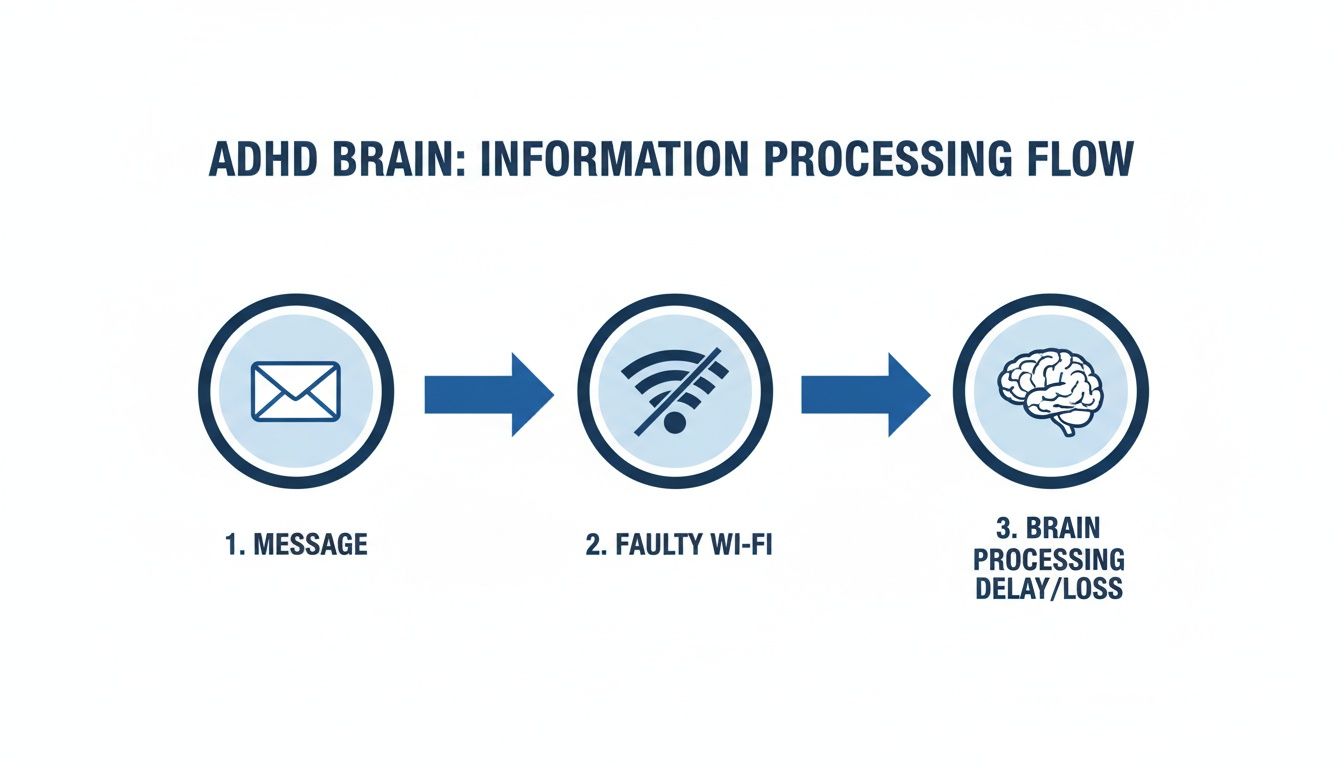
This helps explain why tasks that require steady, sustained focus can feel almost impossible. The brain’s “signal” for attention just isn’t consistent.
How Therapsy Simplifies Your First Step
Trying to figure all this out on your own in Italy can be intimidating. Where do you find a qualified professional who speaks your language? How can you be sure they understand the unique pressures of expat life?
This is exactly where Therapsy comes in, offering a clear and supportive path forward.
We believe that getting help should feel straightforward and reassuring. Your very first conversation with us connects you directly with a clinical expert who understands both ADHD and the Italian healthcare system.
Instead of spending hours on dead-end searches, your journey can start with one simple action: booking a free assessment call with a Therapsy Clinical Director.
This isn’t a therapy session, but a professional consultation designed to understand exactly what you need. The Clinical Director will listen to your concerns and, if it seems like a good fit, match you with a licensed, multilingual psychologist from our team who is fully qualified to conduct ADHD assessments.
This approach takes the guesswork out of the equation and connects you with the right support from day one. If medication is a path you’re considering, our team can also coordinate with our network and help you learn more about our psychiatrists and how they can become part of a complete treatment plan.
Effective Treatment And Management For ADHD

Receiving an ADHD diagnosis can bring a profound sense of relief and validation. But it’s also the start of a new, proactive chapter in your life. The good news is that ADHD is one of the most treatable mental health conditions, and a range of evidence-based strategies can help you manage your symptoms and build a more balanced, productive life.
The most successful approach to managing adult ADHD is almost always multimodal, which simply means it combines several different types of support. Think of it like building a personalised toolkit; no single tool works for every job, but having a variety of them allows you to tackle any challenge that comes your way. At Therapsy, our licensed psychologists specialise in creating these integrated plans.
Key Insight: Effective ADHD management isn’t about finding a single “cure.” It’s about building a supportive ecosystem of strategies that work together to address the unique ways ADHD affects your life, from brain chemistry to daily habits.
A strong ADHD treatment plan typically rests on three core pillars: psychotherapy, medication, and practical life strategies. Each one targets a different aspect of the condition, and together, they create a powerful framework for lasting change.
Psychotherapy: The Foundation Of Skill-Building
Therapy is the cornerstone of managing ADHD because it provides the “how-to” manual for your unique brain. While medication can improve focus and reduce impulsivity, therapy teaches you the specific skills needed to navigate a world that wasn’t built for your neurotype.
For adults with ADHD, Cognitive Behavioural Therapy (CBT) is considered a gold-standard approach. CBT for ADHD is specifically adapted to help you:
- Develop Practical Skills: Learn concrete techniques for organisation, planning, and time management to compensate for executive function challenges.
- Reframe Negative Thinking: Challenge the patterns of self-criticism and low self-esteem that often build up after years of struggling with undiagnosed ADHD symptoms.
- Manage Emotional Dysregulation: Build strategies to cope with frustration, impatience, and mood swings, which are common but often overlooked aspects of adult ADHD.
The goal is to empower you with coping mechanisms that become second nature over time. You can learn more about how our specialised therapists apply these techniques in our guide to ADHD in adults therapy and treatment.
Medication: A Tool To Level The Playing Field
For many adults, ADHD medication can be a crucial part of treatment. It works by addressing the underlying neurochemical imbalances discussed earlier, primarily involving dopamine and norepinephrine. It’s not a personality-changer or a “magic pill,” but rather a tool that can make your brain more receptive to building new habits and skills.
There are two main categories of ADHD medications:
- Stimulants: These are the most commonly prescribed medications (e.g., methylphenidate, amphetamines). They work by increasing the availability of dopamine and norepinephrine, which helps improve focus, reduce impulsivity, and quiet the “noise” in the brain.
- Non-Stimulants: These are often a good alternative for individuals who don’t respond well to stimulants or cannot take them for other health reasons. They work more gradually and can also help with emotional regulation and attention.
The decision to use medication is deeply personal and should always be made in consultation with a qualified psychiatrist who can oversee your treatment and ensure its safety and effectiveness.
Practical Life Strategies And Psychoeducation
The final pillar involves structuring your environment and daily routines to support your ADHD brain. This is where psychoeducation—learning as much as you can about your condition—becomes incredibly powerful. Understanding why you struggle with certain things removes the blame and allows you to find creative workarounds.
This is a challenge felt by many families. In Lombardy, for instance, a register tracked 4,091 children and adolescents diagnosed with ADHD between 2011 and 2021, showing the widespread need for support systems at home and school.
Practical strategies include:
- ADHD Coaching: Working with a coach to implement accountability systems and break down large goals.
- Workplace Accommodations: Requesting simple changes like noise-cancelling headphones, a quieter workspace, or written instructions.
- Using Technology: Relying on apps, digital calendars, and reminders to “outsource” your memory and keep you on track.
To better manage daily tasks and boost productivity, exploring effective time management strategies for ADHD can be a game-changer. By combining these pillars, you can create a robust support system tailored to you.
Recognizing ADHD In Children And Teens For Expat Families
Watching your child struggle in a new country can be incredibly unsettling. As an expat parent in Italy, you might find yourself wondering if their trouble focusing in school, making friends, or following directions at home is just part of the adjustment, or if it points to something more. This is a common worry, especially since ADHD in children and teenagers often looks very different from how it presents in adults.
The real challenge for many international families is untangling this very question. Is it ADHD, or is it the stress of adapting to a new language, culture, and school system? The truth is, these two issues aren’t mutually exclusive. In fact, the pressure of relocation can often amplify underlying ADHD symptoms, making them much more noticeable than they were back home. The only way to get clarity is through an expert assessment from a professional who understands both child development and the unique intercultural context you’re in.
ADHD Symptoms In The Classroom And Beyond
Often, the first signs of ADHD in children appear in a structured setting like school. But these behaviours can be easily misinterpreted, particularly in a new country where teachers might not be as familiar with neurodiversity. As a parent, you are in the best position to see the complete picture.
Key signs to watch for in children (ages 6-12):
- Inattention: This might look like constant daydreaming during lessons, a perpetually messy desk or backpack, frequently lost homework, or an inability to follow multi-step instructions.
- Hyperactivity: This often shows up as non-stop fidgeting, an inability to stay seated when expected, talking excessively, and running or climbing in situations where it’s inappropriate.
- Impulsivity: This can manifest as blurting out answers in class without being called on, having a tough time waiting their turn in games, or frequently interrupting others.
As children move into their teenage years, these symptoms often shift and evolve.
Key signs to watch for in adolescents (ages 13-18):
- Intense Internal Restlessness: The obvious hyperactivity of childhood might fade, replaced by a constant feeling of being on edge, agitated, or intensely bored.
- Risk-Taking Behaviour: Impulsivity can start to show up in more serious ways, like making rash decisions without thinking through the potential consequences.
- Social Difficulties: They might struggle to keep friends because they interrupt, seem emotionally overreactive, or have a hard time “reading the room” in social situations.
- Academic Underachievement: You may have a bright teen whose grades are slipping due to chronic procrastination, poor time management, and an inability to plan for long-term projects.
Key Insight: In the expat context, these symptoms are often mistaken for cultural shock or language-learning difficulties. A child struggling to follow a lesson in Italian might be seen as having a language barrier, when the root cause could be an attentional issue that makes it hard to focus in any language.
Understanding ADHD Prevalence And Diagnosis In Italy
Trying to navigate a potential diagnosis in a new country adds another layer of complexity. It might be helpful to know that in Italy, studies show the prevalence of ADHD among children and adolescents is around 1.4% when applying strict diagnostic criteria. This rate is lower than the global average and may reflect different historical approaches to mental health in Italy, which can sometimes lead to symptom-based conditions being overlooked. You can read the full research on ADHD prevalence in Italy to get a clearer picture of the local landscape.
This information is vital for parents because it helps explain why getting your child’s challenges recognised might feel different or more difficult here than it would in your home country. It underscores just how important it is to partner with a service that gets these systemic nuances.
At Therapsy, we specialise in supporting international families through this exact process. Our multilingual child and adolescent therapists are not only experts in ADHD assessment but are also skilled at liaising with Italian schools. We can help you understand your child’s needs, advocate for them effectively, and bridge any cultural or linguistic gaps you encounter. Understanding the unique challenges of your new environment is key, and our approach to multilingual psychotherapy for expats in Italy is designed to provide that essential support.
Frequently Asked Questions About ADHD In Italy
Living in a new country like Italy while managing ADHD comes with its own set of very specific questions. We get it. You’re trying to figure out a new system, new rules, and a new culture, all while navigating your own brain. This section tackles some of the most common concerns we hear from expats and adults dealing with ADHD in Italy. You’re not alone in this, and there are clear paths forward.
Can I Use My Foreign ADHD Prescription In Italy?
This is one of the first and most critical questions people ask. The short answer is almost always no. A prescription for ADHD medication from a doctor outside of Italy, or even the EU in some cases, won’t be filled at an Italian pharmacy.
To get your medication here, you need to see a licensed Italian psychiatrist (psichiatra). They are required to conduct their own assessment to confirm the diagnosis and decide on a treatment plan that aligns with Italian healthcare protocols. Only then can they issue a new, local prescription.
How Is ADHD Perceived Culturally In Italy?
Cultural views on ADHD in Italy are definitely changing, but you may find that general awareness isn’t quite where it is in some other Western nations. For a long time, mental health here was often seen through a psychodynamic lens, which tends to focus more on life experiences than neurobiology.
This means you might still run into some outdated perspectives, like people suggesting the symptoms are just part of your personality or a reaction to stress. The good news is that awareness is growing, particularly within medical and academic circles. The key is to connect with professionals who specialise in neurodevelopmental conditions. They’ll provide modern, evidence-based care that sees ADHD for what it is—a neurobiological condition—and not a cultural misunderstanding. To learn more about getting the right kind of support, our guide on online therapy for expats living in Italy has some great insights.
What Is The Cost Of An ADHD Assessment In Italy?
The cost of an assessment can vary dramatically, and it really depends on whether you use the public healthcare system (SSN) or go private.
- Public System (SSN): An assessment through the public system can be very low-cost or even free. The major downside? The waiting lists can be incredibly long—we’re talking many months, and sometimes even years. For an expat, just figuring out the referral process can be a huge challenge in itself.
- Private System: Going private is much faster, but it comes with a higher price tag. A complete evaluation from a private psychologist or psychiatrist can cost anywhere from several hundred to over a thousand euros.
Therapsy’s Approach: We aim to make this process as clear and supportive as possible. Your journey with us starts with a free assessment call with our Clinical Director. This helps us understand exactly what you need. From there, we connect you with licensed professionals and give you a transparent breakdown of the costs and steps for a formal evaluation.
Is ADHD Considered A Disability In Italy?
Yes, it can be. ADHD is eligible for official recognition as a disability in Italy under Law 104/1992 (Legge 104). Be warned, though: getting this recognition is a complicated and bureaucratic process.
It involves a formal diagnosis followed by a thorough evaluation from a special medical commission, which determines the degree of impairment. If your application is approved, this status can unlock certain rights and accommodations, especially at work or in university. For most expats, however, the main goal is simply getting effective treatment and support, rather than pursuing this legal status unless very specific and significant accommodations are required.