Meta Title: EMDR Therapy in Italy for Expats and Young Adults
Meta Description: Learn how emdr works, what sessions feel like, which issues it can help with, and how to find a qualified emdr therapist in Italy as an expat or international student.
Slug: emdr-therapy-italy-expats
Tags: emdr, emdr therapy italy, trauma therapy, expat mental health, anxiety, burnout, ptsd, online therapy italy, psychotherapy for expats, international students
You moved to Italy for good reasons. Study, work, love, freedom, a different pace of life. From the outside, it may even look like things are going well. You have learned how to order coffee properly, how to handle the bureaucracy a little better, and how to build a life in a place that once felt unfamiliar.
But inside, something may feel less settled.
You might notice that your body is tense for no clear reason. You overreact to small stressors. A conflict at work feels bigger than it should. Loneliness hits harder at night. Old memories you thought were behind you come back when you are already trying to adapt to a new country. Some people describe it as anxiety. Others call it burnout, panic, emotional flooding, numbness, or just feeling unlike themselves.
This is common in expat life. A major transition can unsettle the nervous system. When daily life is already demanding more energy, older unprocessed experiences can rise to the surface. Relocation does not create every emotional difficulty, but it can expose what was already under strain.
A young professional in Milan may find that every mistake at work triggers intense shame. An international student in Bologna may feel safe enough, finally, for past experiences to catch up with them. Someone in Rome may realise that being far from family has made grief, fear, or old relationship wounds harder to manage. These are not signs of weakness. They are signs that your system may be carrying more than it has fully processed.
One specialised approach that often helps is emdr, short for Eye Movement Desensitisation and Reprocessing. It is best known for trauma, but many people first encounter it when they are struggling with anxiety, stress, or persistent emotional patterns they cannot reason their way out of.
If you are looking for support as an international resident, this guide to therapy for expats in Italy may help you understand the broader range of care, including where emdr fits.
Introduction A New Life in Italy and Unexpected Shadows
Moving abroad can feel like a fresh start. It can also remove familiar buffers.
The friend you used to call after a difficult day may be in another time zone. Your usual routines are gone. Even simple tasks can require more effort in another language. When your energy goes into adapting, your mind has fewer resources left to keep distress neatly contained.
Why old pain can resurface during relocation
Many expats feel confused by this. They think, “Why am I struggling now? Things are supposed to be better.”
The answer is often gentle, not alarming. A life change can disturb your internal balance. Stress, uncertainty, isolation, and identity shifts can make old emotional material more active. This may include:
- Past trauma: events you rarely think about, but still carry in your body
- Earlier attachment wounds: feeling abandoned, criticised, unsafe, or unseen
- Accumulated stress: too many years of coping without enough support
- Migration strain: grief, culture fatigue, homesickness, and loss of belonging
Sometimes the trigger is obvious. A move, a breakup, a job crisis. Sometimes it is subtler. You finally slow down, and your nervous system stops outrunning what it has been avoiding.
A new country can offer hope and still stir up old distress. Both can be true at once.
When talking helps, but does not feel sufficient
Some people understand their pattern very well. They know why they panic. They can explain where their self-criticism began. They have read the books, listened to the podcasts, maybe even done therapy before.
And still, the same emotional charge returns.
That is often the point at which emdr becomes relevant. It is not just about insight. It is about helping the brain and nervous system process a distressing memory or experience differently, so it stops feeling as raw, intrusive, or overpowering in the present.
For expats and young adults in Italy, this can be especially meaningful. You may not need more pressure to “cope better.” You may need a structured way to help your system digest what it has not yet resolved.
What is EMDR and How Does It Help the Brain Heal
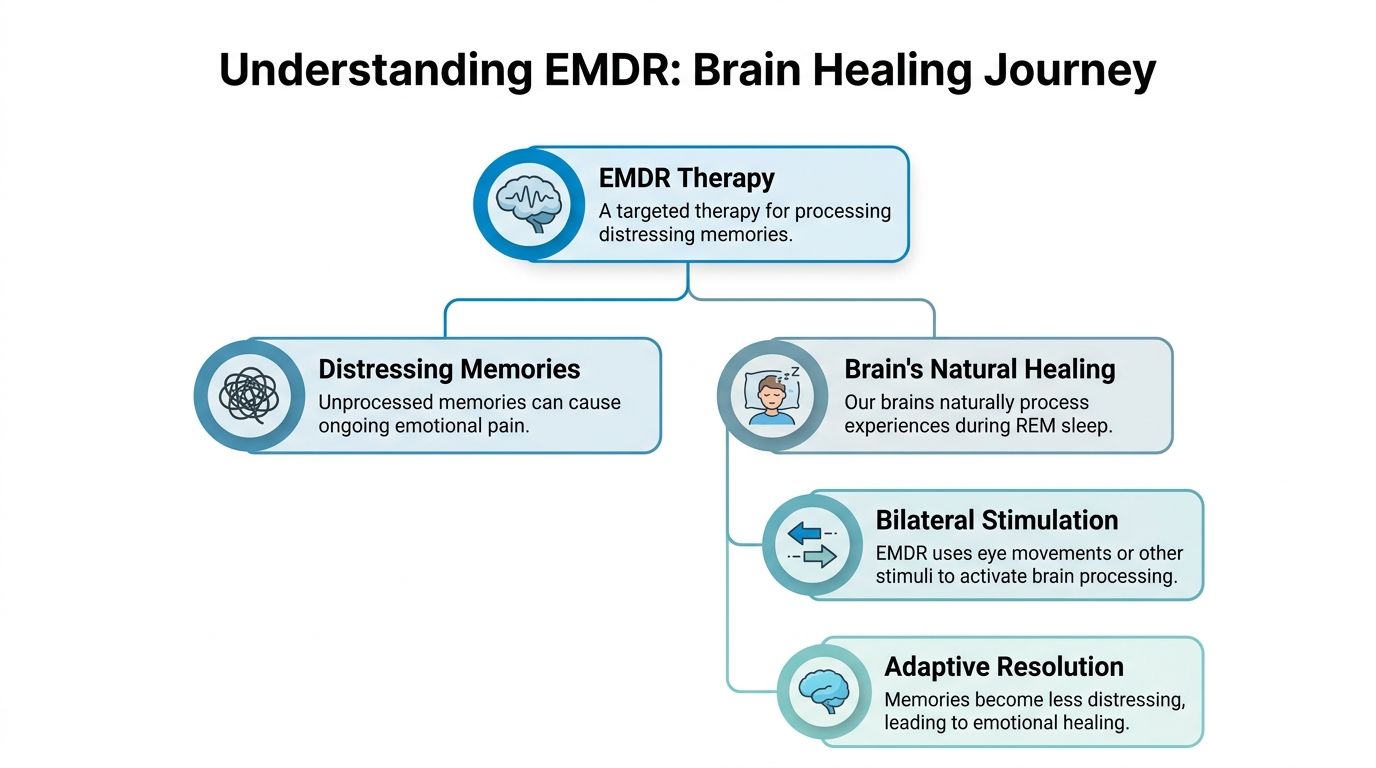
EMDR stands for Eye Movement Desensitisation and Reprocessing. The name sounds technical, but the basic idea is a straightforward one.
Your brain is built to process experience. Most of the time, it does this naturally. A difficult event happens, you feel upset, and over time the memory becomes more manageable. You still remember it, but it no longer feels like it is happening now.
Sometimes that natural processing gets stuck.
The unfiled memory idea
A useful way to think about this is a library.
Most memories get placed on the right shelf. They become part of your history. You can access them, but they do not jump out at you unexpectedly.
A distressing memory can stay “unfiled.” It remains emotionally loud. A present-day trigger then pulls it forward. Your body reacts as if the danger or humiliation or helplessness is current, even when part of you knows it is not.
EMDR helps the brain reprocess that material so it can be stored in a more adaptive way. The memory is not erased. What changes is its emotional intensity and the beliefs attached to it.
What happens during emdr processing
During emdr, a therapist helps you briefly bring a specific memory, image, sensation, or negative belief to mind. At the same time, you use bilateral stimulation, which may involve guided eye movements, taps, or tones.
This does not hypnotise you. It does not force you to relive everything. It creates conditions that support the brain’s own processing.
People often notice changes like these over time:
- Less emotional charge: the memory still exists, but it feels less overwhelming
- A shift in belief: “I am unsafe” may gradually become “I survived” or “I have choices now”
- More present-day calm: triggers lose some of their power
- Greater integration: thoughts, feelings, and body responses feel less chaotic
Why people sometimes confuse emdr with exposure
This is one of the biggest points of confusion.
EMDR does not involve just talking about the traumatic event again and again. You do not have to give every detail. The work is structured and guided. The therapist helps you stay within a window of tolerance, meaning the process should feel challenging but not chaotic.
For many clients, this matters. If you are already carrying stress from living abroad, you may want a trauma approach that is focused, paced, and respectful of your limits.
People also often wonder how emdr compares with other therapies. If you want a broader introduction to structured evidence-based treatment, this guide to cognitive behavioral therapy can help clarify where emdr and CBT differ in focus and method.
A brief history in plain language
EMDR therapy was developed by Francine Shapiro in 1987. The first controlled study in 1989 showed significant desensitisation in trauma survivors, and the approach later received endorsement from the World Health Organization as an evidence-based treatment for PTSD, as noted in this summary of EMDR history and development.
EMDR does not remove the past. It helps the past stop taking over the present.
The Eight Phases of Your EMDR Treatment Journey
The structure of emdr often reassures people. There is a protocol. You are not pushed straight into the hardest memory on day one.
The standard model includes eight phases, and each one has a purpose.
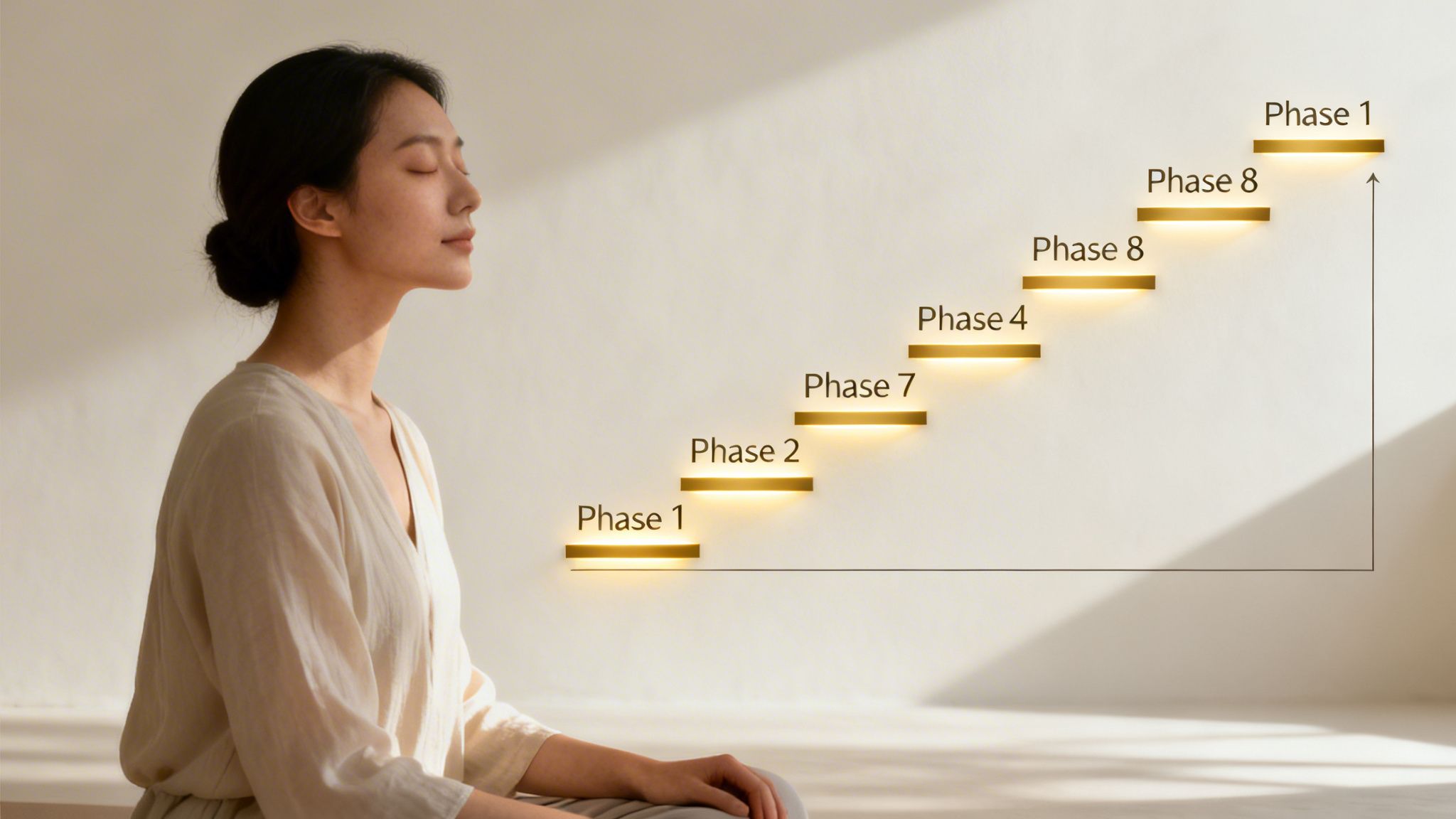
Phase one history taking
The therapist gets to know you, your current symptoms, your background, and what brings you to therapy now.
This phase is not only about “what happened.” It is also about patterns. What triggers you today? What memories seem connected? What does safety look like in your life now?
For an expat, this may include relocation stress, cultural strain, distance from family, language fatigue, and changes in identity.
Phase two preparation
This is one of the most important phases, especially if you are worried about feeling overwhelmed.
The therapist helps you build stability before deeper processing begins. That can include grounding, emotional regulation, imagery, resourcing, and ways to return to the present if distress rises.
Some clients are surprised by how much this matters. Preparation is not a delay. It is part of the treatment.
Good emdr is not rushed. Safety and readiness come first.
Phase three assessment
Here, the therapist and client identify a target memory or issue.
You may focus on:
- a specific image
- a negative belief about yourself
- emotions linked to the memory
- physical sensations in the body
- a more helpful belief you want to strengthen
This makes the work precise. Instead of speaking vaguely about “my anxiety,” you start to identify the experiences and meanings that feed it.
Phases four to six reprocessing and change
These are often the phases people think of when they hear “emdr.”
Phase four desensitisation
You bring the target to mind while following bilateral stimulation. The therapist checks in regularly. Your mind may move through images, emotions, body sensations, or new associations.
The process can feel surprising. A school memory may connect to a work trigger. A moment of panic may link to an old experience of helplessness. As processing unfolds, the intensity often shifts.
Phase five installation
Once the disturbance linked to the target reduces, attention turns to a more adaptive belief.
This is not forced positive thinking. It is about strengthening something that feels true and grounded, such as “I can protect myself now” or “I am no longer trapped.”
Phase six body scan
The body often holds what words do not.
In this phase, you notice whether any residual tension, discomfort, or activation remains when thinking of the target. If something still feels stuck physically, the therapist may continue processing.
Phase seven closure
Every session ends with closure, even if processing is not fully complete.
That may include calming exercises, orientation to the present, and clear steps for aftercare. You should leave with some sense of containment, not with the expectation that you manage a flood of distress alone.
Phase eight re-evaluation
At the start of the next session, the therapist checks what has changed since the last one. This re-evaluation is important because EMDR often continues to unfold between sessions. New insights can emerge. Dreams may be more vivid. A trigger may feel smaller. Or you may realise another related memory needs attention.
What this looks like in real life
A simple overview can help:
| Phase | What it focuses on |
|---|---|
| 1 | Understanding your history and current difficulties |
| 2 | Building safety, trust, and coping resources |
| 3 | Choosing a target and mapping its emotional impact |
| 4 | Reducing disturbance through processing |
| 5 | Strengthening a healthier belief |
| 6 | Checking what remains in the body |
| 7 | Ending the session safely |
| 8 | Reviewing progress and planning next steps |
You stay involved the whole time
EMDR is collaborative. A therapist guides the process, but your experience leads it.
You can slow down. You can ask questions. You can pause. A careful clinician will not treat the protocol like a machine. They will adapt it to your pace, cultural context, nervous system, and current life demands.
That matters even more for people living abroad. If daily life already includes uncertainty, practical stress, and reduced support, the treatment needs to feel anchored, not destabilising.
More Than Just Trauma Conditions EMDR Can Treat
EMDR is widely known for PTSD, but that is not the whole picture. Many people seek emdr because they are struggling with symptoms that do not immediately look like “trauma.”
A perfectionistic young adult may call it anxiety. An expat professional may call it burnout. A student may say they feel constantly on edge, ashamed, stuck, or emotionally flat.

Where emdr has its strongest evidence
The strongest established evidence is for trauma and PTSD. According to this summary of emdr efficacy statistics, over 30 controlled studies support EMDR’s efficacy, with research showing that up to 100% of single-trauma sufferers and 77% of multiple-trauma patients no longer have PTSD after approximately six sessions. The same source notes that its effectiveness extends to anxiety, depression, and other stress-related disorders.
That does not mean every anxious or burned-out person needs emdr. It means emdr can be relevant when current symptoms are linked to experiences that remain unprocessed.
The kinds of difficulties expats often bring
For people living in Italy away from home, the distress may come from a mix of past and present.
- Anxiety linked to old threat signals: You may react strongly to authority, criticism, exclusion, or uncertainty because these experiences connect with earlier pain.
- Depression with a life-transition layer: Major relocation can stir grief, disconnection, and hopelessness, especially if older losses were never fully integrated.
- Burnout that is not only about workload: Some people overwork because slowing down feels unsafe. EMDR can help explore the emotional roots of that pattern.
- Social stress and outsider feelings: Repeated experiences of not belonging can leave lasting marks, even when no single event seems dramatic.
- Somatic distress: Tight chest, nausea, shutdown, or restlessness can reflect a nervous system carrying unresolved material.
Small t trauma still counts
A common misunderstanding is that emdr is only for catastrophic events.
Many people are shaped by repeated smaller experiences. Emotional neglect. Chronic criticism. Bullying. Unpredictable caregiving. Migration stress. Feeling trapped in a relationship or invisible in a family. These experiences may not fit someone’s stereotype of trauma, but the nervous system can still encode them in painful ways.
If your anxiety keeps returning despite insight, or if your body reacts before your rational mind catches up, emdr may be worth considering alongside other forms of support such as therapy for anxiety.
You do not need to prove that your experience was “bad enough” to deserve help.
Benefits Limitations and What to Expect in a Session
EMDR can be very effective. It also asks for care, pacing, and a good clinical fit.
A balanced view is more useful than overselling it.
What many people appreciate about emdr
Some clients choose emdr because they want a therapy that works directly with distressing memories and body responses, not only with current thoughts.
Common benefits people report include:
- Less pressure to explain everything in detail: You do not always need long verbal descriptions for meaningful work to happen.
- Focused treatment: EMDR often targets specific experiences, triggers, and beliefs rather than staying abstract.
- Body and mind together: It can be helpful when distress is felt physically, not only cognitively.
- A structured process: The phases provide a roadmap, which can feel containing for people who fear becoming overwhelmed.
Important limitations and cautions
EMDR is not the right starting point for everyone at every moment.
If someone is in acute crisis, lacks enough day-to-day stability, or becomes highly dysregulated very quickly, a therapist may focus first on safety, routine, coping resources, and stabilisation. That is not a failure. It is good treatment planning.
EMDR can also stir strong material between sessions. You may feel tired, emotionally open, reflective, or temporarily more aware of things you have been avoiding. This is one reason the relationship with the therapist matters so much.
What a session may feel like
A typical session usually includes check-in, preparation or targeting, a period of bilateral stimulation, and time to settle before ending.
Experiences vary. Some clients notice clear emotional shifts quickly. Others feel gradual movement. Some sessions feel intense. Others feel quiet and surprisingly ordinary.
You do not need to “perform” the right response. Your job is to notice what comes up and let the therapist guide the process.
Eye movements, taps, or tones
People often assume emdr always means following a therapist’s fingers with your eyes. Eye movements are common, but they are not the only option.
The American Psychological Association’s overview of eye movement reprocessing notes that EMDR may also use auditory tones or tactile taps, and that no single modality is proven superior for all clients. This is helpful for clients who are neurodivergent, visually sensitive, culturally uncomfortable with direct eye-based work, or more at ease with another form of bilateral stimulation.
A simple comparison
| Question | EMDR | General talk therapy |
|---|---|---|
| Main focus | Distressing memories, beliefs, body responses | Reflection, understanding, emotional expression |
| Structure | Highly structured protocol | Varies by therapist and model |
| Verbal detail required | Often less detailed | Often more discussion-based |
| Pace | Can be direct, but should be carefully paced | Often broader and slower |
If you feel nervous about starting any therapy at all, reading about what happens in a first psychological session can make the first step feel more familiar.
How to Find a Qualified EMDR Therapist in Italy
Not every therapist who mentions trauma work is trained to provide emdr well. This matters.
A strong emdr process depends on more than warmth and good intentions. It requires proper training, supervised practice, and the ability to assess readiness, adapt pacing, and work safely with complex presentations.
What to look for first
When you search for an emdr therapist in Italy, start with credentials and fit.
Look for:
- Licensed professional status: psychologist or psychotherapist with the legal right to practise
- Specific emdr training: not only an interest in trauma, but formal training in the method
- Experience with your concerns: trauma, anxiety, burnout, adjustment stress, relationship wounds, or intercultural issues
- Language comfort: being able to speak in your preferred language matters more than many people expect
- Cultural awareness: expat life brings layers that a therapist should understand without needing long explanations from you
Why verified training matters
For practices in Italy, full EMDR certification requires supervised practice on the complete three-pronged protocol, and this level of training is linked to 82% remission rates in anxiety and depression cohorts according to Italian multicenter trials, as described in these EMDR certification standards.
That does not mean any one therapist can promise a specific result. It does mean that verified training is not a detail. It is central to treatment quality.
Ask direct questions. A qualified therapist should be comfortable explaining their training, how they decide whether emdr is appropriate, and how they handle preparation and safety.
Questions worth asking before you book
A short consultation can tell you a lot. You might ask:
- What emdr training have you completed?
- How do you decide if someone is ready for reprocessing?
- Do you work with expats, international students, or intercultural couples?
- Can sessions be online as well as in person?
- How do you adapt if eye movements do not feel right for me?
These questions are not demanding. They are sensible.
A practical guide on finding the right therapist for expats in Italy can help you think through fit, language, and cultural context in more depth.
Online and in-person care both matter
Italy is geographically diverse. You may live in a major city, a smaller town, or move frequently for work or study.
That is why flexible delivery matters. Some clients want in-person appointments because physical presence helps them feel grounded. Others need online therapy because travel, schedule, or location make regular attendance difficult.
If you want a quick visual overview of the kind of clinician qualities to look for, this short video is a helpful starting point.
For expats especially, the ideal therapist is not someone near you. It is someone qualified, communicative, and able to understand how migration, language, belonging, and identity shape mental health.
Frequently Asked Questions About EMDR for Expats
Is online emdr really effective?
For many people, yes. In Italy, online EMDR has shown high efficacy, with studies reporting a 70-85% reduction in PTSD symptoms. The same source notes that technical standards matter, including using a screen at least 10 inches wide for bilateral eye movements, and that online formats reached 92% client retention, often helped by better accessibility for expats, according to this overview of online EMDR practice standards in Italy.
If you are living in a smaller city, travelling often, or balancing study and work, online care can make consistency far easier.
Do I have to describe the trauma in detail?
Not necessarily.
This is one reason many people feel relieved when they learn about emdr. The process is not based on repeatedly telling the full story in detail. Your therapist still needs enough context to work safely and accurately, but the therapy does not depend on giving a long, graphic account.
What will I feel after a session?
This varies.
Some people feel lighter, calmer, or more clear. Others feel tired, emotional, reflective, or mentally busy for a while. A session can continue to “settle” after it ends. It helps to leave some space afterwards if possible, drink water, and avoid judging yourself for whatever comes up.
What if I get overwhelmed during processing?
A well-trained therapist does not treat overwhelm as something you should endure.
Preparation, pacing, grounding, and resourcing are part of good emdr care. If you become too activated, the therapist can slow down, shift the method, return to stabilisation, or pause processing. You are not expected to push through at all costs.
Feeling nervous before emdr is normal. Good therapy makes room for that nervousness instead of dismissing it.
Is emdr only for PTSD?
No. PTSD is where emdr has its clearest public profile, but clinicians also use it for anxiety, depression, stress-related symptoms, and patterns rooted in earlier difficult experiences. The key question is not whether your life looks dramatic from the outside. The key question is whether unprocessed experiences still shape how you feel and respond now.
How do I know if emdr is right for me?
Usually, this becomes clearer through a careful assessment.
If your distress feels linked to specific memories, recurring triggers, body-based anxiety, or beliefs that seem to come from older experiences, emdr may be worth exploring. If you need more stabilisation first, that is useful information too.
If you are looking for culturally aware, multilingual psychotherapy in Italy, THERAPSY offers online and in-person care for expats, international students, young adults, couples, and adults navigating anxiety, trauma, burnout, depression, and life transitions. You can begin with a human conversation, not a rushed form. Their Clinical Director matches you with a licensed psychologist or psychotherapist suited to your needs, language, and goals. Book your first free assessment call.
Suggested 16:9 image: A calm therapy setting with an expat client in online session from an Italian apartment, with soft natural light and a laptop on a desk.
SEO Alt Text: Expat in Italy attending an emdr therapy session online with a multilingual psychotherapist
LinkedIn post in English:
Living in Italy can be exciting and emotionally demanding at the same time.
For many expats and international students, relocation stress does not just create new pressure. It can also bring older anxiety, trauma, or burnout to the surface.
We’ve published a practical guide to emdr therapy in Italy that explains:
• what emdr is in plain language
• how the 8 phases work
• what a session feels like
• when emdr may help beyond PTSD
• how to find a qualified emdr therapist in Italy
If you support international communities, young adults, or intercultural couples, this is a useful resource to share.
Read more on Therapsy.