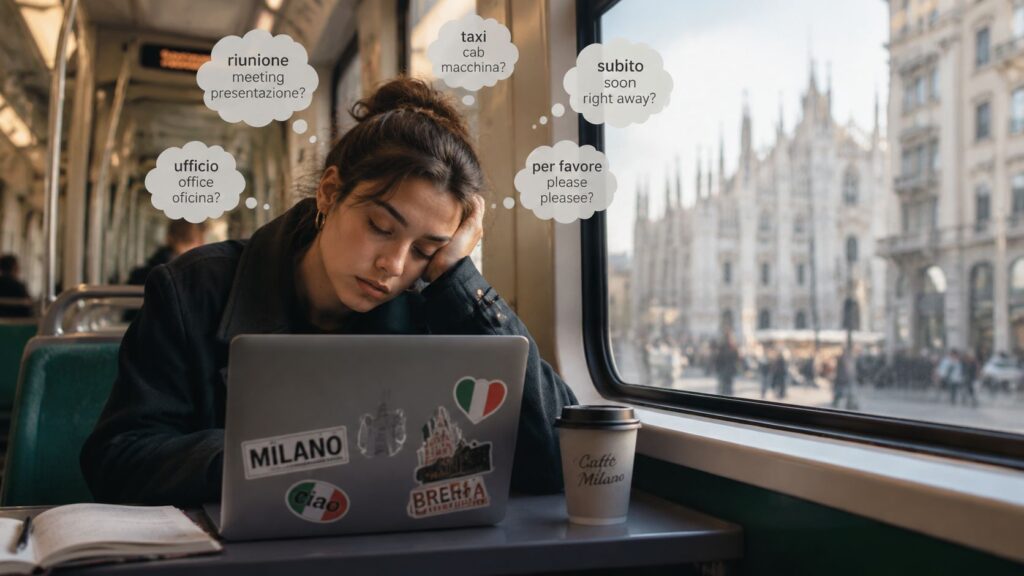
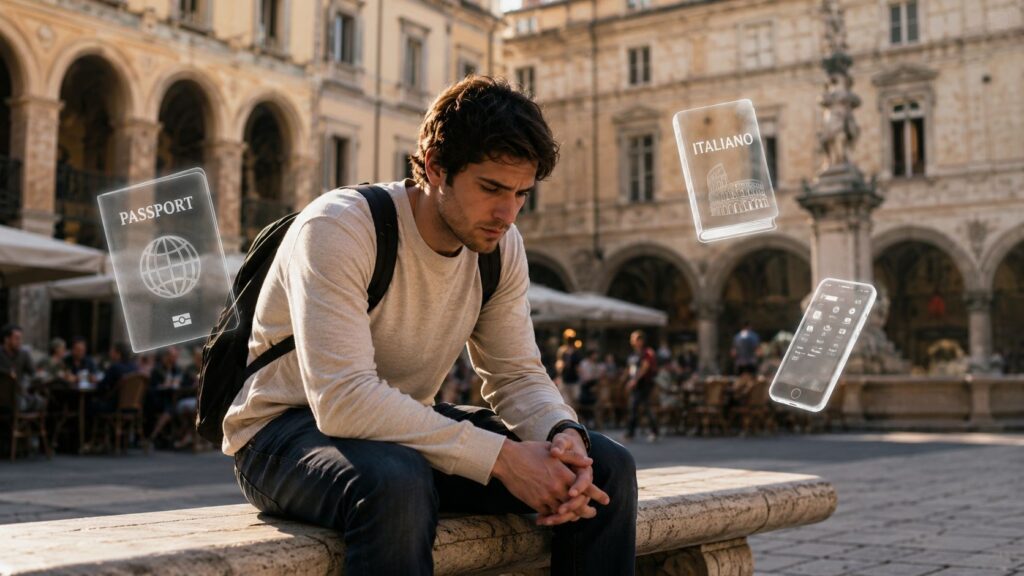
Quick answer: Expats in Italy mostly come to therapy for five things: the delayed crash of the first year, a relationship under strain from the move, work and identity that did not transfer, family left behind, and loneliness inside a full calendar. None of them require a diagnosis to be worth treating, and the single practical decision that changes the outcome is whether you work in your own language.
Therapsy is a multilingual psychotherapy service in Italy that connects expats, international students and Italians with licensed therapists in their own language, online across the country and in person in 24 Italian cities.
Key takeaways
- The hard part of expat life is rarely the first three months. It is month fourteen, when the novelty is gone and the practical problems are solved.
- Most expats arrive in therapy with a problem that has no name attached: tiredness, irritability, a relationship going quiet.
- Working in a second language is not only less comfortable. Research indicates that naming a feeling in a foreign language works less well.
- A relocation puts a relationship under asymmetric pressure: one partner usually paid more for the move than the other.
- You do not need to be in crisis to start, and you do not need to have exhausted your friends first.
- Therapsy works in 14 languages, online across Italy and in person in 24 cities, and the first conversation is free.
Why do expats in Italy end up in therapy?
The delayed crash of the first year
Relocation is usually survived on adrenaline. The flat, the codice fiscale, the permesso, the bank, the job. While there is a list, there is a purpose. The difficulty arrives when the list ends: nothing is wrong, everything works, and it feels flat. People describe it as tiredness rather than distress, and it is the most common reason for a first session in the second year.
A relationship that did not survive the move intact
Relocations are rarely symmetrical. One partner had the job, the other had the upheaval; one is busy and validated, the other is rebuilding a life from zero and is grateful, which makes complaining feel unfair. That unfairness is what stops the conversation, and the silence is what does the damage. It is one of the most treatable patterns we see in couples work.
Work and identity that did not transfer
Qualifications convert badly, seniority resets, and humour and authority both land differently in a second language. Capable people find themselves explaining their own competence, and after a year of that the explanation starts to sound unconvincing to them too.
The family you left
Guilt about being far away, a parent getting older at a distance, the role you used to hold at home now filled by somebody else, and holidays that have become logistics. This is grief without a loss to point at, which is precisely why it goes unnamed.
Loneliness that a full calendar does not fix
Most expats rebuild the social layer within a year. What takes far longer is the layer underneath, the people who know your history. The gap between the two is the specific loneliness of living abroad, and more social contact does not close it.
Does the language of the session really matter?
What changes when you work in a second language?
Two things. Precision goes first: people simplify what they say without noticing, and a simplified account of shame or ambivalence is a different account. Then the emotional charge drops, which feels like control and functions as distance. A study found that foreign language processing undermines affect labeling, and naming a feeling is a large part of what therapy runs on.
When is working in Italian or English the right choice anyway?
When it is genuinely your strongest language for emotional material, which for some long-term residents it is, and when the alternative is no therapy at all. It is a reasonable thing to test in the first sessions rather than decide in advance.
What if you and your partner have different first languages?
Then the working language of the sessions is itself a clinical decision, and it should be made deliberately with the therapist rather than defaulting to whoever is more fluent. That default is usually already part of the problem at home.
What is different about doing this in Italy?
The professions are not the same as at home
A psicologo is a licensed psychologist registered with the Ordine degli Psicologi; a psicoterapeuta has completed a further four-year specialisation; a psichiatra is a doctor and prescribes. The register is public, so ask for the name and registration number and check it.
Public or private?
Public care through the local services is free or nearly free, works in Italian, and has long waits. Private care starts within days, costs money, and lets you choose the professional and the language. For most of the situations above, private is where people actually start.
What does it cost?
At Therapsy individual sessions start from EUR 70, couples from EUR 100 and a psychiatric consultation from EUR 110, with the same fee online and in person; the pricing page has the full list. Psychological care is generally deductible as a health expense in the Italian tax return, so keep the invoices.
Online, in person, or both?
Online removes travel and keeps the same therapist if you move city or leave the country for a while, which is the part of care that most often breaks for expats. In person is available in 24 Italian cities. Many people do both, and there is no clinical reason to choose once and for all; see online therapy for expats in Italy.
How do you start?
What happens in the first conversation?
At Therapsy it is free and it happens with the Clinical Director, not an algorithm. You describe what is going on, the language you want to work in and your practical constraints, and it ends with a proposed therapist and the reason for the choice. The reply arrives within 12 hours.
What if you cannot describe the problem?
That is a normal starting point, not an obstacle. “I am tired and I do not know why” is enough to begin, and sorting out what is underneath is the work rather than the price of entry.
What if the first therapist is not right?
You can change inside the service without starting your history again. You can also see the full network on our therapists page before deciding. A rematch is not a failure and it does not cost you the work already done.
Frequently asked questions
Can I find a therapist in Italy who speaks my language?
Yes. Therapsy works in 14 languages, online across Italy and in person in 24 cities, and the language is part of the match rather than an extra request.
Do I need to speak Italian to have therapy in Italy?
No, not in private multilingual care. In the public system it is usually necessary outside a few large cities, which is one reason many foreigners start privately.
How much does therapy for expats in Italy cost?
At Therapsy individual sessions start from EUR 70 and couples from EUR 100, with no difference in price between online and in person. Public care is free or nearly free with longer waiting times.
Is culture shock a good enough reason to see a therapist?
Yes. You do not need a diagnosis to ask for an assessment, and adjustment difficulties after a move are a common and treatable reason to start.
Can I keep my therapist if I move to another Italian city?
Yes, by continuing online. Continuity is one of the main practical reasons expats choose online sessions, because relocation is the thing that most often interrupts care.
Does insurance cover therapy in Italy?
Some international policies reimburse sessions with a licensed psychologist when a proper invoice is issued. Check the exact wording with your insurer before the first session rather than after the third.
Related reading
- Therapy in Italy for expats: how the service works
- Therapy for depression in Italy
- Emotional loneliness and therapy
Written by Dr. Francesca Adriana Boccalari, Clinical Director at Therapsy and licensed psychologist (Ordine degli Psicologi della Lombardia n. 16241), and reviewed in September 2026.