The sudden, intense rush of a panic attack can be a terrifying experience, especially when you’re navigating the complexities of life in a new country. What you’re feeling is an intense, but not dangerous, misfire of your body's internal alarm system. It’s like a hyper-sensitive smoke detector that blares for a piece of burnt toast, not an actual fire.
This guide, created by the mental health experts at Therapsy, is designed to help expats, international students, and young adults understand and manage panic attacks in Italy. We know the unique pressures of living abroad can sometimes trigger unexpected episodes of intense fear. Our goal is to demystify these experiences, show you that you aren't alone, and explain how what you're feeling is treatable.
We will explore the challenge through a clear framework:
- Problem: Defining the intense physical and psychological experience of a panic attack.
- Insight: Providing psychological insight into why panic attacks are common among expats in Italy, linking them to specific intercultural stressors.
- Solution: Presenting Therapsy as the expert solution, offering specialized, multilingual support to help you find long-term relief.
Navigating Panic Attacks as an Expat in Italy

When you move to a country like Italy, your mind and body are in a constant state of adaptation. From navigating bureaucracy and learning a new language to building a social life from scratch, the background level of stress can be consistently high. A panic attack might feel like it comes out of nowhere, but it's often the boiling point of this accumulated, underlying stress.
A panic attack is a sudden and sharp rise in anxiety accompanied by physical symptoms. The physical symptoms are an adaptive response to the perception of being in acute danger. However, they can unfortunately arise under everyday stress.
This is not a sign of weakness; it's a profoundly human reaction to an extraordinary set of circumstances. The experience itself can be so distressing that you might start to worry about it happening again. This fear can lead to avoiding certain places or situations, which, while a natural instinct, can actually reinforce the cycle of anxiety. Breaking this cycle and reclaiming your confidence is most effectively done with professional support.
Finding the Right Support in Italy
This is where Therapsy’s expertise makes a real difference. We bridge the gap between local Italian life and global mental health standards, offering specialised care designed for the international community. We know that expressing complex emotions is almost always easiest in your native language.
Our team of multilingual, licensed therapists has extensive experience helping young adults, expats, and international students. They provide a safe, confidential space to explore the root causes of anxiety, with sessions available both online and in-person across Italy. If you are struggling with panic attacks, it's so important to find the right mental health support for expats in Italy. Your journey toward feeling calm and in control can begin with a simple, supportive conversation.
What a Panic Attack Feels Like Physically
To truly get a handle on a panic attack, it helps to understand what's happening inside your body. The physical experience is often so powerful that many people are convinced they're having a heart attack or another serious medical emergency. Pulling back the curtain on these sensations is the first real step toward taking away their power.
At its core, a panic attack is your body's ancient "fight-or-flight" system kicking into high gear at the wrong moment. Your brain mistakenly senses a major threat and unleashes a flood of adrenaline. This chemical surge is designed to prepare you for immediate, life-saving action, which sets off a chain reaction of very real and intense physical feelings.
Imagine it like a faulty fire alarm. Your body is doing exactly what it was designed to do when faced with real danger, but it’s reacting to a false trigger—like burnt toast in the kitchen. The alarm itself is loud, jarring, and very real, but the house isn't actually on fire.
This biological reaction is precisely why the symptoms feel so completely overwhelming. Your heart starts hammering to get more blood to your muscles, you breathe faster to pull in more oxygen, and you might break out in a sweat to cool yourself down. These aren't signs you're losing your mind or in actual physical peril; they are the predictable—though terrifying—responses of your body’s emergency system.
Common Physical Symptoms of Panic Attacks
During an attack, you'll likely feel a rush of different symptoms all at once. According to the Diagnostic and Statistical Manual of Mental Disorders (DSM-5), a panic attack involves four or more of the following symptoms reaching a peak within just a few minutes:
- Pounding Heart or Palpitations: You suddenly become hyper-aware of your own heartbeat. It can feel like it's racing out of control, pounding in your chest, or even skipping a beat.
- Sweating: This isn't just a mild glow. You might find yourself covered in sweat, even if you’re not in a warm room.
- Trembling or Shaking: The adrenaline rush often causes uncontrollable shaking, whether it's in your hands, your legs, or your entire body.
- Shortness of Breath: This can feel like you're suffocating or simply can't draw a full, satisfying breath, no matter how hard you try.
- Feelings of Choking: A sudden tightness in your throat can make you feel like you can't swallow or that your airway is closing up.
- Chest Pain or Discomfort: This is one of the most frightening symptoms and is frequently mistaken for a heart attack. It is always vital to rule out a medical cause for chest pain. You can learn more about the connection between anxiety and chest pain in our detailed article.
Psychological Sensations During a Panic Attack
The experience is never just physical. These intense bodily sensations go hand-in-hand with equally powerful and distressing thoughts and feelings, which can leave you feeling like you’re completely losing control.
Common psychological symptoms include:
- Feeling Dizzy or Faint: Changes in your breathing and blood flow can make you feel lightheaded, unsteady, or like you're about to pass out.
- Chills or Hot Flashes: You might feel a sudden wave of icy cold or intense, prickly heat wash over you.
- Numbness or Tingling Sensations: Often felt in the hands, feet, or face, this "pins and needles" feeling is a common side effect of rapid breathing (hyperventilation).
- Derealisation or Depersonalisation: This is a strange feeling of detachment. You might feel like you're watching your life from outside your body, as if in a film, or that the world around you has become fuzzy and unreal.
- Fear of Losing Control or "Going Crazy": The sheer intensity of the attack can create a powerful and convincing fear that you are losing your grip on reality.
- Fear of Dying: Because the physical symptoms so closely mimic those of a life-threatening illness, an overwhelming fear of death is an extremely common part of a panic attack.
Realising that these physical and psychological symptoms are all part of a predictable biological process is a crucial first step. It helps reframe the experience, shifting it from a sign of impending disaster to what it really is: a severe, but temporary, overreaction of your body’s built-in safety system.
Why Expats in Italy Are Uniquely Vulnerable to Panic Attacks
Have you ever wondered why a panic attack can feel like it comes out of nowhere? While the attack itself is sudden, it’s often the final, dramatic result of stress that has been quietly building up over time. For many of us in Italy’s international community, this low-grade, underlying tension is a constant reality.
Think of it like carrying a ‘stress bucket’ around with you. Every little challenge of expat life adds another drop of water. The constant mental effort of understanding a new language, the slow burn of frustration while navigating Italian bureaucracy, or the loneliness that can surprisingly creep in—each one adds a little more weight.
Think of it this way: your baseline stress level is already higher than it was back home. Your system is constantly working overtime just to adapt. A seemingly normal day—a crowded metro in Milan or a social event where you feel like an outsider—can be the final drop that causes the bucket to overflow, triggering a panic attack.
This overflow isn't a sign of weakness or failure. It's a completely understandable reaction from a system that's been pushed to its limits. Recognising that your body is sending a signal—that your capacity to cope is temporarily overwhelmed—is the first, most important step toward getting back in control.
The Specific Stressors of Expat Life in Italy
Living in Italy is a dream for many, but the day-to-day reality involves a steep learning curve. The culture has its own beautiful, but distinct, rhythms and a whole host of unwritten rules. While each challenge might feel manageable on its own, together they can create the perfect storm for anxiety and panic attacks.
Some of the most common triggers for expats include:
- Language Barriers: The mental exhaustion from constantly translating, speaking, and listening in a non-native language is real. It can turn simple tasks into monumental efforts and make social events feel draining.
- Social and Cultural Isolation: Building a true support network takes time. Feeling like an outsider or misreading social cues can lead to a profound sense of loneliness, even in the middle of a bustling city.
- Bureaucratic Hurdles: Anyone who has dealt with the questura, the agenzia delle entrate, or other official bodies knows how stressful it can be. The processes are often confusing, the waits are long, and the experience can be a significant source of anxiety.
- Career and Financial Pressure: For many expats, finding stable work and ensuring financial security are major concerns. This adds yet another layer of pressure on top of the already demanding process of adapting to a new country.
Understanding how these external factors contribute to your internal state is key. We cover this in more detail in our guide on cultural differences in Italy for expats.
Panic Attacks and The Italian Healthcare System
Because the physical symptoms are so intense, a panic attack often sends people straight to the emergency room, which places a real strain on local health services. Data from the University Hospital of Verona, for example, documented 3,771 cases of panic attacks in their Emergency Departments between 2012 and 2016.
That’s an average of about 754 visits each year—a considerable number. For an expat, a confusing and stressful trip to an Italian pronto soccorso can make the anxiety of a panic attack even worse. The study also highlighted women as a significant risk group, which could be linked to unique societal pressures or the added challenges of balancing life in a foreign country. You can read the full research about panic attack presentations in Italy to learn more.
If you’re wondering whether you might be experiencing a panic attack, this flowchart can help you quickly identify the signs.
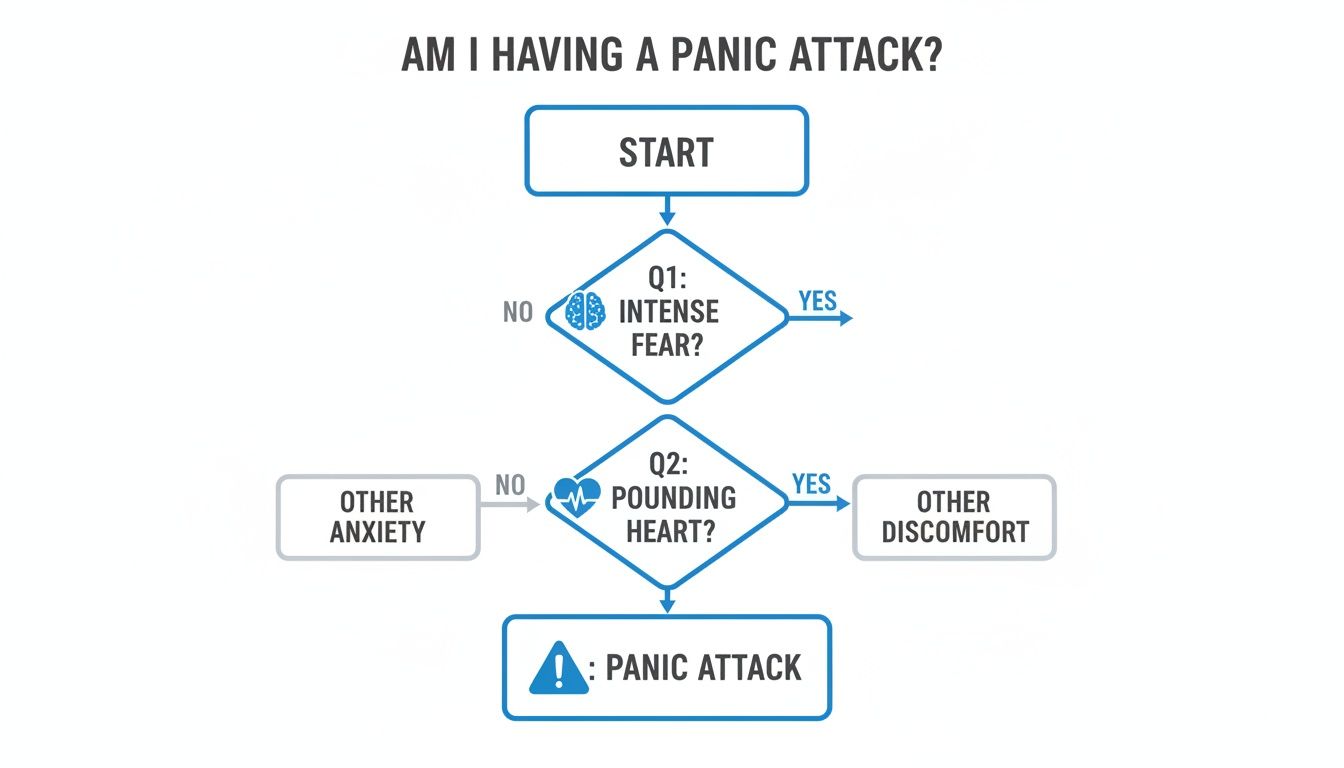
As the chart shows, the combination of intense, overwhelming fear and very real physical symptoms like a pounding heart are the classic signs of a panic attack. Recognising what’s happening is the first step toward getting the right kind of support—which usually doesn't require an emergency room. Therapsy offers a direct and proactive alternative, connecting you with licensed professionals who truly understand these specific challenges.
How to Manage Panic in the Moment

When a panic attack hits, it’s an all-consuming experience. Your body’s internal alarm is blaring, and the most primal instinct is to run or escape. But what if you could face that storm with a toolkit designed to bring you back to solid ground?
These are practical, evidence-based techniques that can help you regain a sense of control when you feel completely overwhelmed. By practising them, you are actively retraining your brain to understand that these intense feelings are temporary and manageable. The secret is shifting your focus from the chaos inside to the physical world right in front of you.
The goal during a panic attack is not to fight the feelings, but to learn how to ride the wave until it passes. Acknowledging the sensations without judgement and gently guiding your attention elsewhere can dramatically shorten the attack’s duration and lessen its intensity.
Think of managing panic attacks in the moment as a skill. Just like learning to ride a bike, it becomes more natural and automatic with practice. The best time to start is when you’re feeling calm, so these tools become second nature and easy to grab when you need them most.
Paced Breathing to Calm Your Nervous System
The moment panic takes hold, your breathing often becomes fast and shallow. This change can amplify feelings of dizziness and lightheadedness, feeding the cycle of fear. By deliberately slowing your breath, you send a direct signal to your nervous system that the threat has passed, helping to switch off that fight-or-flight response.
One of the most reliable techniques is "box breathing". It's simple and structured, which is exactly what your mind needs in a moment of chaos.
- Breathe in slowly through your nose for a count of four.
- Hold your breath gently for a count of four.
- Breathe out slowly through your mouth for a count of four.
- Pause for a count of four before you begin again.
Keep this rhythm going for a few minutes. The simple act of counting and feeling the air move in and out of your body anchors you in the present, pulling you away from the spiralling thoughts of panic.
Grounding Exercises to Reconnect with Your Surroundings
Grounding techniques are powerful because they pull your attention away from the distressing physical sensations and force your brain to focus on your immediate environment. One of the most popular and effective methods is the 5-4-3-2-1 technique.
Wherever you are, take a moment to identify, either out loud or just in your head:
- 5 things you can see: Look for tiny details—the grain of a wooden table, the way light hits a glass, a scuff mark on your shoe.
- 4 things you can feel: Focus on the sensation of your feet on the floor, the texture of the fabric on your chair, or the cool surface of a window.
- 3 things you can hear: Tune into the subtle sounds you normally ignore—the hum of a computer, traffic outside, or your own breathing.
- 2 things you can smell: Can you pick up the scent of coffee, rain, or even the paper in a book?
- 1 thing you can taste: Notice any lingering taste from your last drink or meal, or just the neutral sensation inside your mouth.
This exercise forces your mind to engage with the tangible world, interrupting the panic cycle and reminding your brain that you are safe in your current surroundings.
Challenge the Thoughts That Fuel Panic
Panic attacks thrive on catastrophic thoughts—"I'm having a heart attack," "I'm going crazy," "I'm losing control." Learning to question these thoughts, even in a small way, strips them of their power.
It helps to prepare a few coping statements or cognitive prompts that you can repeat to yourself. The key is to make them realistic and reassuring, not just empty affirmations.
Examples of cognitive prompts:
- "This feels terrifying, but it is not dangerous. It's just my body’s false alarm."
- "I’ve survived this feeling before, and I will survive it now. It always passes."
- "My heart is strong. It's just beating fast because of adrenaline, and that's okay."
Jot these phrases down in a notes app on your phone or on a small card you can keep in your wallet. Reading them can be an immediate lifeline when panicked thoughts start to take over. These in-the-moment strategies are essential first-aid for panic attacks, helping you build the confidence to manage episodes while you explore long-term solutions with professional support.
Finding Long-Term Relief from Panic Attacks with Therapsy
While grounding techniques are fantastic for navigating the immediate chaos of a panic attack, long-term relief comes from understanding what’s causing the storm in the first place. Self-help strategies are a vital part of your toolkit, but professional support offers the most direct path to breaking the cycle of fear and avoidance that so often defines panic disorder.
Therapy gives you a safe, structured space to start untangling the roots of your anxiety. For many expats in Italy, these roots are often tangled up in the unique pressures of adapting to a new culture, feeling socially isolated, or dealing with language barriers that add another layer of stress to daily life. A good therapist helps you build the resilience not just to get through panic attacks, but to truly flourish.
Professional therapy isn’t just about talking; it’s about learning a new way of relating to your thoughts and feelings. You learn to spot the triggers that set off panic, challenge the catastrophic thoughts that fuel the fire, and slowly take back the parts of your life that fear has claimed.
Cognitive Behavioural Therapy: The Gold Standard for Panic Attacks
One of the most effective, well-researched treatments for panic disorder is Cognitive Behavioural Therapy (CBT). At its core, CBT is a practical, goal-oriented approach based on a straightforward idea: our thoughts, feelings, and behaviours are all connected. By changing unhelpful patterns in our thinking and actions, we can directly influence how we feel.
In the context of panic attacks, a CBT therapist will work with you to:
- Identify Triggers: Pinpoint the specific situations, thoughts, or even physical sensations that tend to kick off a panic attack.
- Challenge Catastrophic Thoughts: Learn to catch and reframe the fearful thoughts that can quickly spiral into panic, such as "I'm having a heart attack" or "I'm completely losing control."
- Gradual Exposure: Gently and safely re-enter situations you've been avoiding because of fear. This process, known as exposure therapy, helps retrain your brain to realise these situations aren't actually dangerous.
This structured method gives you real, practical tools to methodically break down the panic cycle. If you're trying to find the right person to guide you, learning how to find the right therapist for expats in Italy is a great place to start.
How Therapsy Offers Expert Support in Italy
At Therapsy, we are the leading psychotherapy service in Italy for young adults, expats, international students, and intercultural couples. Our entire service is built specifically for the international community. Our carefully selected, licensed, multilingual therapists are not only experts in evidence-based treatments like CBT, but they also possess a deep, real-world understanding of intercultural psychology.
We provide a safe, non-judgemental space where you can express yourself in your native language—an absolutely crucial element when you're talking about complex emotions. We offer both online sessions and in-person appointments across Italy, ensuring care is accessible. For a more holistic approach to long-term relief, some people find that integrating natural compounds like Magnesium and GABA, known for their calming effects on the nervous system, can be a useful complement to professional therapy.
Our approach is comprehensive. If needed, we can also provide integrated psychiatric consultations to ensure you’re receiving a full spectrum of clinically sound care. The goal isn’t just to manage symptoms. It's to help you build deep, lasting resilience so you can fully embrace your life in Italy with confidence and a sense of calm.
Your Path to Calm Starts with a Conversation

We’ve walked through what panic attacks truly are, from the tidal wave of physical symptoms to the specific triggers that can surface when living abroad in Italy. If there’s one thing to take away, it’s this: panic attacks are highly treatable. You don’t have to face this alone.
The journey back to calm doesn't begin with some monumental leap. It starts with a single, supportive conversation. We know that taking this first step is often the most difficult part, which is why our entire process is built on clarity and reassurance, starting with a simple chat with a professional who understands.
Why Expert Support Matters for Expats
Life as an expat or international student comes with its own unique layers of stress. You're not just dealing with anxiety; you're navigating cultural adjustments, language hurdles, and the loneliness that can come from being far from home. These factors can make feelings of panic feel even more intense.
This is why finding a therapist who gets the expat experience isn't just a preference—it's essential for effective support. At Therapsy, our entire focus is on the international community in Italy. Our licensed, multilingual professionals are not only experts in the evidence-based treatments that work for panic attacks, but they also have a deep, practical understanding of intercultural psychology. They see the whole picture.
Whether you're looking for online sessions or to meet in person, you can easily find a therapist near you who fits your needs.
Your First Step: The Free Assessment Call
We firmly believe that reaching out for help should feel empowering, not intimidating. Your journey with us begins with a free first assessment call. This is a confidential, human conversation with our Clinical Director, designed to be a risk-free next step.
This is your space to talk about what you’ve been going through. Our Director will listen, answer any questions you have, and then personally match you with the therapist on our team who is the best fit for your needs, personality, and preferred language.
This first conversation is a risk-free, human-centred step designed to remove uncertainty. It ensures that from the very beginning, you are paired with a professional who can provide the right support for your unique situation, helping you feel seen and understood.
It’s all about creating connection and clarity right from the start. This ensures your path to recovery begins on solid ground, with an expert guide who is ready to walk alongside you. You have the strength to move past panic attacks and build a life in Italy filled with confidence and calm. That journey can start today.
FAQ: Your Questions About Panic Attacks in Italy, Answered
When you're navigating life in a new country, experiencing something as frightening as a panic attack can bring up a lot of questions. Here are some clear, straightforward answers to the concerns we hear most often from expats, students, and young adults in Italy.
Can a panic attack actually hurt me?
A panic attack feels catastrophic, but it is not physically dangerous. Think of it as your body's smoke alarm going off when there's no fire. The intense symptoms are a massive, but temporary, overreaction of your built-in safety system. It is an alarm bell, not a sign that you are about to have a heart attack or a stroke.
When should I seek therapy for panic attacks?
It is time to seek professional support if you have experienced more than one panic attack and the fear of having another one begins to impact your life. If you find yourself avoiding places or situations—like crowded piazzas, the metro, or social events—out of fear, this pattern of avoidance is a clear signal that therapy can help you reclaim your freedom and confidence.
What if my Italian isn’t good enough to explain how I feel?
This is a valid and crucial concern for many expats. Expressing deep, complex emotions requires a level of nuance that can feel impossible in a non-native language. This is precisely why Therapsy, as a trusted resource for the international community, provides therapy in your native language. Our multilingual, licensed professionals ensure you can feel completely and truly heard, without the added stress of a language barrier.
Taking that first step can feel like the hardest part, but you absolutely don’t have to do it by yourself. Therapsy is here to listen and help you find your footing again.