You moved to Italy for a fresh start. Maybe it was a master’s degree in Milan, a new job in Rome, or a relationship that brought you here. On paper, life might even look good. But inside, something feels off.
You keep checking whether you locked the flat door. You reread an email in Italian five times because one wrong word feels unbearable. You can’t relax after sending a message to your manager because your mind keeps replaying it, searching for a mistake that could somehow ruin everything.
These can be signs of OCD in adults, especially when stress, uncertainty, and cultural adjustment are already stretching your nervous system. Many adults don’t realise that OCD isn’t always obvious. It doesn’t always look like visible rituals or extreme neatness. Sometimes it feels more like a private loop you can’t switch off.

In Italy, the lifetime prevalence of OCD is estimated at 2-3%, affecting over a million adults, and peak onset is between 18 and 29, which often overlaps with major life transitions such as studying or working abroad, according to the NIMH overview of obsessive-compulsive disorder. That matters for expats because relocation can make existing vulnerabilities louder.
If some of your anxiety already feels familiar, this related image on anxiety symptoms in adults often captures how constant inner tension can look from the outside.
An Unseen Struggle Under the Italian Sun
You can be sitting in a beautiful piazza with a coffee in front of you and still feel trapped by your own mind. That’s part of what makes OCD so confusing. The outside world may look calm while your inner world feels relentless.
Many adults who search for signs of OCD in adults aren’t asking out of curiosity. They’re trying to answer a harder question. “Why do I keep doing this when I know it doesn’t make sense?”
When it doesn’t feel like the stereotype
Some people fear contamination. Others fear harm, mistakes, blasphemy, losing control, or saying the wrong thing. Some don’t have obvious rituals at all. Instead, they review, check, repeat, compare, and reassure themselves in their head.
That’s why OCD often gets missed in adults. It can hide behind labels like perfectionism, stress, adjustment problems, burnout, or “just being anxious”.
OCD is not a lack of willpower. It’s a pattern of intrusive fear and repeated attempts to feel certain again.
Why expat life can make symptoms harder to spot
In an expat context, the line gets blurrier. If you’re in a new country, of course you’ll double-check documents. Of course you’ll worry about language mistakes. Of course you’ll feel pressure to get things right.
The difficulty is that OCD takes ordinary uncertainty and turns it into an exhausting demand for total certainty. And total certainty never arrives.
Understanding OCD Beyond the Stereotypes
Obsessive-compulsive disorder, or OCD, has two core parts.
- Obsessions are unwanted, intrusive thoughts, images, or urges that trigger distress.
- Compulsions are repetitive behaviours or mental acts done to reduce that distress or prevent something bad from happening.
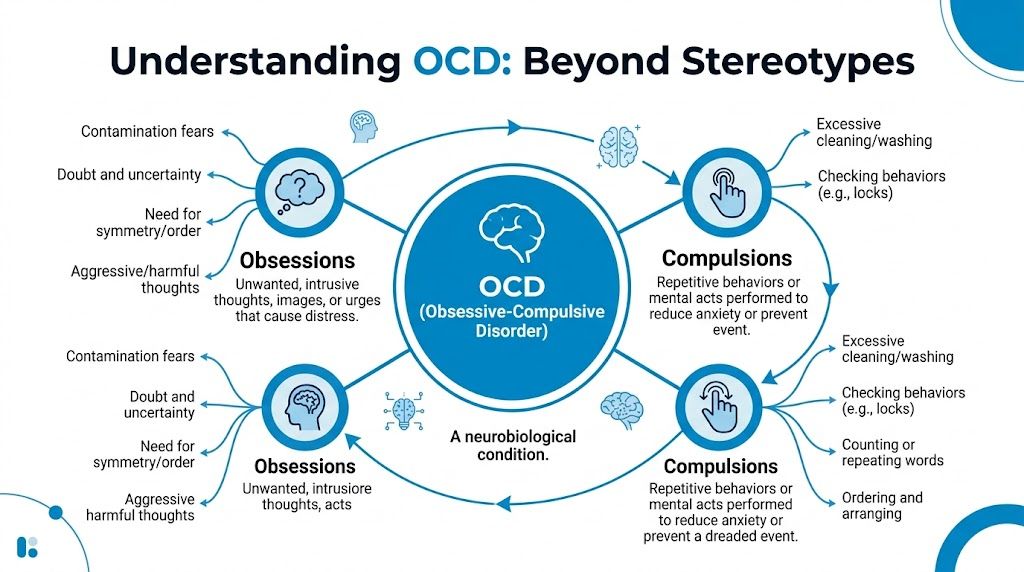
A useful way to understand OCD is to think of it as a faulty alarm system. Your brain sends out a warning signal. The warning feels urgent and serious, even when there is no real danger or when the danger is wildly exaggerated.
You respond by checking, avoiding, washing, confessing, googling, reviewing, or seeking reassurance. That response brings a moment of relief. Then your brain learns the wrong lesson. It learns that the threat must have been important, because you treated it like an emergency.
OCD is not the same as being tidy or organised
A lot of people use “OCD” casually to mean neat, precise, or fussy. That isn’t accurate. A preference for order can be a personality style. OCD is different because it involves distress, loss of freedom, and repeated behaviour driven by anxiety.
Someone who likes a clean kitchen enjoys cleanliness. Someone with OCD may clean because they feel terrified of what will happen if they don’t.
This distinction is often missed, especially when adults are high functioning. They may keep performing well at work while suffering intensely in private. This comparison image about psychologist vs psychiatrist can also help if you’re trying to understand what kind of support mental health professionals provide.
The hidden nature of OCD
The stereotype focuses on handwashing and visible rituals. But many forms of OCD are almost invisible. The compulsions happen inside the mind. The person may look calm while internally battling fear, guilt, or doubt for hours.
Practical rule: If a thought feels intrusive, upsetting, repetitive, and pushes you to do something to feel safe or certain, OCD is worth considering.
That doesn’t mean every intrusive thought is OCD. It means the pattern matters. The thought appears. Anxiety rises. A ritual follows. Relief comes briefly. Then the cycle repeats.
Common Obsessions You Might Experience
Obsessions are not mere worries. They tend to feel sticky, repetitive, and hard to dismiss. They often go against your values, which is why they can feel so disturbing.

Fear of harm and responsibility
A common sign of OCD in adults is an exaggerated fear of causing harm. You may know rationally that you’re careful, but your mind keeps generating “what if” scenarios.
Examples include:
- Home safety fears such as worrying you left the gas on, caused a fire, or didn’t lock the door properly.
- Driving fears where you replay a journey and panic that you may have hit someone without noticing.
- Work-related responsibility such as fearing one typo in a document could trigger a catastrophic chain of consequences.
For expats, this can latch onto unfamiliar systems. If you’re already adjusting to Italian bureaucracy, rental contracts, or medical appointments in another language, your mind may fixate on the possibility of a costly mistake.
Taboo thoughts and moral distress
Some obsessions involve thoughts that feel shocking, shameful, or morally unacceptable. These might concern sex, religion, violence, identity, or blasphemy. People often panic because they mistake the thought for intent.
That misunderstanding causes enormous distress. In reality, OCD often attacks what matters most to you. If you value kindness, you may get violent intrusive thoughts. If you value morality, you may get obsessive doubts about being a bad person.
Perfectionism and relationship doubts
Not all obsessional themes sound dramatic. Some sound almost respectable.
You may become consumed by getting a presentation exactly right, writing the perfect message, pronouncing Italian correctly, or choosing the “right” wording so nobody misunderstands you. This isn’t ordinary conscientiousness when it becomes paralysing.
Another pattern is relationship OCD. You might feel trapped in repeated doubts like:
- Do I really love my partner enough?
- What if I’m missing a red flag?
- What if one moment of doubt means the relationship is wrong?
Later in the day, this quick visual explanation can help connect intrusive thoughts with everyday experience:
If you’re questioning whether what you feel is significant, this assessment image may be a useful reminder that private distress still counts, even when nobody else can see it.
Recognising Compulsions and Mental Rituals
Compulsions are the actions people take to feel safer, more certain, or less guilty. Some are visible. Some are entirely mental.
The key point is not the form of the ritual. It’s the function. A compulsion is something you do to neutralise distress.
Visible compulsions
These are easier to recognise because other people may notice them.
Common examples include:
- Checking locks, appliances, documents, bags, or messages repeatedly
- Cleaning hands, surfaces, or personal items in a way that goes beyond ordinary hygiene
- Ordering objects until they feel symmetrical or “just right”
- Avoiding certain places, words, people, or situations because they trigger obsessional fear
Visible rituals can look practical at first. In OCD, they become rigid, repetitive, and hard to stop even when you know they’re excessive.
Mental rituals
Many adults often find themselves confused. They think, “I can’t have OCD because I don’t wash my hands or count tiles.” But mental rituals are a core part of OCD.
According to Stanford’s explanation of OCD, mental rituals such as silent counting or internal reassurance-seeking can consume more than an hour a day and impair cognitive function through hyperactivity in cortico-striato-thalamo-cortical circuits in the brain, as described in their guide to understanding obsessive-compulsive disorder.
Mental rituals often sound like this:
- Reviewing a conversation again and again to make sure you didn’t offend someone
- Repeating a phrase internally until it feels safe
- Praying in a rigid way to cancel a bad thought
- Reassuring yourself with silent arguments such as “I would never do that”
- Googling for certainty and never feeling settled by the answer
Why the cycle gets stronger
Compulsions work briefly. That’s the trap.
You check the door and feel better for ten minutes. You reread the message and feel calmer for a moment. You ask a friend for reassurance and feel relief until the doubt returns.
The short-term relief is real. The long-term effect is that OCD gets louder.
If you’ve seen references to cognitive behavioural therapy for anxiety and online therapy, that can be helpful background, because effective OCD treatment often targets this exact cycle rather than arguing with every intrusive thought.
Is It OCD or Something Else
Adults often hesitate because they don’t want to overreact. That caution makes sense. Not every repetitive thought is OCD, and not every careful habit is a symptom.
A simpler question helps. Is the thought part of a loop of distress and ritual, or is it just concern, preference, or habit?
A practical comparison
| Experience | Usually feels like | Main driver | What follows |
|---|---|---|---|
| OCD | Intrusive, unwanted, often alien or disturbing | Fear, doubt, urgency, need for certainty | Compulsions, mental rituals, avoidance |
| General anxiety | Ongoing worry about real-life problems | Concern about future outcomes | Planning, overthinking, tension |
| Strong habits or conscientiousness | Chosen routines or standards | Preference, discipline, values | Behaviour feels useful and flexible |
With OCD, thoughts often feel ego-dystonic. That means they clash with who you are. A kind person may be horrified by violent intrusive thoughts. A faithful person may be shaken by blasphemous images. A careful employee may be tortured by endless doubts about tiny mistakes.
Questions worth asking yourself
- Does the thought feel unwanted and repetitive?
- Do I do something to neutralise it or feel certain again?
- Does it consume time, energy, or attention?
- Is it affecting work, study, relationships, sleep, or daily freedom?
If the answer is often yes, OCD becomes more likely.
Where people get stuck
Perfectionism creates a lot of confusion. Being thorough is not the same as OCD. The difference is flexibility. A healthy standard bends when needed. OCD demands that you keep going until the feeling of certainty arrives, even though it rarely does.
The same applies to worry. In general anxiety, the mind usually worries about realistic life problems. In OCD, the mind often locks onto unlikely possibilities, taboo content, or impossible standards of certainty and moral purity.
If you’re unsure whether your distress has crossed the line from stress into something more entrenched, this image on do I need a psychologist can be a gentle prompt to take your own experience seriously.
How OCD Can Impact Your Life as an Expat in Italy
Living abroad asks a lot from the mind. You’re processing new rules, new language, new social cues, and often a new version of yourself. If OCD is already present, that uncertainty can become perfect fuel.

Work and study pressures
Expats often feel they must prove themselves. That pressure can intensify checking, perfectionism, and fear of mistakes.
You may spend far too long on routine tasks because your brain keeps insisting that one small error in Italian could damage your reputation. You may avoid sending emails, delay assignments, or repeatedly ask colleagues for reassurance.
Relationships and social life
OCD can interfere with closeness in subtle ways. You might seek reassurance from a partner over and over. You might obsess over whether you offended someone at dinner. You might replay a text conversation for hours because a joke didn’t land in the way you intended.
This can look like social anxiety or cultural awkwardness from the outside. Inside, it feels more relentless. The mind isn’t just embarrassed. It’s trying to eliminate uncertainty completely.
Why expat stress can amplify symptoms
Cultural adaptation already creates ambiguity. Language barriers make communication feel less precise. Distance from family and familiar routines can reduce your sense of safety. Even simple administrative tasks can trigger outsized responsibility fears.
When your whole environment feels less predictable, OCD often promises certainty. That promise is seductive, but it comes at the cost of freedom.
A person might think, “I’m just stressed because I moved.” Sometimes that’s true. Sometimes relocation stress is also masking a pattern that deserves proper treatment.
Your Path to Regaining Control and Well-Being
OCD is treatable. That matters, because many adults spend years thinking they should be able to solve it alone.
The turning point usually comes when someone stops asking, “Why am I like this?” and starts asking, “What process is keeping this cycle alive?”
When to seek help
It’s time to get support if your symptoms are interfering with daily life, consuming significant mental space, or making you avoid situations you value. You don’t need to wait until things are extreme.
Some signs that help would be useful:
- You lose time to checking, reviewing, repeating, or reassurance-seeking
- You avoid ordinary tasks because they trigger obsessional doubt
- You feel ashamed of thoughts that don’t reflect your true intentions
- You keep trying self-help strategies but the same loop returns
What effective treatment often looks like
The best-known psychological treatment for OCD is Exposure and Response Prevention, often called ERP. In plain language, ERP helps you face the trigger and resist the ritual that usually follows.
If your OCD says you must reread the email six times, ERP may involve sending it after a more limited check and then tolerating the discomfort without going back. If your mind demands reassurance, ERP helps you notice the urge without feeding it.
This work is structured and collaborative. It isn’t about throwing you into panic. It’s about helping your brain learn that anxiety can rise and fall without rituals, and that uncertainty can be tolerated.
Some people also explore broader approaches to care, including psychiatric input where needed. If you want a general overview of combined approaches, this piece on integrative OCD treatment gives useful context on how therapy and medical support can sometimes fit together.
What therapy should feel like
Good OCD treatment should feel clear, respectful, and practical. You should understand why a therapist is suggesting a particular exercise. You should feel that your shame is met with competence, not shock.
For expats in Italy, language matters. If you’re explaining taboo thoughts, perfectionism, or relationship fears, doing that in your strongest language can make a major difference. Cultural understanding matters too. A therapist should recognise the extra strain created by relocation, visa stress, intercultural relationships, and professional pressure in a foreign system.
Who works with OCD at Therapsy
These clinicians work with obsessive-compulsive difficulties specifically, in English.
Dr. Silvia Cau works with OCD, anxiety, mood disorders and trauma using Acceptance and Commitment Therapy, in which the aim is not to argue thoughts down but to loosen their grip enough to act on what matters to you. She is in Cagliari and works online.
Dr. Giorgia Pro works with obsessive-compulsive difficulties, anxiety, self-esteem and identity, with children, teenagers, adults and families. She offers sessions in Spanish and French as well as English and Italian, in Rome.
Dr. Paola Lazzarini works with OCD alongside behavioural addictions and eating disorders, and offers sessions in Spanish as well as English and Italian, in Brescia and Cremona.
You do not have to work out who fits on your own. You tell Therapsy what you are looking for, a member of our clinical team reads your request, and they introduce you. The first call is free.
Take the First Step Today
If you recognised yourself in these signs of OCD in adults, try not to turn this article into another ritual. You don’t need to analyse every sentence or prove your suffering beyond doubt before seeking support.
The important question isn’t whether your experience matches every example perfectly. The important question is whether a recurring pattern of intrusive thoughts and compulsive responses is narrowing your life.
Many people feel relief from learning that OCD can be subtle, internal, and effectively treatable. If you want a broader sense of what first-step mental health screening can involve, this overview of a private mental health assessment may help make the process feel less mysterious.
Understanding the pattern is often the first moment of real change.
You don’t need to keep living in a private argument with your own mind. Help exists, and it can be practical, compassionate, and effective.
If you’re looking for multilingual, evidence-based psychotherapy in Italy, THERAPSY offers online and in-person support for expats, international students, young adults, couples, and adults. You can start with a free assessment call and speak with a human who helps match you with a licensed therapist who fits your needs and language. Book your first free assessment call.