Moving to Italy can feel exciting and disorienting at the same time. You might love the light, the food, the pace of daily life, and still find yourself lying awake at night replaying small interactions. Did I say the wrong thing in class? Did my manager think I sounded incompetent? Why does every simple task suddenly feel hard?
That experience is common. Anxiety often grows in the gap between what you used to know automatically and what now takes effort. In a new country, ordinary life can become mentally expensive. Booking an appointment, making friends, understanding bureaucracy, dating across cultures, or speaking in a language that isn't your own can all keep your nervous system on alert.
If you're searching for cognitive behavioral therapy for anxiety, you're probably not looking for theory alone. You want to know what it is, whether it works, and what getting help would look like in Italy. This guide is written for that moment. It explains CBT in plain English, with examples that fit expat and international student life, so you can understand how anxiety works and what helps shift it.
Anxiety in a New Country and How CBT Can Help
Why anxiety often gets louder after relocation
Anxiety in a new country doesn't always arrive dramatically. Sometimes it shows up as overthinking, irritability, stomach tension, procrastination, or avoiding messages because answering them feels oddly overwhelming.
For expats and international students in Italy, anxiety often has an intercultural layer. You may be coping with homesickness, social uncertainty, academic pressure, professional burnout, or the constant effort of translating yourself into another language and another set of social rules.
That matters because many people assume their distress is just part of “adjusting” and that they should push through it alone. But anxiety doesn't always settle on its own when your daily environment keeps asking your brain to stay vigilant.
Anxiety abroad often isn't a sign that you're failing to adapt. It's often a sign that your mind and body are working overtime to protect you.
What CBT offers when life feels too activated
Cognitive behavioral therapy for anxiety is a structured, practical form of therapy that helps you understand the patterns keeping anxiety going. It doesn't ask you to ignore reality or force positive thoughts. It helps you notice the link between what you think, what you feel, and what you do next.
For someone living in Italy away from familiar support, that structure can be grounding. CBT gives language to experiences that feel chaotic. It also gives you exercises you can use between sessions.
Examples include:
- Spotting threat-focused thoughts that appear automatically in social, academic, or work situations
- Reducing avoidance when anxiety pushes you to cancel plans, delay tasks, or stay silent
- Testing fears in real life rather than treating every anxious prediction as fact
- Building routines that create steadiness when life feels culturally unanchored
If you're still settling in, practical relocation support can also reduce background stress. Resources like these essential tips for moving abroad can help you lower the day-to-day friction that often feeds anxiety indirectly.
When support becomes especially important
You don't need to wait until things feel unmanageable. CBT can help if anxiety is starting to shape your decisions, shrink your world, or make you feel unlike yourself.
Common signs include:
- Social avoidance: You want connection, but keep turning down invitations
- Mental overchecking: You rehearse conversations or emails repeatedly
- Physical tension: Your body stays braced even during ordinary tasks
- Loss of confidence: You second-guess abilities that once felt natural
Seeking help early isn't overreacting. It's often the clearest way to stop anxiety from organising your life around fear.
What Is Cognitive Behavioural Therapy for Anxiety
A simple way to understand CBT
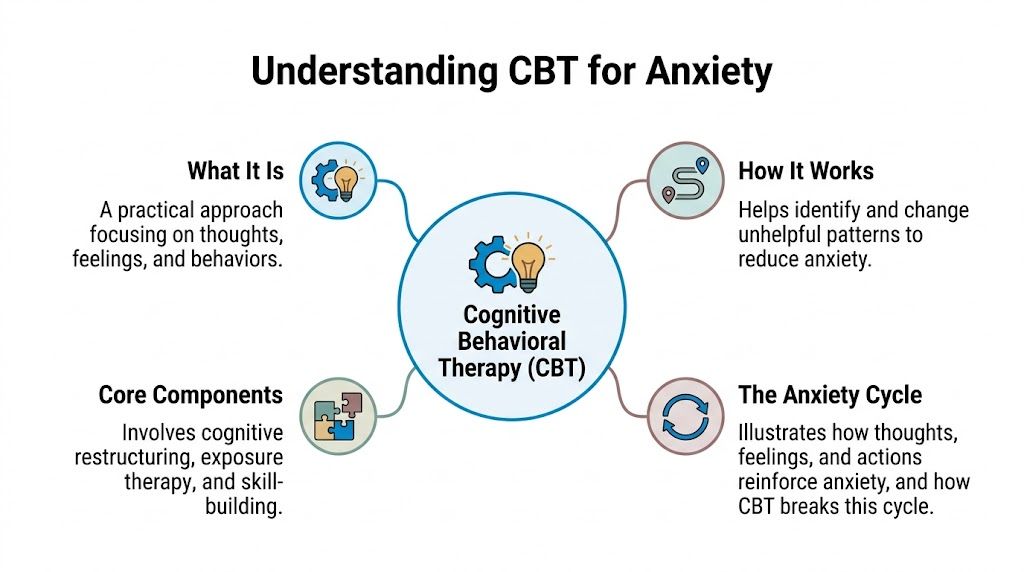
The easiest way to understand cognitive behavioral therapy for anxiety is to think of it as working with a mental feedback loop.
Something happens. You have a thought about it. That thought creates anxiety in your body. Then you respond in a way that makes short-term sense, but often keeps the anxiety alive.
For example, you get invited to an aperitivo with Italian colleagues. Your mind says, “I'll sound awkward and everyone will notice.” Your chest tightens. You decline the invitation. You feel relief that evening, but your brain learns that avoidance kept you safe. Next time, the fear returns even faster.
CBT helps you interrupt that loop.
The three parts of the anxiety cycle
CBT often looks at three connected parts of experience:
| Part | What it sounds or feels like | What happens next |
|---|---|---|
| Thoughts | “I'm going to mess this up” | You predict threat |
| Feelings and body | Fear, shame, racing heart, tight stomach | Your system prepares for danger |
| Behaviours | Avoiding, overpreparing, reassurance-seeking | Anxiety gets reinforced |
This is why CBT isn't just “thinking positively.” It isn't about replacing every anxious thought with a cheerful one. It's about asking whether a thought is accurate, useful, and complete. Then it's about changing the behaviour that keeps fear convincing.
Practical rule: If a strategy reduces anxiety immediately but shrinks your life over time, CBT gets curious about it.
What CBT sessions actually focus on
In therapy, you and your therapist look closely at recent moments of anxiety. Not in a vague way. In a detailed, concrete way.
You might explore:
- The trigger: What happened just before the anxiety rose?
- The meaning you gave it: What did your mind predict?
- Your response: Did you avoid, freeze, overexplain, or seek reassurance?
- The outcome: What did the situation teach your anxious brain?
Over time, you learn to identify distorted conclusions before they run the whole interaction. You also practise new responses that help your nervous system learn that discomfort isn't the same as danger.
The process often begins with an assessment: understanding patterns before trying to change them.
Why CBT is considered a strong option for anxiety
CBT is one of the most studied approaches for anxiety. A large review of 409 trials involving over 52,000 patients found that CBT for anxiety achieved a 42% response rate, showed a large effect size of g=0.79, and had a Number Needed to Treat of 3.6 for remission (industry sources).
You don't need to memorise those terms. The practical meaning is simpler. CBT has been tested a lot, across many settings, and it consistently helps many people reduce anxiety in a meaningful way.
For expats, another point matters just as much as the method itself. Therapy is often more effective when you can explain yourself fully, without translating your emotions in your head first.
The Evidence Behind CBTs Effectiveness
What the research means in everyday language
People often hear that CBT is “evidence-based” and don't know what that means for real life. In practice, it means researchers have studied cognitive behavioral therapy for anxiety across many groups and found that it repeatedly helps people reduce symptoms, function better, and in many cases recover substantially.
A landmark 2008 meta-analysis found that CBT for anxiety disorders showed an effect size of 0.73 compared to placebo.
If you're not used to research language, the important part is this. CBT doesn't help only in a narrow set of situations. It has strong support across different kinds of anxiety.
Different anxiety problems, same underlying pattern
Although anxiety can look different from person to person, many forms share a familiar mechanism. The mind overestimates danger and underestimates your ability to cope. Then behaviour shifts to protect you, often through avoidance or control.
That's why CBT can be useful for concerns such as:
- Generalised worry: Your mind keeps scanning for what could go wrong
- Social anxiety: You fear embarrassment, judgment, or exclusion
- Panic symptoms: Physical sensations get interpreted as dangerous
- Phobias: Specific situations trigger intense fear and avoidance
The techniques vary depending on the problem, but the treatment logic stays coherent. Identify the fear pattern. Test it. Reduce avoidance. Build tolerance for uncertainty.
Why this matters in Italy
For expats and international students in Italy, anxiety isn't only about internal symptoms. It often gets tangled with context. You may be dealing with unstable housing, unfamiliar academic expectations, family pressure from home, or stress from navigating work life in another language.
In those conditions, it helps to use a therapy model that is organised and transparent. CBT tends to suit that need because it gives both therapist and client a shared map. You're not left wondering what therapy is for or whether you're “doing it right.”
Some people also find it helpful to combine CBT with stabilising practices such as breathing work, mindfulness, or body-based regulation. This guide to mindfulness shows how calming skills can complement cognitive work.
Good anxiety treatment doesn't only reduce symptoms. It helps you re-enter the parts of life that anxiety has been quietly narrowing.
A realistic view of effectiveness
CBT isn't magic, and it doesn't erase all stress. If you're living through a major transition, some anxiety is understandable. Therapy helps you respond to that anxiety differently, so it stops dominating your choices.
That's an important distinction. The aim isn't to become fearless. The aim is to become less governed by fear.
For many people, that looks like speaking up even while nervous, attending the event even with a fast heartbeat, or stopping the habit of treating every uncertain situation like a threat. Those shifts may sound small from the outside. In therapy, they're often the beginning of real freedom.
Core CBT Techniques Explained With Examples
Cognitive restructuring
One of the central tools in cognitive behavioral therapy for anxiety is cognitive restructuring. That phrase sounds technical, but the process is straightforward. You learn to catch an anxious thought, examine it, and build a more balanced version that fits the facts better.

An example from expat life in Italy:
You go to a group dinner and struggle to follow the conversation in Italian. On the way home, your mind says, “Everyone thinks I'm boring and awkward.”
A CBT therapist won't say, “That's not true.” Instead, they might ask:
- What evidence supports that thought?
- What evidence doesn't support it?
- Are you confusing discomfort with rejection?
- If a friend said this about themselves, what would you tell them?
A more balanced thought might become, “I felt self-conscious tonight because I was tired and translating in my head. That doesn't mean people judged me harshly.”
A 2022 Italian multicentre RCT found that 12 weekly CBT sessions reduced GAD-7 scores by 68%, and the core mechanism of cognitive restructuring for catastrophic predictions showed a very large effect size of Cohen's d=1.42 (pmc.ncbi.nlm.nih.gov).
Exposure therapy
Exposure therapy helps when anxiety leads you to avoid situations that feel risky. The key idea is simple. Avoidance teaches your brain that the situation was dangerous. Gradual exposure teaches your brain that you can survive the discomfort and that the feared outcome often doesn't happen in the way anxiety predicts.
For an expat, exposure might involve social anxiety around speaking Italian in public.
A graded approach could look like this:
- Low-pressure practice: Ask for a coffee order in Italian.
- Slightly harder step: Make small talk with a cashier.
- Bigger challenge: Join a language exchange for half an hour.
- Meaningful exposure: Attend an aperitivo and stay even if you feel awkward.
The point isn't to feel calm before you act. The point is to act in a manageable way while learning that anxiety can rise and fall without needing to control everything.
If social situations are one of your main triggers, this resource on how to deal with social anxiety describes the kind of fear pattern many people work on in CBT.
Behavioural experiments
Behavioural experiments are small real-world tests. They help you check whether an anxious belief is true.
Suppose your belief is, “If I ask a question in my university seminar, people will think I don't belong here.”
A behavioural experiment doesn't argue abstractly. It creates data from life.
You might:
- Ask one genuine question in class
- Notice how people respond
- Record what you predicted would happen
- Compare the prediction with the result
Sometimes the feared outcome doesn't happen. Sometimes it happens only mildly. Sometimes you do feel embarrassed, but you also realise you can tolerate that feeling better than you expected.
That's powerful because anxiety often survives by staying untested.
Anxious thoughts feel like facts when they live only in your head. They often weaken when you test them in the world.
Relaxation and regulation skills
Relaxation techniques don't cure anxiety on their own, but they help create enough steadiness for you to use the other CBT tools well. If your body is highly activated, your mind is more likely to believe threatening interpretations.
In CBT, regulation skills might include:
- Slow breathing: To reduce physical escalation
- Grounding: To orient yourself when your mind races ahead
- Muscle relaxation: To release stored tension
- Brief settling routines: Before work meetings, classes, or social events
These skills work best when used as support, not escape. The goal isn't to make sure you never feel anxious. The goal is to stay present enough to choose your response instead of being pushed around by fear.
A brief demonstration can make these methods easier to picture:
How these techniques fit together
CBT works well because the techniques reinforce each other.
- Cognitive restructuring changes how you interpret threat.
- Exposure changes what your brain learns from action.
- Behavioural experiments test beliefs directly.
- Regulation skills help you stay engaged during the process.
That combination is what makes the therapy practical. You're not only talking about anxiety. You're changing the habits that keep it alive.
Your CBT Journey What to Expect From Therapy
How therapy usually begins
Starting cognitive behavioral therapy for anxiety often feels easier once you know the rhythm of it. CBT is usually active, collaborative, and fairly structured. That can be reassuring when anxiety already makes life feel uncertain.
Early sessions often focus on understanding your patterns in detail. Your therapist may ask about recent situations, physical symptoms, recurring thoughts, avoidance habits, sleep, stress, and what anxiety is interfering with most right now.
You don't need to arrive with perfect insight. Part of the work is learning how to describe what happens inside you with more clarity.
What a typical session feels like
Most CBT sessions are focused rather than free-floating. You and your therapist might begin by checking in on the week, then choose one or two main issues to explore.
A session often includes:
- Reviewing recent anxiety episodes: What happened, what you thought, and what you did
- Learning or practising a skill: Such as reframing a thought or planning an exposure
- Making sense of patterns: Especially the habits that bring short-term relief but long-term restriction
- Agreeing on practice between sessions: Small tasks that help therapy continue in daily life
This “between-session” part matters. CBT is effective partly because it doesn't stay in the room. You apply it while living your real life in Milan, Rome, Bologna, Florence, or wherever you are.
How long the process can take
CBT is often a time-limited therapy, though the exact length varies. Some people come with one clear problem, such as panic before oral exams. Others bring anxiety mixed with perfectionism, burnout, homesickness, or relationship strain.
What's more useful than counting sessions is watching for change in these areas:
| Early in therapy | Later in therapy |
|---|---|
| Anxiety feels mysterious | Anxiety feels understandable |
| You react automatically | You notice and choose more often |
| Avoidance runs the show | You can face more situations gradually |
| Fear defines the next step | Values and goals start guiding action |
Why flexibility matters for mobile lives
For young adults and professionals in Italy, attendance isn't a small issue. Travel, exams, relocation, and irregular schedules can disrupt therapy even when motivation is strong.
Italian data from the Ministry of Health, reported in a review on digital CBT, found that dropout rates can reach 40% for in-person therapy among mobile young adults, while hybrid online models can reduce dropout to around 22% (pmc.ncbi.nlm.nih.gov).
That doesn't mean in-person therapy is wrong. It means fit matters. If your life is mobile, the format of therapy can affect whether you stay with it long enough to benefit.
Therapy works best when it fits the reality of your life, not an ideal version of it.
What often surprises people
Many new clients expect therapy to remove anxiety quickly. More often, CBT helps you build a different relationship with it. You still notice the spike in your body. The difference is that you become less likely to obey it immediately.
That change can feel subtle at first. Then one day you realise you replied to the message, went to the event, asked the question, or made the phone call without spending the whole day trapped in dread.
That's usually how progress looks. Less drama. More freedom.
How to Choose a CBT Therapist in Italy
Finding the right therapist in a new country can feel harder than deciding to start therapy in the first place. Credentials may be unfamiliar. Search results can be confusing. And when you're already anxious, comparing options can become one more task you postpone.
What to look for first
The first filter is professional qualification. You want a licensed psychologist or psychotherapist with specific experience in cognitive behavioral therapy for anxiety.
Then look at practical fit.
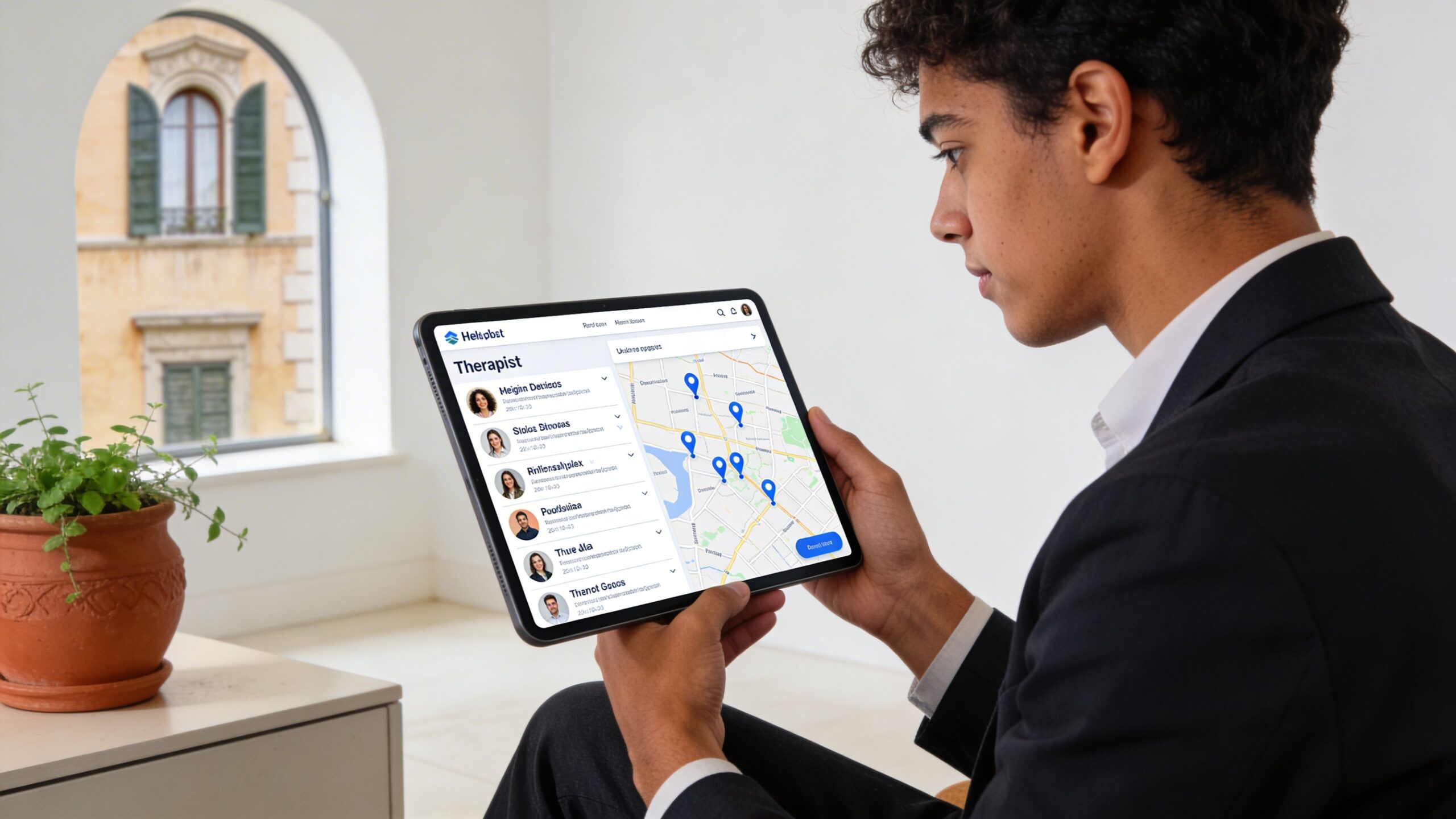
A good shortlist usually includes these criteria:
- Language fit: You can discuss complex emotions without searching for words
- CBT training: The therapist uses structured methods for anxiety, not only general supportive conversation
- Cultural sensitivity: They understand relocation stress, identity strain, and intercultural relationships
- Format options: Online or in-person sessions that suit your schedule and city
- Clear process: You know what the first step is, what sessions are like, and how matching works
Why language matters more than many people expect
Speaking in your native language isn't only about comfort. It changes the quality of therapy. Anxiety often lives in quick, automatic thoughts. If you have to translate those thoughts before you say them, important nuance can get lost.
This is especially relevant for expats and international students. The anxiety itself may be tied to language. You might feel ashamed when you can't express yourself fluently outside therapy. In the therapy room, you shouldn't have to keep performing competence.
That's one reason multilingual care can be so valuable in Italy.
A useful question beyond qualifications
When choosing a therapist, it helps to ask not only “Are they qualified?” but also “Can I imagine thinking openly with this person?”
That includes interpersonal qualities such as clarity, steadiness, warmth, and the ability to challenge you respectfully. Although coaching and psychotherapy are different fields, general relational qualities still matter. This overview of characteristics of a good coach is useful because it highlights traits like listening, attunement, and communication style, which also affect whether any helping relationship feels safe and productive.
How to evaluate practical access in Italy
If you live in a large city, local availability may matter. If you travel often or plan to move, continuity may matter more than location.
You can use a simple decision frame:
| If this matters most to you | Prioritise this |
|---|---|
| Speaking freely in your strongest language | Multilingual therapist matching |
| Keeping therapy going during travel or relocation | Online continuity |
| Feeling anchored in your local community | In-person access in your city |
| Anxiety tied to expat life or mixed-culture relationships | Intercultural experience |
For people looking specifically in major Italian cities, Therapsy’s Milan locations show the kind of city-based access many clients look for when they want in-person support.
A final standard to keep in mind
Good therapy shouldn't feel mysterious. The therapist doesn't need to overwhelm you with jargon, but they should be able to explain how they work, what they think is maintaining the anxiety, and what treatment will involve.
If those answers stay vague, keep looking. Anxiety already creates enough confusion. Therapy should bring more clarity, not less.
Your Path Forward With Therapsy
When you're anxious, the hardest step is often the first one. Not the deep emotional work. Just the act of beginning. That's why the process matters.
Therapsy is designed for people who need mental health support that fits international life in Italy. That includes expats, international students, young adults, couples, and professionals who want therapy in a language they can think and feel in naturally.
What the process looks like
You begin with a free assessment call. This isn't a pressure-filled sales conversation. It's a chance to speak with a human Clinical Director about what you're dealing with, what kind of support you're looking for, and what language and format suit you best.
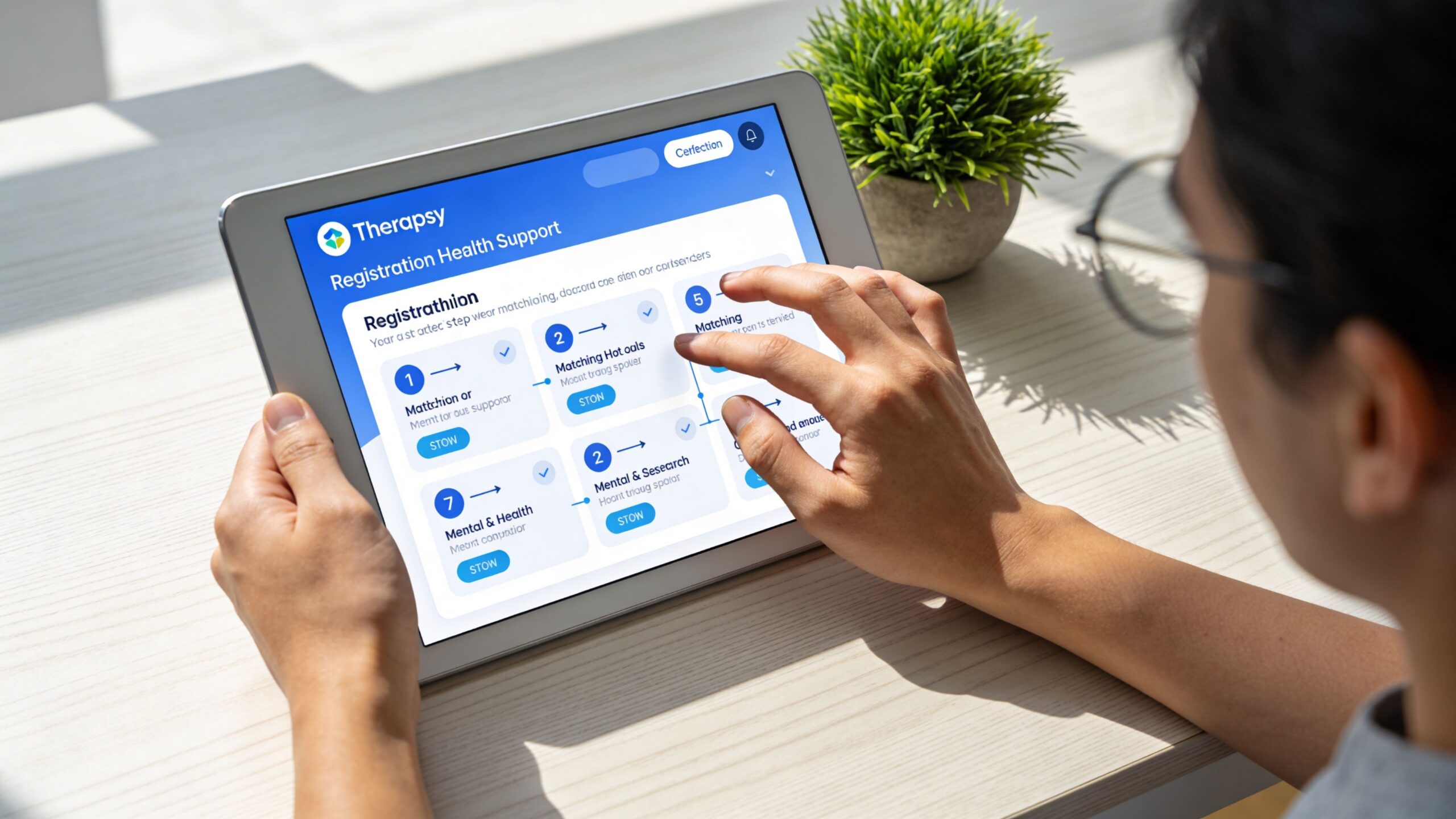
From there, the service matches you with a licensed psychologist or psychotherapist based on your goals, preferences, and practical needs. Sessions are available online from anywhere in the world, and in person across major Italian cities.
For many expats, that matching process is the key difference. Instead of spending hours trying to guess from directories who might understand relocation stress, language needs, or intercultural relationships, you start with a guided human conversation.
Why this model suits anxious clients well
Anxiety often makes decision-making harder. Too many choices can lead to more delay. A clear intake process reduces that burden.
Therapsy also offers:
- Multilingual care: Including English, Italian, French, Spanish, German, Portuguese, Russian, Ukrainian, Greek, and Hebrew
- Evidence-based support: For anxiety, stress, burnout, depression, OCD, relationship issues, and life transitions
- Online and in-person flexibility: So care can continue even when life changes
- Integrated psychiatric consultations when appropriate: For clients who need a broader clinical pathway
- Transparent pricing: With sessions starting from €70
Social proof can also help when taking a first step feels vulnerable. Therapsy’s reviews on Trustpilot offer a quick sense of how clients experience the service.
Starting therapy doesn't require certainty. It only requires enough willingness to let someone help you sort what feels tangled.
What makes it especially relevant for expats
Many therapy services in Italy are built for local clients first. Therapsy is built with international life in mind. That means the emotional reality of moving countries isn't treated as a side note. It's part of the clinical understanding from the start.
If your anxiety is tied to language, belonging, burnout, isolation, identity, or the strain of building a life far from home, that context matters. Good therapy should recognise it immediately.
Frequently Asked Questions
Is online CBT as effective as in-person therapy for anxiety
For many people, yes. The best format is often the one you can attend consistently and engage. For expats, students, and mobile professionals in Italy, online care can make therapy easier to sustain when schedules or locations change.
Can I do CBT if I'm not sure my anxiety is “serious enough”
Yes. You don't need to wait for a crisis. CBT can help when anxiety is already affecting sleep, concentration, relationships, study, work, confidence, or your willingness to do ordinary things.
What's the difference between a psychologist and a psychiatrist
A psychologist or psychotherapist provides talking therapy. A psychiatrist is a medical doctor who can assess whether medication is appropriate. Some people need therapy only. Others benefit from combined support. Therapsy can also arrange integrated psychiatric consultations when that makes sense clinically.
I speak English well. Do I still need therapy in my native language
Not always, but many people find that deeper emotional work becomes easier in the language that feels most instinctive. This is especially true when discussing fear, shame, grief, family dynamics, or identity struggles.
What if I don't know which therapist I need
That's common. You don't need to figure it out alone. A structured assessment and matching process can help identify the right clinician based on your concerns, language, and preferences.
If anxiety has started shaping your life in Italy more than you'd like, you don't have to keep working it out alone. Therapsy offers multilingual, evidence-based psychotherapy for expats, international students, young adults, couples, and adults across Italy, with online and in-person options and a supportive matching process that starts with a real human conversation. Book your first free assessment call.