You wake up in Italy and feel nothing. The light is beautiful, the streets are full, people are ordering coffee at the bar, and somehow your body feels heavy and far away from all of it. Many expats feel ashamed of this. They think, “I live in Italy. I should be grateful. Why do I feel so low?”
That reaction is common, and it’s one reason people wait too long before getting help. If you’re searching for how to deal with depression, start here: depression is not ingratitude, weakness, or a failure to adapt well enough. It’s a real mental health condition, and living abroad can intensify it in ways that are easy to miss at first.
For expats in Italy, depression often gets tangled up with relocation stress. Language barriers make ordinary tasks draining. Distance from family removes the support you’d usually lean on without thinking. Cultural differences can leave you feeling socially present but emotionally alone. Data cited in this overview of treatment-resistant depression notes that expats and migrants can experience depression rates up to 40% higher than local populations, and only 20% access therapy, with native-language access being a major barrier.
You don't need to solve everything today. You need a way to get through today, understand what’s happening, and take the next useful step.
Navigating Darkness Under the Italian Sun
Depression abroad often hides behind a convincing story. You tell yourself you’re just tired from moving, stressed by paperwork, lonely because you miss home, or unsettled because your Italian isn’t strong enough yet. Sometimes that’s true. Sometimes those are the first layers of something deeper.
I see this often in expat mental health work. A person arrives in Italy hoping for renewal, then slowly loses interest in the very life they worked hard to build. They stop exploring. Messages go unanswered. Simple decisions feel enormous. Even pleasant things begin to feel flat.
Why expat depression can feel confusing
Part of the difficulty is contrast. Your surroundings may look enviable to other people. That contrast can make you minimise your own pain. It can also make friends back home misunderstand what you’re going through.
Depression can exist in a beautiful place. Environment matters, but it doesn’t override grief, stress, isolation, biology, or exhaustion.
For many expats, three pressures pile up at once:
- Language strain. Every phone call, medical appointment, and administrative task can feel like a test.
- Social disconnection. You may know people, but not yet feel known by them.
- Loss of familiar support. The people who used to notice when you were struggling are far away.
A foreign country also removes routines that used to regulate you. Your gym, your corner shop, your therapist, your best friend, your weekend habits, even your preferred foods may be gone. That doesn’t just create inconvenience. It can destabilise mood.
Start with one honest question
Ask yourself this: am I having a hard time adjusting, or am I starting to disappear from my own life?
That question matters more than whether you’re “coping well enough.” If you’re withdrawing, feeling persistently hopeless, or struggling to function, treat that seriously.
A small grounding image can help here. Think of your distress as something that deserves care, not judgement, like a person pausing in a city square because they’ve gone too far without rest. Even a simple visual cue, such as a person pausing in a quiet square, can remind you that slowing down is not failure.
A practical first response
When someone asks me how to deal with depression in an expat context, I don’t begin with grand reinvention. I begin with three tasks:
- Name it clearly. “I may be depressed” is more useful than “I’m just bad at this.”
- Reduce the next demand. Lower what you expect from yourself this week.
- Add support early. Don’t wait until you’re in full crisis to reach out.
That’s how movement begins. Not with motivation, but with accurate recognition and smaller next steps.
Recognizing Depression Beyond Culture Shock
Culture shock rises and falls. Depression tends to settle in and flatten life from the inside. That difference matters.
Someone adjusting to Italy might feel awkward at a dinner table because they can’t follow the conversation. Someone developing depression may stop wanting to attend the dinner at all, even when language isn’t the main problem. The first experience is stressful. The second points to loss of energy, pleasure, or hope.

What depression often looks like for expats
Depression doesn’t always announce itself as crying all day. More often, it appears as dullness, self-criticism, or emotional retreat.
You may still go to work, attend class, answer messages, and look “fine” while feeling internally shut down.
Common signs include:
- Mood changes. Persistent sadness, emptiness, numbness, irritability, or a sense that nothing feels worth the effort.
- Loss of interest. Places you wanted to visit, meals you used to enjoy, or plans you were excited about no longer feel appealing.
- Body symptoms. Sleeping too much or too little, appetite changes, slowed movement, agitation, or deep fatigue that rest doesn’t fix.
- Thinking changes. Poor concentration, indecision, harsh self-talk, guilt, hopelessness, or recurring thoughts that you’re trapped or failing.
A useful distinction
Here’s a simple way to separate adjustment stress from depression.
More likely adjustment stress
- You feel overwhelmed in specific situations.
- Relief comes when you speak your own language or connect with familiar people.
- Your mood still lifts at times.
- You can imagine things getting easier as you settle in.
More likely depression
- Low mood follows you across settings.
- Things that should help barely register.
- Ordinary tasks feel disproportionately hard.
- Your inner voice becomes increasingly negative and unforgiving.
Neither category means you should “wait it out” alone. But if your distress has become broad, persistent, and functionally impairing, treat it as depression until proven otherwise.
When to stop minimising it
Pay attention if your life has become smaller over the past few weeks. Are you avoiding messages, cancelling plans, skipping meals, neglecting hygiene, or struggling to get through basic responsibilities? Those are not small signs.
If your world is shrinking, your depression may be growing.
The earlier you recognise that shift, the easier it is to interrupt. Depression feeds on isolation, silence, and postponement. Naming the pattern is often the first moment of relief because confusion starts to lift.
Immediate Coping Techniques for Overwhelming Feelings
When depression is heavy, advice about “building a better life” can feel impossible. In acute moments, the goal is narrower. Bring your nervous system down enough to get through the next hour safely and with less suffering.
Use the body first
Thoughts are often too slippery when you’re overwhelmed. Start with physical grounding.
Try the 5 4 3 2 1 method:
- Name 5 things you can see
- Name 4 things you can feel
- Name 3 things you can hear
- Name 2 things you can smell
- Name 1 thing you can taste
This works well in ordinary Italian settings because it doesn’t require privacy. You can do it on a train platform, in a supermarket queue, or sitting on your bed.
Another reliable option is paced breathing. Inhale gently, pause, and exhale longer than you inhale. Don’t force it. The point is to signal safety to your body, not to perform a perfect exercise.
Make a low-energy rescue list
Depression often erases memory for what helps. Build a written list before your next difficult moment.
Include a few categories:
- People. One friend, one family member, one local contact.
- Places. A nearby bench, church, park, library, or café where you feel less trapped.
- Actions. Shower, tea, brief walk, change clothes, open curtains, eat something plain.
- Soothers. Music, a familiar jumper, a calming scent, a comforting film, a voice note from home.
If you need a reminder to slow down and choose one steadying action, this guide on how to cope with anxiety offers a few places to start.
Reduce the decision load
Depression gets louder when everything becomes a choice. Remove some choices in advance.
Practical rule: when you feel overwhelmed, don't ask “what will fix me?” Ask “what is the smallest helpful action available in the next ten minutes?”
Examples:
- Fill a glass of water.
- Stand on the balcony for two minutes.
- Send one message saying, “I’m having a hard day.”
- Eat bread, fruit, yoghurt, or soup if cooking feels impossible.
- Put your medication or keys where you can see them.
What usually doesn’t help
Certain coping habits bring short relief and longer pain. Be wary of:
- Isolating completely. Solitude can become emotional freefall.
- Overexplaining your mood to unsupportive people. That often increases shame.
- Using alcohol as emotional sedation. It can worsen mood and disrupt sleep.
- Waiting for motivation. Action usually comes before relief, not after it.
If your thoughts turn toward self-harm or you feel you may not stay safe, treat that as urgent and contact emergency support immediately. In those moments, coping techniques are not enough on their own. Safety comes first.
If you or someone near you is in immediate danger, call 112, the emergency number in Italy and across the EU. Therapy is not an emergency service.
Building a Supportive Daily Routine as an Expat
Depression improves when life becomes more predictable, more embodied, and less governed by avoidance. Routine helps because it reduces friction. You don’t have to reinvent yourself. You need a rhythm that carries you when mood doesn’t.

Use Italy to your advantage
Many expats imagine self-care has to be elaborate. In practice, some of the best anti-depressive routines in Italy are simple and local.
A student in Bologna might start with coffee, ten minutes of journalling, and a short walk before lectures. A professional in Milan might leave the metro one stop early and use that extra walk as transition time. Someone in Florence might build in an evening passeggiata, not as exercise perfection, but as a daily cue to leave the flat and rejoin the world.
These habits matter because depression narrows life. Routine gently widens it again.
Four anchors that stabilise mood
Food that is regular enough
Depression often disrupts appetite. Some people stop eating. Others graze all day without feeling nourished. Don’t aim for an ideal diet first. Aim for regular meals that are accessible in your actual life.
Think practical: yoghurt, bread, eggs, soup, fruit, pasta, beans, olive oil, cheese, frozen vegetables. Repetition is fine. Reliability matters more than variety when you’re depleted.
Movement that feels doable
You do not need a high-performance fitness plan. Walking counts. Stretching counts. Taking stairs counts. The key is regular contact with your body.
A gentle routine can begin with ten minutes outside each day. If that’s all you manage, it still interrupts the depressive tendency to remain shut indoors.
Sleep that is protected
Depression and sleep disrupt each other. Create a sequence your body can recognise. Lower lights, reduce stimulating input, and keep the final part of the evening boring in a good way.
If mornings are chaotic, structured habit-building can help. A practical resource on how to create a morning routine that actually sticks can be useful when your days feel unanchored.
Reflection that is light, not intense
Journalling helps when it’s structured. It harms when it becomes endless rumination. Keep it brief:
- What am I feeling?
- What happened before that feeling?
- What is one helpful thing I can do today?
For some people, small routines for improving mental health while studying or working help connect routine with care rather than pressure.
A better standard for success
A good routine is not the one you can follow on your best day. It’s the one you can still do on a hard day.
That’s the standard I recommend to expats. Keep it portable. Keep it forgiving. Build around your real energy, your commute, your language level, and your budget. Depression responds better to steady repetition than to dramatic resets.
Evidence-Based Self-Help and Professional Therapy Pathways
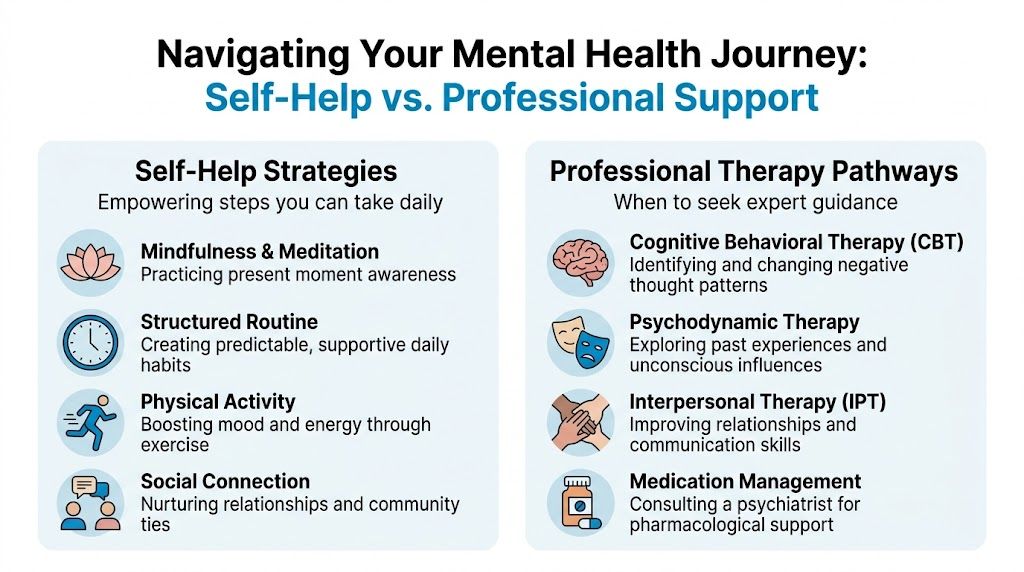
A common question in my practice is whether self-help is enough, especially for expats who are already spending so much energy coping with life in Italy. The answer depends less on willpower and more on impact. If depression is affecting your work, language learning, relationships, appetite, sleep, or ability to complete ordinary tasks, it makes sense to add professional support rather than waiting until things get worse.
Self-help that holds up clinically
Self-help works best when it is structured, modest, and repeated. In depression, the goal is not to feel motivated first. The goal is to create enough movement in the system that mood can begin to shift.
The approaches with the strongest clinical roots often come from cognitive behavioural therapy. They are simple, but not simplistic.
- Mood tracking. Record mood, sleep, activity, and triggers for a week or two. This helps separate patterns from the depressed brain’s tendency to flatten everything into “nothing helps.”
- Behavioural activation. Plan one or two specific actions before the day starts. Keep them concrete and small enough to complete even in Italian summer heat, after poor sleep, or when speaking another language already feels draining.
- Thought checking. Write the thought down exactly as it appears, then ask whether it is a fact, an interpretation, or a fear.
- Deliberate contact. Choose one safe person and one small interaction. Depression often reduces contact first, then uses the resulting isolation as proof that you do not matter.
A short written prompt is often enough:
“I noticed…”
“My mind said…”
“A fairer statement is…”
What therapy and medication add
Professional care adds something self-help cannot provide on its own. It gives you an outside perspective, a treatment plan, and a place where shame, avoidance, grief, and hopelessness can be addressed with skill rather than managed in private.
For expats in Italy, therapy also helps with context. Depression abroad is often tied to losses that are easy to minimise, such as reduced family contact, identity strain, visa stress, language fatigue, and the quiet exhaustion of doing daily life in translation. Good therapy does not treat those factors as side notes.
Medication is sometimes appropriate too. That does not mean medication is the right first step for everyone. It means depression deserves real treatment options, not self-criticism disguised as resilience.
Self-Help vs. Professional Care When to Choose Each Path
| Consider Self-Help When… | Consider Professional Help When… |
|---|---|
| Symptoms are mild and daily functioning is mostly intact | Symptoms are lasting, worsening, or disrupting work, study, sleep, relationships, or self-care |
| You can follow a few basic routines with effort | Basic routines keep collapsing despite repeated attempts |
| Painful thoughts are present but still open to challenge | Hopelessness, numbness, or worthlessness feel fixed and hard to question |
| You can use support from friends, family, or community | You are withdrawing, concealing how bad things feel, or feeling alone even with people around |
| You feel low but safe | You have thoughts of self-harm, feel unsafe, or are afraid of what you might do |
When psychiatry enters the picture
Some cases need more than weekly therapy and self-help tools. If symptoms are severe, longstanding, recurring, or only partly responsive to treatment, a psychiatric assessment can clarify whether medication, diagnostic review, or a different treatment plan is needed.
The National Institute of Mental Health explains that some people experience depression that does not improve after standard treatment, often called treatment-resistant depression, and may need a revised approach that includes medication changes, psychotherapy, or other interventions in consultation with a clinician. If you want a clearer sense of how talk therapy and medical care differ, this guide to psychologist vs psychiatrist roles can help.
For expats, psychiatric care can feel harder to arrange because accuracy matters. Describing side effects, suicidal thinking, panic, or dissociation in a second language increases the risk of misunderstanding. The life-threatening consequences of poor medical translation are not limited to hospitals. Mental health treatment also depends on precision.
In practice, the strongest plan is often layered. Self-help supports daily stability. Therapy helps you understand and change the patterns keeping depression in place. Psychiatry can be added when symptoms are heavier, more biologically driven, or less responsive than expected.
How Expats Can Access Multilingual Therapy in Italy
You finally decide to get help after weeks of dragging yourself through work, avoiding messages from home, and crying more than you can explain. Then a new problem appears. Every clinic website is in Italian, the intake forms use unfamiliar terms, and you are supposed to describe your mental state in a language you do not fully trust under stress.
For many expats in Italy, access is the barrier.
The World Health Organization has reported a wide treatment gap for depression, including in high-income countries, and expats often face extra barriers on top of that. In practice, I see the same obstacles repeatedly: uncertainty about how the Italian system works, fear of being misunderstood, long waits in public pathways, and hesitation about whether your distress is "serious enough" to justify private care.
Language is not a small detail in therapy. Depression often comes with shame, numbness, guilt, hopelessness, and thoughts people already struggle to say out loud. If you have to translate those experiences in real time, important meaning can get lost. The risks of unclear communication are well documented in healthcare more broadly. This article on the life-threatening consequences of poor medical translation gives useful context for why accuracy matters.
A good therapist for an expat in Italy needs more than clinical skill. They need to understand how migration stress can distort mood, sleep, identity, relationships, and confidence without assuming every symptom is "just culture shock." They should be able to work in the language that feels most emotionally natural to you, explain practical steps clearly, and tell you what happens if you later need medical input, insurance paperwork, or a psychiatric referral.
That is one reason multilingual online therapy is often the easiest starting point.
For expats, it removes several points of friction at once. You do not need to search city by city for an English-speaking clinician, worry about commuting across Milan or Rome when your energy is low, or force yourself into a local service that may not fit your language needs. Online therapy for expats in Italy is one reason many people start sooner: access feels simple and private. Therapsy stands out here because it offers multilingual care designed for people living between cultures, rather than treating language as an afterthought.
If you are not sure how to begin, keep the first step small. Book an initial consultation. You do not need a polished explanation. Clear and basic is enough:
- “I think I may be depressed.”
- “Living in Italy has become harder than I expected.”
- “I can function, but everything feels heavy.”
- “I need someone I can speak to in my own language.”
That gives a therapist plenty to work with.
A short explanation of how online support can feel in practice may also help:
Private therapy is usually the fastest route for expats who want choice in language and scheduling. Public services can be useful, but they often involve more administrative effort, more waiting, and less control over therapist match. The trade-off is cost. If finances are tight, ask directly about session frequency, online formats, or short-term structured support. Good care is not only about starting. It is also about choosing a format you can realistically continue.
Frequently Asked Questions on Managing Depression in Italy
What is the average cost of therapy in Italy
Private therapy fees vary widely by city, clinician, and format. Some services offer transparent pricing from €70 per session, but fees differ, so it’s worth checking directly before booking. If cost feels overwhelming, ask about online options, frequency flexibility, or whether an initial consultation can help you find the right level of support.
Are online therapy sessions as effective as in-person sessions
For many people, yes. Online therapy can work well when the therapist is a good fit, the platform is secure, and the person feels comfortable speaking openly in that format. For expats, online sessions can be especially helpful because they remove travel friction and widen access to multilingual care.
Do I need a doctor’s referral to see a therapist
In private practice, you often don’t need a referral to start therapy. Some psychiatric pathways or insurance arrangements may work differently, but for psychotherapy itself, people commonly book directly.
How do I know if I need therapy or medication
If your symptoms are mild and you’re still managing daily life, structured self-help may be a useful starting point. If symptoms are persistent, worsening, or affecting your functioning, therapy is a strong next step. Medication becomes worth discussing when symptoms are moderate to severe, when therapy alone isn’t enough, or when sleep, appetite, concentration, and hopelessness are significantly affected.
What should I do in a mental health emergency in Italy
If you feel at immediate risk of harming yourself or you cannot stay safe, seek emergency help immediately. Go to the nearest emergency department, call 112, or contact a trusted person who can stay with you and help you access urgent care. In an emergency, don’t stay alone with the hope that the feeling will pass.
What if I feel embarrassed asking for help
Embarrassment is common, especially for expats who are used to being capable and self-reliant. But depression is not a personal failure. Reaching out is a clinical decision, not a character flaw. If speaking feels difficult, write down a few sentences first and read them in session.
Recovery rarely begins with certainty. It begins with one clear act of care.
If you're struggling with how to deal with depression while living in Italy, you don't have to figure it out alone. THERAPSY offers multilingual psychotherapy for expats, international students, young adults, couples, and adults across Italy and online worldwide. You can start with a free assessment call with the Clinical Director, who will help match you with a licensed therapist in the language and format that fits you best. Book your first free assessment call.
Not sure whether what you are feeling is depression?
Our free online depression test takes two minutes. It is based on the PHQ-9, the screening questionnaire used by clinicians worldwide, and it is anonymous – no email required to see your result.
If the result suggests you could use support, the next step is a free first call with a licensed therapist who speaks your language, online or in person across Italy.