You moved to Italy for a fresh chapter. On the surface, life may even look enviable. Coffee in Florence, classes in Milan, work calls from Rome, weekends by the sea. But privately, your mind may feel trapped in a pattern you can’t explain. You reread a message ten times before sending it in Italian. You keep checking whether you offended someone. You get a sudden thought about harming a person you love and feel horrified by it. Then you try to “fix” the thought by reviewing it, praying, confessing, googling, or asking for reassurance.
These can be signs you have ocd, especially when the thoughts feel intrusive, repetitive, and out of step with who you are.
For expats and international students, OCD often hides behind other labels. People call it stress, overthinking, perfectionism, culture shock, or anxiety. Sometimes it is anxiety. But sometimes the pattern is more specific. OCD has its own rhythm, and once you recognise that rhythm, treatment becomes much clearer.
Navigating Unwanted Thoughts as an Expat in Italy
Living abroad often sharpens self-awareness. You notice your grammar, your tone, your body language, your manners, your mistakes. That’s normal. What’s harder is knowing when normal adaptation turns into relentless mental checking.

A common starting point sounds like this: “I know this thought doesn’t make sense, but I can’t let it go.” Another version is: “I keep doing small things to feel safe, but the relief never lasts.” Those are often the moments when people begin searching for signs you have ocd, usually late at night and often with a mix of fear and relief.
Why OCD can feel harder to spot abroad
In Italy, epidemiological studies estimate OCD affects approximately 1.2% of the adult population annually, and 50.6% of cases are classified as severe, which matters because many people wait too long before getting proper support.
When you’re far from home, symptoms can blend into expat life:
- Language strain: You may assume compulsive rereading is just being careful in a second language.
- Social uncertainty: You may call repeated reassurance-seeking “wanting to be polite”.
- Isolation: Without familiar people around you, intrusive thoughts can feel more believable.
- Cultural adjustment: You may dismiss distress as a temporary phase instead of noticing a clinical pattern.
Some people first realise something deeper is happening while reading about coping with anxiety abroad, then notice their experience isn’t just broad worry. It’s narrower, stickier, and tied to rituals.
OCD isn’t a character flaw. It’s a pattern of obsessions and compulsions that can become highly distressing, and it is treatable.
What to pay attention to first
If you’re wondering about signs you have ocd, start with function, not labels. Ask:
- Do the thoughts feel intrusive rather than chosen?
- Do you do something repetitive to get certainty or relief?
- Does the relief fade quickly, forcing you back into the cycle?
- Is it affecting your sleep, concentration, relationships, studying, or work?
That pattern matters more than whether your symptoms look “serious enough”. OCD ranges from visible rituals to invisible mental loops. Many expats miss it precisely because it doesn’t match the stereotype.
What OCD Really Is and What It Is Not
OCD is often reduced to tidiness, neatness, or liking things a certain way. That misunderstanding delays help. Clinical OCD is not about preferences. It’s about obsessions, compulsions, and the distressing loop between them.
Clear definition: OCD involves unwanted, intrusive thoughts, images, or urges that create distress, followed by repetitive behaviours or mental acts performed to feel safer, more certain, or less anxious.
The two core parts
Obsessions are intrusive experiences. They can be thoughts, images, doubts, or impulses. They aren’t enjoyable, and they usually target what matters most to you. A caring person may obsess about harm. A faithful person may obsess about blasphemy. A committed partner may obsess about whether the relationship is “really right”.
Compulsions are the things you do to neutralise that distress. Sometimes they’re visible, such as checking, washing, arranging, or avoiding. Sometimes they happen entirely inside your mind, such as reviewing, counting, mentally correcting, analysing, or praying in a rigid way.
If you’re unsure whether a thought is intrusive or whether it reflects an urge to act, this explanation of intrusive thoughts vs. impulsive thoughts is a useful distinction.
What OCD is not
OCD is not the same as being organised.
It’s not the same as having high standards.
It’s not the same as everyday worry.
And it’s not just “liking control”.
A perfectionistic person may spend a long time editing because they want excellent work. A person with OCD may spend hours rewriting because they fear a small mistake could make them immoral, dangerous, offensive, or catastrophically irresponsible. The behaviour can look similar from the outside. The internal driver is different.
Here’s another practical distinction:
- General anxiety often spreads across many areas of life.
- OCD tends to latch onto specific feared meanings and then demand rituals to reduce uncertainty.
- Non-clinical perfectionism may be rigid, but it doesn’t usually involve intrusive taboo thoughts and repetitive neutralising rituals.
Some people also confuse OCD with other mental health concerns and wonder who they should even speak to first. This overview on psychologist versus psychiatrist can help clarify the difference in roles.
Why accurate naming matters
If you call OCD “just stress”, you’ll probably use the wrong strategies. You may try to reason with every thought, seek reassurance, avoid triggers, or build stricter routines. Those moves feel sensible. In OCD, they often keep the cycle going.
The question isn’t “Do I hate mess?” The question is “Am I trapped in intrusive fear and repetitive attempts to feel certain?”
That’s the point where signs you have ocd become more than a curiosity. They become clinically relevant.
Common Obsessions You Might Be Experiencing
Many people know contamination OCD. Far fewer recognise the quieter themes that often torment expats and students. The obsessions can sound dramatic, taboo, or bizarre, which is exactly why people hide them.

The thoughts people rarely say out loud
Here are several forms obsessions can take.
- Fear of harm: You worry you left the stove on, hit someone while driving, contaminated a friend, or caused danger through carelessness.
- Relationship OCD: You keep doubting your feelings, your partner’s feelings, or whether the relationship is “right”, even when nothing concrete has changed.
- Sexual or taboo intrusive thoughts: You experience disturbing unwanted images or thoughts that clash with your values and leave you feeling ashamed or frightened.
- Religious or moral scrupulosity: You fear being sinful, dishonest, offensive, impure, or morally corrupt, then monitor yourself constantly.
- Symmetry or exactness: You feel intense distress if words, objects, or actions don’t feel balanced, complete, or “just right”.
- Real-event fixation: Your mind locks onto a past mistake and demands endless review to determine whether you are a bad person.
For expats, these themes often get tangled with adaptation. A simple email can become a mental crime scene. You reread it again and again, checking tone, hidden meaning, or possible disrespect in a non-native language.
A lot of people first notice this in patterns linked to adult anxiety symptoms while living abroad, but later realise the cycle is narrower and more ritualised.
Pure O is often invisible
Many expats in Italy experience subtle mental compulsions mistaken for adjustment stress, such as obsessively rereading emails in a non-native language.
Pure O does not mean there are no compulsions. It usually means the compulsions are mental and therefore harder to see.
Examples include:
- Mental reviewing: Replaying a conversation to check whether you sounded rude.
- Internal checking: Asking yourself repeatedly whether you really love your partner.
- Silent reassurance: Telling yourself “I would never do that” over and over.
- Compulsive googling: Searching for proof that your thought means nothing dangerous.
- Confessing: Repeatedly disclosing tiny details to feel morally clean.
This short video may help you recognise how intrusive thoughts and compulsive responses can hide in plain sight.
A useful reality check
If the thought feels alien, upsetting, and repetitive, and you keep doing mental acts to feel certain, that’s one of the clearest signs you have ocd. The content can vary a lot. The process is what links it together.
Recognising Compulsive Behaviours and Mental Rituals
Compulsions are often misunderstood as habits or preferences. They’re not. A compulsion is a response to fear, doubt, disgust, or a felt sense that something is incomplete. The purpose is relief. The problem is that relief trains the brain to return to the same alarm again.
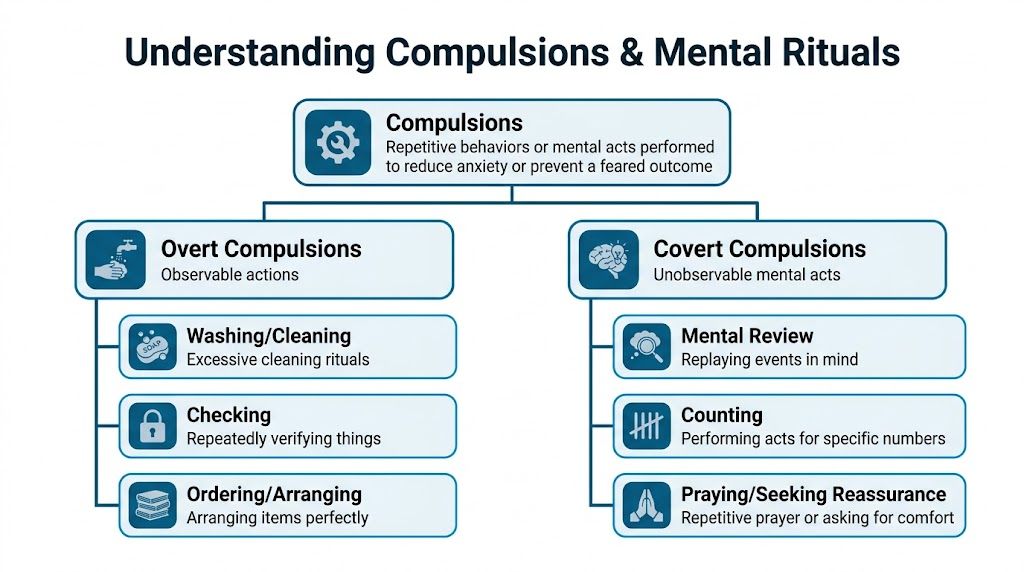
Overt compulsions
These are easier to spot because another person can often observe them.
- Checking locks, appliances, or messages
- Handwashing or cleaning
- Arranging objects until they feel correct
- Avoiding places, people, or situations linked to a feared thought
- Repeatedly asking others for reassurance
The visible action is only part of the story. Two people can check a lock. One checks once and moves on. The other checks repeatedly because doubt doesn’t settle.
Covert compulsions
These happen internally and are frequently missed in therapy unless someone asks the right questions.
- Mental review of past events
- Counting, repeating, or neutralising phrases
- Praying rigidly to cancel a thought
- Testing your feelings or attraction
- Scanning your body for signs of danger, arousal, guilt, or certainty
Someone may look calm while doing compulsions for hours. That’s why signs you have ocd can be missed by friends, teachers, colleagues, and even clinicians who focus only on visible rituals.
A basic mental health assessment process should include questions about these hidden rituals, not just checking and handwashing.
Why checking feels so convincing
In checking OCD, functional MRI studies show hyperactivity in a brain circuit involving the orbitofrontal cortex and caudate nucleus. This hyperactive loop creates excessive doubt and memory mistrust. Symptom provocation can increase blood flow in these areas by up to 30%, and targeted therapies such as ERP have been shown to normalise this activity by 15% to 25% after 12 weeks (Stanford Medicine’s explanation of OCD brain circuitry).
That matters clinically because many people say, “But I really don’t feel sure.” In checking OCD, that lack of certainty is not proof of danger. It is part of the disorder.
Practical rule: If a ritual helps briefly but makes the urge stronger later, it’s probably feeding the OCD cycle.
What tends not to work
People naturally try to solve OCD by:
- Arguing with the thought
- Seeking perfect certainty
- Avoiding every trigger
- Asking loved ones to reassure them repeatedly
These strategies reduce distress for a moment. Then the mind learns that the obsession must have mattered, because you responded as if it did.
What works better is treatment that helps you face uncertainty without performing the ritual. That’s difficult, but it’s the route out of the loop.
Less-Known Signs of OCD in Young Adults and Expats
Not every form of OCD looks dramatic. Some presentations are so internal that people dismiss them for years. This is especially common among young adults who are studying, dating across cultures, starting jobs, or trying to build a life in a new country.
When it has to feel just right
Some people don’t fear contamination or catastrophe. They feel intense internal discomfort until something is aligned, complete, symmetrical, or exact. That can involve writing and rewriting a sentence until it feels correct, walking back through a doorway, repeating a movement, or adjusting posture, blinking, or swallowing until the body feels “right”.
That doesn’t mean every perfectionistic or body-focused experience is OCD. It means internal discomfort deserves a more careful assessment than “you’re just stressed”.
Body hyperawareness and sensory obsession
A less-known pattern involves becoming fixated on automatic bodily processes. Blinking. Breathing. Swallowing. Eye contact. The position of your tongue. A small physical sensation can become impossible to ignore, and then the person starts monitoring it constantly.
This can be brutal in academic settings. You sit in a lecture trying to listen, but your mind is locked onto whether your breathing feels natural. Or you’re in a meeting and all your attention goes to whether you are blinking normally. The more you monitor, the louder it gets.
Students often first stumble onto these concerns while reading about improving mental health during studies abroad, but body-focused obsessions need a more specific lens.
Relationship OCD in intercultural life
Relationship OCD can become especially confusing abroad. Cross-cultural dating already involves translation, different emotional norms, family expectations, and uncertainty about the future. OCD exploits that uncertainty.
You may start asking:
- “Do I love them enough?”
- “Am I only with them because I’m lonely here?”
- “What if the fact I noticed someone attractive means this relationship is wrong?”
- “What if I never felt the exact certainty I’m supposed to feel?”
Those questions can happen in any relationship. In OCD, they become repetitive, urgent, and ritualised. The person checks feelings, compares constantly, seeks reassurance, analyses old memories, and loses the ability to be present.
If you spend more time testing your feelings than actually living your life, OCD should be considered.
When Do These Signs Mean It is Time for Help
Many people have intrusive thoughts. Many people also like order, double-check things, or worry. The issue is not whether a symptom exists. The issue is whether the pattern is becoming costly.
OCD is the fourth most common mental health disorder, affecting 1 in 40 adults over their lifetime.
Signs that it’s time to stop self-managing
Consider professional support when any of the following are true:
- Your day is organised around rituals: You’re planning life around checking, avoiding, researching, confessing, reviewing, or seeking reassurance.
- Your mind is consumed by doubt: You can’t stay focused because you’re constantly trying to get certainty.
- You’re functioning, but at a high cost: Outwardly you look fine, but simple tasks are exhausting because your mind is doing hidden rituals.
- Your relationships are affected: Partners, friends, or family are being pulled into reassurance loops.
- You feel ashamed of the content: The thoughts are so upsetting that you hide them and suffer alone.
A practical way to think about severity is this. If symptoms are taking a lot of time, causing marked distress, or interfering with work, study, sleep, or relationships, it’s time for a proper assessment.
Differentiating OCD, Anxiety, and Perfectionism
| Symptom Area | Obsessive-Compulsive Disorder (OCD) | Generalised Anxiety Disorder (GAD) | Perfectionism (Non-Clinical) |
|---|---|---|---|
| Main mental pattern | Intrusive obsessions tied to specific feared meanings | Broad worry across many life areas | High standards and self-criticism |
| Response to distress | Repetitive rituals or mental acts to reduce anxiety or gain certainty | Reassurance-seeking, rumination, planning, avoidance | Extra effort, revision, overpreparation |
| Thought quality | Feels unwanted, sticky, often bizarre or taboo | Feels like persistent worry about realistic concerns | Feels goal-directed, even if rigid |
| Sense of relief | Brief relief after compulsions, then the cycle returns | Relief may come from problem-solving or reassurance | Satisfaction may come from doing well |
| Core difficulty | Intolerance of uncertainty plus compulsive neutralising | Ongoing apprehension and tension | Difficulty accepting “good enough” |
| Typical impact | Can become highly time-consuming and impairing | Can be draining and impairing | May be stressful but isn’t always clinical |
What proper help looks like
Support should be specific. Generic talk therapy that only reassures you can accidentally strengthen OCD. Helpful treatment usually includes careful assessment, psychoeducation, and a structured plan.
If you want a broader non-local overview of what evidence-based care can involve, this comprehensive guide to treatment for OCD offers a useful starting point.
The main decision point is simple. If you’ve been trying to outthink, outcheck, or outcontrol the problem and it keeps returning, self-reassurance is no longer enough.
How to Find Professional OCD Support in Italy
The most effective treatment path usually begins with recognising that OCD doesn’t respond well to the strategies people instinctively use. Reassurance, avoidance, endless analysis, and trying to eliminate uncertainty often keep the disorder alive.
What effective treatment usually includes
Exposure and Response Prevention (ERP) is the gold-standard psychological treatment for OCD. In practical terms, ERP helps you face triggers without doing the ritual that usually follows. Over time, the brain learns that anxiety can rise and fall without checking, confessing, washing, reviewing, or mentally neutralising.
For some people, medication is also part of treatment, especially when symptoms are severe, persistent, or mixed with depression or broader anxiety. That decision should be made with a qualified clinician who understands OCD well.
What expats in Italy need that generic care often misses
Living in Italy adds extra layers to assessment and treatment:
- Language matters: Intrusive thoughts are hard enough to describe in your native language. In a second language, people often minimise, censor, or misstate them.
- Culture matters: Doubts about morality, relationships, family, religion, or social behaviour may be shaped by intercultural life and need context-sensitive care.
- Access matters: Navigating a foreign healthcare system while already anxious can delay treatment.
- Format matters: Some people need online flexibility. Others benefit from in-person sessions in a familiar setting.
A strong support system for expats should offer licensed clinicians, multilingual care, and a clear route into treatment without making you decode the local system alone. It should also be comfortable discussing the forms of OCD that are easy to miss, such as Pure O, scrupulosity, relationship OCD, checking, and sensory-based presentations.
If you’ve been searching for signs you have ocd, there is a good chance part of you already recognises the pattern. What you may need now is not more googling, but a skilled assessment that separates OCD from anxiety, perfectionism, burnout, trauma responses, or normal adaptation stress.
You do not need to wait until symptoms become unbearable to ask for help. Earlier intervention usually makes treatment more straightforward and less disruptive to your life.
If you’re an expat, international student, or young adult in Italy and this pattern feels familiar, THERAPSY offers multilingual therapy with licensed professionals, available online and in person across Italy. The first step is simple and low pressure. Book your first free assessment call.