You’re sitting with your phone in your hand, or a blank email open on your laptop, and you know you need support. But one question keeps getting in the way. How do you talk to a therapist when you don’t even know where to begin?
That hesitation is common. Many people worry they’ll say the wrong thing, sound dramatic, forget something important, or freeze when the therapist asks a simple opening question. If you’re living in Italy as an expat, international student, or young adult far from your usual support system, that uncertainty can feel even heavier. You may also be carrying things that are hard to explain across languages, cultures, or family expectations.
The good news is that learning how to talk to a therapist isn’t about performing well. It’s about showing up authentically, even if what you share is, “I’m nervous and I don’t know how to start.” That is already a strong beginning.
Embracing Your First Conversation with a Therapist
A first therapy conversation often starts before the session itself. It starts in the pause before you press call. You may rehearse what to say, then delete it. You may tell yourself your problems aren’t serious enough. You may even feel guilty for needing help when other people seem to be coping.
That reaction makes sense. Therapy asks you to do something unfamiliar. Speak about private pain to someone you’ve just met.

Therapy is a guided conversation
The biggest misunderstanding about therapy is that you’re supposed to arrive with a perfect explanation. You aren’t. A trained therapist knows how to help you slow down, sort through your thoughts, and put words to experiences that may feel messy or confusing.
Sometimes a first conversation sounds polished. Often it sounds more like this:
“Something feels off lately, and I can’t tell if I’m burnt out, homesick, anxious, or all three.”
That’s enough. In fact, it’s useful. A therapist isn’t grading your clarity. They’re listening for patterns, emotions, stressors, and what matters most to you.
If you need help picturing what a supportive exchange can feel like, this therapy conversation example can make the process feel less abstract.
You’re not alone in doing this
Therapy is far more normal than many people realise. In 2021 alone, about 42 million people in the U.S.
Those numbers matter because they challenge the idea that therapy is only for crisis. Many people start because they feel stuck, overwhelmed, disconnected, or tired of coping alone.
If you live in a new country, your fear may have layers
For expats and international students in Italy, the first conversation can carry extra pressure. You might wonder:
- Will I have to translate my feelings into a language that doesn’t quite fit?
- Will the therapist understand relocation stress or cultural confusion?
- Will my problem sound small compared with what other people face?
- What if I cry immediately and feel embarrassed?
These fears don’t mean you’re not ready. They usually mean this matters.
Therapy isn’t a test of how well you can explain yourself. It’s a place to become more understandable to yourself.
A simpler way to think about the first step
Instead of asking, “What should I say?” try asking, “What feels hardest right now?” That question is gentler and more practical. It turns the first conversation into a starting point, not a full life summary.
You don’t need a dramatic story. You need a real one.
Preparing for Your First Therapy Session
Preparation helps, but not because you need a script. It helps because anxiety tends to scatter your thoughts. A little structure makes it easier to say what matters when the session begins.
For many people, the most useful preparation is brief and imperfect. Think notes, not an essay.
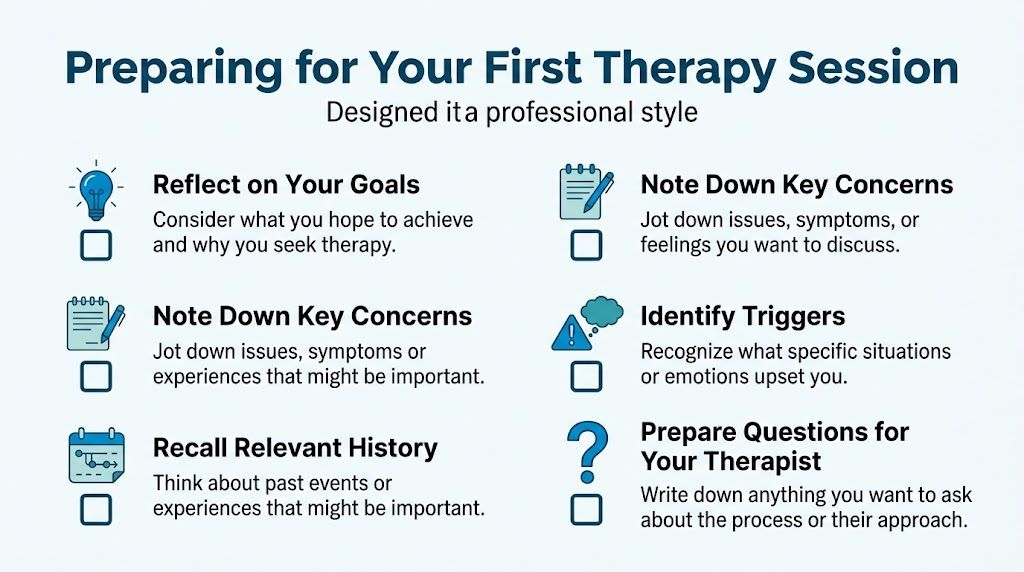
Write down three things before you start
A practical way to prepare is to jot down a few short answers to these prompts:
What feels most difficult lately
Maybe you’re anxious at night, crying more than usual, losing motivation, or snapping at people you care about.What seems to trigger it
Work meetings, silence at home, visa stress, relationship conflict, university pressure, loneliness, or family calls from home.What you hope will change
This can be vague. You might want to sleep better, stop overthinking, feel less homesick, or understand yourself more clearly.
That’s already enough material for a meaningful first session.
Goals help even when they’re rough
Many people worry that goals will make therapy feel too formal. In practice, goals often create relief. They give the conversation direction.
In the Milan-Turin region, collaborative goal-setting using SMART criteria showed a 75% success rate in goal adherence, compared with 45% for therapist-led plans, and preparing three prioritised goals before an initial call can improve the effectiveness of the process, according to this summary of the therapy process and goal-setting approach.
Your goals don’t need to sound clinical. They can be human and ordinary.
| Rough concern | Helpful first goal |
|---|---|
| “I feel overwhelmed all the time.” | “I want to feel calmer during the week.” |
| “I can’t stop thinking about moving abroad.” | “I want to adjust to life here without feeling lost.” |
| “My relationship feels tense.” | “I want to communicate without shutting down.” |
If you like visual prompts, this assessment overview image reflects the kind of practical preparation that can make an early conversation easier.
Prepare the setting, not just the words
If your session is online, your environment matters. Emotional openness is harder when you’re worried someone will walk in or your connection will fail.
A few basics can help:
- Choose privacy. Sit somewhere you won’t be overheard if possible.
- Check your tech. Test your headphones, battery, microphone, and internet.
- Keep water and tissues nearby. Small comforts reduce self-consciousness.
- Bring your notes. You don’t have to remember everything.
- Allow a few quiet minutes beforehand. Don’t jump into therapy straight from a stressful call if you can avoid it.
Practical rule: Prepare for therapy the way you’d prepare for an important conversation with someone you trust. Quiet space. A few notes. Enough time to arrive mentally.
Questions are part of preparation too
You’re allowed to be curious about the process. Some useful questions to write down are:
- How do sessions usually work?
- What should I do if I don’t know what to say?
- How do we measure progress?
- What happens if I feel uncomfortable talking about something?
These aren’t side issues. They help you feel safer, and safety makes honest conversation easier.
What to Say and Ask in Your First Meeting
The first meeting often begins with a simple question such as, “What brings you here today?” That can sound easy until you hear it out loud. Then your mind may go blank.
That’s normal. You don’t need a perfect opening sentence. You need a sentence that is true.

Easy sentence starters that actually work
Try one of these if you’re unsure how to begin:
“I’m not sure where to start, but I haven’t felt like myself lately.”
“The main thing that brought me here is that I feel overwhelmed all the time.”
“I function on the outside, but inside I feel exhausted.”
“I think I’m struggling, even though I keep telling myself I should be able to handle it.”
“A lot has changed since I moved, and I don’t think I’ve caught up emotionally.”
These openings work because they don’t force you to explain everything at once. They give the therapist a place to start with you.
You can describe your experience in everyday language
You don’t need diagnostic words. You don’t have to know whether it’s anxiety, burnout, depression, grief, or adjustment stress. You can describe what daily life feels like.
For example:
- Sleep: “I’m tired but I can’t switch off.”
- Body: “My chest gets tight before work.”
- Thinking: “I keep replaying conversations.”
- Mood: “I cry over small things lately.”
- Relationships: “I withdraw when people ask how I’m doing.”
- Functioning: “Simple tasks feel heavy.”
Therapists often use patient-centred questions like “What brings you here today?” because that style helps people open up. The same guidance emphasises that moving past politeness and speaking openly is important for progress.
How to talk about history without flooding yourself
Some people think they need to explain their whole childhood in the first session. Others avoid background completely because it feels too much. A middle ground works better.
Start with what feels relevant now:
- what’s happening,
- when it started,
- what seems connected,
- what you’ve already tried.
You can say, “There’s more background to this, but I think the current trigger is my move, my workload, and feeling alone.” That gives shape without forcing you to tell everything at once.
A brief video can also help make the first conversation feel more familiar:
Questions to ask your therapist
The conversation goes both ways. You’re not just there to answer questions. You’re also allowed to understand how this person works.
Consider asking:
- How do you usually work with someone with concerns like mine?
- What can I expect from the first few sessions?
- How will we know if therapy is helping?
- What if I find it hard to open up?
- Can we go slowly if I feel overwhelmed?
If you feel awkward, say that too. “I’m finding it hard to be fully open because I’m nervous” is useful clinical information, not a failure.
If you cry, ramble, or lose your train of thought
That is still talking to a therapist. Tears are communication. Silence is communication. Confusion is communication.
The first meeting is not about being impressive. It’s about being real enough that the two of you can begin.
Navigating Therapy as an Expat in Italy
Living abroad can intensify ordinary stress and create problems that don’t fit neat categories. You may not only be anxious. You may be anxious in a second language, in a new healthcare system, with different social rules, while missing home and trying to build a life that still doesn’t feel fully yours.
That context matters in therapy. It shapes what you need to say and what a good therapist needs to understand.

Name the cultural layer directly
Many expats minimise their distress because they think they should be grateful for the opportunity to live in Italy. Gratitude and struggle can exist together.
You can say things like:
“I wanted this move, but I’m lonelier than I expected.”
“I’m functioning at work, but daily life here takes so much emotional energy.”
“I don’t know whether I’m depressed or just disconnected from everything familiar.”
“Part of my stress is practical, but part of it is that I don’t feel fully understood here.”
These statements help a therapist see the full picture. Relocation stress often includes identity strain, not just logistics.
Language changes what people are able to say
When someone speaks in their native language, they often reach emotional detail faster. When they don’t, they may simplify, soften, or leave out what matters most.
That gap is significant.
If you’ve been wondering whether language fit matters, it does. Not because your Italian or English is inadequate, but because emotional precision matters.
For a related perspective on emotional strain abroad, this piece on homesickness versus depression in expats in Italy shows how easily cultural adjustment and mental health symptoms can overlap.
Topics expats often hesitate to bring up
The subjects below are common and worth naming early:
- Cultural mismatch. “I’m struggling with the work culture and I don’t know if I’m overreacting.”
- Migration grief. “I miss my old self, not just my old home.”
- Family pressure. “My family thinks I should be happy because I chose this life.”
- Belonging. “I feel too foreign here and different when I go home.”
- Discrimination or exclusion. “Some experiences here have made me feel small or hyper-aware of being an outsider.”
- Relationship strain across cultures. “My partner and I interpret family, independence, and conflict very differently.”
You don’t need to translate your whole identity
A useful first goal in expat therapy is not “fix everything.” It might be: speak about your experience without editing it to sound easier, more reasonable, or more acceptable.
The more your therapist understands your cultural context, the less energy you spend explaining the background of your pain.
That’s often where real therapeutic work begins.
Deepening the Conversation in Ongoing Sessions
The first session opens the door. Ongoing sessions are where trust gets tested, strengthened, and used. Some weeks you’ll leave with relief and clarity. Some weeks you may feel stirred up, uncertain, or annoyed that the same issue keeps returning.
That doesn’t always mean therapy is failing. It often means you’ve reached material that matters.
Progress depends on honesty, not smoothness
Many clients become more careful after the first few sessions. They start editing themselves. They talk about the easy part of the week instead of the argument that shook them, the shame they felt, or the thought they don’t want to admit out loud.
Try saying the harder sentence. For example:
- “I’m embarrassed to tell you this, but I think I’m avoiding something important.”
- “I keep talking around the main issue.”
- “Part of me wants help, and part of me doesn’t want to be seen.”
- “Last session upset me, and I think we should talk about why.”
These moments are not interruptions to therapy. They are therapy.
Give feedback to your therapist
A strong therapeutic relationship grows through feedback. If something helped, say so. If something felt off, say that too.
Useful phrases include:
| Situation | What you can say |
|---|---|
| A session felt useful | “What helped last time was how specific we got.” |
| You felt misunderstood | “I don’t think I explained myself well, and I also don’t think we landed on the main issue.” |
| The pace felt wrong | “I want to talk about this, but I need to go more slowly.” |
| You feel stuck | “I keep circling the same problem. Can we look at what’s blocking progress?” |
This kind of honesty can feel uncomfortable, especially if you’re used to pleasing authority figures or staying polite. In therapy, respectful directness is healthy.
Therapy works through relationship and repetition
Psychotherapy has a strong evidence base.
Those benefits rarely come from one breakthrough conversation alone. They usually come from repeated moments of insight, practice, correction, and trust.
If you’re curious about structured approaches that build these skills over time, this overview of cognitive behavioural therapy for anxiety and online therapy can help make the process more concrete.
Growth in therapy often sounds less like “I’m fixed” and more like “I noticed what I was doing, and I responded differently this time.”
If you feel stuck, don’t disappear
A common pattern is to stop attending when therapy becomes uncomfortable or unclear. Before you withdraw, try bringing the stuckness into the room.
Say:
- “I don’t know if this is helping, and I want to talk about that.”
- “I’m having trouble knowing what to focus on.”
- “I think I need a clearer sense of what we’re working toward.”
These conversations can improve the work. If the fit isn’t right, speaking openly can also help you leave thoughtfully rather than without a word.
Your Next Step A Human Conversation with Therapsy
If you’ve read this far, you probably don’t need more convincing that your struggle matters. What you may need is a first step that feels manageable.
That’s where a guided entry point can make a real difference. Instead of asking you to choose a therapist alone while already stressed, a human conversation can reduce pressure and help you feel understood from the start.
Why a guided first contact helps
For people who feel hesitant, overwhelmed, or unsure how to talk to a therapist, a supportive intake conversation can bridge the gap between intention and action.
That matters if you’ve been postponing help because the process itself feels daunting.
What makes the first conversation easier
A good assessment call doesn’t require you to tell your whole story perfectly. It gives you room to say:
- what feels difficult,
- what language you’re most comfortable in,
- whether you prefer online or in-person support,
- what kind of therapist might feel like a good fit.
For expats, international students, and intercultural couples, that matching process matters. It can save you from the exhausting experience of having to explain your cultural context from scratch in the wrong room.
For a broader view of how modern clinics are improving the way people access care, this overview of Mental Health Therapy Practices offers helpful context on patient-centred support systems.
Why Therapsy is a strong next step
Therapsy is built for people who need both clinical quality and intercultural understanding. The service offers multilingual licensed professionals, online and in-person sessions across Italy, and a free first assessment call designed to feel like a human conversation rather than an intimidating intake form.
That matters when you’re trying to explain burnout in your second language, manage relationship stress across cultures, or make sense of loneliness in a country you may also love. Therapsy bridges local Italian life and international mental health standards in a way that many generic directories don’t.
If reassurance helps, you can also view this snapshot of Therapsy Google reviews to get a sense of how others have experienced the service.
What you can do today
You do not need to feel completely ready. You do not need to have all the right words. You only need enough willingness to begin one honest conversation.
If your starting sentence is “I’m not sure how to talk about this,” that is still a beginning. It may be the most important one.
If you’re looking for support that understands expat life, language fit, and the emotional reality of building a life in Italy, THERAPSY offers a gentle place to start. Book your first free assessment call.