You may be in Italy for work, study, love, or a new start. On paper, life looks enviable. Then anxiety starts creeping in on Sunday evenings, small tasks feel heavier than they should, or you realise that every difficult conversation in your day is happening in a language that still costs you energy.
That’s often the point when people start searching for english speaking therapist italy and discover that the search itself is stressful. The problem isn’t just finding a name online. It’s knowing who is qualified, who understands intercultural life, who can see you soon, and who can work in English without missing nuance.
Good therapy in a new country should reduce confusion, not add to it. What helps is a clear process: understand the system, narrow your options, vet credentials carefully, and prepare for the first conversation so you can choose with confidence.
The Expat's Dilemma Finding Mental Health Support in Italy
Living abroad can sharpen everything. Pleasure feels vivid. So does loneliness. A normal life transition that might have felt manageable at home can become harder when you’re also navigating residency paperwork, housing, healthcare, and social life in a second language.
That’s why the search for an english speaking therapist italy can feel strangely personal. Many expats tell themselves they should be coping better because they’re in a beautiful place. In practice, beauty doesn’t protect anyone from panic, grief, burnout, relationship strain, or the slow fatigue of adaptation.

Why it feels so hard
Part of the difficulty is structural, not personal. In Italy’s public health sector, there are about 8.5 psychologists per 100,000 population, public mental health services can involve waiting lists of several months, and services are primarily in Italian, which makes qualified English-speaking therapists “virtually impossible” to find in the public system, according to this overview of Italy’s mental health access data.
If you’ve been feeling discouraged, that context matters. You’re not failing at the search. The system is hard to access, especially if you need care that is both linguistically fluent and culturally attuned.
Finding therapy abroad often fails at two points. Access fails first. Fit fails second.
What expats usually need, and what generic searches miss
A list of local clinicians is rarely enough. Expats often need someone who understands:
Language fatigue
You may function well in Italian at work or university and still need therapy in English because emotional processing is different from ordering coffee or attending meetings.Intercultural identity strain
Many people aren’t just dealing with anxiety. They’re dealing with who they are becoming between countries, families, and expectations.Practical instability
Visa uncertainty, changing addresses, travel, and long-distance relationships can affect the kind of therapy setup that will be effective.A non-judgemental approach to transition
Missing home, resenting your host country, or feeling detached from both is common. It doesn’t mean you made the wrong decision.
A more useful starting point is mental health support for expats in Italy, especially if you want to understand options beyond public services and generic directories.
Decoding Italian Mental Health Credentials
The fastest way to waste time in your search is to contact people without knowing what their title means. In Italy, professional labels matter. They tell you what training a person has completed, what they are legally allowed to do, and whether they are the right type of clinician for what you need.
The three titles that matter
A psicologo is a psychologist. In practical terms, this professional has psychology training and formal registration with the relevant professional order. A psychologist may offer assessment, counselling, and psychological support.
A psicoterapeuta is a psychotherapist. This is usually the title people mean when they are looking for ongoing therapy. In Italy, psychotherapists complete additional specialist training beyond the base qualification. If you want structured therapeutic work for anxiety, depression, trauma, relationship patterns, or long-standing emotional difficulties, this is often the more relevant credential.
A psichiatra is a psychiatrist. This professional is a medical doctor specialising in mental health. Psychiatrists assess mental health conditions from a medical perspective and can prescribe medication.
What to verify before you book
A mandatory check is registration with the Ordine degli Psicologi in the clinician’s region, where applicable to their profession. If a therapist cannot clearly tell you their professional registration, pause there.
Use this simple checklist:
Registration first
Ask for their professional order registration details. A qualified clinician should be comfortable providing them.Actual working language
“Speaks English” can mean anything from basic conversational ability to real clinical fluency. Ask whether they conduct therapy regularly in English.Therapy training, not only psychology background
If you want psychotherapy, look for a psychotherapist rather than assuming every psychologist offers the same kind of work.Scope of practice
If you think medication might be part of your care, you may need a psychiatrist involved as well.
A polished website isn’t proof of clinical training. Registration is.
Why this matters for expats
Expats often search under pressure. They may be distressed, isolated, or trying to organise support quickly between travel and bureaucracy. That makes it easier to skip due diligence and overvalue convenience. A well-worded profile can still leave out the details that matter most.
The distinction between psychologist, psychotherapist, and psychiatrist also affects expectations. Some people want practical support and brief consultation. Others need deeper psychotherapy. Others need combined care. If you don’t clarify the role at the start, the mismatch often shows up in the third or fourth session, when you realise the work isn’t moving in the direction you expected.
A straightforward guide on psychologist vs psychiatrist can help if you’re deciding whether you need talking therapy, medication support, or both.
Your Search Strategy for English-Speaking Therapists
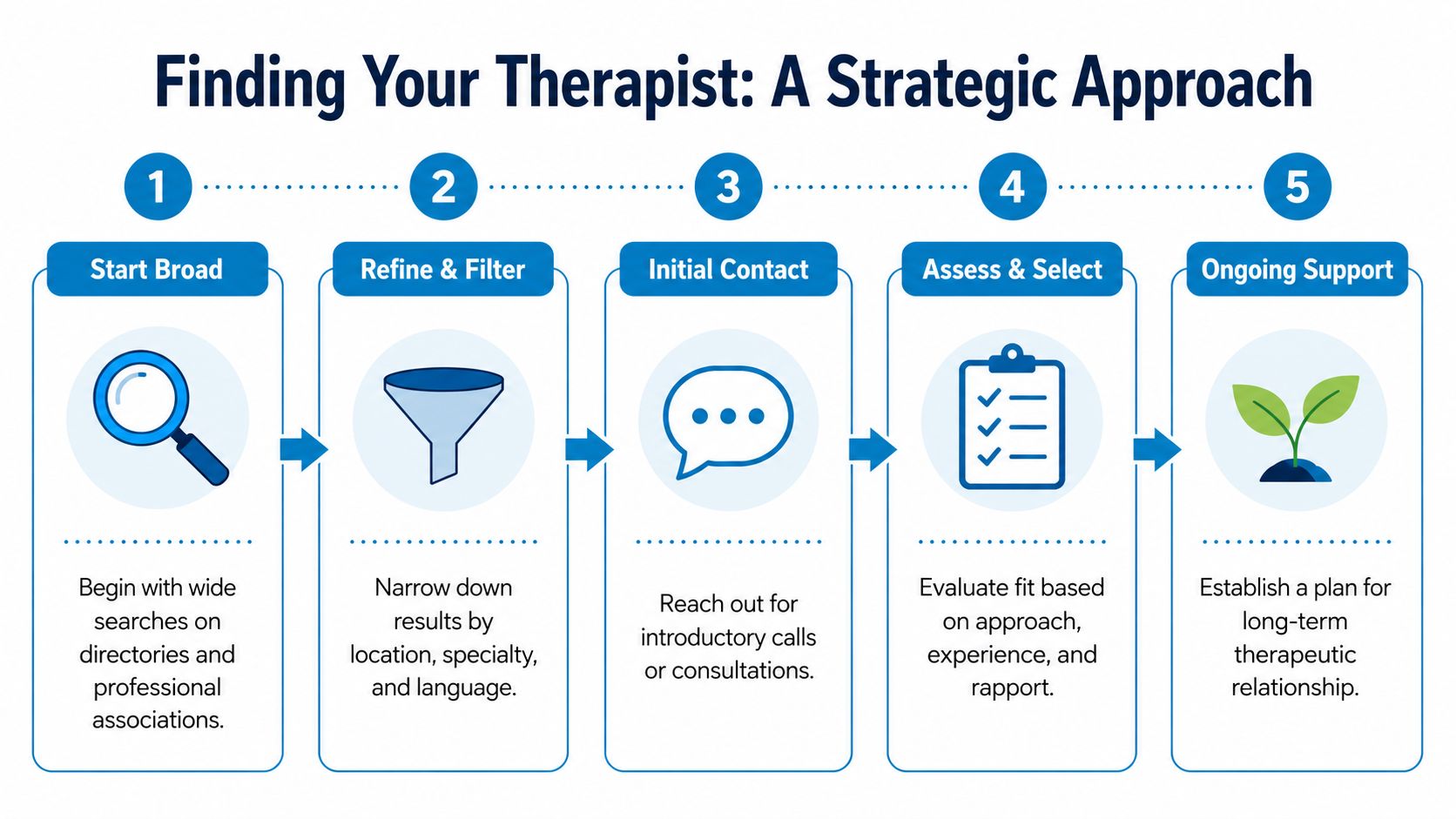
Many individuals begin the search too widely. They type english speaking therapist italy into Google, open ten tabs, skim profiles, get overwhelmed, and stop. The problem isn’t effort. The problem is sequence.
A better search starts broad, then narrows fast.
Start with sources that already filter something
Some search routes are useful, but each has trade-offs.
| Search route | What it helps with | Where it falls short |
|---|---|---|
| International directories | Easy starting point for English-language browsing | Listings can be uneven in quality and depth |
| Professional associations | Better for checking formal identity | Often less helpful for fit, approach, and intercultural experience |
| Embassy or consulate suggestions | Familiar option for newcomers | Lists may be limited and not clinically curated |
| University counselling services | Relevant for students | Capacity, scope, and continuity can vary |
| Personal recommendations | Can reduce uncertainty | A good fit for your friend may be wrong for you |
What to look for as you narrow
Once you’ve gathered a shortlist, don’t keep browsing endlessly. Move quickly into filtering.
Location flexibility
If you travel frequently or live outside a major city, check whether the therapist works online as well as in person.Intercultural experience
A therapist can be excellent with local clients and still miss the emotional logic of migration, language-switching, bicultural conflict, or expat relationship strain.Clarity of method
Profiles should explain how the therapist works, not just list broad problem areas.Response quality
The first reply often tells you a lot. If the response is vague, administrative only, or doesn’t answer your actual question, expect more of the same later.
The main weakness of directories
Directories are built for discovery, not for matching. They can help you find names. They rarely help you decide which of those names is likely to work for your situation. That gap matters because therapy success depends heavily on fit, not just availability.
One practical alternative is to use a curated service where clinicians are pre-vetted for licensing, language, and intercultural work. Therapist near me is one route people use when they want online or in-person options across Italy rather than a random collection of profiles.
This is also the one place in the article where it makes sense to mention Therapsy directly. It offers multilingual therapy in Italy, online and in person, with licensed psychologists and psychotherapists, plus a free assessment call to help match clients to an appropriate clinician. That model solves a real problem that open directories don’t solve well. It reduces guesswork at the point where many expats stall.
Broad search is fine for ten minutes. After that, you need criteria.
How to Choose the Right Therapist for You
A therapist can be fully qualified and still not be right for you. This is the part many people underestimate when searching for english speaking therapist italy. Credentials get someone onto the shortlist. Fit is what makes therapy useful.

Match the therapist to the real issue, not just the symptom
Many expats search using symptom words like anxiety, low mood, stress, or sleep problems. Those are real concerns, but they may not describe the deeper pattern driving the distress.
For example, you may look for anxiety support when the actual issue is cultural dislocation, a relationship under migration pressure, or a perfectionistic coping style that became unsustainable after moving abroad.
Look for someone whose profile reflects the layers under the symptom:
- Adjustment and identity work for relocation, culture shock, and belonging
- Couples or family expertise if conflict has intensified across languages or cultures
- Young adult support for academic pressure, autonomy, friendships, and direction
- Burnout and work stress competence if the problem is tied to performance and over-adaptation
This matters sharply for younger clients, because generic profiles often aren’t enough for international students and young professionals.
Understand the therapist’s style
Not every good therapist works in the same way. Ask what their approach is, then translate it into plain language for yourself.
| Therapeutic style | Often feels like | May suit you if |
|---|---|---|
| CBT | Structured, practical, present-focused | You want tools, patterns, and homework |
| Psychodynamic therapy | Reflective, exploratory, insight-oriented | You want to understand recurring relational or emotional patterns |
| Humanistic or integrative work | Collaborative and flexible | You want a relational approach that adapts to your needs |
None of these is universally better. The useful question is whether the approach fits your goals, personality, and current capacity.
A short explainer may help if you’re comparing profiles and trying to sort instinct from evidence.
Signs of a good fit in the first contact
You don’t need to decide based on charm. Use simple markers.
They answer clearly
Good clinicians can explain how they work without hiding behind jargon.They understand intercultural context
They don’t treat migration as background decoration. They recognise it as part of the clinical picture.They can hold complexity
You shouldn’t feel pushed into a simplistic story about your problem.You feel both at ease and taken seriously
Therapy doesn’t need to feel instantly comfortable, but it should feel possible.
If you want a fuller guide to this decision, finding the right therapist for expats in Italy is a useful place to compare what matters clinically versus what only feels reassuring on the surface.
Preparing for Your Initial Consultation Call
The first call often carries too much pressure. People think they need to decide immediately, explain their whole life coherently, or sound “serious enough” to deserve support. None of that is necessary.
A consultation works best when you treat it as a mutual assessment. The therapist is learning about your needs. You are checking whether this person feels competent, clear, and suitable for the work ahead.
What to say when you don’t know where to begin
You don’t need a polished summary. A simple opening is enough:
- “I’m living in Italy and I’m finding that the move has affected me more than I expected.”
- “I’m not in crisis, but I’m not doing well and I’d like support before it gets worse.”
- “I can function day to day, but I feel anxious, isolated, or emotionally flat.”
- “I’m looking for therapy in English because that’s the language I need for this kind of conversation.”
Those sentences give a clinician plenty to work with.
Questions worth asking
Many people only ask about fees and availability. Those matter, but they won’t tell you whether the therapy is likely to help.
Ask questions like these instead:
- What experience do you have working with expats or international clients?
- How do you approach cultural adjustment, identity strain, or homesickness?
- Do you work more practically, more insightfully, or a mixture of both?
- What might the first few sessions focus on?
- How do you know whether therapy is progressing?
- If I need psychiatric support, how is that usually handled?
- Do you offer online sessions if my schedule or location changes?
Your first consultation is not an audition. It’s a suitability check.
What to notice beyond the answers
Listen for tone as much as content. Does the therapist answer directly? Do they seem comfortable with nuance? Do you feel rushed, managed, or gently understood?
Also notice your own body. After the call, do you feel slightly more settled, or more confused than before? A good first contact doesn’t need to feel magical. It should feel organised, respectful, and realistic.
If you’re unsure what usually happens at the beginning of therapy, first psychological session gives a useful sense of what to expect and what you don’t need to worry about.
Frequently Asked Questions About Therapy in Italy
People searching for english speaking therapist italy often have the same practical concerns. The answers below are the ones that most often reduce unnecessary stress.

Is therapy in Italy confidential
Yes. Confidentiality is a core clinical expectation, and therapy providers operating professionally in Italy should also handle personal data in line with GDPR requirements. If privacy matters strongly to you, ask directly how records, payments, and communications are managed.
If you like to keep your own personal notes from sessions, it can help to store them carefully.
Do I need to speak Italian to start therapy
No. If you’re looking specifically for therapy in English, you do not need to wait until your Italian improves. In fact, many people do their most meaningful emotional work in their first language because nuance, memory, humour, and vulnerability come more naturally there.
For some expats, speaking Italian in therapy can even create distance from true feeling. That may be useful occasionally, but it shouldn’t be forced.
Is online therapy a good option in Italy
Often, yes. Online therapy is particularly helpful if you travel, live outside a large city, have irregular hours, or want continuity during relocations. In-person therapy can suit people who value the ritual of physically going to a session or who feel more grounded face to face.
The better question isn’t which format is universally better. It’s which format you’re most likely to attend consistently and use honestly.
How much does private therapy usually cost
Cost is a real barrier, and it helps to speak about it directly. Data shows that 24% of Italians need more than 12 hours of work to afford a single psychologist session, while private English-speaking therapy in major cities often costs €80 to €150 per session. The same source notes that services such as Therapsy offer pricing from €70. Those affordability figures come from this Statista overview of mental health economics in Italy.
The practical takeaway is simple. Don’t assume every English-speaking option will fit your budget. Ask for the exact fee, cancellation policy, and payment process before you commit.
Will foreign insurance cover therapy
Sometimes, but the process varies widely. Some insurers reimburse part of the cost, while others require specific documentation or only recognise certain professional categories. The safe approach is to ask your insurer in writing what they need before your first paid session.
You’ll usually want to confirm:
Professional requirements
Which therapist credentials are accepted.Invoice requirements
What details must appear on the receipt.Language and location rules
Whether English-language sessions and online care are reimbursable.
How many sessions will I need
There isn’t a universal number. Some people need a brief, focused period of support. Others use therapy for deeper work over time. If a therapist promises a fixed outcome too confidently during the first call, be cautious.
A better sign is a clinician who can describe an initial direction while staying open to what emerges once the work begins.
Next Steps Towards Comprehensive Care in Italy
Finding the right clinician is the beginning, not the whole process. The first few sessions usually focus on building a shared understanding of the problem, the context around it, and what kind of change would feel meaningful in your daily life.
In that stage, practical honesty helps. Say if your schedule is unstable. Say if money is tight. Say if you’re unsure whether you want coping tools, deeper exploration, or both. Therapy tends to work better when the logistics and the emotional goals are discussed in the same straightforward way.
When therapy alone may not be enough
Some expats need more than a weekly talking space. They may also need psychiatric input for medication review, sleep issues, severe anxiety, or depression that is making day-to-day functioning much harder.
For non-Italian speakers, Italy can feel complicated. The challenge isn’t only finding any psychiatrist. It’s finding a coordinated path where therapy and psychiatric care can communicate clearly and where language doesn’t distort symptoms, history, or consent. That’s one reason integrated care matters so much in cross-border and intercultural contexts.
What helps treatment continue
The biggest gains usually come from continuity. Not perfection. Continuity. A good therapeutic relationship gives enough structure that you can keep working even when life in Italy becomes messy again.
Useful signs early on include:
Clarity about goals
You should know what you are roughly working on, even if the full picture is still emerging.Room for feedback
You need to be able to say when something isn’t landing.A workable format
Online, in person, or mixed. The best setup is the one you can realistically sustain.Access to wider care when needed
If medication or specialist input becomes relevant, the pathway shouldn’t feel improvised.
The right therapy doesn’t remove complexity from expat life. It helps you carry complexity without collapsing under it.
At this stage, matching matters. A structured intake process with real human review tends to reduce the random trial-and-error that leaves many clients discouraged after one or two poor starts. What works is a process that combines licensing checks, attention to clinical needs, and practical fit around language, modality, and availability.
If you’ve been postponing support because the search felt too confusing, that hesitation makes sense. It also doesn’t have to be permanent.
If you’re looking for thoughtful, multilingual therapy in Italy with a clear starting point, book your first free assessment call with THERAPSY.