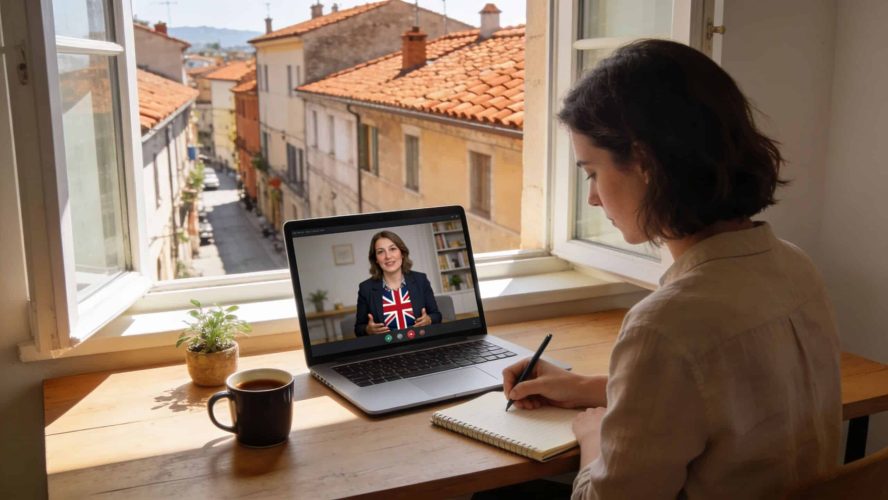
Some evenings in Italy feel exactly as you hoped they would. The light is soft, the streets are beautiful, and even a quick coffee can feel cinematic. Then you go home and realise you haven’t had a real conversation all day in the language that feels most like yours.
That contrast is common. It doesn’t mean you’re ungrateful, weak, or “doing expat life badly”. It means you’re adapting to a new country while trying to keep your footing psychologically.
Online therapy in English in italy is professional psychological support delivered remotely, in English, by a qualified therapist who understands both mental health and the practical strain of living abroad. For many expats, it becomes the bridge between functioning on the outside and feeling supported on the inside.
As a clinical psychotherapist working with international clients in Italy, I see this often. People usually don’t come to therapy because Italy is disappointing. They come because even a beautiful life transition can overload the mind and nervous system. Language barriers, bureaucracy, isolation, homesickness, relationship strain, and work pressure all accumulate gradually.
Finding Your Footing in a New Country
You might be reading this after a move to Milan for work, a master’s in Rome, or a relationship that brought you here. Outwardly, things may look fine. Inwardly, you may feel more fragile than expected.

Sometimes the first sign is subtle. You stop sleeping properly. Small admin tasks feel huge. You dread phone calls in Italian. You miss home, but you also feel guilty for missing home because you chose this life. Even finding the right support can feel confusing, especially when most directories only give you names rather than a clear path. If you would rather start from someone who knows your cultural background, this guide to finding an American therapist in Italy explains the options.
What this kind of therapy actually offers
Online therapy in English isn’t only for crisis. It’s useful when you need:
- A space to think clearly about adjustment, anxiety, burnout, loneliness, or relationship stress.
- A language you don’t have to work hard in when discussing grief, fear, anger, shame, or identity.
- Continuity if you move city, travel often, or don’t yet know where you’ll settle.
- Psychological support that fits real life instead of adding one more logistical obstacle.
A new country often asks for flexibility in every area of life. Therapy should be one place where you don't have to translate yourself.
Why many expats wait too long
Expats often postpone therapy for understandable reasons. They tell themselves the distress is temporary, or that they should be able to cope because the move was voluntary. Others assume therapy in Italy will be too difficult to access in English, too bureaucratic, or too hard to fit around work and study.
Those worries are real. They’re also solvable.
The aim isn’t to become “perfectly adjusted”. The aim is steadier functioning, more self-understanding, and a place where your experience makes sense in context.
The Unique Mental Health Needs of Expats in Italy
Moving abroad doesn’t only change your address. It changes routines, identity, attachment cues, and the effort required for everyday life. In cross-cultural psychology, that matters because the mind depends heavily on familiarity.
A common mistake is to reduce expat distress to homesickness. Homesickness may be part of it, but it’s rarely the whole picture. Many expats are managing a layered psychological load that includes culture shock, language fatigue, social dislocation, and a shift in who they feel they are.
What tends to happen beneath the surface
Several patterns appear again and again in therapy with expats:
- Culture shock. Daily norms are different, even when they seem small. Timing, communication style, administration, dating expectations, and social rules all require adaptation.
- Identity strain. At home, you likely knew how to function and how you were perceived. Abroad, competent adults can suddenly feel less articulate, less independent, or less recognisable to themselves.
- Language fatigue. Even high-level English speakers who also speak some Italian can feel depleted by constant cognitive effort. Emotional conversations become harder when your most precise words aren’t readily available.
- The pressure to enjoy it. Italy is idealised. When reality includes loneliness, bureaucracy, professional uncertainty, or marital stress, people often feel they’ve failed a dream they were supposed to love.
Many expats don’t need someone to tell them to “be positive”. They need someone to explain why their nervous system feels overstretched in a context that looks enviable from the outside.
Why online support became central
Demand for online psychological support in Italy rose sharply during the pandemic and stayed high afterwards. A 2023 study using Google Trends data found a sustained increase in interest in online psychological services, indicating a durable shift in how people access care, especially for groups who already faced barriers to in-person support such as expats, according to this peer-reviewed study on public interest in online and in-person psychological support in Italy.
That makes clinical sense. If access is already difficult because of language, location, or confidence navigating a foreign healthcare culture, online therapy removes several barriers at once.
What expat distress can look like clinically
The presenting issue isn’t always “I’m struggling with moving abroad.” Often it shows up as:
- Anxiety through overthinking, panic, hypervigilance, or fear of making mistakes
- Depression through withdrawal, numbness, tearfulness, or loss of motivation
- Burnout through irritability, sleep problems, exhaustion, and emotional detachment
- Relationship conflict when one partner adjusts faster than the other
- Trauma activation when instability, isolation, or helplessness reawakens older wounds
Frameworks such as CBT, Schema Therapy, EMDR, attachment theory, and intercultural psychology all help make sense of these patterns. Not because expat life is pathological, but because transition magnifies existing vulnerabilities and coping styles.
Why Online Therapy is a Game-Changer for Expats
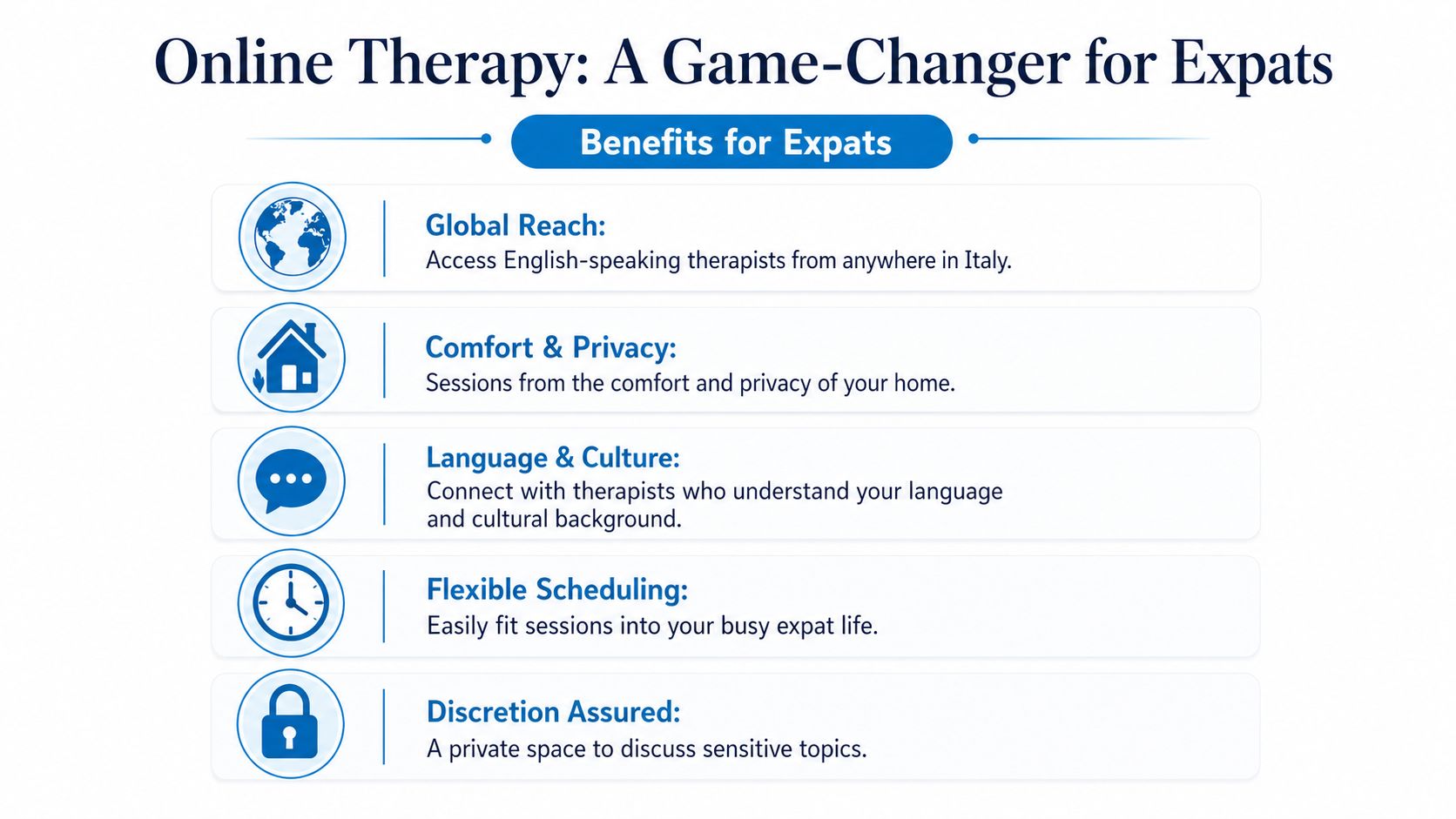
For many people living abroad, online therapy isn’t a second-best option. It’s the format that fits the conditions of expat life more closely than traditional local in-person care.
What works better online
When people imagine therapy, they often picture a physical office. That image can be reassuring, but it doesn’t automatically make the therapy more effective for someone building a life across languages, time zones, and changing commitments.
Online sessions are often more workable because they remove friction:
| Practical issue | In-person therapy | Online therapy |
|---|---|---|
| Commute | Travel time can become a reason to cancel | You can join from home or a private room |
| Location | Your options may depend on one city | You can access support from anywhere in Italy |
| Language choice | Local availability may be limited | It’s easier to find English-speaking clinicians |
| Continuity | A move can interrupt treatment | Therapy can continue across relocations |
| Scheduling | Office hours may clash with work or study | Sessions often fit more flexibly around life |
For expats, consistency matters more than idealised form. The best therapy is the one you can attend regularly, without resenting the process before it starts.
Retention matters more than good intentions
That finding reflects something clinicians see every week. Progress depends partly on insight, but also on attendance. If therapy fits your life, you’re more likely to stay with it long enough for the work to deepen.
Practical fit is clinical fit. A therapy model that reduces cancellation pressure often supports better engagement.
Why English changes the quality of the work
Many expats can discuss surface issues in Italian. Therapy asks for more than surface language. It asks for nuance, memory, emotional precision, and the ability to say something before you censor or simplify it.
That’s why therapy in your strongest language often works differently. You don’t spend half the session searching for words. You can speak from the emotional centre rather than from the most functional vocabulary available.
Online delivery also protects continuity. If you move from Milan to Florence, spend a month abroad for family reasons, or take on a demanding role with irregular hours, you don’t have to restart with a new clinician because logistics changed.
Understanding Italian Legal and Privacy Standards
Trust matters even more when you’re seeking help in a country that still feels unfamiliar. Before you start online therapy in English in italy, it’s worth knowing how to check that a service is legitimate, confidential, and professionally accountable.

Check professional registration first
In Italy, a psychologist or psychotherapist should be appropriately licensed and registered with the Albo degli Psicologi, the official professional register. For an expat, this is one of the most useful first checks because it tells you the clinician operates within a recognised legal and ethical framework.
That framework matters because therapy is not just conversation. It involves professional standards around informed consent, record keeping, confidentiality, competence, and referral when a client needs a different level of care.
Privacy in online sessions
A properly run online therapy service should explain:
- How sessions are conducted
- How your personal data is stored and protected
- What confidentiality covers
- What its limits are, such as serious immediate risk situations
In Italy, privacy obligations also sit within broader GDPR requirements. If you’re comparing platforms, it helps to understand how secure digital communication is assessed more generally.
If initial contact happens through messaging, a professional service should still move quickly into a clear consent and privacy process rather than keeping things vague. Some practices use familiar channels for first contact, such as WhatsApp, but the clinical relationship itself should be governed by proper documentation and confidentiality standards.
The administrative gap expats often face
A major practical problem is that many resources never explain how private English-language therapy fits into the wider Italian healthcare system. Expats often struggle to understand insurance reimbursement, employer EAP coverage such as Cigna, or when to use the public system, as described in this overview of therapist access challenges for English speakers in Italy.
That gap creates unnecessary hesitation. You shouldn’t have to decode everything alone.
If a provider cannot clearly explain credentials, privacy, payment documentation, and referral boundaries, keep looking.
How to Choose the Right English-Speaking Therapist for You
Finding a therapist isn’t only about finding someone available. It’s about finding someone whose training, style, and cultural understanding fit the problem you’re bringing.
Start with the problem you want help with
Don’t begin by asking, “Who is the best therapist?” Start with, “What am I dealing with?”
Your needs may include panic attacks, trauma, relationship conflict, compulsive overthinking, workplace burnout, or a more diffuse sense that you’re not yourself. The right therapeutic approach depends partly on that.
Here is a simple way to think about common modalities:
- CBT helps you identify unhelpful thought patterns, emotional triggers, and behavioural loops. It’s often helpful when anxiety, panic, self-criticism, or avoidance are central.
- EMDR is often used when distress is linked to traumatic or overwhelming memories that still feel unprocessed.
- Schema Therapy looks at deeper life patterns, especially recurring themes in relationships, self-worth, abandonment, or emotional deprivation.
- TMI (Terapia Metacognitiva Interpersonale) can be useful when people struggle to understand their own internal states and repeated interpersonal difficulties.
Then assess fit, not only credentials
Credentials are necessary. They are not sufficient.
A therapist may be well trained and still not be the right fit for you. In expat therapy, cultural fit often matters more than people expect. A good therapist doesn’t need to share your passport or life story, but they should understand what relocation can do to identity, attachment, work pressure, family roles, and loneliness.
A few questions help:
- Do they work in English comfortably? Conversational English is not the same as clinical fluency.
- Have they worked with expats, international students, or cross-cultural couples?
- Do they understand workplace strain in international settings?
- Can they explain their approach in plain language?
- Do you feel more settled or more guarded after speaking with them?
The therapeutic relationship is not a bonus feature. It is part of the treatment.
Burnout needs more specificity than “stress support”
This matters especially for high-functioning professionals. A major underserved group in Italy includes people working in international organisations, NGOs, embassies, tech, finance, and similar environments, where sector-specific burnout is often overlooked and generic “stress” content misses the underlying issue, as noted in this analysis of online therapy gaps for international professionals in Italy.
If your distress is tied to leadership pressure, confidentiality fears, relocation fatigue, high performance culture, or remote work isolation, ask directly whether the therapist has experience with workplace mental health. Generic support may feel kind, but still miss the pressure system you’re living inside.
A practical selection checklist
Use this when comparing options:
- Verify registration with the relevant Italian professional board.
- Check modality. Make sure the therapist’s methods match your goals.
- Confirm language depth. You want emotional fluency, not just polite conversation.
- Ask about expat experience. This reduces the risk of spending weeks explaining context.
- Clarify logistics. Time zones, cancellations, payment documents, and platform all matter.
- Notice your reaction. The right therapist doesn’t need to feel instantly familiar, but the contact should feel understandable and safe.
Some clients prefer a service where a clinician helps with matching rather than leaving them alone with a long directory. A guide to talking with a therapist can also help if your main worry is not knowing what to say in the first conversation.
One structured option in Italy is Therapsy, where the initial matching is handled by the Clinical Director and a free assessment call is used to identify the most appropriate therapist based on language, clinical needs, and availability.
Your Step-by-Step Guide to Starting Online Therapy
Once you’ve decided you want support, the next challenge is often momentum. People feel ready in principle, but stalled in practice. A simple sequence helps.
Step 1 and step 2
Step 1. Name what feels off.
You don’t need a perfect explanation. “I’m anxious all the time”, “I cry after work”, “I don’t feel at home anywhere”, and “my relationship is struggling since the move” are all enough reasons to reach out.
Step 2. Decide what format you need.
If your schedule is unstable, your Italian is limited, or you may relocate again, online therapy is often the most sustainable choice. If you’re not sure, ask a provider how online and in-person options differ in practice rather than in theory.
A practical starting point is this guide to finding an English-speaking therapist in Italy, because the clearer the first step feels, the more likely you are to begin.
Step 3 and step 4
Step 3. Book an initial call.
A good assessment call should feel exploratory, not pressurised. You should be able to ask about language, credentials, approach, availability, and whether the therapist has worked with situations similar to yours.
Step 4. Prepare one or two priorities for the first session.
You don’t need to tell your whole life story immediately. Start with what is most pressing now, what has changed since moving, and what you hope will feel different if therapy helps.
Step 5 and step 6
Step 5. Set up the practical conditions.
Choose a private space, stable internet connection, and headphones if needed. Privacy affects emotional openness more than is commonly expected.
Step 6. Clarify cost and documentation early.
In private practice, individual therapy may start from €70 per session, couple therapy from €100, psychiatric consultation from €110, and psychodiagnostic assessment from €255 for three sessions, depending on the clinician’s experience and specialisation. Ask in advance whether receipts or documentation can support insurance or employer reimbursement requests.
Italy also has a public subsidy route worth checking. The Bonus Psicologo allocates €8 million annually and can subsidise psychotherapy costs, including online sessions, which can be especially relevant for expats and students budgeting carefully, according to this overview of Italy’s Bonus Psicologo initiative.
What usually helps most in the first month
People often expect immediate breakthroughs. More often, the first gains are quieter:
- Relief from not having to carry everything alone
- Better language for your experience
- A clearer sense of patterns
- A routine of support that stabilises the week
If the first match doesn’t feel right, that doesn’t mean therapy isn’t for you. It usually means the fit needs adjustment.
FAQ
Is online therapy in English in italy effective?
Yes, it can be very effective when the therapist is qualified and the format suits your life. For expats, online work often improves consistency because it removes travel, location, and scheduling barriers that interrupt care.
Do I need a doctor’s referral to start therapy in Italy?
No, private therapy usually does not require a doctor’s referral. A referral may become relevant only in specific public system pathways or if you’re trying to manage specific reimbursement processes.
How can I check if a therapist in Italy is properly qualified?
Start by checking professional registration and asking directly about training and clinical approach. A legitimate therapist should be able to explain credentials, confidentiality, and how they work without being evasive.
Is therapy in English better than therapy in Italian if I speak some Italian?
Often, yes, if English is the language in which you think and feel most precisely. Therapy works best when you can talk with emotional nuance, not only with functional vocabulary.
What if I start with one therapist and it doesn’t feel right?
That happens, and it doesn’t mean you’ve failed. A different therapeutic style, language fit, or level of intercultural understanding can make a meaningful difference.
Can online therapy help with burnout from work in Italy?
Yes, especially when the therapist understands high-pressure international work environments. Burnout support is more useful when it addresses performance pressure, relocation strain, confidentiality concerns, and the realities of employer-funded support where relevant.
Is online therapy confidential?
Yes, it should be, provided the clinician follows proper legal, ethical, and privacy standards. You should receive clear information about confidentiality, data handling, and the limits of privacy before treatment begins.
How quickly should I expect to feel better?
Some people feel relief after the first few conversations because they finally feel understood. Deeper change usually comes from regular work over time, especially when the issues involve trauma, identity shifts, or long-standing patterns.
If you’re looking for online therapy in English in italy and want a starting point that feels human, you can book your first free assessment call with THERAPSY. There’s no commitment, just a conversation with our Clinical Director to listen carefully and help match you with the right therapist for your needs.