When seeking a couple therapist in Malta, there's a good chance the relationship itself isn't the only thing under strain. One of you may feel lonely after relocating. The other may feel responsible for holding daily life together. You may be arguing about small things, but the deeper pressure sits underneath: language differences, family expectations, career imbalance, money stress, homesickness, or the quiet exhaustion of building a life abroad.
For expat and intercultural couples, relationship distress rarely happens in a vacuum. It often grows where attachment needs, migration stress, and cultural misunderstanding meet. A good therapist doesn't reduce that to “communication problems”. They help you understand the pattern the two of you are caught in, then guide you towards a different way of relating.
Malta is a distinctive place for this work. Relationship life here exists within changing social patterns. In 2020, Malta recorded 748 registered civil marriages and 326 registered religious marriages, reflecting evolving partnership norms within the local context, as noted in this Maltese counselling reference. For expat couples, those wider cultural shifts can add another layer to an already complex life together.
Understanding What Couple Therapy Actually Is
It isn't a court hearing
Many couples delay therapy because they assume it starts when trust is already broken beyond repair, or because they fear the therapist will decide who is right. That isn't what good couple therapy does.
Couple therapy is a structured, collaborative process that helps partners understand their recurring patterns, improve emotional safety, and respond to each other more effectively. The focus isn't on fixing one “difficult” person. The focus is the relationship system itself.
A useful way to think about it: a couple therapist is less like a judge and more like a skilled trainer for the relationship. They notice the form, the blind spots, and the habits that keep producing the same painful result.
That matters because most couples already know the content of their arguments. They know what they're fighting about. What they can't always see clearly is how they move from tension to defensiveness, from defensiveness to withdrawal, and from withdrawal to disconnection.
What actually happens in sessions
In practice, sessions usually involve slowing things down enough to understand what happens between you.
A therapist may help you:
- Map the cycle: identify the repeated pattern that pulls you into the same conflict
- Clarify triggers: notice what each partner experiences as threat, rejection, criticism, or abandonment
- Translate emotion: move from blame statements to the deeper feeling underneath
- Build new responses: practise ways of speaking and listening that reduce escalation
- Address intimacy directly: include emotional and sexual concerns when they are part of the difficulty
This is one reason specialist training matters. Relationship work isn't just two individual therapies happening in the same room.
The strongest evidence base we have shows that couple therapy is often effective. A major review found that the average person receiving couple therapy is better off at the end of treatment than 70% to 80% of individuals who don't receive it, according to this peer-reviewed overview on PMC.
If you're trying to improve how you speak to each other between sessions, practical tools can help. Some couples find it useful to start with concrete frameworks such as WeUnite's guide for relationship communication, especially when arguments keep turning into criticism, shutdown, or misunderstanding.
What therapy is trying to change
Therapy works best when both partners stop asking, “Who started it?” and begin asking, “What keeps happening to us?”
That shift changes everything.
A competent therapist helps you:
- recognise the negative loop
- understand what each partner protects underneath the conflict
- create more secure ways of reaching for each other
If anxiety is shaping the relationship dynamic, it can also help to understand how individual distress and couple distress interact. This overview on anxiety and couple therapy gives a useful starting point.
How to Find a Qualified Couple Therapist in Malta
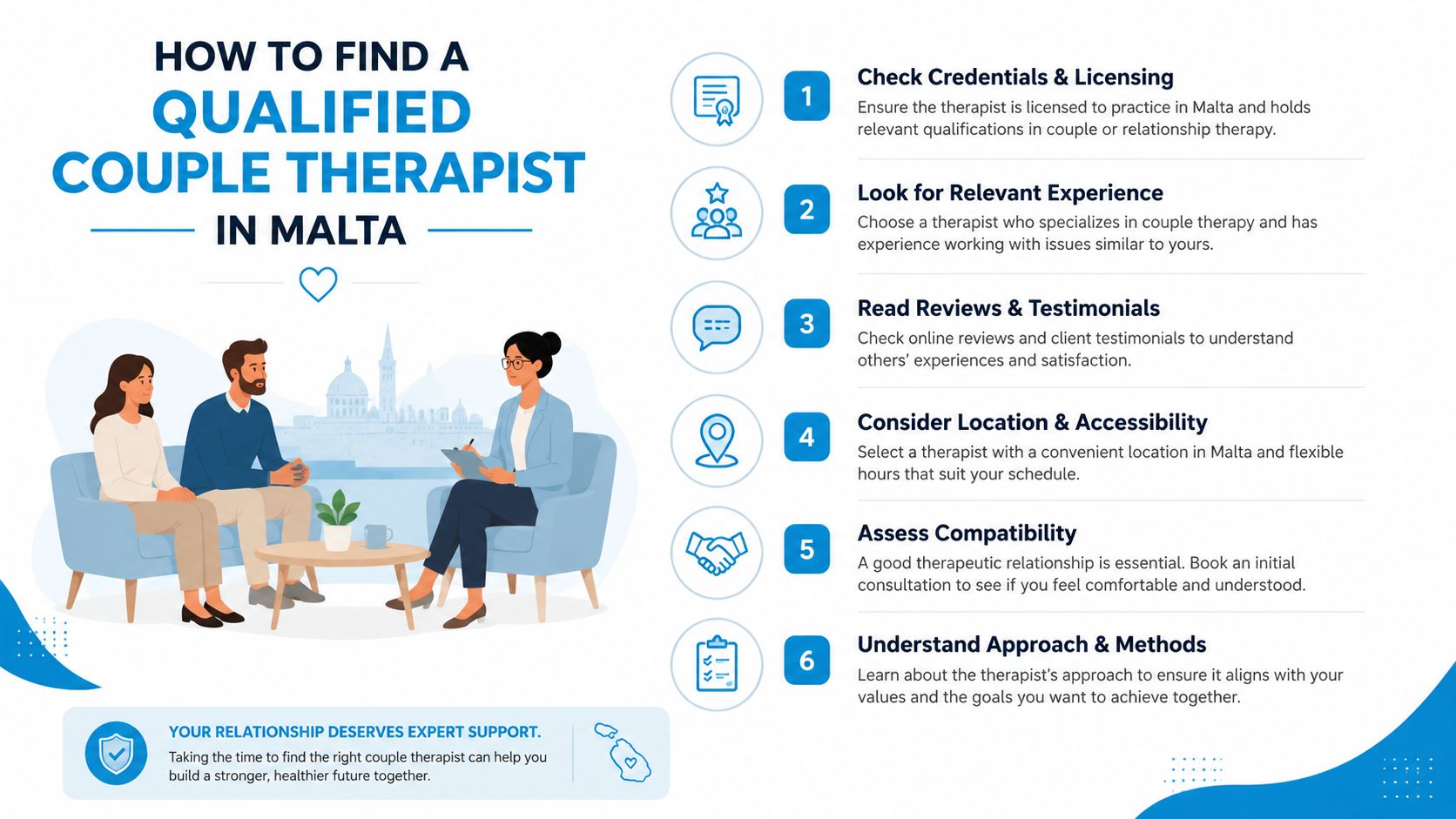
A therapist can be kind, warm, and still not be the right clinician for couple work. Relationship therapy requires specific training, clear structure, and the ability to hold both partners in mind at the same time.
Look for specialisation, not just general counselling
In Malta, specialist training in this field is formally recognised. The University of Malta includes a postgraduate study unit in Couples Counselling and Sex Therapy, which shows that this is treated as a distinct area of clinical practice rather than a generic extension of individual therapy. You can see that directly in the University of Malta study unit description.
That has a practical implication. An effective couple therapist in Malta should know how to assess relational dynamics, intimacy concerns, attachment patterns, and conflict cycles as part of one shared system.
Here's a simple visual checklist to keep in mind while comparing options.
Questions worth asking before you book
You don't need to sound “clinical” in a consultation. You only need to ask direct, practical questions.
Good questions include:
- What training do you have in couple therapy? You want to hear something more specific than general counselling experience.
- Do you work with intercultural or multilingual couples? This is essential in Malta's expat reality.
- How do you manage sessions when one partner speaks more confidently than the other? Language imbalance can distort the work if the therapist isn't attentive.
- How do you approach intimacy or sexual concerns? Avoiding the subject usually means the therapist isn't comfortable treating the whole picture.
- What happens if conflict escalates in session? A skilled therapist can regulate the room without shaming either partner.
- Do you ever take sides? The answer should reassure you that accountability matters, but alignment with one partner does not help treatment.
A first consultation should leave you feeling more oriented, not more confused.
Green flags and red flags
A few signs matter more than polished marketing copy.
| What to notice | Why it matters |
|---|---|
| Clear explanation of confidentiality | Couples need to know how information is handled |
| Structured description of the process | Good therapy has a frame, not just conversation |
| Comfort with complexity | Intercultural relationships need nuance, not simplistic advice |
| No promises of guaranteed results | Ethical clinicians don't make guarantees |
| No subtle blame of one partner | Therapy fails quickly when one person becomes “the problem” |
If you're comparing local and cross-border options, it can also help to see how an English-speaking couples therapist in Italy may structure support for international couples facing similar issues.
Special Considerations for Expats and Intercultural Couples
The argument may sound like it's about chores, in-laws, spending, or who forgot to answer a message. For expat couples, those surface issues often carry a much heavier emotional load.
One partner may have left a career, family, or language behind. The other may be carrying pressure to provide stability in a country that still doesn't fully feel like home. Both can feel unseen at the same time.
The expat layer changes the meaning of conflict
In intercultural relationships, the same event can mean very different things to each person.
A missed family call might feel minor to one partner and profoundly disrespectful to the other. A conversation about budgeting might in reality be about safety, pride, or fear of dependence. A choice about where to spend holidays can reopen old questions about belonging, loyalty, and whose life is being prioritised.
Couples living abroad often don't just argue about decisions. They argue about identity, home, and whose reality counts.
Attachment theory helps make sense of this. When stress rises, partners usually move towards one of two positions. One protests and pursues. The other withdraws and protects space. Neither response is random. Each is an attempt to feel safe.
Common pressure points in Malta's expat environment
Malta's everyday multilingualism can be enriching, but it can also create invisible strain in a relationship.
Common themes include:
- The trailing partner problem: one partner's move makes professional sense, while the other feels displaced or diminished
- Family involvement: expectations about privacy, loyalty, and extended family can differ sharply
- Money meanings: spending, saving, and financial transparency often reflect cultural values, not just habits
- Gender roles: assumptions about care, work, and household labour may clash more than either partner expected
- Language hierarchy: the partner who speaks the dominant shared language more fluently may end up controlling the emotional narrative
For some couples, even affection becomes misread. One partner wants direct verbal reassurance. The other shows love through practical action. Without context, both feel rejected.
That is why generic couple advice often falls short. Intercultural couples usually need a therapist who can recognise how migration, bicultural identity, and family-of-origin expectations shape the bond itself. If that describes your relationship, this page on intercultural couples therapy may help you frame what kind of support to look for.
Why validation matters before strategy
Many expat couples come to therapy feeling ashamed that they “should be coping better”. That shame gets in the way.
These struggles are not a sign that your relationship is weak. They are often predictable responses to relocation stress, chronic adaptation, and reduced support networks. When a therapist understands that context, the work becomes less blaming and more precise.
Key Therapeutic Approaches Your Therapist Might Use
Different therapists work in different ways. That isn't a problem if the method fits the couple's needs and the therapist can explain it clearly.
Emotionally focused and systemic work
Some therapists work from an attachment-based perspective, often associated with emotionally focused couple therapy. This approach is especially helpful when couples feel stuck in a painful cycle of pursuit, shutdown, criticism, or distance.
It asks questions such as:
- What does each partner fear most in moments of conflict?
- How does each person protect themselves when they feel hurt?
- What would a safer emotional bond look like in daily life?
This can be useful when the core problem is disconnection, insecurity, or repeated escalation after seemingly small triggers.
Systemic therapy takes a slightly wider lens. It looks at the couple as a system shaped by family patterns, culture, migration, and role expectations. That makes it particularly relevant for cross-cultural pairs, because the issue often isn't only “how we talk”, but also what each of us learned love, duty, and conflict should look like.
CBT in couple work
Cognitive behavioural therapy, or CBT, is often more practical and structured. It helps couples notice the thoughts, assumptions, and interpretations that intensify conflict.
For example, one partner thinks, “If they loved me, they would know what I need.” The other thinks, “Nothing I do is ever enough.” Those beliefs then shape tone, withdrawal, criticism, and hopelessness.
CBT can help with:
- recurring misunderstandings
- jealousy and reassurance-seeking
- conflict around anxiety or stress spillover
- rigid patterns of interpretation
If you want a plain-language introduction to how CBT works, this cognitive behavioural therapy guide is a good place to start. For readers comparing how CBT is discussed across services, Vancouver CBT costs and tips is also a useful example of the practical questions people often ask before beginning.
A good therapist chooses tools, not ideology
The best couple therapists don't force every relationship into one model. They draw from approaches that fit the problem in front of them.
Clinical rule: if a therapist can't explain why they are using a given approach for your specific pattern, ask more questions.
The model matters. The fit matters more.
Online vs In-Person Therapy and Pricing in Malta
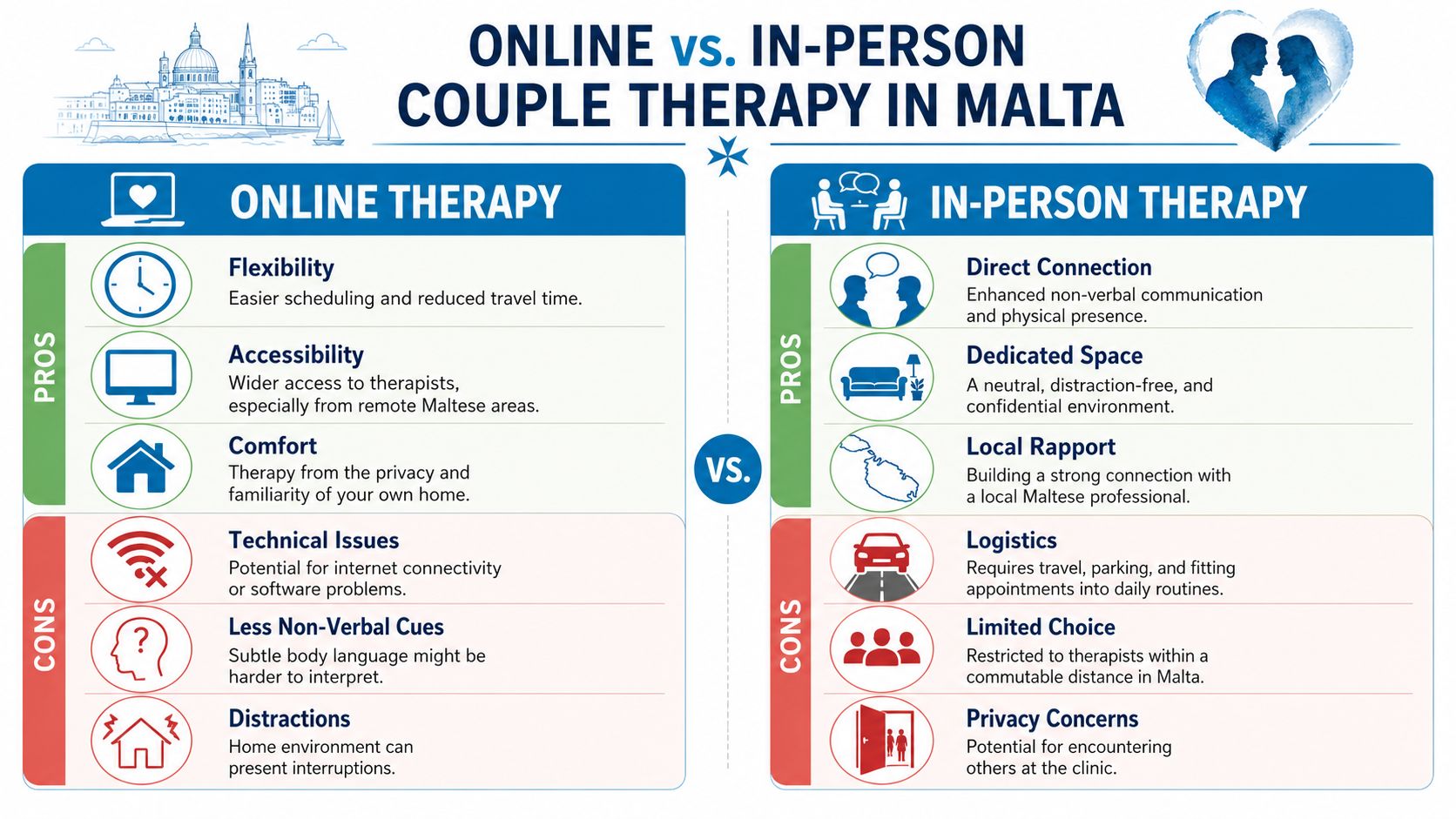
For many couples in Malta, the real decision isn't whether to seek help. It's whether the help should happen online or in person.
What in-person therapy offers
In-person sessions give you a shared physical room with fewer digital distractions. For some couples, that makes it easier to stay present, especially when emotions run high or the home environment doesn't feel private enough.
That said, in-person care can narrow your options. If you need someone experienced with intercultural dynamics, mixed-language sessions, or a specific therapeutic style, your local pool may be limited.
Why online therapy matters for mixed-language couples
This matters even more in Malta because a key gap in the local market concerns mixed-language and cross-cultural couples. As noted by this Maltese couple therapy page, many services mention confidentiality and safety but don't explain how therapy works when partners have different native languages or cultural backgrounds. In practice, online work can make it easier to access a therapist who is properly equipped for that complexity.
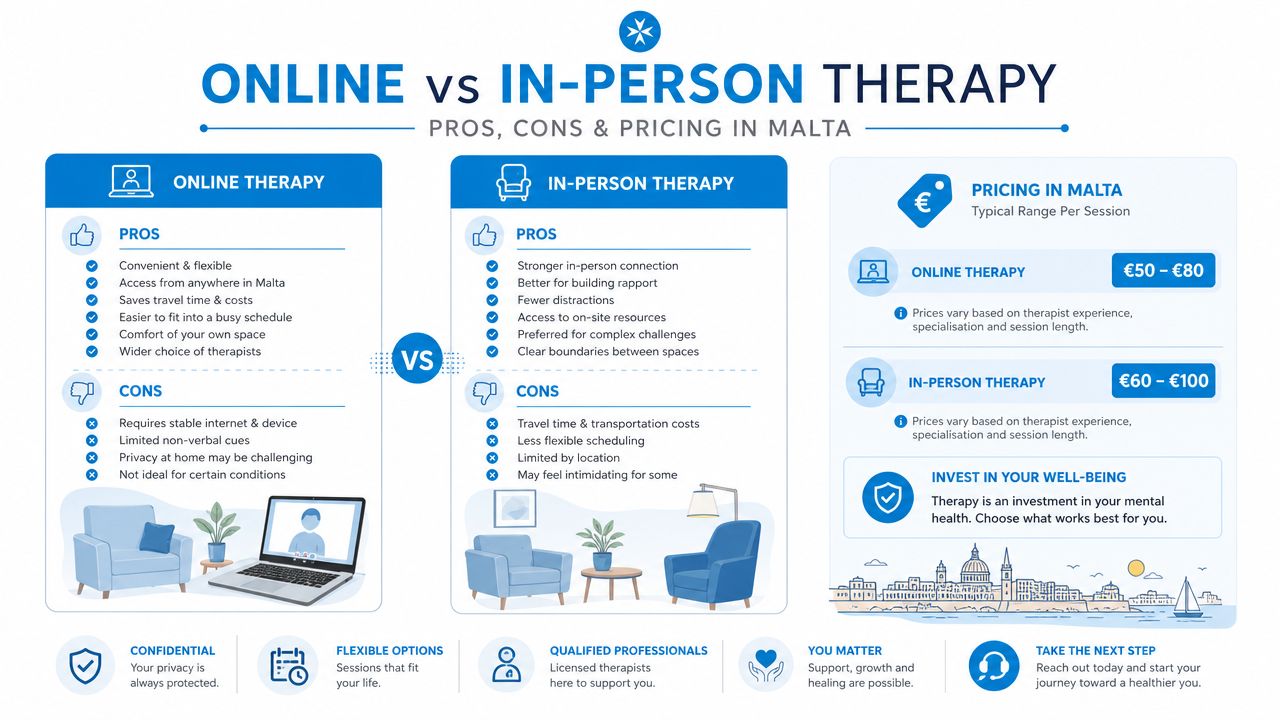
A balanced comparison often looks like this:
| Format | Best for | Possible drawback |
|---|---|---|
| Online therapy | Couples needing flexibility, language choice, or specialist fit | Home interruptions or reduced non-verbal cues |
| In-person therapy | Couples who focus better in a neutral shared space | Smaller therapist pool and added logistics |
If you're weighing the trade-offs carefully, this guide to online vs in-person therapy in Italy for expats offers a useful framework that also applies well to Malta.
What pricing usually looks like
In private practice, couple therapy through Therapsy starts from €100 per session. Final fees depend on the therapist's experience and the kind of support needed.
Rather than looking for the lowest fee alone, focus on value:
- Specialist relevance: can the therapist work with your kind of relationship dynamic?
- Language fit: can both partners express difficult emotions clearly?
- Practical consistency: can you attend regularly without the format becoming another source of stress?
Cheaper therapy that one partner resents attending isn't cheaper in the long run.
How Therapsy Provides Expert Support for Couples in Malta
For expat and intercultural couples in Malta, the hardest part is often not deciding to get help. It's finding support that understands both the relationship and the international life around it.
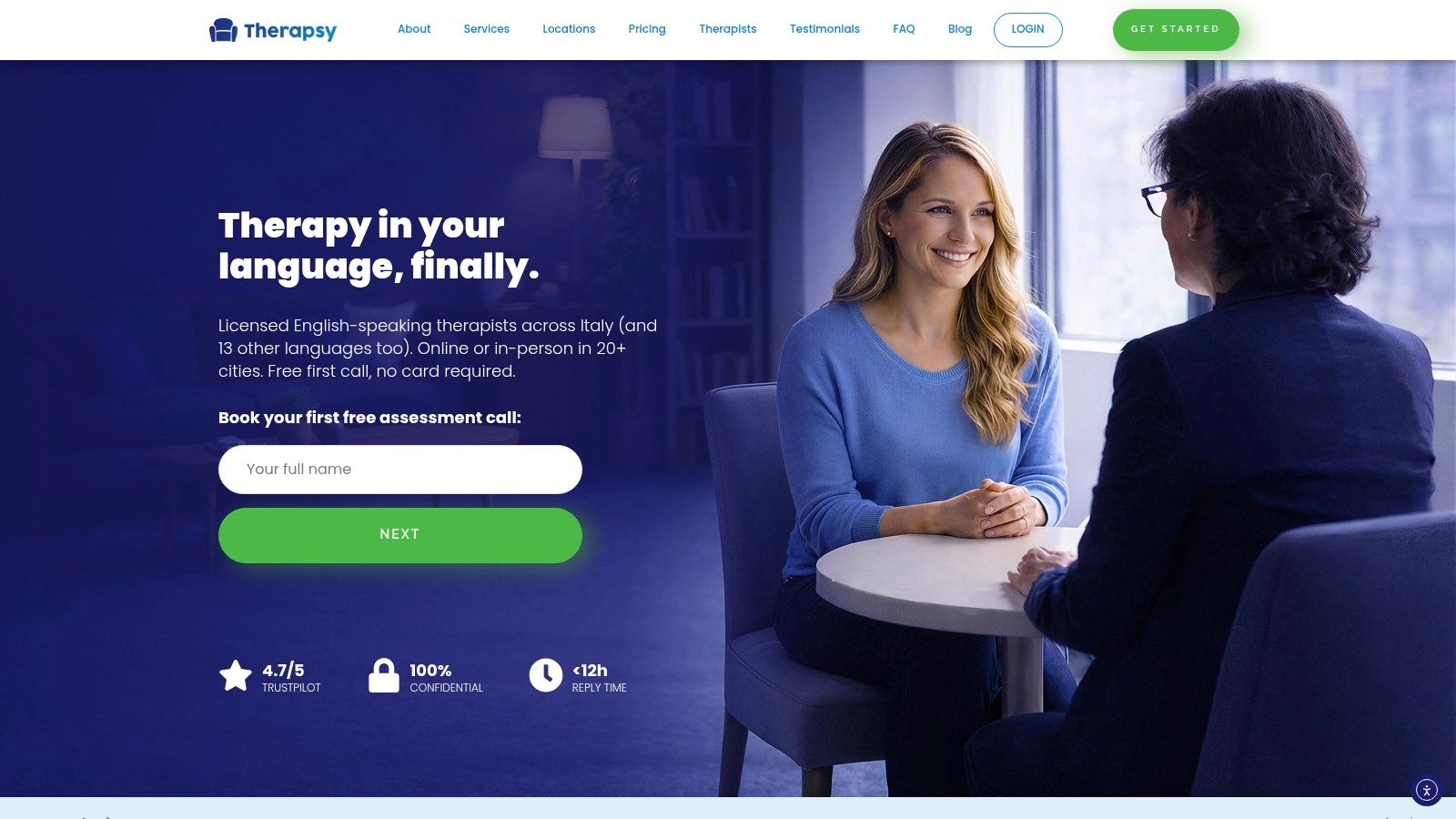
Dr. Francesca Adriana Boccalari, Clinical Director at Therapsy, leads a model designed around exactly that challenge. Therapsy is a trusted multilingual psychotherapy service in Italy, with support available online for couples living in Malta who need specialist care in a language and framework that fits their lives.
Why this model works well for couples abroad
Therapsy offers several strengths that matter specifically for multilingual and cross-cultural relationships:
- 11 multilingual therapists, including English, Italian, French, Spanish, German, Portuguese, Ukrainian, Russian, Greek, Arabic, and Hebrew
- Human matching by the Clinical Director, not an automated quiz or chatbot
- Evidence-based approaches, including CBT, EMDR, Schema Therapy, systemic-relational therapy, and ethnopsychotherapy
- Online and in-person care across Italy, with online sessions making access simple from Malta
- A team of carefully selected licensed professionals supervised clinically for quality and fit
This isn't just about convenience. It's about reducing the risk of a poor therapeutic match. When one partner already feels misunderstood in daily life, sitting with a therapist who misses the cultural layer can deepen frustration rather than relieve it.
What couples often need most
Many international couples don't need a dramatic intervention. They need a therapist who can hold complexity calmly.
They need someone who can work with:
- bilingual or uneven-language conversations
- mixed expectations around commitment, gender, and family
- relocation grief and role imbalance
- anxiety, shutdown, or resentment that spills into the relationship
Therapsy also offers a free first assessment call, with no commitment and no payment, so couples can speak to a real clinician before deciding what to do next.
Practical Steps to Prepare for Your First Session
Your first session doesn't need to be polished. It helps more if it's honest.
What to do beforehand
A little preparation can make the first appointment feel less overwhelming and more productive.
Try this:
- Name your goals separately first. Each partner should think about what they hope will improve, without editing for the other's comfort.
- Discuss one shared goal together. Keep it simple. Better communication is too broad. “We want to stop turning every disagreement into a two-day shutdown” is more usable.
- Write down the repeating pattern. Not every detail. Just the loop. For example: criticism, defensiveness, silence, then distance.
- Note major turning points. Include both painful moments and meaningful ones. A therapist needs the history of the bond, not only the history of conflict.
- Prepare practical questions. Ask about confidentiality, format, scheduling, language use, and how sessions are structured.
The most helpful starting attitude is curiosity. Not “How do I prove my point?” but “What are we both missing when this pattern takes over?”
What not to worry about
You don't need to arrive with the perfect summary. You don't need to agree on everything before you begin. And you don't need to wait until the relationship is on the verge of collapse.
Starting earlier usually gives therapy more room to work.
FAQ
How do I choose the right couple therapist in Malta
Choose a therapist with specific training in couple work and experience with intercultural dynamics. General counselling skills aren't always enough for relationship treatment, especially when language differences, migration stress, or intimacy concerns are part of the picture. Ask direct questions about training, method, confidentiality, and how the therapist handles imbalance between partners.
Is couple therapy only for relationships in crisis
No, couple therapy isn't only for relationships in crisis. Many couples begin when they notice recurring patterns and want help before resentment becomes entrenched. Therapy can be preventative as well as reparative.
Can therapy help if we come from different cultures or speak different first languages
Yes, therapy can help a great deal in mixed-language and cross-cultural relationships. The key is finding a therapist who understands that conflict may be shaped by values, identity, migration, and family expectations, not just by poor communication. Language fit matters because people need enough precision to talk about pain, fear, and love clearly.
Is online couple therapy effective for couples living in Malta
Yes, online couple therapy can be a strong option for couples living in Malta. It often improves access to therapists with the right language skills and intercultural experience, which can matter more than physical proximity. The format works best when both partners have privacy, a stable connection, and a commitment to showing up fully.
How long does couple therapy usually take
The length of therapy depends on the issues involved and the couple's goals. Some couples come with one focused problem, while others need deeper work around trust, attachment, or long-standing conflict patterns. What matters most is whether the process is clear, structured, and helping you move out of the cycle that brought you in.
How much does couple therapy cost
Fees vary by provider and level of specialisation. At Therapsy, couple therapy starts from €100 per session, and the final fee depends on the therapist's experience and focus area. It's worth asking not only about price, but also about format, therapist fit, and whether the clinician has real experience with couples like you.
Will the therapist keep our sessions confidential
Yes, couple therapy is designed to be confidential, but the therapist should explain clearly how confidentiality works in practice. This is especially important in couple work because questions can arise about individual disclosures, shared information, and communication outside sessions. If the policy isn't explained well, ask before you begin.
If you're looking for thoughtful, multilingual support that understands expat and intercultural relationships, book your first free assessment call with Therapsy. There's no commitment, just a conversation with our Clinical Director who will listen carefully and match you with the right therapist for you.
Dr. Francesca Adriana Boccalari, Clinical Director at Therapsy