If you're facing the end of a marriage while living in Italy, the experience often feels split in two. One part is heartbreak, anger, confusion, or relief. The other part is paperwork, language barriers, residency questions, children's routines, housing, and the strange loneliness of trying to make major decisions far from the people who usually know you best.
Divorce therapy for expats is specialised psychological support for people separating abroad. It addresses both the emotional impact of divorce and the practical strain of navigating separation in a foreign system. That difference matters. A domestic divorce is already painful. An international one can also involve unfamiliar institutions, mixed cultural expectations, and the loss of the shared life that made the move abroad feel meaningful in the first place.
In clinical practice, I often see expats minimise this complexity. They tell themselves they should be coping better because they are “functional” at work or because the relationship had been difficult for a long time. But functioning isn't the same as being supported. When you are trying to hold grief, conflict, bureaucracy, and uncertainty in a language that may not be your own, the burden becomes heavier.
If part of your separation also connects to another legal system, it can help to understand your Florida divorce options or the options in your home jurisdiction alongside emotional support in Italy. For broader psychological guidance specifically addressing relocation stress, mental health support for expats in Italy can also help you place this experience in the larger context of expat life.
Introduction
The end of a relationship abroad rarely stays inside the relationship. It spills into visas, schools, tax residency, shared friendships, and the question many expats dread most: where is home now?
That is why divorce therapy for expats should never be reduced to “talking about feelings.” Good therapy creates enough stability for clear decisions. It helps you regulate conflict, process grief, and rebuild daily life in a country that may still feel only partly yours.
A separation abroad is both an emotional crisis and a coordination crisis. Therapy works best when it treats both.
I'm Dr. Francesca Adriana Boccalari, Clinical Director at Therapsy, and I specialise in intercultural psychotherapy. In this kind of work, warmth matters, but structure matters too. People usually don't need vague reassurance. They need a calm, skilled space where the psychological and logistical realities of expat divorce can be held together without confusion.
The Unique Challenges of Expat Divorce in Italy
Expat divorce in Italy has a particular shape. The pain is not only about the relationship ending. It is also about separation happening inside a foreign legal, social, and cultural environment.
A peer-reviewed review in Frontiers in Psychology treats expatriate divorce as a high-stakes adjustment event because relocation can place extra strain on marriage, and it notes that expat divorce can intensify stress and trauma through cross-border disputes while social support acts as a key protective factor (Frontiers in Psychology review).
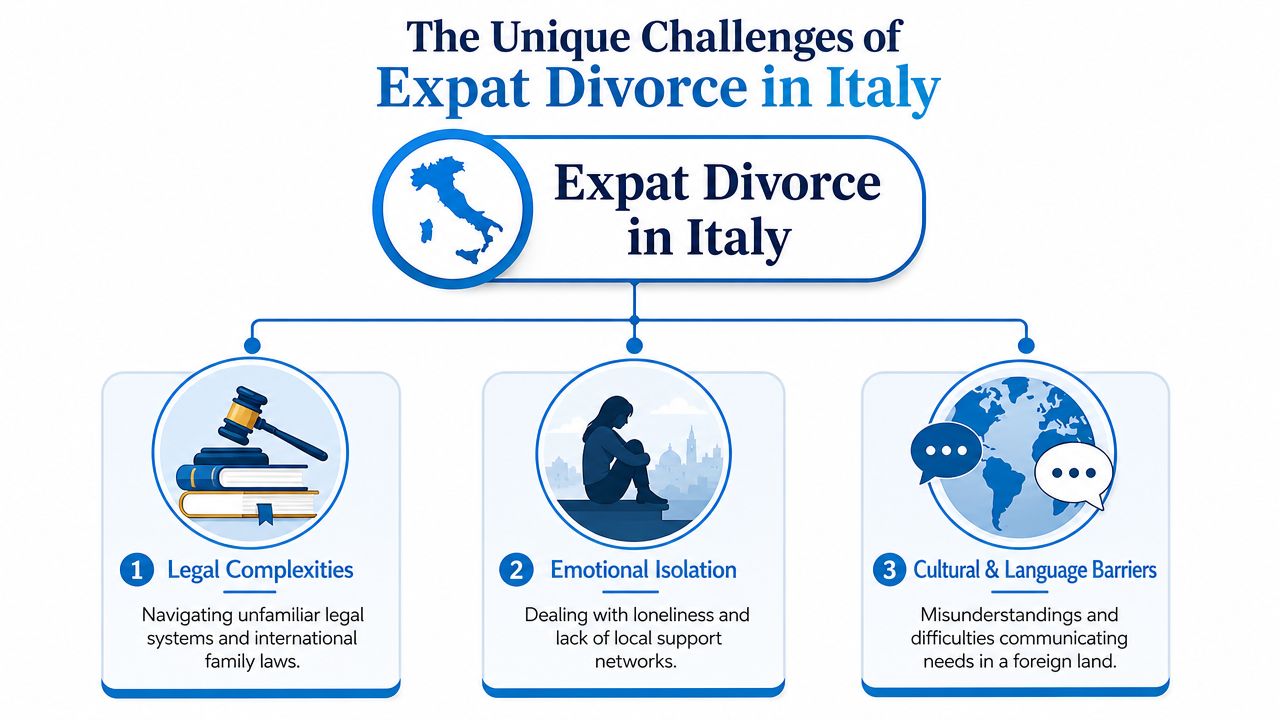
Legal and practical pressure
The first challenge is operational. Many expats are trying to answer difficult questions while emotionally depleted.
- Jurisdiction confusion often appears early. Which country will handle the divorce, parenting arrangements, or financial decisions?
- Residency and immigration concerns can raise anxiety fast, especially if one partner's right to stay is tied to marriage, work, or family status.
- Administrative overload becomes intense in Italy when documents, appointments, and formal communication happen in a non-native language.
- Parenting logistics can become especially tense when one parent wants to return home and the other wants to remain in Italy.
In these moments, people often think they need to “be less emotional.” Usually, they need better containment. Emotional flooding is predictable when the practical stakes are high.
Emotional isolation and identity disruption
Expat divorce often removes several layers of emotional safety at once.
You may be losing a partner, a home routine, a future plan, and the identity you built around the move. For many people, there is also grief for the “expat project” itself. The life in Italy was not only where you lived. It was part of the story you told yourself about who you were becoming.
Sometimes the most painful loss is not only the partner. It is the collapse of the life narrative built around the move abroad.
Without nearby family, emotional recovery can slow down. Even people with local friends may hold back because social circles in expat communities can feel small, overlapping, and exposed. Similar dynamics often appear in wider family stress too, especially where intercultural expectations are already tense. That is one reason some readers also relate to themes discussed in stress with Italian in-laws.
Social rupture and co-parenting across cultures
The third challenge is social. Separation can reorganise your entire support system.
A few patterns are especially common:
- Shared friendships split and people feel pressure to take sides.
- Children absorb bicultural tension when parents differ on schooling, language, religion, or where “home” should be.
- Communication styles clash because one partner may value directness while the other values caution, family hierarchy, or indirect communication.
- Distance from extended family removes the practical help that often softens divorce for couples who separate in their home country.
None of this means expat divorce is doomed to become traumatic. It means the stressors are layered, and therapy has to be designed with those layers in mind.
What Is Divorce Therapy for Expats and How Can It Help
Divorce therapy for expats is a structured form of psychological support that helps people separate with more clarity, less destructive conflict, and better emotional stability while living across cultures or legal systems.
Its primary goal is stabilisation first, insight second, and decision support throughout.
That may sound simple, but in practice it changes everything. Many people start therapy believing they must choose between “processing emotions” and “getting practical.” In good expat divorce work, those are not competing tasks. Regulated thinking improves decisions. Clear decisions reduce emotional chaos.
What this therapy actually does
This kind of therapy usually helps in five concrete ways:
- It lowers the emotional temperature. When conversations keep spiralling, therapy helps identify triggers, set communication rules, and reduce reactive exchanges.
- It creates a place to think clearly. Clients often need help sorting urgent questions from important ones.
- It supports grief without romanticising the relationship. You can mourn what mattered and still recognise what was harmful or no longer workable.
- It protects functioning. Sleep, work concentration, eating routines, and parenting presence often suffer during separation.
- It helps rebuild a support system in the host country. This is essential when your usual support network lives elsewhere.
A practical article like insights on healing during a Texas divorce can be useful because it reflects a wider truth. Healing during divorce is not passive. It depends on structure, support, and repeated small decisions that reduce chaos.
What does not work well
In my experience, several approaches tend to fail expat clients during divorce:
- Therapy that stays too abstract and never addresses real-life decisions
- Advice that ignores international context, especially children, residency, and distance
- Sessions with no goals, where the client leaves relieved for an hour but still disorganised
- Pressure to reconcile too quickly, or pressure to separate before the client is ready
By contrast, the most useful therapy gives clients a reliable frame. That frame can hold ambivalence, conflict, practical problem-solving, and genuine mourning without collapsing into confusion.
Therapeutic Approaches for Navigating Separation Abroad
Different therapeutic models do different jobs. A good clinician chooses the method that fits the task in front of you, not the other way around.
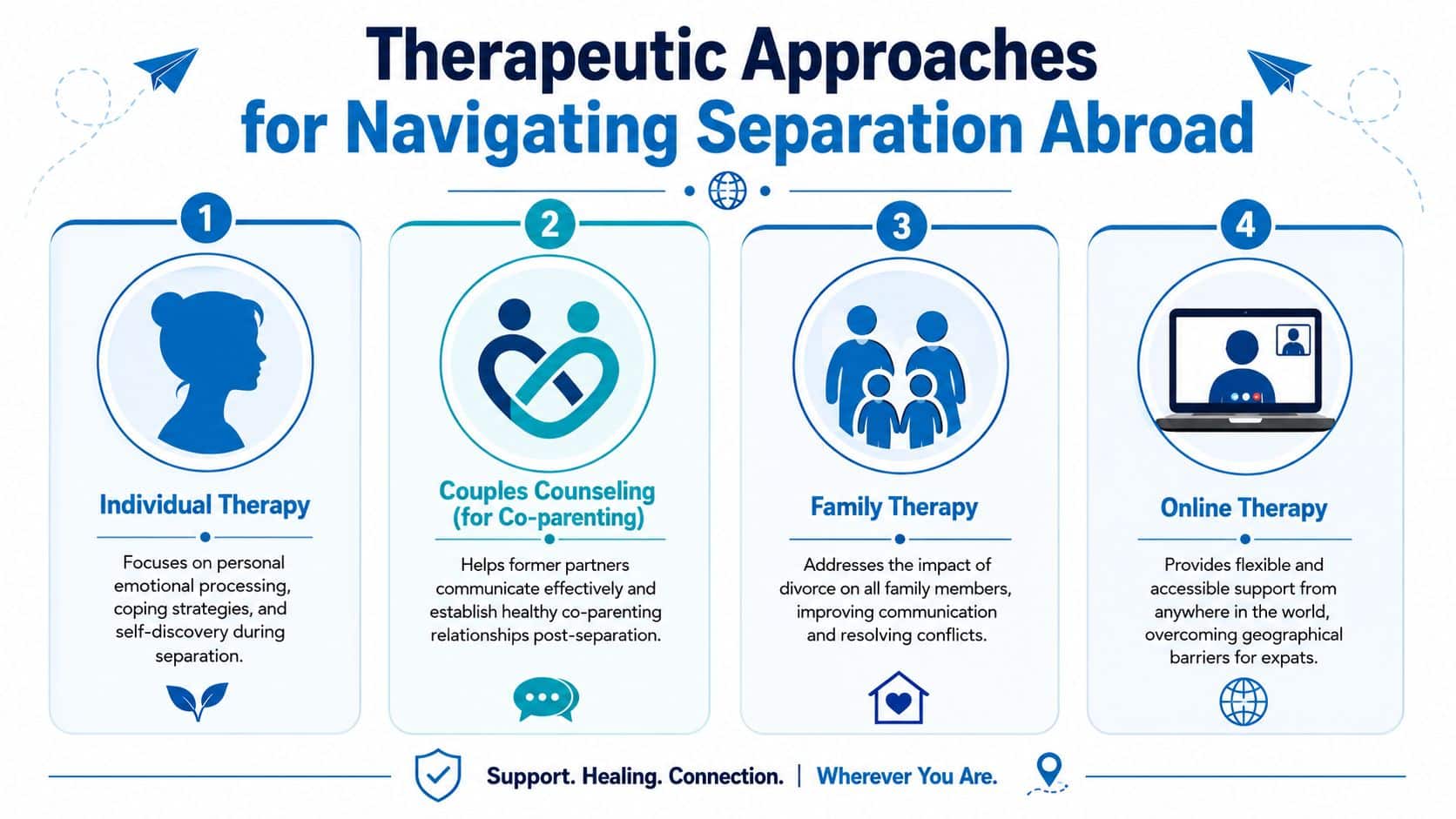
Which approach fits which problem
| Approach | Best suited for | What it helps with |
|---|---|---|
| Individual therapy | One partner needs support, clarity, or recovery | Grief, anxiety, identity loss, boundaries, decision-making |
| Discernment or structured couple work | The couple is unsure whether to separate | Clarifying whether repair is possible or separation is the healthiest step |
| Co-parenting therapy | The relationship is over, but parenting continues | Communication rules, child-focused decisions, conflict reduction |
| Trauma-informed therapy | The separation has been high-conflict, coercive, or destabilising | Nervous system regulation, intrusive stress responses, emotional safety |
CBT and Schema Therapy
CBT, or Cognitive Behavioural Therapy, helps you notice the link between thoughts, emotions, and actions. During divorce, this is useful when the mind starts generating catastrophic predictions, self-blame, or repetitive arguments.
Schema Therapy goes deeper into longstanding patterns. It can help people who repeatedly enter relationships where they over-function, fear abandonment, suppress needs, or remain stuck in painful dynamics because those patterns feel familiar.
For expats, both models can be especially helpful because relocation often strips away normal anchors. Old coping styles become more visible when your language, community, and routines are already under pressure.
Trauma-informed work and EMDR
Some separations feel less like a transition and more like a shock. This is particularly true when there has been betrayal, coercive conflict, legal intimidation, or chronic emotional destabilisation.
In these cases, trauma-informed care can help the person move out of survival mode. EMDR, which stands for Eye Movement Desensitisation and Reprocessing, is one evidence-based option often used to process distressing memories and reduce the intensity of emotional triggers. Readers who want to understand this approach better can explore EMDR therapy for expats in Italy.
Interaction patterns and loss processing
A second technical point matters here. Effective divorce therapy works best when it addresses both interaction patterns and loss processing. Divorce often activates grief-like responses while also trapping people in repetitive conflict cycles. Clinical guidance on divorce therapy describes a progression through shock or denial, pain or guilt, anger or bargaining, rebuilding, acceptance, and growth, and it recommends interventions such as role-play, guided imagery, the empty-chair technique, and work on negative thought patterns (divorce therapy guidance).
For expats, the challenge is sharper because family is often far away. That means emotional regulation depends more heavily on deliberate routines, regulated communication, and a replacement support structure in the host country.
The practical benchmark is not only “feeling better.” It is being able to communicate without escalation, sleep more reliably, function at work, and build support where you live now.
How to Find the Right Therapist in Italy or Online
Finding the right therapist during a separation is not a minor detail. It shapes how quickly you feel understood, how safe you feel discussing sensitive issues, and whether the work stays relevant to your actual life.
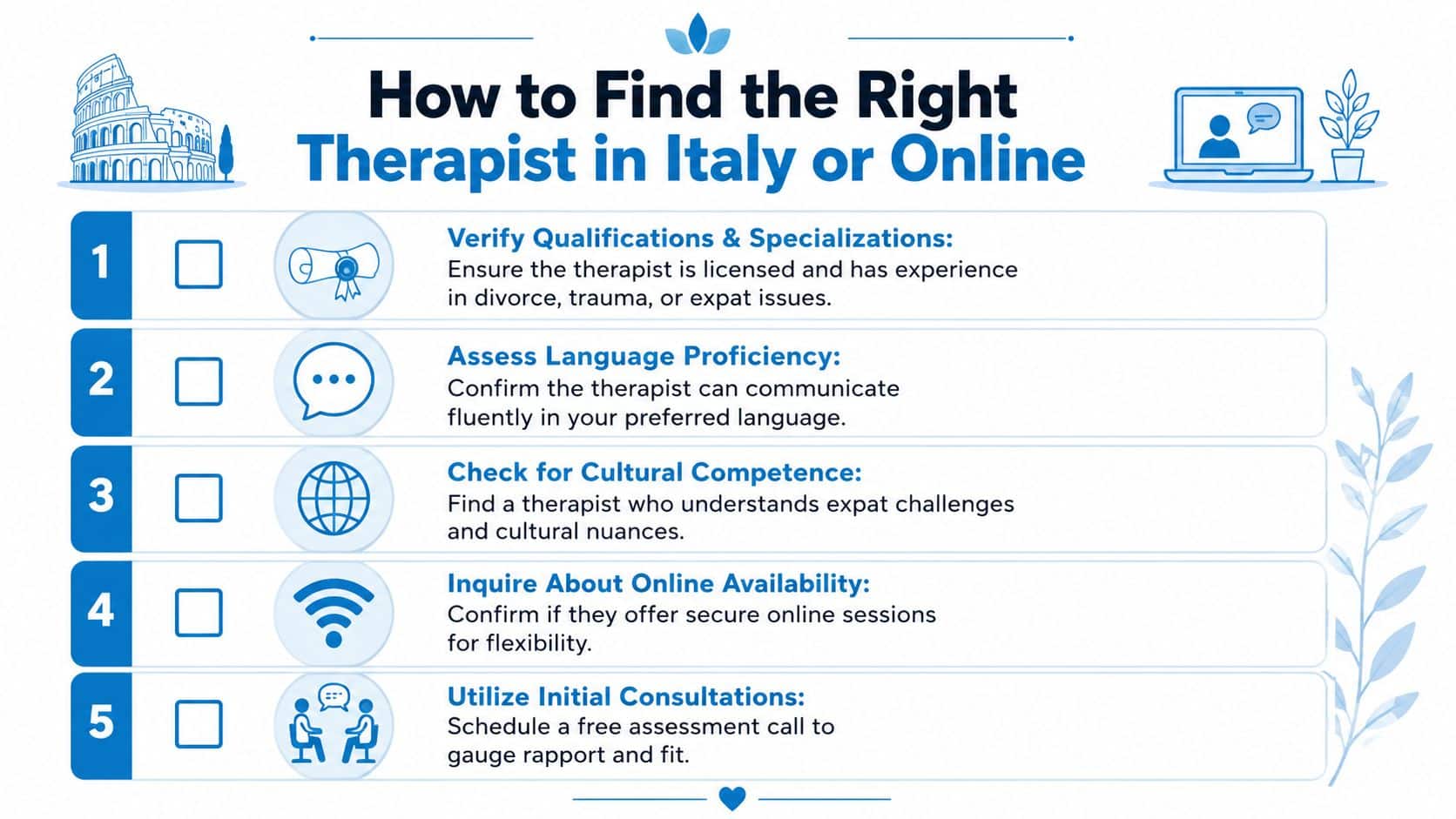
The non-negotiables
Start with the essentials. If these are missing, the fit usually won't improve with time.
- Licensed clinical training matters. Look for a psychologist or psychotherapist with clear qualifications and relevant experience.
- Language fit matters more than many people expect. If you need to discuss grief, legal stress, family history, and conflict, your strongest language is often the safest one.
- Cultural competence is not a luxury. The therapist should understand relocation stress, mixed-cultural relationships, and what it means to function in a country that is not fully familiar.
- Comfort with online work may be important if travel, childcare, work schedules, or privacy make in-person sessions difficult.
The expat-specific question many people forget to ask
Ask whether the therapist knows how to screen for cross-border complications.
For expat couples in Italy, effective therapy requires cross-jurisdictional planning. A therapist should screen for how the separation affects residence rules, foreign nationality, and children across two legal systems, because the stress is both emotional and administrative. Guidance for internationally mobile couples also notes that consulates are often recommended for finding local professional support (guidance on cross-jurisdictional planning).
That does not mean the therapist gives legal advice. It means they understand the psychological consequences of legal uncertainty and know when practical referrals are needed.
A useful checklist for first contact
When you speak to a therapist or service, listen for answers to questions like these:
- Can we work in my preferred language throughout the process?
- Have you worked with international couples or expats separating in Italy?
- How do you handle sessions when there are children, multiple countries, or residence concerns involved?
- Do you offer online sessions if I need flexibility or privacy?
- What happens in the first assessment, and how are goals set?
If you want a practical starting point, finding the right therapist for expats in Italy offers a useful framework.
One option some expats consider is Therapsy, which offers online and in-person psychotherapy in 14 languages and works across 24 Italian cities with 90+ physical locations, with matching handled by the Clinical Director rather than an automated system (Therapsy overview). That kind of structure can be helpful when the main challenge is finding a therapist who understands both intercultural stress and life in Italy.
What to Expect in Your Assessment and Therapy Sessions
Starting therapy during a separation can feel daunting, especially if you're already exhausted. Clients often arrive with two worries. They're afraid they'll fall apart, or they're afraid they won't know what to say. Both are common, and neither is a problem.

The first assessment
The first contact is not an exam. It is a structured conversation that helps the therapist understand what is happening and what kind of support will be most useful.
You may be asked about:
- the current stage of the separation
- whether there are children involved
- how communication with your former partner is going
- whether there are urgent practical stressors
- how your sleep, work, appetite, and concentration have been affected
- what kind of support you currently have in Italy
This early phase is also where goals begin to take shape. Some clients need stabilisation first. Others need help deciding how to communicate, how to co-parent, or how to stop every exchange from becoming a fight.
The early sessions
In the first few sessions, therapy often focuses on reducing immediate overload.
That can include:
- Communication boundaries such as when to reply, what channel to use, and which topics should stay off text
- Emotional regulation tools for panic, intrusive thoughts, or spiralling arguments
- Grief work that helps you process the loss without becoming trapped in rumination
- Support mapping so you're not trying to manage everything alone
- Short-term routines around sleep, food, work, movement, and social contact
Effective divorce therapy targets both interaction patterns and loss processing, because divorce triggers grief and conflict cycles. For expats, distance from family removes the usual social buffer, making it essential to build deliberate coping routines and a new support system in the host country.
Early therapy is often less about deep analysis and more about restoring enough steadiness for life to feel manageable again.
What progress looks like
Progress during expat divorce rarely means feeling good all the time. It usually looks more practical at first.
You may notice that you:
- react less impulsively
- recover faster after difficult exchanges
- feel clearer about next decisions
- sleep more consistently
- stop explaining yourself to people who don't need access
- create a weekly structure that supports you in Italy, not only emotionally but socially
Therapy should feel collaborative. The clinician brings training and containment. You bring your history, values, limits, and goals. Good work happens when those two forms of knowledge meet.
Practical Resources and Next Steps in Italy
During separation, support works best when it comes from more than one place. Therapy is one part of the picture. Reliable information, legal orientation, and local connection matter too.
A useful next-step plan often includes:
- Your consulate or embassy for referrals to English-speaking or international lawyers, notaries, and local support professionals
- Official residency and municipal information if your living situation or registration may change
- School or childcare communication if children need consistent messaging across households
- Trusted expat communities for practical, non-clinical recommendations, while being selective about what you share
- A therapy intake pathway that helps you begin quickly and in your preferred language
If you're unsure how to begin, how to start therapy in Italy gives a clear overview of the first steps, including what to expect from initial contact and how matching usually works.
The aim is not to solve everything in a week. It is to reduce confusion, protect your functioning, and build a support structure that can hold the next stage of your life.
Who works with separation at Therapsy
Separating in a country that is not your own, often in a legal system you do not know, is a specific problem. These clinicians work on it.
Dr. Daniele Damiani provides expert psychological consultation for legal cases involving separation and divorce alongside his clinical work, a combination of clinical and forensic competence that is uncommon.
Dr. Paola Lazzarini supports people through betrayal, separation, co-parenting and child custody, using specific tools for couples and families such as the genogram and the generational clinical interview.
Dr. Arianna Antonelli works with adults and couples in an integrated systemic frame, using therapeutic assessment: tests used collaboratively with the person rather than on them, which helps when two people describe the same situation in incompatible ways.
You do not have to work out who fits on your own. You tell Therapsy what you are looking for, a member of our clinical team reads your request, and they introduce you. The first call is free.
FAQ
Can divorce therapy help if we have already decided to separate
Yes. Divorce therapy for expats is often very helpful even after the decision to separate has been made. At that stage, the work usually focuses on emotional stabilisation, communication rules, co-parenting, grief, and practical adjustment rather than reconciliation.
Is divorce therapy only for couples
No. It can be individual, couple-based, or focused specifically on co-parenting. Many expats start alone because they need a private space to think clearly, regulate emotions, and decide how to handle contact with a former partner.
Should I choose therapy in English or in my mother tongue
Choose the language in which you can think and feel most freely. For emotionally complex work, your strongest language usually gives you more precision and safety. Some clients manage well in English, while others realise they need their native language when discussing childhood patterns, grief, or conflict.
How long does divorce therapy usually last
It depends on the level of conflict, the presence of children, and how much practical stress surrounds the separation. Some people need short-term stabilisation, while others benefit from longer work on grief, trauma, identity, or co-parenting. A good therapist should help you define goals early so the process feels purposeful.
Can therapy help with high-conflict communication
Yes. One of the most useful functions of therapy is reducing destructive communication cycles. This may include boundary-setting, planning communication windows, identifying triggers, and shifting from emotional reactivity to clearer, more contained exchanges.
What if legal issues in two countries are involved
Therapy can help, but it should not replace legal advice. In cross-border cases, the therapist's role is to help you manage the emotional strain, clarify decisions, and identify when legal or consular referrals are needed. That combination is often essential for expats in Italy.
Is online therapy a good option during separation
Often, yes. Online therapy can make support more accessible when privacy, travel, work, or childcare are difficult. It can also make continuity easier if your location changes during the separation process.
If you're navigating separation far from home, you don't have to carry the emotional and practical weight alone. Book your first free assessment call with THERAPSY, no commitment, just a conversation with our Clinical Director who will listen carefully and help match you with the right therapist for you.
If you are in the Veneto, parenting support for separated parents in Padua and Venice is also available in Italian and English, in person or online.