An aperitivo in Milan can look like proof that everything is working. You’ve found a table outside, the light is soft, people are talking loudly around you, and from the outside you seem like a couple living the Italian dream. But many intercultural couples know the private version of that scene. One partner feels alone in a language they still don’t fully trust. The other feels responsible for translating, managing family expectations, and keeping daily life moving. A small disagreement about plans, money, in-laws, or paperwork turns into something much bigger.
That’s often the moment people start searching for an english speaking couples therapist in italy. Not because the relationship is broken, but because living abroad changes the pressure on a relationship. It strips away familiar routines, support systems, and the easy shorthand couples used to rely on. In Italy, those pressures often include bureaucracy, relocation stress, different cultural assumptions about family life, and the emotional fatigue of switching between languages all day.
I see this pattern often in my work with expats and intercultural couples. The problem usually isn’t “poor communication” in the generic sense. The problem is that communication is happening inside multiple systems at once: language, culture, attachment, migration stress, and sometimes grief for the life each partner imagined they would have here.
Therapy can help, but only if it addresses those layers directly. Generic couple advice rarely reaches the underlying fault line. What works is a clinically grounded approach that understands intercultural dynamics in practice, not only in theory.
Introduction Finding Your Way Back to Each Other in Italy
When Italy feels beautiful and heavy at the same time
Many couples arrive in Italy with hope. A work move, a university placement, a return to a partner’s home country, or a shared wish to build something new can all feel exciting at the start. Then ordinary life begins. Renting a flat, speaking to landlords, dealing with residency documents, understanding unspoken social rules, and negotiating time with extended family can all create tension that didn’t exist before.
For intercultural couples, that tension often becomes personal very quickly. The partner who knows Italy better may feel overburdened. The partner who feels less at home may become more dependent, more withdrawn, or more reactive. Neither position feels good. Both can lead to resentment.
A relationship under migration stress often looks like a communication problem, but the deeper issue is usually emotional safety.
An english speaking couples therapist in italy can offer something specific. A space where both partners can slow down, name what is happening, and understand the pattern without reducing it to blame. That matters because intercultural conflict rarely comes from one bad conversation. It usually comes from repeated misunderstandings around belonging, loyalty, independence, family, and emotional expression.
What specialised couples therapy changes
A good couples therapist doesn’t decide who is right. The task is to identify the cycle the couple is trapped in. One person pursues, the other shuts down. One explains more and more, the other hears criticism. One reaches for closeness through family involvement, the other experiences intrusion. These patterns are common, but in Italy they often intersect with cultural assumptions in ways that make them harder to recognise.
In practice, therapy helps couples do three things:
- Name the problem: not just the last argument, but the pattern underneath it.
- Reduce misinterpretation: especially when language, tone, and cultural habits distort meaning.
- Build workable agreements: about family boundaries, decision-making, conflict repair, and emotional support.
The aim isn’t to make an intercultural couple act like a same-culture couple. The aim is to help them create a relationship culture of their own.
The Unique Strains on Expat Relationships in Italy

Italy changes the relationship around the couple
A couple can arrive in Italy loving each other well and still find themselves arguing in ways that feel unfamiliar. One partner is trying to settle into a new country. The other is carrying the invisible work of translating systems, expectations, and social codes. By the end of the week, the argument is about who called the pediatrician, but the strain underneath is often about dependence, fairness, and whose way of living sets the norm.
I see this often in intercultural couples. The pressure is rarely only external. It enters the relationship through repeated practical moments: dealing with residency paperwork, responding to an involved parent, deciding where to spend holidays, or working out whether loyalty means prioritising the couple or the wider family.
For mixed Italian foreign couples, those moments can become loaded quickly. In clinical work, that pattern is familiar. Bilingual stress affects timing, humour, emotional precision, and who gets to sound competent in difficult conversations.
Intercultural conflict follows patterns
Couples usually are not fighting about everything. They are caught in a small number of recurring collisions, and culture gives those collisions shape.
A partner from a more collectivist background may read frequent contact with family as care, duty, and stability. A partner from a more individualist background may experience the same contact as intrusion, overreach, or a sign that the couple is not functioning as a team. Neither interpretation is irrational. The problem is that each person often treats their own framework as obvious and the other person's as provocative.
The same is true in conflict. Directness can feel honest and respectful in one cultural context. In another, restraint protects dignity and keeps conflict from escalating. If a couple does not name those differences clearly, they start assigning character judgments. One becomes "cold" or "too sensitive." The other becomes "aggressive" or "immature." Those labels harden fast.
Common pressure points include:
- Family involvement: how often relatives visit, how much influence parents have, and whether saying no is acceptable
- Money and obligation: support for family members, different attitudes to saving and spending, and what counts as shared versus personal money
- Gender and domestic roles: who carries planning, childcare, emotional labour, and public-facing tasks
- Social belonging: whether the foreign partner feels included, tolerated, or permanently peripheral in local life
- Future planning: where to raise children, which language to use at home, and whose country remains the long-term reference point
Money deserves special attention because it often carries moral meaning in intercultural relationships. An argument about spending may really be about respect, security, or obligation to family back home.
Stress changes the balance of power
One of the least discussed strains in expat relationships is asymmetry. One partner knows how things work. One has the local language. One can call the school, read the tax letter, charm the official, or understand what the in-laws meant without needing an explanation.
That imbalance can create gratitude, but it can also create parent child dynamics inside an adult partnership. The more locally competent partner may feel overburdened and unappreciated. The less locally competent partner may feel corrected, dependent, or subtly diminished. Couples often miss this because the presenting complaint sounds mundane. The emotional impact is not.
If the relationship is also dealing with temporary separation because of visa delays, work travel, or a staged move, the strain intensifies. In those cases, therapy for long-distance relationships for expats can help couples address attachment stress, reunion conflict, and the practical distortions that distance introduces.
The core task is to treat the relationship problem at the right level. In Italy, intercultural couples are often dealing with stress, culture, language, and family systems at the same time. Therapy works better when all four are brought into the room.
Why Native Language Therapy Isnt a Luxury It Is a Necessity
Emotional nuance gets lost before the argument even starts
Couples therapy depends on precision. Not polished language, but emotionally precise language. A person has to be able to say, “I felt dismissed,” and mean exactly that, not “angry,” not “annoyed,” not “fine.” When someone is speaking in a non-native language, that precision often collapses first. They may sound flatter, harsher, or less clear than they are.
This is one reason an english speaking couples therapist in italy can make such a difference. Therapy in English is not merely a convenience for expats. It often reduces the friction between what someone feels and what they can express in the room.
If one partner is constantly translating their inner life, they’re doing two demanding tasks at once. They’re feeling and editing. That can make vulnerable work slower, especially in couples therapy where timing matters and a missed nuance can trigger a defensive spiral.
Language shapes safety in the room
There’s also a relational issue. If one partner speaks the local language with ease and the other doesn’t, therapy can accidentally reproduce the same imbalance they live with outside the room. The more fluent partner becomes the natural explainer. The less fluent partner may sound less articulate, less thoughtful, or less emotionally mature than they really are.
When language is more natural, trust repairs faster. The less fluent partner doesn’t have to borrow the other person’s words to describe their own pain.
Native-language therapy is clinically practical
Think of therapy as detailed work, not broad sketching. If a couple is trying to repair betrayal, rebuild trust after relocation stress, or negotiate different family loyalties, they need a fine brush. Not a thick one.
An effective therapist listens for:
- The exact word choice: “ignored” is different from “unimportant.”
- Cultural references: humour, irony, and politeness vary across countries.
- Relational asymmetry: who speaks first, who edits themselves, who overexplains.
- What isn’t said: pauses, hesitations, and emotionally loaded substitutions.
For many expats and mixed-nationality couples, multilingual therapy for expats worldwide is less about convenience than clinical fit. The right language often creates the conditions for honesty. Without that, couples can spend months discussing the relationship without ever fully entering it.
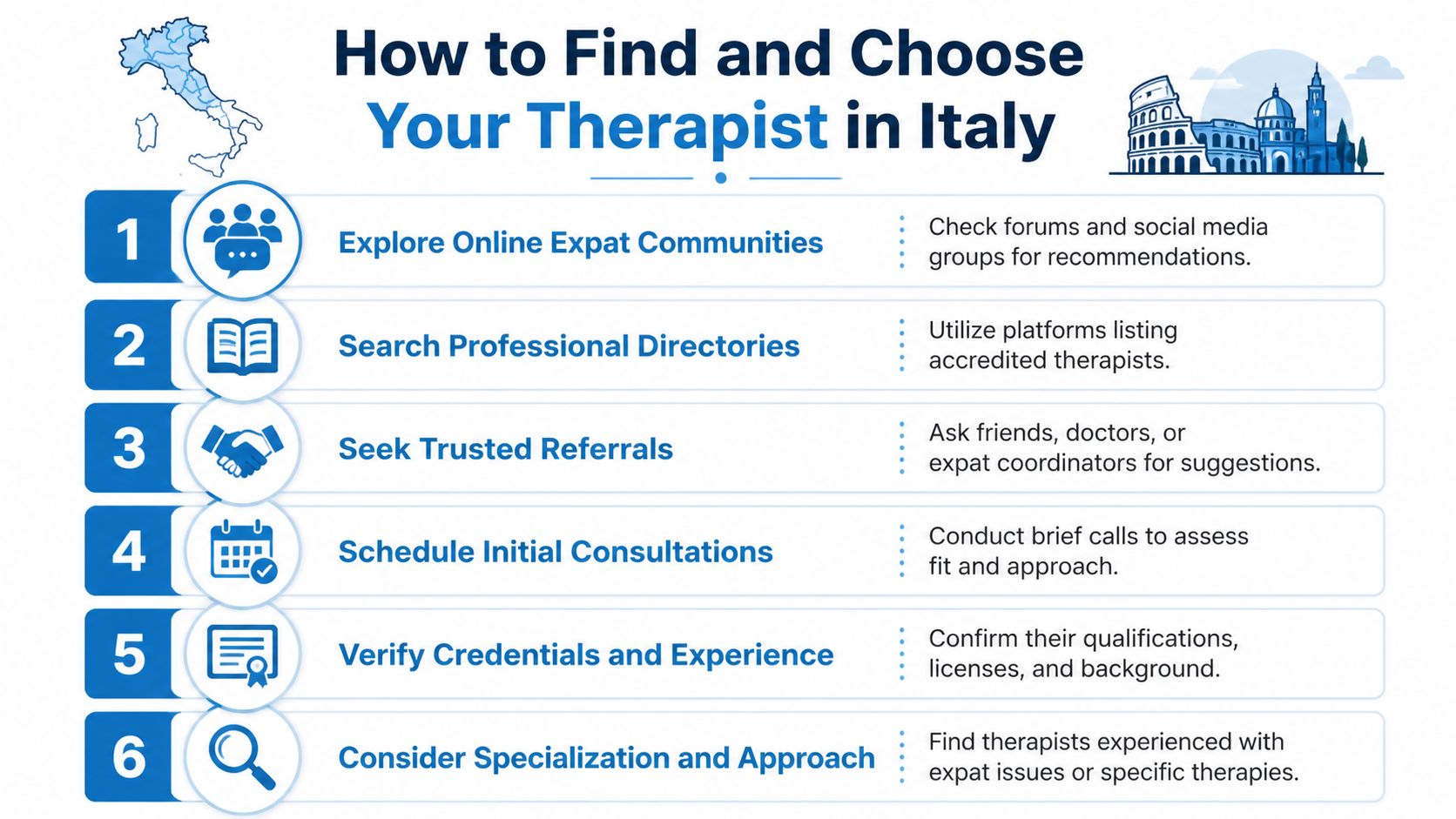
How to Find and Choose Your Therapist in Italy
Where most couples start
The search often begins in predictable places: Expat Facebook groups. Reddit threads. Embassy lists. A friend of a friend. A search for “english speaking couples therapist in italy” followed by a scan of websites that all sound vaguely similar.
Those routes can help, but they have limits. Community recommendations are personal, not clinical. A therapist who was helpful for individual anxiety may not be equipped for intercultural couple work. Directory listings can also make it hard to tell who understands expat dynamics, bilingual imbalance, or migration-related conflict.
What to check before you book
A first consultation should help you assess fit, not only availability. Couples often feel relieved just to find someone who speaks English. That’s understandable, but language alone isn’t enough.
Use questions like these:
What experience do you have with intercultural couples?
You’re listening for concrete familiarity with differences in family structure, communication style, and adaptation speed.How do you work when one partner is more fluent or more socially established in Italy? Power imbalance can shape how each person is heard.
What is your approach when conflict keeps repeating?
A thoughtful answer usually includes patterns, emotional triggers, and repair, not only “better communication.”How do you handle sessions if one partner feels blamed easily?
Good couples therapy protects both partners from turning the room into a courtroom.Are you licensed to practise in Italy, and what is your training in couples work?
Credentials matter. So does specialisation.Do you offer online and in-person sessions?
Flexibility helps when travel, work, or family obligations interrupt continuity.
Practical rule: Don’t choose only on warmth. Choose on warmth plus structure.
A simple way to compare options
| What to assess | Useful sign | Caution sign |
|---|---|---|
| Language fit | Therapist can work comfortably in the language the couple actually uses during conflict | Therapist offers English, but the subtleties feel effortful |
| Intercultural experience | Understands migration stress, bicultural dynamics, and family-of-origin clashes | Talks about couples in very generic terms |
| Therapeutic frame | Explains process clearly and neutrally | Seems to promise quick fixes or take sides early |
| Logistics | Consistent scheduling, clear fees, online or in-person options | Vague process, slow replies, unclear boundaries |
Why curation can matter
For many couples, the hardest part isn’t deciding to start therapy. It’s sorting through options while already stressed. A curated service can reduce that burden if the therapists are licensed, supervised, and matched according to the couple’s language and clinical needs. One option in Italy is an American therapist in Italy network page, which helps English-speaking expats identify therapists who understand relocation and cultural adjustment. What matters most is not the label itself, but whether the clinician understands the relational reality of living between systems.
Understanding Therapeutic Approaches for Couples

Systemic-relational therapy looks at the dance, not the villain
Systemic-relational therapy is often a strong fit for intercultural couples because it examines the pattern between partners. Not only each person’s intentions. If one partner criticises and the other withdraws, the therapist tracks the cycle itself. That shift matters because couples often arrive believing the problem is the other person’s personality.
In intercultural relationships, the cycle may also include outside systems. Families, migration, homesickness, and loyalty conflicts all shape the dance. A systemic lens helps the couple see that the argument at dinner may be about belonging, autonomy, or divided identities.
CBT helps couples interrupt the pattern in real time
Cognitive Behavioural Therapy, or CBT, is useful when a couple gets trapped in automatic interpretations. “You’re late, so you don’t care.” “You need space, so you must be pulling away.” CBT helps partners identify the thought, test it, and respond differently.
This approach can be especially practical for couples who want concrete tools. That matters because many intercultural conflicts are sustained by assumptions that feel obvious to the person having them, but aren’t accurate.
Schema therapy goes deeper when the same wound keeps appearing
Schema Therapy is useful when conflict keeps activating old pain. A partner who feels quickly abandoned may not only be reacting to the present disagreement. They may be responding from a much older fear. Another partner may shut down because criticism triggers shame learned long before this relationship began.
Schema work helps couples understand why a current conflict can feel disproportionate. It doesn’t excuse harmful behaviour. It explains why certain themes carry so much emotional force.
Couples often don’t need less feeling. They need a safer way to understand what the feeling belongs to.
EMDR can matter when migration stress is traumatic
Not every relationship problem is “just communication.” Some couples are carrying trauma linked to relocation, loss, medical events, family rupture, or immigration stress. In those cases, unresolved trauma can intensify conflict because the nervous system remains on alert.
EMDR is not a standard couples format, but when trauma is one driver of relational reactivity, it can be a valuable part of the treatment plan.
The Logistics of Couples Therapy Online In-Person and Cost

Online and in-person both work, but they solve different problems
One partner is in Milan, the other is travelling between Italy and the UK for work. Or you both live in the same home, but every serious conversation turns into the same argument before you even leave the kitchen. The format matters because the setting affects how well each of you can stay regulated, heard, and engaged.
Online therapy often works well for intercultural couples whose practical lives are already stretched. It helps when distance, travel, childcare, irregular schedules, or life between two countries would otherwise interrupt treatment. It also allows each partner to join from a separate private space when that leads to less escalation and more honest speech.
In-person therapy offers a different advantage. The consulting room creates a neutral environment outside the relationship’s daily battlefield. For some couples, especially where one partner withdraws and the other pursues, that physical container helps slow the cycle down. It can also be easier to read body language, manage interruptions, and hold tension safely when cultural misunderstandings quickly become emotional.
Neither format is better on its own. The better choice depends on what gets in the way of good work.
Format decisions are often clinical, not only practical
For intercultural couples in Italy, logistics are rarely just logistics. A couple may need online sessions because one partner speaks more freely in their first language from home, while the other feels less exposed on screen. Another couple may need in-person work because conflict becomes too chaotic in the home environment, especially if family members are nearby or privacy is limited.
I often advise couples to choose the format that gives the relationship the best chance of consistency. Weekly therapy that happens is usually more useful than an ideal format that gets cancelled every third session.
A mixed format can also work. Some couples attend in person when both are in the same city and switch online during work travel, school holidays, or visits from family abroad. If that flexibility matters, it helps to ask about it before you begin. Couples looking for online therapy in English in Italy often do better when the therapist can offer both continuity and a clear structure across formats.
Cost is usually private, and clarity helps
English-speaking couples therapy in Italy is usually a private service. Public options may exist, but specialised couples work in English is harder to find through the national system, and waiting times or language limitations can be a real barrier.
Fees vary by city, therapist experience, session length, and whether you are booking standard couples sessions or a more specialised service with intercultural or trauma expertise. In larger cities such as Milan, Rome, and Florence, fees are often higher than in smaller towns. Some therapists offer a brief consultation call, while others charge from the first appointment. Some include individual check-ins as part of the treatment plan, and some bill those separately.
These differences matter. Money is one of the quickest ways practical stress becomes relational stress, especially in couples already carrying different assumptions about spending, family obligations, or what therapy should reasonably cost.
A practical checklist before you book
- Ask the fee for couples sessions specifically. Individual and couples rates are often different.
- Confirm the session length. A 50-minute session and a 90-minute session are not equivalent.
- Check the cancellation policy early. This prevents resentment later.
- Ask whether online and in-person sessions are priced the same.
- Clarify where each partner can join from. This matters if one of you travels or lives part-time outside Italy.
- Discuss privacy. Online therapy only works if both partners can speak freely without relatives, children, or housemates overhearing.
Good couples therapy is not only about the method. It is also about choosing a format and fee structure that your relationship can sustain.
What to Expect in Your First Couples Therapy Sessions
The first session is usually calmer than people fear
Most couples arrive carrying one of two anxieties. They worry the therapist will take sides, or they worry they’ll be asked to reveal everything immediately. In a well-held first session, neither happens.
The therapist usually begins by understanding what brought you there now. Not every detail of your history, but the current pressure point. What keeps happening. What each of you thinks the problem is. What each of you hopes will change.
You’re building a map before trying to fix the road
Early sessions often focus on the relationship story. How you met. How the move to Italy affected you. Where conflict tends to start. What happens next. What repair looks like when it happens at all.
A therapist is also listening for interaction, not only content. Who interrupts. Who minimises. Who shifts into explanation. Who goes quiet. These observations help identify the relational cycle more accurately than the surface topic alone.
You may also be asked questions such as:
- Why now? What made therapy necessary at this moment?
- What have you tried already? Some couples have had the same conversation many times with no shift.
- What does each partner fear most? Rejection, control, abandonment, shame, loneliness, failure.
- What would “better” look like? Less fighting, more intimacy, stronger boundaries, safer communication.
Neutrality doesn’t mean distance
A skilled couples therapist is neutral in the sense that they don’t align with one partner against the other. That doesn’t mean emotionally distant. Good therapy feels engaged, respectful, and structured. It should be possible for both partners to feel challenged without feeling humiliated.
It’s completely normal to feel tense in the first session. The task isn’t to perform well. It’s to begin honestly.
Some therapists may also suggest an individual session alongside joint work if more context is needed. That isn’t a sign that the couples process is failing. It can help the therapist understand each person’s history, stress load, and emotional triggers more clearly. If you want a clearer sense of how that first contact usually unfolds, this guide to the first psychological session can make the process feel less opaque.
How Therapsy Streamlines Your Search for the Right Support
A couple reaches out after the same argument has started to stand in for many others. One partner wants therapy in English because that is the language of the relationship. The other is Italian and worries they will sound colder, harsher, or less articulate outside their mother tongue. Both are already tired. At that point, the search itself can become another source of strain.
Matching matters because intercultural couples in Italy need more than English fluency. They often need a therapist who can recognize how conflict is shaped by different ideas about loyalty, privacy, money, gender roles, parenting, and contact with extended family. A generic couples profile rarely tells you whether the clinician can work with those layers.
Therapsy tries to reduce that friction with a structured intake and therapist matching process. The service offers therapy in multiple languages, works online and in person across Italy, and includes an initial conversation to clarify language needs, the couple’s main pattern, and practical constraints such as location and schedule. That kind of sorting is useful for couples who do not have the time or emotional bandwidth to contact five different therapists and retell the same story each time.
The point is clinical fit. If one partner is carrying relocation stress, the other is caught between the relationship and family expectations, and both switch languages under pressure, the therapist needs to understand that from the start.
Human matching reduces one common expat frustration
Directory searches often look efficient until a couple tries to use them. Profiles can sound similar, and the details that matter most are often missing. Does the therapist understand mixed-nationality relationships? Can they hold the room fairly if one partner speaks more confidently in English? Do they know how Italian family structures can intensify couple conflict without turning the family into the villain?
A human matching process helps answer those questions earlier. Instead of asking couples to filter dozens of profiles alone, it starts with a conversation about fit, not just availability.
FAQ
How do I find an english speaking couples therapist in italy
Look for a therapist or service with clear experience in intercultural couples, not just English fluency. Ask about registration, clinical approach, work with mixed-nationality partners, and whether they can handle language imbalance, family pressure, and different cultural assumptions about commitment and conflict.
Can couples therapy work if one partner is Italian and the other is not
Yes. It often works well when the therapist understands that the couple is not only dealing with communication problems, but also with different cultural rules about closeness, independence, obligation, and repair after conflict.
Is online couples therapy effective for expats in Italy
Yes, especially when access and consistency are the main problems. It can be a good option for couples living outside larger cities, managing travel, or splitting time between countries.
How much does couples therapy cost in Italy
Fees vary by therapist, format, and location. In private practice, specialist English-speaking couples therapy is usually priced in the higher private range, and sessions from €100 are common.
What if my partner is nervous about starting therapy
That is common. Many people worry they will be blamed, misunderstood, or pushed into a format that feels exposing. A well-run first session is structured, balanced, and focused on the pattern between you, not on deciding who is the problem.
Do we need a bilingual therapist if we mostly speak English together
Not always. But it can help when conflict touches identity, extended family, or painful material that lives more naturally in one partner’s first language. In intercultural work, the emotional meaning of a word often matters as much as the word itself.
How long does couples therapy usually take
It depends on the severity and duration of the problem, the couple’s goals, and whether the work is focused on a current crisis or a longstanding pattern. Some couples need brief, focused work. Others need a longer process that includes attachment wounds, betrayal, trauma, or repeated conflict with family.
Book your first free assessment call with THERAPSY. There’s no commitment, just a conversation with our Clinical Director who will listen carefully and help match you with the right therapist for your relationship, language, and situation in Italy.