When considering an English speaking therapist in Rimini, you may be feeling a strange split. Life may look beautiful on the outside. Sea air, a walkable historic center, aperitivo with colleagues, maybe even the move to Italy you once dreamed about. But inside, something feels harder than it should. You may be more anxious, more tearful, more irritable, or more alone than you expected.
That experience is common in expat life, especially in a mid-sized city where daily life runs in Italian and support can feel hidden. In Rimini, the challenge often isn't deciding to get help. It's finding someone who can understand your emotional life in English, and who also understands relocation stress, cultural adjustment, identity strain, and the quiet exhaustion of functioning far from home.
The Expat's Dilemma Navigating Mental Health in Rimini
A lot of people arrive in Rimini assuming help will be easy enough to find if they ever need it. Then anxiety starts building, or a relationship begins to fray, or the homesickness doesn't fade. A quick search produces scattered listings, partial information, and uncertainty about who works in English well enough for therapy.
That confusion isn't in your head. It reflects a real access problem.

Why this feels harder in Rimini
Rimini is not Milan or Rome. That's part of its charm, and part of the difficulty.
In a larger city, there are usually more multilingual clinicians, more international communities, and more people used to navigating foreign-language care. In a mid-sized city, you often face a more local system with fewer obvious entry points. When you're already stressed, that extra friction matters.
Direct answer: Finding an English speaking therapist in Rimini is difficult because the local supply is limited, and the public system is not built around multilingual access.
Italy has a documented shortage of English-speaking mental health professionals, with only approximately 15% of licensed psychotherapists able to conduct therapy fluently in English, and in smaller cities like Rimini there are fewer than 5 registered English-speaking therapists on the national healthcare registry, according to this overview of mental healthcare access in Italy for expats.
For many expats, that shortage creates a painful mismatch between need and availability. You may find a clinician nearby. That doesn't mean you will find one who can work with grief, panic, trauma, burnout, or relationship distress in fluent, emotionally precise English.
What expat distress often looks like
It doesn't always arrive as a clear crisis. More often, it shows up in ordinary life.
- Anxiety that becomes constant – You overthink simple tasks, dread phone calls, and feel overwhelmed by bureaucracy.
- Low mood that feels confusing – Nothing is dramatically wrong, yet you feel flat, isolated, or unlike yourself.
- Relationship tension – Cross-cultural couples often struggle with conflict style, family expectations, or unequal adaptation.
- Identity strain – You were competent and confident at home. In Italy, even basic tasks can leave you feeling reduced.
- Old wounds becoming louder – Relocation often removes routines and support systems that used to keep deeper issues manageable.
A good clinical frame for this is cross-cultural psychology. Distress isn't only about symptoms. It's also about belonging, meaning, language, and the stress of adapting to a different social code.
For readers who want a broader picture of this pattern, this guide to mental health challenges faced by expats is a useful starting point.
What actually helps
Support works best when it addresses both the symptom and the context. CBT can help with spirals of worry and harsh self-talk. Attachment-based work can clarify why distance, change, and uncertainty feel so destabilizing. EMDR may help if trauma or earlier painful experiences are getting activated. Schema Therapy can be especially useful when relocation stress sharpens old patterns like abandonment fears, perfectionism, or emotional deprivation.
The key is simple.
Therapy for expats in Italy works better when the therapist understands both language and relocation context.
That is why services built around multilingual, intercultural care matter so much in cities like Rimini. They don't remove the difficulty of moving abroad. They reduce the loneliness of carrying it alone.
Your Search Strategy Where to Find English-Speaking Support
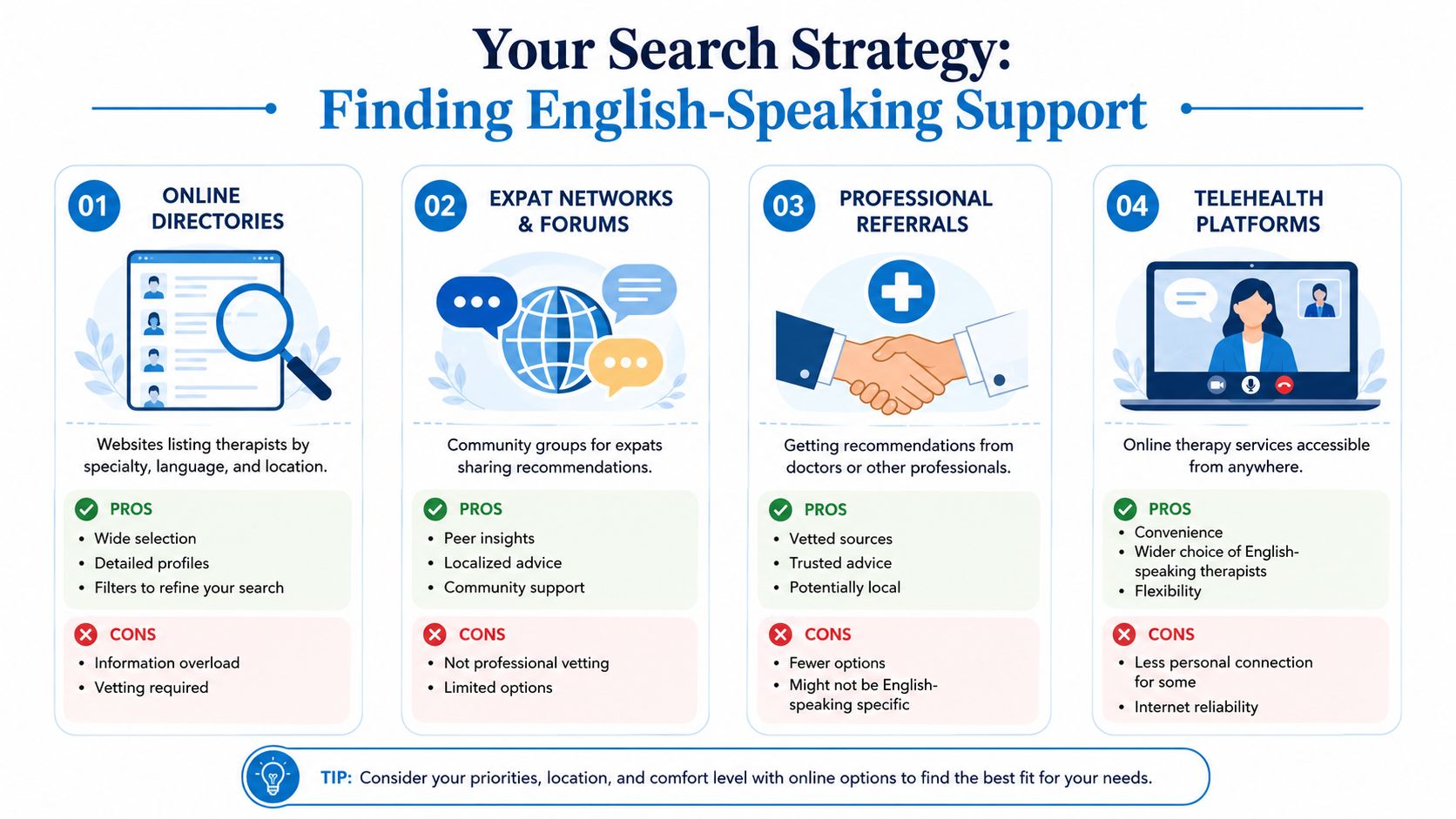
When people look for an English speaking therapist in Rimini, they often start with a broad online search and stop there. That usually creates more noise than clarity. A better approach is to treat the search like a filtering process. You're not just looking for someone who is available. You're looking for someone who can understand you well enough to help.
Start with local clinics carefully
Local private practices can sometimes be a fit, especially if you strongly prefer in-person care. But in Rimini, this route often requires patience and a willingness to ask direct questions before booking.
The practical issue is that many profiles tell you where a therapist works, but not whether they can conduct therapy in English at a clinical level. Conversational fluency is not the same thing as the ability to work with panic, shame, grief, or trauma without nuance getting lost.
Ask early:
- Do you provide therapy in English regularly
- Have you worked with expats or international students
- Is the first conversation possible in English
That may feel blunt, but it saves time.
Use expat communities for orientation, not vetting
Local groups can be helpful for finding out what the system feels like on the ground. People often share which neighborhoods are easier, whether waiting times are long, or which practical obstacles to expect.
Still, peer recommendations have limits.
- Useful for context – You may learn which options other internationals have used.
- Not enough for clinical fit – A therapist who helped one person may not suit your concerns, pace, or communication style.
- Easy to confuse warmth with expertise – A kind recommendation isn't the same as a clinically informed one.
Use these communities to gather names and impressions. Don't use them as your only filter.
Referrals can simplify the process
A doctor, university service, or another health professional may be able to suggest someone. This is often one of the clearest routes if you already have contact with a local professional you trust.
The trade-off is that referral options may still be narrow. In a city with limited English-speaking availability, a referral can point you in the right direction without solving the language-fit problem completely.
Specialized multilingual services solve a different problem
This is often the most efficient route for expats in smaller cities because the search no longer depends only on geography.
At a specialized service like Therapsy, the matching process involves a Clinical Director personally contacting the client to guide them through a free conversation and match them with a therapist based on language, cultural background, and specific situation, without requiring a doctor's referral or Italian language skills, as described on this page about expat therapy in Italy.
That matters because individuals don't arrive with a neat category. What looks like anxiety may also involve grief. What sounds like burnout may include trauma, isolation, or a painful relationship dynamic. Human matching is often more useful than trying to sort yourself alone.
If you want to understand what a guided intake looks like, this explanation of therapist matching makes the process more concrete.
A practical search sequence
Try this order instead of contacting random names one by one:
- Clarify your need – Anxiety, trauma, burnout, relationship stress, relocation fatigue, or a mix.
- Decide your core requirements – English fluency, online option, experience with expats, female therapist, evening slots.
- Shortlist only a few options – Too many names usually increases paralysis.
- Use the first conversation well – The goal isn't to impress the therapist. It's to assess whether you feel understood.
- Stay open on format – In Rimini, flexibility often gives you better care.
The best search question isn't “Who is closest to me?” It's “Who can understand me accurately enough to help?”
Online vs In-Person Therapy A Rimini-Specific Comparison
For someone living in Rimini, the question isn't whether online or in-person therapy is better in the abstract. The question is which format gives you the strongest chance of consistent, well-matched care.
What in-person therapy offers
In-person work can feel grounding. Some people think and feel more freely when they are physically in the room with another person. The ritual of traveling to a session, sitting down, and stepping outside daily life can help the mind shift into a more reflective state.
That preference is valid. It can be especially meaningful if home doesn't feel private, or if face-to-face presence helps you trust more easily.
But there is a local trade-off. In a city with limited English-speaking options, in-person care may narrow your choices sharply. You may end up choosing proximity over specialization.
What online therapy changes in Rimini
For expats in a mid-sized Italian city, online therapy is often not a compromise. It's access.
It opens the door to a wider pool of therapists across Italy, including clinicians with experience in trauma, intercultural relationships, panic, burnout, or young adult identity issues. It also makes continuity easier if you travel, move, or split time between places.
A simple way to think about it:
| Format | Often works well when | Main limitation |
|---|---|---|
| In-person | You strongly value physical presence and have a suitable local match | Local English-speaking choice may be very limited |
| Online | You want wider therapist choice, schedule flexibility, and continuity | You need a private space and stable connection |
What matters more than format
People often assume the format is the main issue. Clinically, that usually isn't true. What matters more is whether you can speak naturally, whether the therapist understands your context, and whether you can keep attending regularly enough for the work to build.
That is especially relevant in expat therapy. If you have to simplify every feeling or explain cultural basics in every session, the process becomes tiring before it becomes helpful.
How to decide honestly
These questions usually clarify the choice fast:
- Do I have a realistic local option in fluent English
- Would I rather widen my choices than stay close to home
- Can I protect a private hour online
- Do I need continuity across travel or possible relocation
- Am I choosing in-person because it suits me, or because I assume online is less serious
For many people in Rimini, online therapy becomes the more sustainable option because sustainability matters. A format you can keep is usually more therapeutic than a format that sounds ideal but creates logistical strain.
If you're weighing these issues in detail, this guide to online vs in-person therapy in Italy for expats can help you think through the decision more practically.
In a city with scarce multilingual care, online therapy often expands quality, not just convenience.
The First Free Assessment What to Ask Your Potential Therapist
The first assessment call matters more than many people realize. It isn't only an introduction. It's where you begin to sense whether this person can meet you with enough clarity, warmth, and structure to make therapy feel usable.
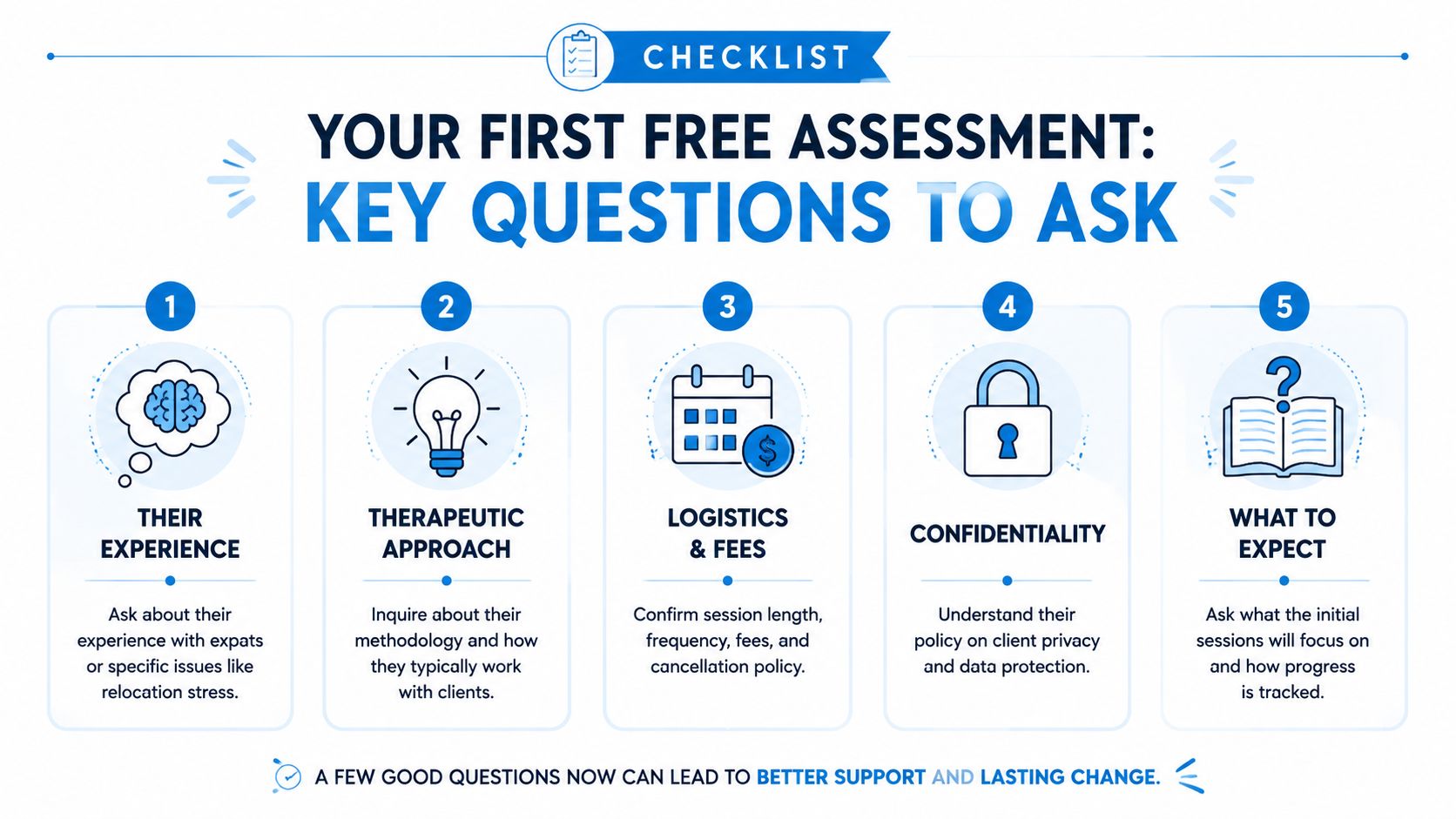
The therapeutic relationship, or fit, is statistically one of the strongest predictors of treatment success, often outweighing the specific modality used, and a free 15–30 minute assessment call gives the client a chance to evaluate that fit before beginning, as noted in this page on therapy access and fit in Italy.
Questions that reveal clinical fit
These questions help you understand how the therapist thinks, not just what they offer.
- Have you worked with expats or people adjusting to life in Italy
This tells you whether the therapist recognizes relocation as a clinical context, not just background detail.
- How do you usually work with anxiety, burnout, or relationship stress
Listen for clarity. A good answer doesn't need jargon, but it should give you a sense of method.
- Do you use CBT, EMDR, Schema Therapy, or another approach
These approaches differ. CBT focuses on the link between thoughts, emotions, and behavior. EMDR is often used for trauma processing. Schema Therapy looks at deeper recurring patterns shaped by earlier experiences.
- How do you know whether therapy is progressing
You don't need a rigid formula, but it helps if the therapist can describe what change usually looks like.
Questions that reveal intercultural sensitivity
Not every therapist who speaks English understands expat psychology. These questions help you notice the difference.
- What themes do you often see in clients who have relocated
- How do you work when language, family distance, or cultural conflict are part of the stress
- How do you approach cross-cultural couple dynamics, if relevant
A strong answer usually includes curiosity, nuance, and an understanding that moving abroad can intensify both current stress and older emotional patterns.
Practical rule: If you leave the call feeling you had to translate your entire reality, the fit may not be right.
Questions about logistics that actually matter
Many clients avoid these because they seem awkward. Ask them anyway.
- How long are sessions usually
- What is the cancellation policy
- Do you offer online, in-person, or both
- What fees should I expect
- If the fit doesn't feel right, what happens next
These aren't administrative details alone. They affect whether therapy will remain doable when life gets busy, finances tighten, or emotional resistance appears.
What to notice in yourself during the call
You don't have to feel immediate trust or complete certainty. But a few signals are useful:
- Do you feel rushed
- Do the therapist's questions make sense
- Do you feel more settled or more guarded by the end
- Can you imagine being honest here, even gradually
That last question often matters most.
If you want a clearer sense of what the opening phase of therapy usually feels like, this article on the first psychological session can make it less intimidating.
A good assessment call is not a performance
You don't need to summarize your life perfectly. You don't need a diagnosis before asking for help. You don't need to know which therapy model is right for you.
You only need enough openness to describe what's been difficult, and enough permission to ask whether this person feels like the right guide.
Understanding Costs Specialties and Session Types
Cost uncertainty stops many people before therapy even begins. In Rimini, it helps to replace guesswork with realistic expectations. Private English-speaking care is available, but it's important to know what you're paying for and what different therapy formats are designed to address.
What therapy may cost in Rimini
In Rimini, clients can access private individual therapy starting from €70 per session, couple therapy from €100 per session, and a full psychodiagnostic assessment from €255 for a three-session package, according to this page on therapy in Rimini.
Those figures matter because many expats assume that bilingual or intercultural therapy will be impossible to budget for. It may still require planning, but knowing the starting range usually makes the process feel more concrete and less intimidating.
If therapy needs to fit into a tighter monthly budget, it can help to review broader money-saving tips for Italy, especially if housing, transport, or seasonal expenses are already stretching your finances.
What different session types are for
Not every person needs the same kind of support.
- Individual therapy – Best when the focus is your own anxiety, mood, trauma history, burnout, identity questions, or adjustment stress.
- Couple therapy – Useful when conflict, communication problems, intercultural misunderstandings, or intimacy strain are affecting the relationship.
- Psychodiagnostic assessment – More structured. This can help when the clinical picture is unclear and you need a fuller understanding of symptoms and patterns.
- Psychiatric consultation – In some cases, medication evaluation may be part of a broader treatment plan.
Choosing a modality that fits the problem
Therapy can often feel confusing from the outside. The names sound technical, but the core differences are practical.
| Approach | Often useful for | What it focuses on |
|---|---|---|
| CBT | Anxiety, overthinking, panic, self-criticism | The link between thoughts, emotions, and behavior |
| EMDR | Trauma, distressing memories, stuck reactions | Processing experiences that still feel emotionally charged |
| Schema Therapy | Repeating patterns in relationships and self-worth | Longstanding emotional themes shaped earlier in life |
| Systemic-relational therapy | Couple and family dynamics | Interaction patterns between people |
| Ethnopsychotherapy | Cultural identity and migration-related distress | The psychological meaning of language, culture, and belonging |
Why specialization matters in expat care
Anxiety after relocation isn't always just anxiety. It may include loneliness, shame about dependence, anger at bureaucracy, grief for a previous self, or conflict between cultures. The same symptom can come from very different places.
That's why matching by issue matters more than many people expect. If you are carrying trauma, generic supportive conversation may not be enough. If you're in a cross-cultural relationship, insight without attention to culture may miss the actual point of conflict.
For a fuller picture of fees and what shapes them, this guide on how much therapy costs in Italy can help you assess what is realistic for your situation.
Your First Session and Building Continuity of Care
Once you've chosen a therapist, a new question usually appears. What now?
The first session is rarely dramatic in the way people imagine. More often, it is a careful beginning. You talk about what brought you there, what feels most urgent, what has already been tried, and what you hope might change. The therapist starts building a map with you.

How to prepare without overpreparing
You don't need pages of notes. But a little reflection can make the first session feel easier.
Useful things to think about:
- What feels hardest right now
- When this started or worsened
- What support you do or don't have in Italy
- What you want help with first
- Whether there are cultural, language, or relationship factors shaping the problem
If you freeze in session, that's okay too. A good therapist knows that people often arrive unsure, embarrassed, or emotionally tired.
What continuity of care really means
Therapy helps through repetition, trust, and pattern recognition. One meaningful session can bring relief, but deeper change usually depends on continuity.
That continuity matters even more in expat life because daily stressors keep shifting. A stable therapeutic relationship can become one of the few places where your inner world doesn't need constant adaptation. Over time, the therapist learns your triggers, defenses, attachment patterns, strengths, and blind spots. That depth is part of the work.
Early doubts are common
Many people worry after the first or second session:
- Am I saying the right things
- Shouldn't I feel better already
- What if I like the therapist but don't know what to talk about
- What if this person isn't the right fit after all
These concerns don't mean therapy is failing. They usually mean the process is becoming real.
Feeling unsure early on is normal. What matters is whether the uncertainty can be discussed inside the therapy, not hidden from it.
When the fit isn't right
Sometimes a therapist is competent, kind, and still not the right match. That can happen for many reasons. Pace, communication style, cultural understanding, or clinical approach may not align with what you need.
A responsible care process should allow for rematching rather than pushing you to "make it work." This is especially important for expats, who may already feel pressure to adapt in every other part of life.
One practical model some clients choose is a multilingual service where a Clinical Director handles matching and can adjust that match if needed. Therapsy uses that type of human-led process, including a free first assessment call and support without requiring a doctor's referral, Italian language skills, or a diagnosis.
What makes therapy sustainable
The most effective therapy is often the one you can continue consistently. That usually depends on a few unglamorous but essential factors:
- A session time you can protect
- A format that fits your life
- A therapist you don't have to translate yourself for
- A pace that feels challenging, but not overwhelming
- A relationship where honesty becomes easier over time
Therapy is not a quick fix. But for many expats in Rimini, it becomes a stable place to process what life abroad has stirred up, strained, or exposed. That stability matters.
The English-speaking therapists we work with in Rimini
Therapsy works with a therapist who receives in person in Rimini and also sees patients online.
Dr. Stéphane Courtois is a psychologist and psychotherapist with over 25 years of practice. French is her first language, and she also works in English and Italian, with certifications from both the Italian and the French professional boards. She works with depression, eating disorders, addictions and work-related stress, and with families in every configuration: single-parent, same-sex parents, adoption.
You tell Therapsy what you are looking for, a member of our clinical team reads your request, and they introduce you. The first call is free.
FAQ
Can I use the Bonus Psicologo for an English-speaking therapist?
Yes, it may be possible to use the Bonus Psicologo for an English-speaking therapist if the specific professional is licensed in Italy and registered in the relevant national system. Italy's Bonus Psicologo covers up to €1,200 per year, and this is an important affordability issue for younger adults, especially because 72% of Therapsy's clients are aged 20–39, as noted in this guide to mental health support in Italy for expats. The practical step is to confirm the individual therapist's registration status during the initial consultation rather than assuming all multilingual providers are automatically eligible.
Do I need a doctor's referral to see a therapist in Italy?
No, you usually don't need a doctor's referral to see a private therapist in Italy. In private care, you can generally contact a psychologist or psychotherapist directly and arrange an initial conversation yourself. This is often the simplest route for expats because it avoids extra bureaucracy and lets you seek support more quickly.
Is therapy in Italy confidential?
Yes, therapy with a licensed professional in Italy is confidential. Your sessions and personal information are protected by professional ethics and privacy rules, and reputable providers should also explain how they handle data protection and communication. If confidentiality is especially important to you, ask directly how records, online platforms, and contact methods are managed.
How long does therapy usually last?
Therapy length depends on your goals, the issues involved, and the approach being used. Some people use therapy for a focused period around a specific problem, while others benefit from longer work when patterns are deeper or more complex. It helps to discuss pace and expectations early, but it's also normal for that plan to evolve as the work becomes clearer.
Book your first free assessment call – no commitment, just a conversation with our Clinical Director who will listen and match you with the right therapist for you. Visit therapsy.it.