Finding an English-speaking therapist in Cuneo and its province is a different problem from finding one in Milan or Turin. The province is large, the towns are small, and the people who move here from abroad rarely arrive for the same reason twice: a job at a food company in Alba, a season in the vineyards, a partner who grew up here and wanted to come back, a remote job and a house that costs a third of what it costs in a city. What they share is the moment when something stops working and the search for help turns out to be harder than expected.
This guide covers what that search actually looks like here, how to judge a therapist before you book, what therapy costs in Italy, and where Therapsy fits in.
The expat’s dilemma in the province of Cuneo
The first thing worth saying plainly: there is no shortage of good clinicians in Piedmont. The shortage is of clinicians who work in your language, who have appointments within a reasonable drive, and who understand what it means to build a life in a place where you did not grow up.
Where the practice actually is, and why we say so
Therapsy receives in person in this province at Corso Piave 146 in Alba, about an hour from Cuneo itself and twenty minutes from most of the Langhe. We say it this way because the alternative, writing “we receive in Cuneo” and letting you discover the real address after you book, wastes your time and ours. If you live in Cuneo, Mondovì or Saluzzo, the drive is real and you should factor it in. If you live in Alba, Bra, Barolo or Canale, the practice is close.
The honest alternative, for anyone who finds the distance unworkable, is online. More on that below, because in a province this wide it is not a second-best option.
Small-town privacy, and the fear of being seen
This comes up here more than in cities, and it is rarely said out loud. In a town of twenty or thirty thousand people, where your colleague’s mother is your neighbour, the waiting room is not anonymous. People postpone for months because of it, or drive to Turin so that nobody recognises the car.
Two things help. The first is that therapists in small provinces are used to this and manage it: scheduling, entrances, how a chance meeting at the supermarket is handled, are things you can ask about in the first call rather than hope for. The second is that an online session removes the problem entirely, which is why many people here start online and move in person later, or keep a mix.
Why cultural competence matters more than language alone
A therapist who speaks English is not the same as a therapist who works with internationals. The difference shows up in the details.
The vocabulary of distress does not cross languages cleanly
Describing panic, shame or grief in a language you learned as an adult flattens them. People reach for the nearest available word and end up describing something slightly different from what they feel, then spend the session correcting the misunderstanding instead of working. In your own language the description arrives whole, with its register and its hesitations, and the therapist hears what is underneath it.
This is also why a therapist who speaks your language can hear when you switch: the sentence you can only say in English, or the one that only comes out in Italian, is usually the important one.
What a therapist used to international patients already knows
They do not need the background explained. That a residence permit renewal can occupy a month of mental space. That a parent falling ill two thousand kilometres away is a specific kind of helplessness, not a generic worry. That a partner who relocated for your job may be carrying a resentment neither of you has named. That the holidays are not restful when going home is a flight, a cost and a negotiation.
None of this is exotic. It is simply the material that comes up every week with people who live away from where they started, and a clinician who meets it every week does not treat it as a side note.
In-person care in the province versus online platforms
What a room in Alba gives you that a screen does not
A physical appointment creates a boundary that is hard to reproduce at home: a journey there, fifty minutes inside, a journey back. For trauma work, for anything involving the body, and for people whose home is noisy or shared, the room matters. It also removes the small negotiations of online therapy, the connection dropping at the wrong moment, the housemate behind the door.
When online is the better answer here, not the fallback
In a province that stretches from the Langhe to the French border, distance is not a detail. An hour of driving each way turns a fifty-minute session into a three-hour commitment, and the sessions people cancel first are the ones that cost the most time. Online removes that, keeps the appointment stable through harvest season or a work trip, and widens the choice of therapist from “whoever is nearby” to “whoever fits”.
A 2021 meta-analysis of live psychotherapy by video found outcomes that differed negligibly from in-person therapy, with the largest improvements in anxiety, depression and PTSD. The practical question is not which is better in the abstract, but which one you will still be attending in three months.
You are not locked into one format
Most people here end up with a mix: in person when the work needs the room, online when the week does not allow the drive. You are not signing up for one format at the first call.
Your vetting checklist: what to ask before you book
Credentials you can verify in five minutes
In Italy a psicologo is registered with the regional Order of Psychologists, and the registration number is public: you can check it in the national register of psychologists. A psicoterapeuta has completed a four-year specialisation on top of that and is annotated accordingly. A psichiatra is a medical doctor, registered with the Order of Physicians, and is the only one of the three who can prescribe medication. A counsellor is not a regulated clinical profession in Italy: that does not make the work worthless, but you should know which one you are booking.
Ask directly. A clinician who is registered will tell you the number without hesitating.
Approach, and what it actually looks like in the room
CBT, systemic, psychodynamic, Gestalt, EMDR: the labels mean little until someone tells you what a session looks like. Ask what the first four sessions usually involve, whether there is anything to do between them, and how progress gets reviewed. A clear answer is a good sign in itself.
The questions people only think of afterwards
How long is a session, and what does it cost. How cancellations work. Whether the therapist takes a break in August, which in Italy is a real question. Whether they can write an invoice you can use for the Italian tax deduction, or submit to an insurer or EAP scheme. Whether they work with a psychiatrist when medication becomes part of the picture.
What therapy costs in Italy, and what affects access
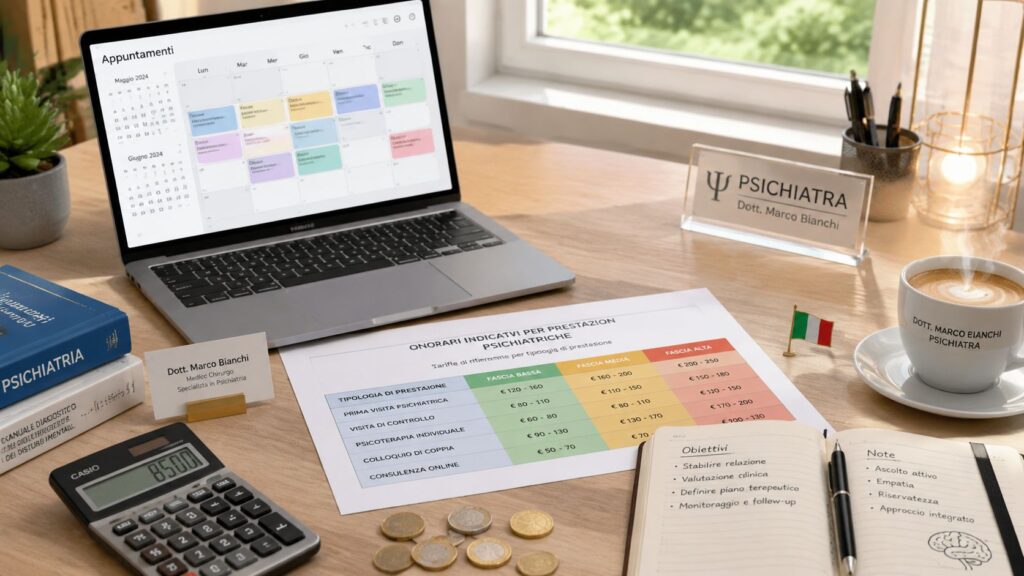
With Therapsy, individual sessions start from 70 euros and couple sessions from 100. A psychiatric consultation starts from 110 euros. A full psychodiagnostic assessment, three sessions ending in a written clinical report, starts from 255 euros. The first call, fifteen to thirty minutes with the therapist you have been matched with, is free and exists so that you can decide whether the fit is right before paying for anything.
Two things worth knowing. Psychotherapy expenses are health expenses in Italy, which means a 19 per cent tax credit (detrazione) on the portion of your yearly health spending above 129.11 euros, claimed with your tax return, as long as you pay by traceable means. And the Bonus Psicologo, now a permanent measure, contributes up to 50 euros per session for residents who meet the income requirement, within an annual cap. It can be used only with psychotherapists on the INPS list, and Therapsy does not accept it.
Price is not a proxy for quality. A higher fee can mean a central address rather than better care, and the cheapest option is expensive if you stop after three sessions because the fit was wrong.
How a human-matched process simplifies the search
Why matching is the part that usually fails
The search normally runs like this: a directory, twelve profiles that all say the same things, three emails, one reply, an appointment with whoever answered. The decision that matters most, who you work with, gets made by availability. Then, if it does not fit, most people do not start again.
How the match is made at Therapsy
The match is made by a person, not an algorithm. You describe what is going on, in which language you want to work, and whether you prefer in person or online. Our Clinical Director, Dr. Francesca Boccalari, reads it and chooses the clinician she would send a friend to, considering language, clinical approach, availability and the practical details. Then you meet that therapist in a free first call. If the fit is not right, you say so and we match you again.
Behind it there is a network of more than 50 therapists working in 14 languages, with 90 practices across 24 Italian cities and online everywhere else. Fewer than one applicant in a hundred joins it.
The English-speaking therapists we work with in the province of Cuneo
In this province the in-person work is done by Cecilia Iacono, psychologist and Gestalt counsellor in Turin and Alba, who works in English and Italian and receives at Corso Piave 146 in Alba, as well as online with people elsewhere in Italy and abroad. If the drive does not work for you, or if your language is not one of hers, the match widens to the rest of the network and the sessions happen online.
You can see the practice address, the map and the booking form on the page for English-speaking therapy in Cuneo.
FAQ
Is there an English-speaking therapist in Cuneo itself?
Our practice in this province is in Alba, at Corso Piave 146, not in Cuneo city. From Cuneo it is about an hour by car. If that is not workable, online sessions with an English-speaking therapist are available from anywhere in the province.
Do I need a diagnosis or a referral to start?
No. You do not need a referral, a diagnosis or a medical certificate to book private therapy in Italy, and you do not need to speak Italian. You book the first call and describe what is going on in your own words.
What if I want to work in a language other than English?
Therapsy works in 14 languages. In this province the in-person option is in English and Italian; for other languages the sessions are online, with a therapist matched to your language rather than to your postcode.
Can I switch therapist if it does not feel right?
Yes, and it is not a failure of the process. Tell us and we match you again. Fit is one of the strongest predictors of whether therapy works, which is why the first call is free and why we would rather rematch early than have you stop.
Can therapy be combined with medication?
Where it is appropriate, yes. Medication is always a medical decision: the psychiatrists in the network assess whether it is the right option and, when it is, prescribe privately. Therapy and medication are often more effective together than either alone.
How quickly can I start?
Francesca and the onboarding team reply to every request within 12 hours. How soon the first call happens after that depends on your availability and the therapist’s.
The next step
If you have read this far, you have probably been thinking about it for a while. The next step is small: a free first call, fifteen to thirty minutes, with a therapist chosen for your situation rather than for proximity. No diagnosis needed, no commitment, in your own language.