Is a general counsellor enough for an eating disorder in Italy, or does the situation require specialist care? An eating disorder therapist in Italy should use a diagnosis-specific model, monitor symptoms with validated tools, and coordinate with medical and nutritional professionals when physical risk is present. For an expat, the right choice also includes language, cultural understanding, and a clear route into Italian healthcare services.
Therapsy is a multilingual psychotherapy service in Italy that connects expats with therapists who speak their native language.
What Eating Disorder Therapy Involves in Italy
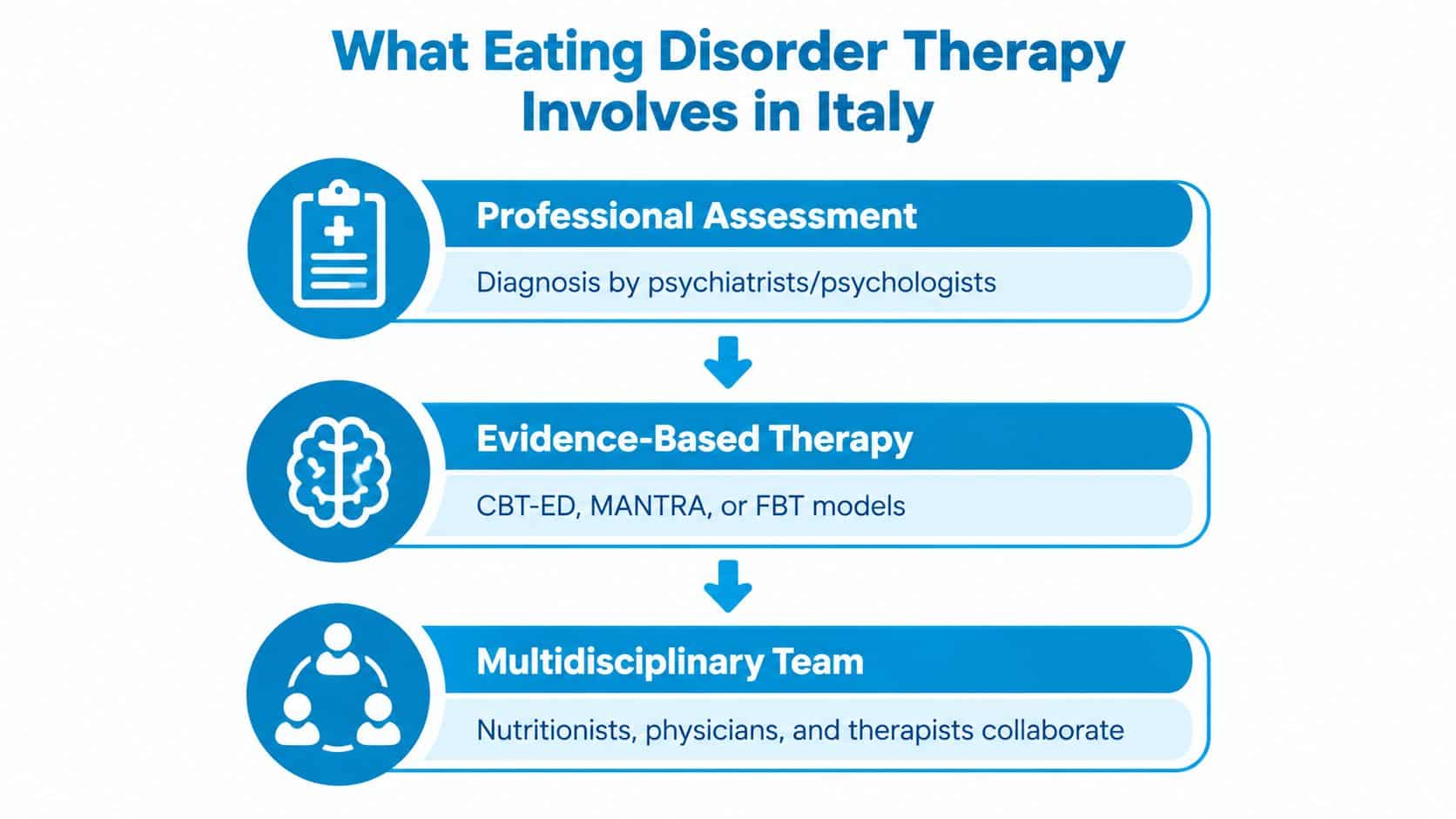
Finding an eating disorder therapist in Italy means looking for specialist training, structured treatment, and medical coordination, not only general emotional support. Eating disorders can involve restriction, binge episodes, purging, compulsive exercise, severe body-image distress, and physical complications. A therapist needs to understand how these patterns reinforce one another and how treatment changes according to diagnosis and risk.
Italy's care system includes a national network of specialist services, but access varies by region. In March 2022, the Italian National Institute of Health service mapping identified 108 accredited facilities, including 101 within the National Health Service and 7 privately accredited facilities. The same mapping found 55 facilities in Northern Italy, 18 in Central Italy, and 35 in Southern Italy and the islands, showing why someone outside the north may need to search beyond the nearest city.
What makes specialist eating disorder therapy different?
Specialist therapy assesses eating-disorder behaviours directly and tracks whether those behaviours are changing, rather than focusing only on general anxiety or self-esteem. A therapist may establish a baseline for restriction, binge eating, compensatory behaviours, body-image concerns, and the effect of symptoms on work, study, relationships, and daily functioning.
The Eating Disorder Examination Questionnaire, or EDE-Q, can help monitor symptom severity and change over time. A structured treatment plan also gives the therapist and client a shared way to review progress, identify obstacles, and decide whether another level of care is needed.
Practical rule: A therapist should be able to explain the treatment model, the outcome measures used, and the referral plan before regular sessions begin.
A multilingual therapist can also help someone describe culturally specific foods, family expectations, migration stress, religious practices, and fears about Italian healthcare accurately. For concerns involving body image without a confirmed eating-disorder diagnosis, body-image therapy in Italy may be relevant, but physical symptoms still require appropriate medical assessment.
Some presentations are easy to misunderstand, particularly when food avoidance is linked to sensory sensitivity, fear of choking, gastrointestinal discomfort, or low interest in eating rather than weight and shape concerns.
Evidence-Based Treatment Models for Eating Disorders
Evidence-based treatment uses a diagnosis-specific framework, measurable goals, and coordinated care rather than open-ended supportive counselling. The NICE recommendations for eating disorders identify eating-disorder-focused CBT, MANTRA, and specialist supportive clinical management as options for adults with anorexia nervosa. CBT is also recommended for bulimia nervosa and binge-eating disorder, while guided self-help may be considered initially for some adults with binge-eating disorder.
Which treatment model might an eating disorder therapist use?
CBT-ED examines the relationship between thoughts, emotions, and behaviours that maintain the eating disorder. For example, a rigid food rule may produce anxiety, avoidance may temporarily reduce that anxiety, and the short-term relief may strengthen the rule. Treatment gradually addresses this cycle through structured behavioural and cognitive work.
MANTRA focuses on the thinking style, emotional processes, social context, and meaning-making that can maintain anorexia nervosa. Specialist supportive clinical management combines therapeutic support with education, symptom monitoring, and attention to physical and nutritional needs.
The model should match the person's diagnosis, age, medical condition, treatment history, and readiness to engage. A therapist may also draw on Schema Therapy, attachment theory, or cross-cultural psychology when longstanding shame, perfectionism, trauma, family relationships, or migration experiences affect recovery. A general explanation of Schema Therapy can help a reader understand how deeper emotional patterns may be explored alongside eating-disorder treatment.
Why does outcome monitoring matter?
Outcome monitoring turns a broad goal such as “feeling better” into specific clinical questions about symptoms, functioning, adherence, and risk. Repeated use of a validated questionnaire such as the EDE-Q can show whether binge eating, restriction, compensatory behaviours, or weight and shape concerns are changing.
For binge-eating disorder, weight loss shouldn't be presented as the therapy target. Psychological treatment focuses primarily on reducing binge eating and associated distress, while nutritional and medical professionals address physical health and nutrition when needed.
Medication may have a role in some treatment plans, particularly when another psychiatric condition requires attention, but the Italian Ministry of Health guidance states that medication shouldn't be offered as the sole treatment for anorexia nervosa. A therapist should therefore be comfortable coordinating with a physician, psychiatrist, dietitian, or specialist service.
How to Find an Eating Disorder Therapist in Italy
The most practical route is to start with the ISS service map or a local healthcare professional, then verify expertise, language, and the level of care available. The ISS platform distinguishes between treatment centres and support associations. A support association may provide information, family support, peer connection, or referral guidance, while a treatment centre should be assessed for its clinical services.
The national mapping updated in September 2024 identified 180 dedicated facilities, including 132 treatment centres and 48 support associations. Among the treatment centres, 105 operated within the National Health Service and 27 were private. The same mapping reported that 92% offered outpatient care, 62% offered intensive outpatient or semi-residential programmes, and 17% offered intensive residential rehabilitation. These figures describe availability, not the level of care suitable for a particular person.
Which care option fits a person living in Italy?
| Type | Language Access | Care Level | Best For |
|---|---|---|---|
| Public National Health Service centre | Usually depends on the region and local team | Outpatient, day treatment, or higher-intensity care where available | People seeking publicly organised multidisciplinary services |
| Accredited private provider | Varies by provider and clinician | Often outpatient, with referral options depending on the service | People seeking a private appointment or a specific specialist |
| Multilingual online service | Can offer therapy in a preferred language | Usually outpatient psychological treatment | Expats, international students, and people outside major cities who are medically stable |
| Support association | Information and support languages vary | Usually not a replacement for clinical treatment | Families or individuals needing orientation and referral information |
Therapsy connects clients with a therapist through human matching by the Clinical Director rather than an algorithm, offers therapy in the client's own language across 14 languages, and provides a choice between online and in-person sessions. Its network includes 50+ therapists, 24 Italian cities, and 90 physical locations, although a specialist eating-disorder case may still require coordination with local medical services.
When regional waiting lists are long, someone can contact a GP, ASL service, mapped specialist centre, or private therapist in parallel. The key question isn't just whether an appointment is available. It is whether the clinician can assess eating-disorder symptoms and connect the person with medical, nutritional, psychiatric, or higher-intensity care.
A practical guide to finding the right therapist for expats in Italy can help someone prepare for this first comparison.
Verifying Specialist Training and Coordination
A qualified therapist should be able to show eating-disorder training, access clinical supervision, and explain how medical referrals work. These checks are especially important when a therapist works online or when the client lives far from a specialist centre.
How can someone verify eating disorder expertise?
A short first conversation can establish whether the therapist has relevant experience and a defined clinical framework. Useful questions include:
- Specialist preparation: What formal training has the therapist completed in eating disorders?
- Treatment model: Which approach is used for anorexia nervosa, bulimia nervosa, binge-eating disorder, or other presentations?
- Supervision: Does the therapist receive clinical supervision for complex eating-disorder work?
- Medical coordination: Can the therapist work with a GP, psychiatrist, physician, or dietitian in Italy?
- Escalation: What happens if purging increases, nutrition deteriorates, or physical symptoms appear?
- Language: Can the therapist work fluently in the client's strongest language while understanding Italian healthcare terminology?
Language concordance affects more than comfort. A client may need to explain food rituals, family pressure, culturally specific meals, religious fasting, shame, or immigration stress with precision. If important details remain untranslated or misunderstood, the therapist may underestimate severity or miss a maintaining factor.
Therapsy's clinical team uses human matching by the Clinical Director, rather than an automated questionnaire, to consider language, cultural context, therapeutic needs, and the choice between online and in-person care. Therapsy offers therapy in 14 languages, including Italian, English, French, Spanish, German, Portuguese, Ukrainian, Russian, Greek, Arabic, Urdu, Hebrew, Hindi, and Persian (Farsi).

Why does coordination matter?
Psychological therapy can't safely monitor every physical consequence of restriction, bingeing, purging, dehydration, rapid nutritional change, or medication complications. A specialist therapist should know when to involve a physician, psychiatrist, dietitian, or eating-disorder team.
A reader may also be unsure whether to contact a psychologist or psychiatrist first. The difference between a psychologist and psychiatrist in Italy becomes clinically important when medication review, severe psychiatric symptoms, or urgent medical assessment may be required.
When Online Therapy Is Appropriate and When It Is Not
Online therapy can improve language access and continuity, but it isn't a replacement for urgent medical assessment or multidisciplinary care. It may be appropriate when the client is medically stable, can access physical monitoring locally, and has a clear plan for contacting healthcare services if risk changes.
Italian research has described a substantial treatment gap, with only an estimated 19% to 36% of people with eating disorders seeking specialised treatment. Reported barriers include shame, stigma, limited recognition of illness, geographical obstacles, and fragmented services, as described in this peer-reviewed overview of eating-disorder care and access.
When is online therapy a reasonable option?
Remote therapy can be useful for an expat who lives outside a major city, needs English or another preferred language, or feels unable to disclose symptoms in Italian. The therapist can work on eating-disorder thoughts and behaviours while coordinating with a local GP, physician, psychiatrist, or nutrition professional.
Cultural adaptation is part of clinical accuracy. A therapist may need to understand family meals, food availability, religious practices, immigration stress, homesickness, body ideals from more than one culture, and fear of institutions. A familiar language can make disclosure easier, but language access must sit within a broader safety plan.
Therapsy offers a free first assessment call with the therapist selected for the client, and sessions can take place online or in person. The service provides a human matching process, therapy across 14 languages, and access to sessions in 24 Italian cities, but online care remains outpatient support and doesn't replace medical monitoring.
When is remote therapy not enough?
Same-day medical help is appropriate when someone has fainting, severe dehydration, cardiac symptoms, rapidly worsening nutritional status, serious medication complications, or immediate safety concerns such as suicidality. A routine therapy appointment shouldn't be used as a substitute for emergency assistance in those situations.
A therapist may recommend a higher level of care when outpatient sessions can't provide sufficient monitoring, nutrition is deteriorating, purging is escalating, or the person can't maintain basic safety between appointments. More information about the practical differences between online and in-person therapy for expats can help someone compare access and limitations without treating format as a clinical decision by itself.
Practical Steps for Beginning Your Search
The search becomes clearer when a person separates three questions: where to enter care, whether the clinician is specialised, and whether the current format is safe. Starting with the ISS map, a GP, an ASL service, or a specialist centre can identify local options and possible referral requirements.
What should someone do first?
A simple sequence can reduce confusion:
- Identify the concern. Note restriction, binge eating, purging, compulsive exercise, food avoidance, body-image distress, or physical symptoms without trying to assign a diagnosis.
- Choose an entry point. Contact the ISS-mapped service, GP, ASL, private specialist, or multilingual therapy service.
- Prepare verification questions. Ask about eating-disorder training, supervision, outcome monitoring, medical coordination, language, and escalation.
- Arrange an assessment. The first meeting should clarify the clinical picture, current risk, treatment goals, and whether another professional needs to be involved.
- Review the plan. The therapist should explain the proposed model, monitoring process, appointment format, and referral pathway.
Therapsy's first assessment call is free and takes place with the therapist chosen for that person. Therapsy's matching process is handled by the Clinical Director rather than an algorithm, and clients can request therapy in their preferred language with the option of online or in-person sessions.
The service reports 1,500+ clients and 13,000+ sessions since 2023, a Trustpilot rating of 4.8/5, “Excellent”, and first contact within 12 hours. Individual therapy starts from EUR 70 per session, while the first assessment call is free. Costs and clinical suitability should still be discussed directly because a specialist eating-disorder plan may require additional professionals.
A person doesn't need to feel completely ready before asking for an assessment. Ambivalence, shame, and uncertainty can be discussed clinically, while urgent physical or safety concerns should be directed to medical or emergency services.
Who works with eating disorders at Therapsy
Dr. Alexandra Kraslavski, a psychologist in Milan, is trained in CBT-E, the enhanced cognitive behavioural protocol developed for eating disorders. Dr. Silvia Vitello, a psychotherapist, worked for years with anorexia, bulimia and obesity in a hospital eating disorder service in Milan. Dr. Giorgia Gamberini, a psychologist, has eating disorders and body image at the centre of her clinical work. When there is medical risk, psychological therapy for an eating disorder works alongside physicians, dietitians and specialist services, not in place of them.
FAQ – Common Questions About Eating Disorder Therapy in Italy
Can an English-speaking eating disorder therapist help in Italy?
Yes, an English-speaking therapist can provide the psychological part of care when the clinician has relevant eating-disorder training and can coordinate with Italian medical services. Language access can help a client describe food rules, body-image distress, family expectations, and migration stress accurately.
How can someone distinguish specialist therapy from general counselling?
Specialist therapy includes a diagnosis-specific model, measurable treatment goals, symptom monitoring, and a referral plan. A therapist should be able to discuss approaches such as CBT-ED, MANTRA, or specialist supportive clinical management rather than offering only general emotional support.
Does online therapy replace medical care?
No. Online therapy may support a medically stable client, but it can't replace physical monitoring, nutritional care, psychiatric review, or urgent medical assessment. Fainting, severe dehydration, cardiac symptoms, rapidly worsening nutrition, or immediate safety concerns require same-day medical or emergency assistance.
What happens during a first assessment?
The therapist usually asks about eating patterns, restriction, binge episodes, compensatory behaviours, body-image concerns, mental health, physical symptoms, medication, daily functioning, and previous treatment. The assessment should also clarify language, cultural context, treatment goals, coordination needs, and whether outpatient therapy is suitable.
How much does therapy cost?
Therapsy lists individual therapy from EUR 70, couple therapy from EUR 100, psychodiagnostic assessment from EUR 255 for 3 sessions, and psychiatric consultation from EUR 110. The first assessment call is free, and the final price depends on the therapist's experience and specialisation.
Is recovery possible if someone feels unsure about treatment?
Uncertainty doesn't mean that treatment can't begin. A therapist can explore ambivalence, shame, fear of change, and practical barriers without requiring perfect motivation, while specialist assessment determines the appropriate clinical pathway.
Therapsy offers human matching by the Clinical Director, therapy in the client's own language across 14 languages, and a choice between online and in-person sessions for people seeking eating-disorder support in Italy. The first call is free, it takes place with the therapist chosen for that person, and there's no obligation to continue. Visit Therapsy to explore a suitable starting point.