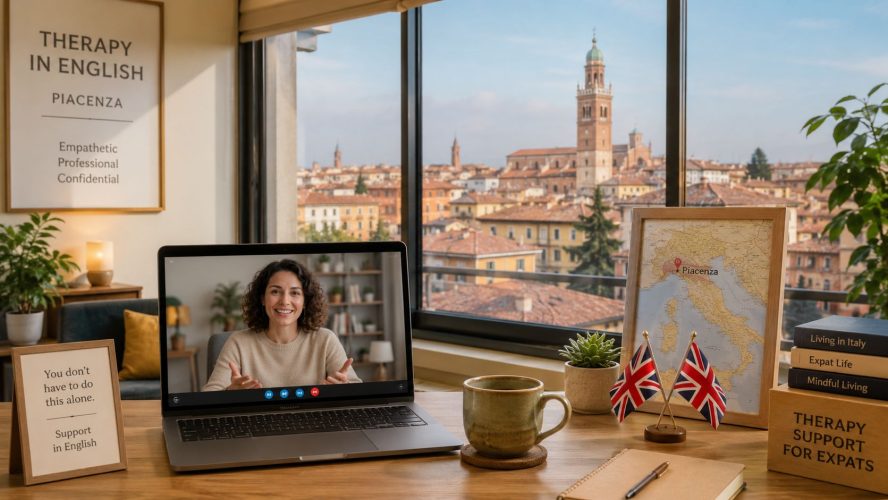
You're in Piacenza, you've typed english speaking therapist Piacenza into search after search, and the results still feel thin. You don't need a lecture, you need a real person who can understand what's happening in your life, in your language, and in the emotional reality of living abroad.
That's the hard part in smaller Italian cities. You can find someone who speaks English. Much harder is finding someone who understands expat adjustment, identity loss, cross-cultural stress, or why your week can feel heavier just because every task takes more effort in a foreign system. Piacenza is a useful test case for that problem, because the need is real even when the local market looks modest on paper.
What Finding an English Speaking Therapist in Piacenza Actually Looks Like
A lot of people in Piacenza start the search the same way. They look for a local therapist, scan a directory, and realize the useful options are fewer than they expected. Then they start widening the search to nearby cities, online care, or multilingual services that can bridge the gap without making therapy feel like another bureaucratic errand.
That search can be frustrating, but it's not unusual. Piacenza is one of the 20+ Italian cities where Therapsy offers in-person multilingual psychotherapy, and the local page lists the address at Corso Vittorio Emanuele II 148. The same service also emphasizes that English-speaking sessions are available in major cities and online from anywhere in Italy, which matters if you live outside a big hub and still want continuity of care. You can see the local page for Piacenza support here.
What usually exists in practice
Most English-speaking residents in a city like Piacenza end up considering three paths.
- A private therapist in town, if one is available and comfortable working in English.
- Online therapy from anywhere in Italy, which opens the pool and often fits expat life better.
- A multilingual service with both in-person and online care, which can reduce the feeling that you must choose between quality and convenience.
The main problem is that availability and fit are not the same thing. A therapist can be perfectly polite in English and still miss the emotional texture of relocation, homesickness, or the exhaustion of always translating yourself.
If you've ever searched for support in another city, the experience is similar to trying to find a therapist in London, except Piacenza gives you even fewer obvious local options. That's why the smartest search is not “Who speaks English?” but “Who can work well with my situation?”
Practical rule: If a listing only proves language ability, keep looking. You need clinical fit, not just conversational fluency.
Linguistic Fit and Cultural Fit Are Not the Same Thing
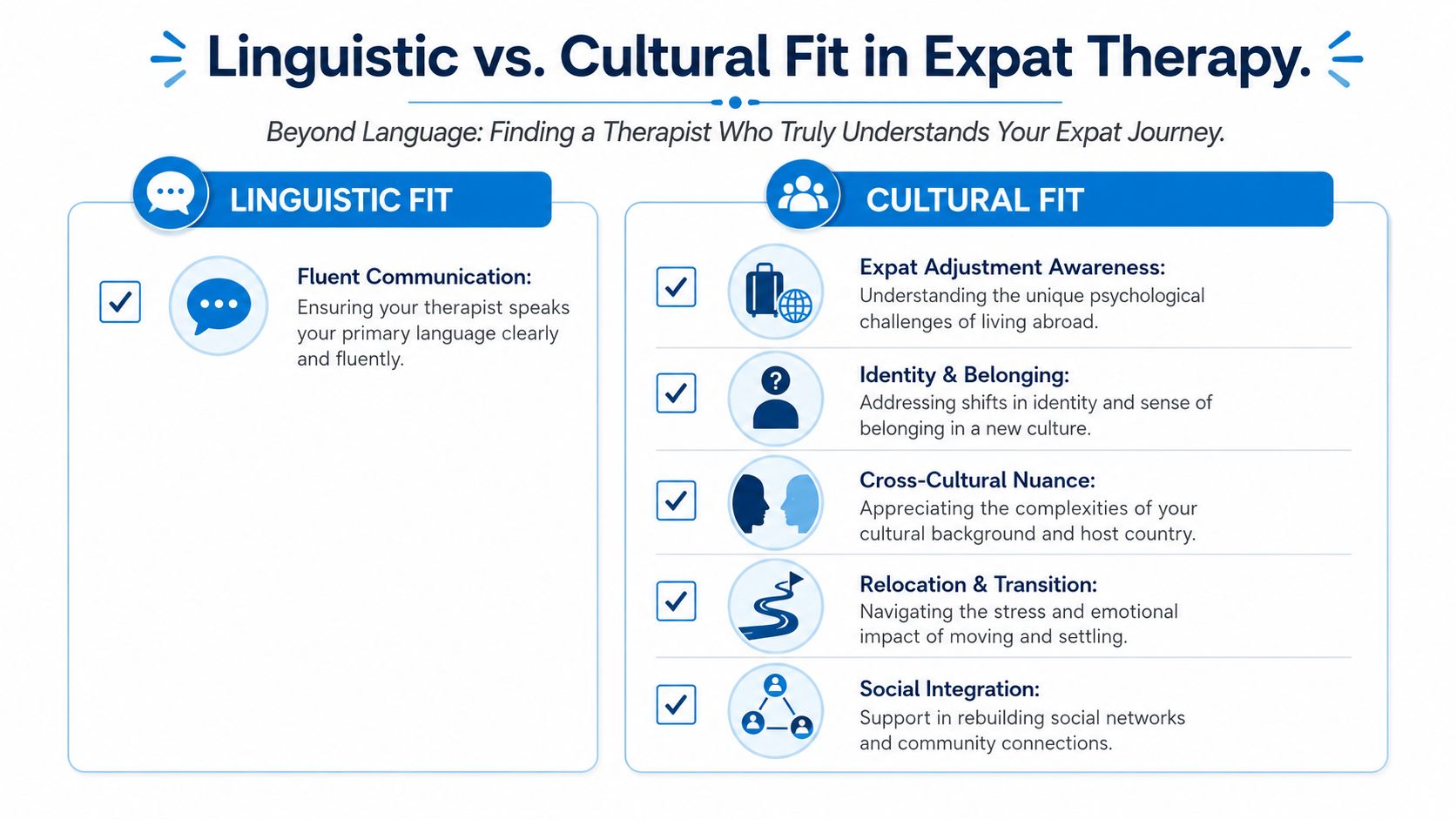
A good translator is not the same as a good travel companion. That's the difference here. Linguistic fit means the therapist can understand your words. Cultural fit means they understand what those words carry when you're living in Italy as an expat, student, or internationally mobile adult.
Why this distinction matters
Language alone won't tell a therapist whether your distress is tied to identity loss, cross-cultural strain, or the constant effort of adapting to a new social code. Someone may speak fluent English and still not grasp why a move abroad can unsettle your sense of competence, belonging, or relationship stability.
Italy-focused guidance for expats makes this point clearly. It says language filters aren't enough and recommends asking about training, international experience, and cultural background. That is the right standard. A therapist who understands cross-cultural psychology is better placed to notice when your symptoms are really about adaptation pressure, not weakness.
A simple way to screen for real fit
Ask questions that go beyond “Do you speak English?”
- What kinds of expat or intercultural clients have you worked with?
- Do you have training in CBT, EMDR, Schema Therapy, or systemic-relational work?
- How do you handle identity shifts, relocation stress, or homesickness?
- Have you worked in multicultural settings before?
- Can you explain your approach in plain English without jargon?
Best sign of cultural competence: the therapist can talk about your move, your relationships, and your stress without reducing everything to a generic anxiety label.
Therapsy's Piacenza page already signals this broader need by emphasizing multilingual, in-person and online care, free assessment calls, and native-language matching. That's useful because people in smaller cities usually aren't just looking for a name. They're looking for reassurance that the therapist can hold their whole context, not only their vocabulary.
In-Person and Online Options Compared for Piacenza Residents
For someone in Piacenza, the choice is usually between local in-person sessions and online sessions from anywhere in Italy. Both can work. The better one depends on your schedule, your privacy at home, and how much you value the feeling of being physically present with your therapist.
| Factor | In-Person in Piacenza | Online from Piacenza |
|---|---|---|
| Access to English-speaking care | More limited, because the local pool is smaller | Wider, because you can choose from therapists across Italy |
| Routine | Easier if you want a fixed weekly habit | Easier if you travel, work irregular hours, or split time between places |
| Privacy | Good if you value a separate therapeutic space | Strong if home is quiet and private, weaker if your apartment is noisy |
| Embodied presence | Useful for people who feel safer face to face | Still effective for many clients, especially if the relationship is strong |
| Practical burden | You need to factor in commuting and timing | You save travel time and reduce friction |
| Best fit for | People who want structure and local continuity | People who want the broadest choice and more flexibility |
The honest answer is that online therapy is not second best. It's often the most realistic way to access a therapist who fits your language and cultural needs, especially if the local pool is thin. That said, in-person therapy can be valuable if you work better when you leave home for care and return to daily life afterward.
Piacenza living can make this choice more concrete than it sounds. If your apartment is small, your neighbors are close, or your schedule is already fragmented, online sessions may be easier to protect. If you like the discipline of leaving the house for appointments, in-person may help you show up more consistently.
For a deeper comparison of format choices, the guide on online versus in-person therapy in Italy for expats is worth reading before you decide.
Straight answer: the best format is the one you can sustain without adding stress.
How to Book and What to Ask at First Contact
The first contact should feel like a screening conversation, not a leap of faith. You're not committing to a life decision. You're checking whether the therapist can do the work you need in a way that feels safe and clear.
What to send or say first
Keep it simple. A short message is enough.
- Who you are: mention that you live in Piacenza and want therapy in English.
- What brings you in: anxiety, burnout, isolation, relationship strain, adjustment stress, or something else.
- What you need: online, in-person, or either.
- What matters most: language fluency, cultural understanding, or a specific approach.
A professional first reply should tell you whether the therapist understands your concern, whether they work in English at a clinical level, and how the next step works. If the response feels vague, rushed, or overly generic, trust that signal.
Questions worth asking before you book
Use these as a checklist:
- How fluent are you in English for emotional and clinical work?
- Have you worked with expats, international students, or cross-cultural couples?
- Which approaches do you use most often, such as CBT, EMDR, Schema Therapy, or systemic-relational therapy?
- Do you offer online, in-person, or both?
- What is your cancellation policy?
- How do you handle rematching if the fit is not right?
- What is the session fee, and is it clear from the start?
If you want a practical script for that first email or call, the page on how to talk to a therapist is a helpful reference.
A real red flag is a practice that treats your questions as unnecessary. Good therapy begins with clarity. If a provider can't answer basic questions about language, approach, and process, they're not making the experience easier. They're making it harder.
Therapsy in Piacenza and the Value of a Free Assessment Call
Therapsy is one of the few services that makes Piacenza feel connected to a wider multilingual network instead of leaving you to piece things together alone. It operates in 14 languages across 20+ Italian cities including Piacenza, with the local location at Corso Vittorio Emanuele II 148, and it offers both in-person and online sessions for expats. That matters because your week may not always support the same format, and your needs may change over time. You can also see how the service handles therapist matching here.

Why the free assessment call matters
The free first assessment call lowers the pressure. You can speak with the Clinical Director, explain what you're dealing with, and see whether the matching feels right before committing. That is a much saner way to start than booking blindly and hoping for the best.
This is especially useful in a city like Piacenza, where the issue is not only access but confidence. People often hesitate because they're unsure whether an English-speaking therapist will understand them culturally, not just linguistically. A human matching process helps answer that question before therapy starts.
Therapsy's model is straightforward. The service works with carefully selected licensed professionals, offers multilingual care, and keeps the first step low-risk. That is exactly what expats usually need when they're already carrying enough uncertainty.
The right first contact should reduce friction, not add it.
What to Expect in Your First Sessions and When to Reassess
The first session is usually about understanding, not performing. A competent therapist will ask about your history, your current stressors, what has changed since you moved, and what feels hardest right now. They'll also explain consent, confidentiality, and how the work will proceed.
What good early therapy usually includes
- History-taking: enough context to understand your situation without turning the session into an interview.
- Goal-setting: a simple sense of what you want help with, even if the goal is not fully clear yet.
- Fit-checking: both sides noticing whether communication feels easy and respectful.
- Pacing: no rush into painful material before there's a basic sense of safety.
Different approaches will feel different. CBT focuses on the link between thoughts, feelings, and behaviour. EMDR is often used when distressing memories still feel active. Schema Therapy looks at long-standing patterns such as self-criticism or abandonment fear. Systemic-relational therapy pays close attention to relationships and the systems around you.
When to reassess
You usually don't need months to know whether the match is decent. If you leave sessions feeling more confused, dismissed, or unable to speak openly, that's a valid reason to ask for a change. If the therapist seems technically skilled but misses your cultural reality, that's also a problem.
A few good signs are easy to spot.
Good therapy feels clear, steady, and respectful.
You may not feel better immediately, but you should feel understood enough to keep going.
For a closer look at the first appointment itself, the page on the first psychological session gives a useful sense of what that opening step should feel like. If you've had therapy in another country before, use that experience as a reference point. If not, keep it simple, your job is not to be a perfect client, it's to notice whether the therapist can help.
Common Assumptions That Delay Help for Expats in Italy
A lot of people in Piacenza wait too long because they tell themselves a few believable stories. None of them are irrational. They're just incomplete.
“I should wait until my Italian is better.”
No. If your emotional language is stronger in English, starting in English is often the smarter choice. Therapy depends on nuance, not language homework.
“Online therapy is less real.”
Not if it gives you better access, better fit, and more consistency. The format matters less than the quality of the therapeutic relationship and your ability to stay engaged.
“Therapy is only for crisis.”
That belief keeps people stuck. Therapy can help with anxiety, burnout, relationship tension, identity shifts, or the low-grade loneliness that builds up after relocation.
“My situation is too small for therapy.”
That's rarely true. Small stressors can become big when they pile up in a foreign setting, especially if you're holding work, housing, social, and cultural adjustments at the same time.
“It will probably be too expensive.”
Ask first. Don't assume. Private therapy in Italy varies, and the better question is whether the service is transparent and whether the fit is worth the cost.
The bigger point is simple. Starting therapy in English from Piacenza is normal. It's not a special case, and it doesn't mean you're failing at integration. It means you're choosing the version of support that's most likely to work for you.
Taking the Next Step Without Overthinking It
The core decision is already clear. Linguistic fluency gets you in the door, cultural fit helps therapy work, and Piacenza residents have both in-person and online routes worth taking seriously. You don't need to solve the whole future of your mental health this week. You just need to make one good first move.
Start with three actions. First, name what you need, not what you think you should need. Second, write down two or three screening questions about language, cultural understanding, and approach. Third, reach out for a free assessment call so you can judge the fit before committing.
If you want a human, multilingual starting point, Therapsy makes that first conversation easy and low-pressure. Book the free assessment, ask direct questions, and see whether the match feels right for your life in Piacenza.
If you're ready to stop guessing, take the first step with THERAPSY. You can start with a free assessment call, talk through what you need in English, and get matched with a therapist who fits your situation in Piacenza. Visit THERAPSY and begin with a conversation, not a commitment.
The English-speaking therapists we work with in Piacenza
Therapsy works with a therapist who receives in person in Piacenza and also sees patients online.
Dr. Barbara Fiorani is a clinical psychologist and neuropsychologist specialised in Ericksonian hypnosis, working in English and Italian. She took her honours degree at City, University of London and worked at the Chelsea Psychology Clinic there. She treats anxiety, phobias, insomnia, chronic pain and psychosomatic difficulties. In the Ericksonian model hypnosis is not a loss of control: it is a focused state of awareness, the same one you are in when absorbed in a film.
You tell Therapsy what you are looking for, a member of our clinical team reads your request, and they introduce you. The first call is free.
FAQ
Can I find an English speaking therapist in Piacenza without going to Milan?
Yes, you can. Piacenza has local multilingual therapy options, and online sessions also let you widen the search without leaving the city. That gives you a realistic path even if the local pool feels limited.
Is cultural fit really that important if the therapist speaks English well?
Yes, it matters a lot. A therapist can be fluent in English and still miss the emotional reality of expat life, relocation stress, or identity shifts. Cultural fit helps the therapist understand what your symptoms mean in context.
Should I choose online or in-person therapy from Piacenza?
Choose the format you can sustain. In-person helps some people keep a steady routine, while online gives you more choice and often makes access easier. If your schedule or privacy at home is a concern, that should guide your decision.
What should I ask before booking the first session?
Ask about English fluency, experience with expats, the therapist's approach, session format, cancellation policy, and how rematching works if the fit is wrong. Those questions are basic, and a serious provider should welcome them.
What happens in the first therapy session?
Usually, the therapist will ask about your background, what brought you in, and what you want help with. They should also explain confidentiality, consent, and how the process will work. The first session is about orientation, not pressure.
What if I'm not sure therapy is right for me yet?
That's fine. A free assessment call is a good way to test the waters without committing. It lets you ask direct questions and decide whether the therapist feels like the right fit before you begin.