You can be sitting across from an Italian woman, enjoying the chemistry, and still feel oddly unsure about what's happening. She's warm, expressive, and present, but the rules underneath the interaction may not match what you're used to. Dating an Italian woman cultural differences are less about “mystery” and more about learning a relationship style that values social context, visible effort, and faster assumptions about seriousness.
That's why so many expats feel confused early on. In Italy, romance often develops inside a social ecosystem, not in isolation. A relationship can feel intimate quickly, while still carrying unspoken expectations about family, presentation, and commitment that aren't always spelled out.
Why Dating an Italian Woman Feels Different
A common first mistake is assuming that affection means the same thing everywhere. An expat may read a flirty dinner, a kiss, and frequent eye contact as a sign that the relationship is still in an exploratory phase, while the Italian woman may already assume the connection is moving toward exclusivity. That mismatch is emotionally exhausting, because both people may be acting in good faith.
Italian dating often feels more relational than transactional. There's usually more emphasis on shared presence, social proof, and a sense that someone is taking the connection seriously in everyday life, not just in text messages. A useful way to understand this is to think like someone navigating authentic travel experiences, where you don't just visit a place, you learn its rhythm, its customs, and what counts as respectful behavior.
Practical rule: If you're unsure what something means, assume the meaning is cultural first, personal second.
That mindset reduces unnecessary self-blame. Many foreigners feel rejected when they're just misreading timing, pace, or how interest is shown. If you're dating in Italy while carrying your own home-country script in the background, you're not failing, you're translating.
That's also why a conversation about cultural differences in Italy for expats can be so useful. It helps separate your personality from the local relational code, which is often a significant source of confusion.
How Italian Relationships Actually Form
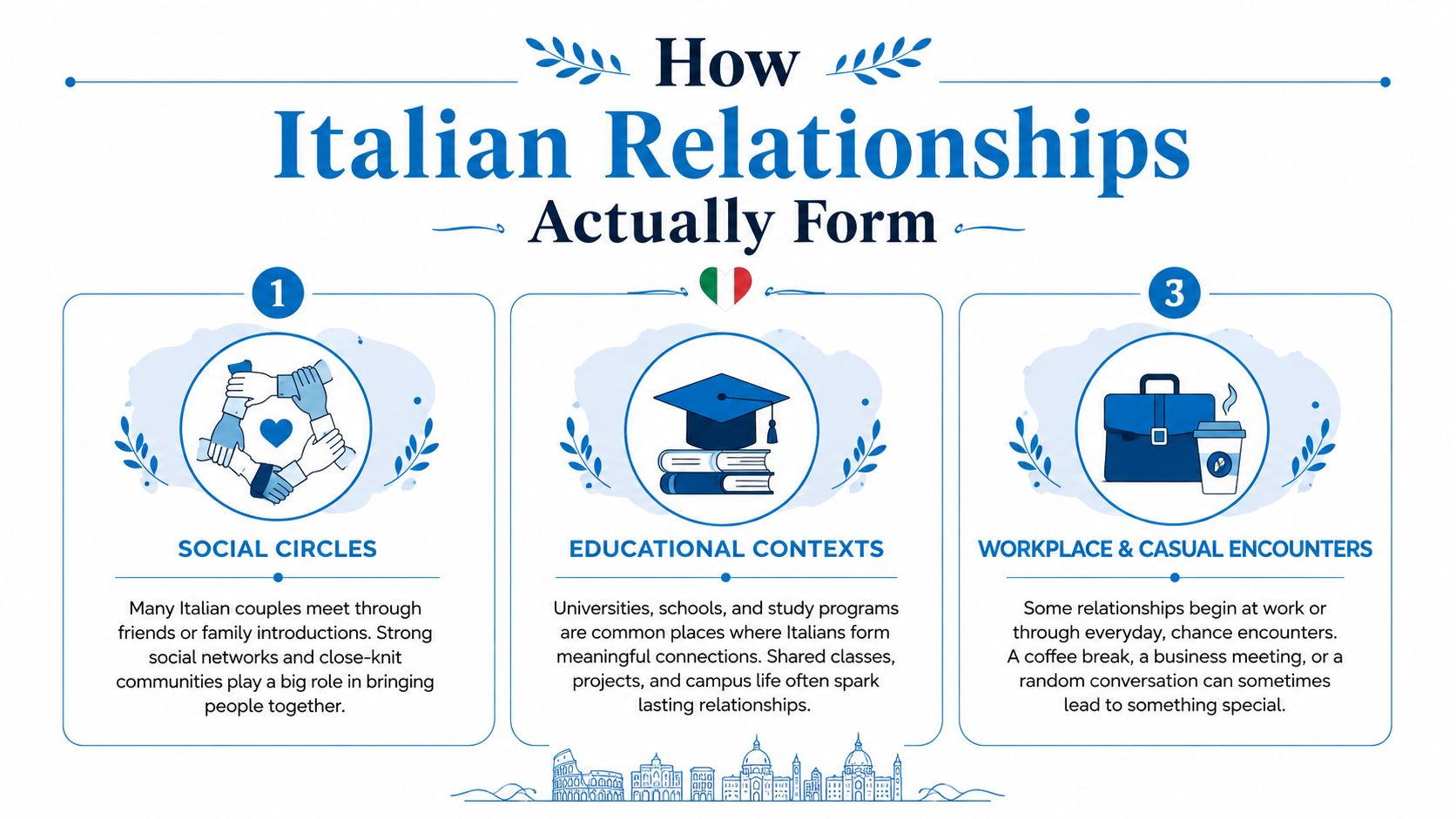
The strongest clue comes from how Italians meet. A 2022 study of marriage choices in Italy found that among spouses in the 2000 to 2009 marriage cohort, only 1.8% met online, while 73.3% met through school or university, and more recent cohorts still rely heavily on offline social networks rather than app-first dating (Arosio 2022). That matters because trust in Italy often grows through repeated in-person contact, not through rapid digital sorting.
Key takeaway: In Italy, social credibility often matters before romantic clarity does.
That's why friends, classmates, colleagues, and mutual acquaintances can play a larger role than many expats expect. The same dataset shows that school and university stayed one of the most important meeting places over time, which reinforces the idea that Italian dating often unfolds inside shared communities rather than anonymous platforms (Arosio 2022).
This also explains why relationship escalation can feel faster. In Italian dating culture, once two people start seeing each other regularly, there is often a social assumption of exclusivity after only a few meetings, and multi-dating may be read as low commitment rather than normal exploration. If you come from a culture where “getting to know several people” is ordinary, you can accidentally create anxiety instead of clarity.
A helpful comparison is this:
- Offline networks build trust first, then romance deepens.
- Repeated in-person contact signals seriousness, even before labels are discussed.
- Ambiguity lasts less well than in many North American dating systems.
- Silence can carry weight, because responsiveness is part of relational meaning.
Communication Styles and Expectations
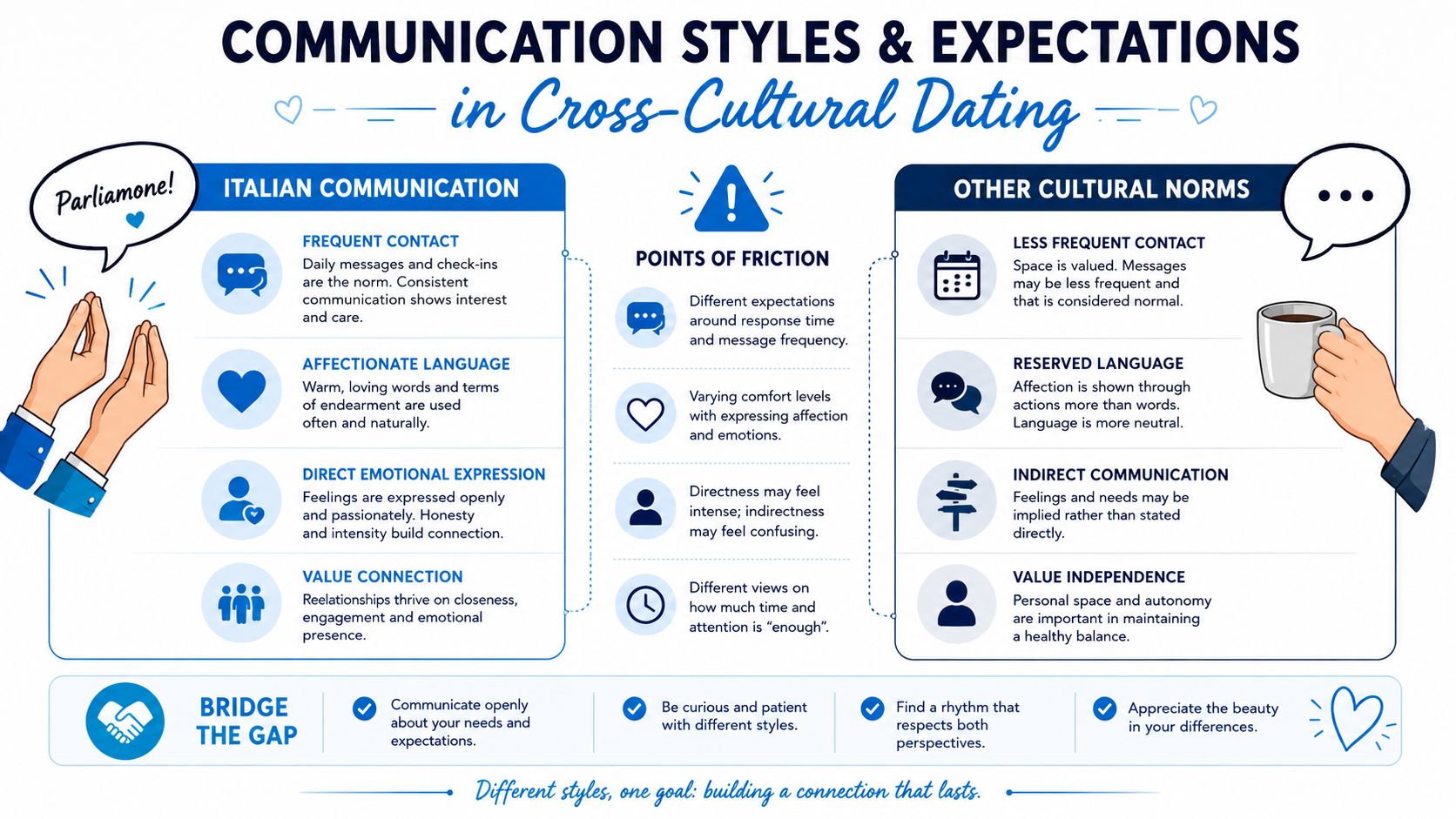
The biggest friction point is usually not attraction, it's timing. Italian romance often includes frequent contact, affectionate gestures, and a lot of in-person energy, while many expats are trained to wait, not over-text, and keep their options open until a label is explicit. That difference can make one person feel pursued and the other feel confused.
What to do when the signals don't match
If she texts often, use that as data. If she prefers face-to-face contact, don't assume the slower digital pace means indifference. In Italian social norms, romance is often emotionally expressive and highly visible, so delayed texting can feel colder than it might in your home culture.
The safest move is direct, calm language. Try:
- “I like spending time with you, and I want to understand what pace feels comfortable for you.”
- “I'm not trying to rush anything, but I don't want to misunderstand where we stand.”
- “If we're seeing each other regularly, I'd rather be clear than guess.”
That kind of sentence respects the relationship without forcing a dramatic label too early. It also helps with the common WhatsApp problem, where one person sees slower replies as normal and the other reads them as withdrawal. For practical dating conversation habits, how to improve communication skills is a useful internal reference point.
Directness is usually safer than prolonged ambiguity.
Presentation matters too. Dressing well, being punctual, and showing visible effort often signal respect and seriousness in Italian dating, not superficiality. If you show up underprepared, you may be read as careless before your personality even has a chance to matter.
Family Dynamics and Social Embeddedness
Family often enters the picture earlier than expats expect. In more serious relationships, meeting parents can happen relatively soon because family is a central reference point in Italian validation. That doesn't mean she's rushing, it means the relationship is being evaluated within a wider social field, not just by the two of you.
Regional context matters significantly. Northern cities such as Milan, Turin, and Bologna are often described as more cosmopolitan and closer to broader European dating patterns, while southern areas tend to be more family-centered and traditional. If you assume one Italian script fits everywhere, you'll miss the local context that shapes expectations.
A simple comparison helps:
| Context | Tendency | What it means for you |
|---|---|---|
| Northern urban settings | More cosmopolitan, more individualistic | Expect modern relationship habits, but don't assume family is irrelevant |
| Southern or more traditional settings | More family-centered, more conventional | Expect stronger visibility of relatives and clearer seriousness signals |
Family approval can carry real weight, which is why in-law stress often becomes relationship stress. If that piece starts to feel heavy, Italian in-laws stress can be a helpful support page to read with your partner's background in mind.
If you're a foreign partner, don't treat family involvement as a threat. Treat it as a system you're being invited into. The question isn't whether family matters, it's how much family presence is normal in this specific relationship and city.
Presentation Manners and Gender Expectations
Italian dating can be modern and traditional at the same time. A woman may value independence, career, and equal dialogue, while still appreciating visible effort, elegance, and confident courtship. Those aren't contradictions, they're often layered expectations that coexist in the same relationship.
The psychological problem appears when a foreign partner mistakes style for shallowness or assumes old-fashioned courtship always means rigid gender roles. Sometimes it does, sometimes it doesn't. The clue is whether the expectations are negotiable, mutual, and respectful, or whether they're being used to control the relationship.
A healthy way to read the situation is:
- Effort is often interpreted as care.
- Punctuality is often interpreted as respect.
- Good presentation is often interpreted as seriousness.
- Gender roles are not one-size-fits-all, especially in urban professional settings.
That means you don't need to become someone else. You do need to notice whether your own habits are sending the message you intend. If you dress casually, arrive late, or act indifferent, she may not think “he's relaxed”, she may think “he's not invested.”
In clinical terms, schema-level expectations can show up. If you grew up believing that “real intimacy shouldn't need effort,” you may feel awkward adapting. If she grew up in a context where effort is proof of respect, your relaxed style can accidentally trigger doubt. The fix is not pretending, it's translating.
The Hidden Mental Health Cost of Cross-Cultural Dating
Cross-cultural dating gets psychologically expensive when the communication gap stays unresolved. A person can feel anxious without being irrational, especially when they're dating in a second language, far from home, and unsure whether they're misreading signs. That uncertainty can produce self-doubt, attachment stress, and obsessive rumination.
When couples speak in an L2, emotionally loaded conversations often become harder to regulate. You may know the vocabulary, but not the emotional nuance, and that can make conflict feel colder or more dangerous than it really is. Research on cross-cultural relationships also highlights how isolation, identity shifts, and culture shock can make love feel heavier than it should (Therapsy guidance on dating across cultures).

What helps when the anxiety starts building
Start by separating facts from interpretations. If she is slower to reply, ask whether there's an Italian-style communication pattern at play before deciding you're being rejected. If a family comment feels intense, ask whether you're hearing a cultural norm or a personal criticism.
Then use simple boundary language:
- Name the issue early. “I think we may be reading this differently.”
- Keep the sentence short. Long explanations can raise tension in a second language.
- Ask for clarification. “What does exclusivity look like for you?”
- Avoid silent testing. Withholding contact to see what happens usually increases anxiety on both sides.
When language gets thin, therapy can hold what the relationship can't yet name.
That's especially true for expats who don't have local support networks. If you're carrying work stress, homesickness, or a recent move at the same time as dating uncertainty, the whole situation can start to feel bigger than the relationship itself. For that broader picture, mental health challenges faced by expats is a useful internal reference.
When to Seek Professional Support for Your Relationship
A couple should consider support when the same misunderstanding keeps returning despite genuine effort. One client may think, “We're just adjusting,” while the other feels increasingly lonely, controlled, or uncertain. That gap is often the sign that the relationship needs a shared language, not more guessing.
I've seen this in couples who were very affectionate but stuck in repeated loops. One partner assumed silence meant space, the other experienced it as withdrawal. Once they had a guided conversation, the issue wasn't love, it was unspoken rules.
A different pattern appears when family pressure, relocation stress, or identity loss starts shaping every discussion. In those cases, couples therapy can help both partners stop arguing about surface behavior and start understanding the emotional system underneath. For intercultural couples in particular, intercultural couples therapy can be a practical next step.
Therapy approaches like CBT can help identify unhelpful assumptions, Schema Therapy can uncover old relationship patterns, and systemic-relational therapy can map the couple's interaction cycle. For trauma-related stress, EMDR may be relevant when past experiences are being activated by current uncertainty.
If you're living in Italy and want support in your own language, Therapsy offers multilingual psychotherapy with carefully selected licensed professionals, matched by the Clinical Director. It's a natural option for expats and intercultural couples who want clarity without having to translate their emotions at the same time.
If you're feeling stuck between attraction and confusion, you don't have to sort it out alone. Therapsy can help you explore relationship stress, communication mismatch, and the emotional strain of cross-cultural dating with a therapist who understands expat life in Italy. Book your first free assessment call at THERAPSY, with no commitment, just a conversation that can help you find the right support.
FAQ
How do I know if an Italian woman is interested in me?
She's usually interested if her actions are consistent, not just warm. Frequent contact, making time to meet, and showing visible effort often matter more than dramatic declarations. In this cultural context, repeated in-person engagement is often a stronger sign than a single flattering message.
Why does dating an Italian woman sometimes move so fast?
It can feel fast because Italian dating often relies on social clarity rather than long ambiguity. Once two people are seeing each other regularly, exclusivity may be assumed sooner than in cultures where multi-dating is considered normal. That's why early, respectful clarity helps.
Is it rude to ask about exclusivity early?
No, it's usually safer to ask than to guess. A calm question about pace, contact, or relationship goals can prevent misunderstandings that otherwise build. The key is to be direct without sounding defensive.
Do Italian women expect men to pay or lead?
Sometimes, but not always, and it depends on the person, city, age, and values. In many settings, effort, attentiveness, and confidence matter more than rigid rules. The best approach is to notice what she prefers instead of assuming one universal standard.
How important is family in dating an Italian woman?
Often very important, especially once the relationship becomes serious. Family can function as a source of validation, not just background context. If you're from a more individualistic culture, that can feel intense at first, but it's often a normal part of relationship embeddedness in Italy.
When should I consider therapy for cross-cultural dating stress?
Consider it when confusion keeps repeating, anxiety starts affecting sleep or focus, or you feel yourself losing confidence in your own perceptions. Therapy can help you separate cultural mismatch from deeper relational problems. It's especially useful when language differences make conflict harder to resolve.
Can online therapy help if I'm dating across cultures in Italy?
Yes, especially if you travel often, live outside major cities, or need support in your native language. Online sessions can make it easier to talk through relationship stress before it turns into chronic anxiety. For many expats, that flexibility makes support much more accessible.