You're in a meeting in Milan. You understand most of what's being said, but not quite all of it. Someone speaks quickly, another person interrupts with a joke, everyone seems to catch the mood of the room except you, and by the time you've organised your reply, the conversation has moved on. Later, you replay it in your head and wonder whether your Italian was the problem, whether you sounded cold, or whether you should have said something more direct.
That is often what people mean when they ask how to improve communication skills as an expat in Italy. It is rarely only about vocabulary. It is usually about listening under pressure, speaking with clarity, reading nonverbal signals, and staying emotionally regulated when you feel exposed.
As a psychotherapist working with expats, international students, and young adults in Italy, I see this often. Communication problems are not always a sign that you are “bad with people”. In an intercultural context, they're often the meeting point of culture shock, anxiety, self-doubt, language fatigue, and unfamiliar social rules. The encouraging part is that communication can be trained. With the right practice, you can become clearer, calmer, and more confident without becoming someone you're not.
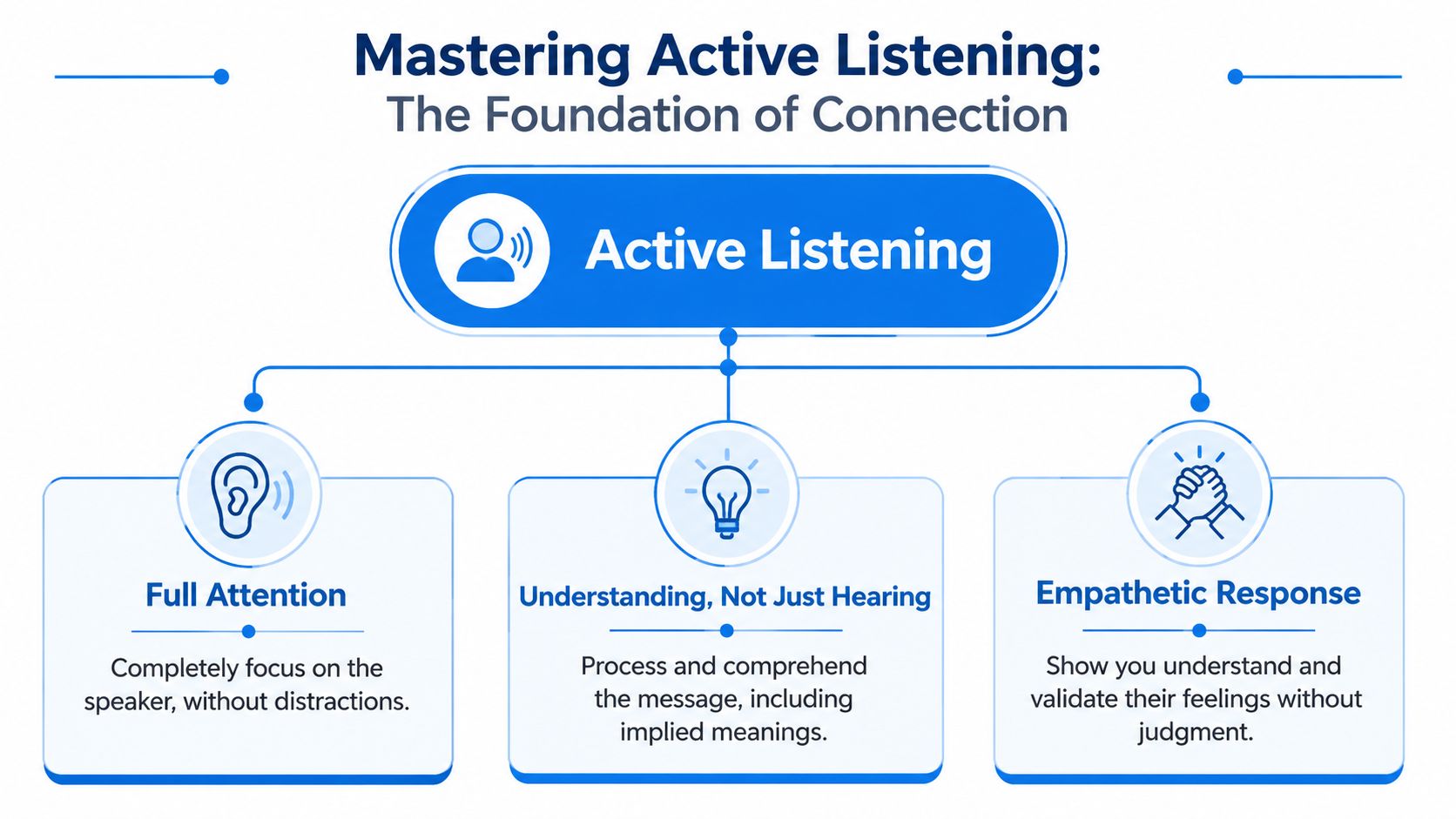
The Foundation of Connection Mastering Active Listening
Active listening means listening to understand, not listening to prepare your reply. In expat life, that distinction matters even more because your brain is already working hard to process accent, speed, unfamiliar references, and social nuance.
The practical lesson is simple. Good communication starts with attention before expression.
Why listening feels harder abroad
When you're living in another country, listening is not passive. It's mentally expensive.
You're often doing several things at once:
- Translating in real time while trying to stay emotionally present
- Guessing cultural meaning behind words that may sound neutral but carry social weight
- Monitoring yourself so you don't appear rude, slow, or confused
- Planning your response too early because silence feels risky
That last pattern is one of the most common. If you're already rehearsing what to say, you stop fully receiving what the other person means.
Practical rule: If your mind is composing your defence, explanation, or witty answer, you are no longer listening.
A useful primer on mastering active listening can help you notice the difference between hearing words and making someone feel understood.
Three practices that change conversations
Paraphrase before you argue
Reflective paraphrasing lowers tension and increases accuracy. It also gives the other person a chance to correct misunderstandings early.
Try phrases like:
- “So if I understand correctly, you're saying…”
- “Let me check that I've got this right…”
- “It sounds like the main concern is…”
This is especially helpful in mixed-language situations. You don't need elegant wording. You need accurate understanding.
Ask open questions
Closed questions often stop a conversation. Open questions keep it moving and reveal context.
Examples:
Instead of “Are you upset?”
Try “How did that land for you?”
Instead of “Did you mean I did something wrong?”
Try “Can you tell me more about what you meant there?”
Open questions reduce defensiveness because they don't push the other person into a narrow answer.
Hold back judgement for one beat longer
This is the hardest skill and often the most powerful. Many misunderstandings happen because people react to the first interpretation rather than checking whether it is correct.
Count to two. Breathe once. Then ask.
That pause can stop a friendship conflict, prevent workplace friction, or soften an argument with a partner. It communicates respect, even when the topic is uncomfortable.
A simple listening reset
If you tend to get overwhelmed, use this quick sequence in conversation:
- Look at the speaker instead of scanning the room.
- Notice your impulse to interrupt or explain.
- Paraphrase one main point.
- Ask one open question.
- Respond only after the other person confirms you understood.
Many communication problems begin to improve not with cleverness, but with steadiness.
Speaking with Clarity and Assertiveness
Many expats don't struggle because they have nothing to say. They struggle because they are torn between two fears. One is “If I speak directly, I'll sound rude.” The other is “If I soften too much, no one will understand what I need.”
Clear communication and assertiveness solve that tension together. Clarity helps people understand you. Assertiveness helps you respect yourself while speaking.
Use the 5 Cs when your thoughts feel messy
A practical framework is the 5 Cs of communication: clear, correct, complete, concise, and compassionate.
When you're anxious, your message often becomes either too long or too vague. The 5 Cs help you organise it.
What the 5 Cs look like in real life
| Principle | What it sounds like |
|---|---|
| Clear | “I need the deadline confirmed by Thursday.” |
| Correct | “Here is the updated information as I understand it.” |
| Complete | “The issue is timing, budget, and who will approve the final version.” |
| Concise | “The short version is that I can do this, but not by tomorrow.” |
| Compassionate | “I understand this is urgent, and I want to find a workable solution.” |
Clarity without compassion can sound harsh. Compassion without clarity can sound uncertain. You need both.
For written and spoken structure, these effective communication strategies are useful because they force you to remove extra wording and keep the point visible.
Assertive is not aggressive
People often confuse assertiveness with dominance. They are not the same.
- Passive communication says yes when you mean no.
- Aggressive communication pushes your needs through at someone else's expense.
- Assertive communication states your needs clearly while respecting the other person's dignity.
Assertiveness is the middle path between self-erasure and attack.
Examples help.
- Passive: “It's fine, don't worry about it.”
- Aggressive: “You never listen and this is your fault.”
- Assertive: “I'm not comfortable with that plan. I'd like us to choose another option.”
The CBT piece most people miss
In Cognitive Behavioural Therapy, we look at the thoughts that drive behaviour. Communication often breaks down before you even speak, because a belief is already shaping your tone.
Common unhelpful thoughts include:
- “If I say no, they'll dislike me.”
- “If I ask for clarification, I'll look incompetent.”
- “If I don't speak perfectly, I shouldn't speak at all.”
When those beliefs go unchallenged, you either stay silent, over-explain, apologise too much, or speak in a way that doesn't match what you feel.
A more helpful internal script is:
- “I can be respectful and still be direct.”
- “Clarifying is responsible, not embarrassing.”
- “My message matters even if my wording isn't perfect.”
If relationship tension makes this harder, it can help to understand how emotional awareness shapes conversations, especially in close bonds. This is well explored in emotional intelligence in relationships.
A practical script for everyday assertiveness
Use this formula when you need to speak clearly under pressure:
- Name the issue
- State your need
- Offer one next step
Example:
“I'm finding the last-minute changes difficult to manage. I need a bit more notice to do the work properly. Can we agree on a cut-off time for edits?”
That structure is calm, direct, and hard to misread.
The Unspoken Language Decoding Nonverbal Cues
In Italy, communication often lives in the space around the words. Tone, gesture, facial expression, rhythm, and eye contact can all carry meaning. If you miss those signals, you may understand the sentence but not the conversation.
For expats, that matters because nonverbal alignment often builds trust faster than grammatical perfection.

Why nonverbal misreading creates anxiety
Many expats assume, “I said the right thing, so why did that feel awkward?” Often the issue is nonverbal mismatch.
A few examples:
- You use very limited facial expression because you are concentrating. The other person reads you as distant.
- Someone stands closer than you expect. You feel crowded, then become tense and less natural.
- A lively tone sounds confrontational to you, even though the other person feels engaged and friendly.
- You avoid eye contact because you're searching for words. The other person reads uncertainty or lack of interest.
None of this means you are doing something wrong. It means your nervous system and cultural expectations are interpreting signals quickly, sometimes inaccurately.
What to observe before you adapt
Don't rush to imitate everything around you. Start by observing patterns.
Notice the rhythm
Italian conversations can feel more overlapping, expressive, and relational than what many expats expect. Interruption is not always hostility. Sometimes it signals involvement.
Watch the face and hands
Gestures and facial animation often add emphasis or emotional shading. If you focus only on words, you may miss whether the speaker is joking, softening, or intensifying a point.
Check your own body
Ask yourself:
- Are my shoulders tight?
- Am I looking away too often?
- Does my tone match my intention?
- Am I smiling when I'm trying to be warm, or only when I'm trying to hide discomfort?
Your body often speaks your stress before your mouth speaks your meaning.
A healthier goal than copying locals
You do not need to perform “Italian-ness” to communicate well. The better goal is flexible authenticity. Stay recognisably yourself, but become more aware of how your signals land.
That may mean softening a very blunt tone, increasing eye contact a little, or allowing more warmth into your voice before discussing logistics. Small shifts can change the whole feeling of an interaction.
Communicating Under Pressure How to Regulate Your Emotions
When people ask how to improve communication skills, they usually expect tips about wording. In difficult moments, wording is not the first problem. Physiology is.
If your nervous system is activated, communication gets narrower, faster, and more defensive. You stop listening well, your tone changes, and your brain starts treating disagreement like danger. This is why emotional regulation is not an optional extra. It is the base layer of good communication.

Stress changes the conversation before words do
Under stress, people usually move toward one of a few patterns:
- Fight by becoming sharp, defensive, or controlling
- Flight by avoiding the conversation or mentally checking out
- Freeze by going blank and saying very little
- Fawn by agreeing too quickly and abandoning their own position
Expats are especially vulnerable to this because ordinary conversations can already carry extra strain. You may be tired from functioning in another language, worried about making a mistake, or already feeling homesick and overstretched.
That is why a difficult exchange at work or at home can feel disproportionately intense.
Regulation first, then expression
Before an important conversation, don't ask only, “What should I say?” Ask, “What state am I in?”
Try this short pre-conversation routine:
- Exhale slowly for longer than you inhale.
- Drop your shoulders and unclench your jaw.
- Name the feeling in one word, such as angry, embarrassed, afraid, or overloaded.
- Choose one intention for the conversation, such as clarity, repair, or boundary-setting.
This takes less than a minute, but it creates psychological space between feeling and reacting.
Calm is not the absence of emotion. It is the ability to stay in contact with yourself while you speak.
Use a pause without disappearing
If a conversation is heating up, many people think they have only two options. Keep going or shut down. There is a third option. Pause on purpose.
You can say:
- “I want to answer properly. Give me a moment.”
- “I'm getting a bit flooded and I don't want to react badly.”
- “Can we slow this down so I can understand clearly?”
That is not weakness. It is regulation in action.
If social anxiety is part of the pattern, the communication difficulty may not be about skill alone. It may also be about threat perception, overthinking, and fear of negative evaluation. This is often worth exploring further in work on how to deal with social anxiety.
One grounding method that works in public
When you can't step away, use a discreet grounding exercise:
- Press both feet into the floor
- Notice three things you can see
- Relax your tongue from the roof of your mouth
- Speak one sentence more slowly than feels natural
That last step matters. Slowing your pace often lowers the emotional temperature for both people.
Navigating Cross-Cultural Conversations as an Expat in Italy
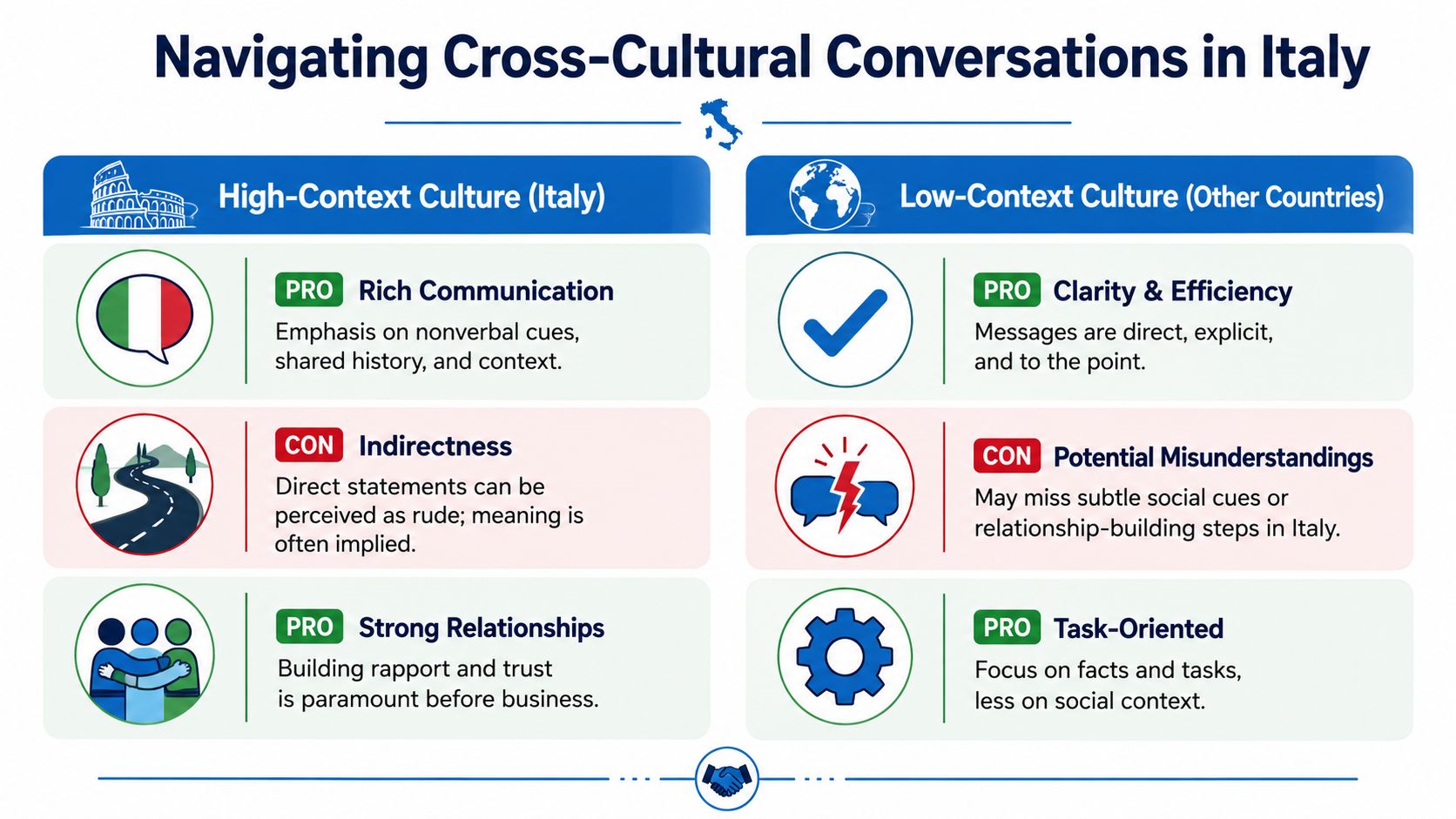
A common expat experience goes like this. You arrive at work wanting to be efficient. You send a direct message, ask a clear question, or move quickly to the practical issue. The response feels vague, delayed, or more socially layered than you expected. You leave thinking, “Why is this so complicated?” The other person may leave thinking, “Why was that so abrupt?”
This is not always a personality clash. Often it is a communication culture clash.
When directness meets context
Many expats come from communication styles that value speed, explicit wording, and task focus. Italy often places more weight on relationship, tone, shared context, and what is implied rather than only what is stated.
Research and practitioner guidance highlighted in a cross-cultural review note a major gap in mainstream communication advice: it often ignores cross-cultural pressure, especially for people navigating language strain, shifting norms, and confidence all at once. The same review points to a practical solution. Slow down, paraphrase, and repair misunderstandings in mixed-language environments (cross-cultural communication pressure review).
A day that many expats recognise
By late afternoon, your Italian is worse than it was in the morning. You miss a joke from a colleague. You're less patient on WhatsApp. At dinner with your partner's family, you can follow the topic but not every shift in tone. Someone says something indirect, everyone else seems to understand it instantly, and you feel half a step behind.
That is often language fatigue. It is not laziness or lack of intelligence. It is cognitive overload.
When language fatigue is high:
- You become more literal
- You miss implied meaning
- You lose tolerance for ambiguity
- You may sound flatter or sharper than intended
What works better in Italy
Build rapport before the request
A purely transactional approach can land badly in settings where relationship comes first. A greeting, a little context, or a warmer opening often makes the practical part easier.
Read the subtext, then verify it
If something sounds indirect, don't assume bad faith. Check your understanding gently.
Try:
- “Am I right in thinking that timing is the concern?”
- “It sounds as though you may prefer another approach. Is that right?”
Repair early
Cross-cultural misunderstandings are normal. Repairing them quickly matters more than avoiding them perfectly.
If family dynamics are part of the challenge, especially with an Italian partner's relatives, many expats find this pressure particularly intense. That dynamic is often linked with identity, belonging, and role expectations, as explored in Italian in-laws stress.
The most useful mindset shift
The question is often not “How do I speak perfectly?” Instead, it is “How do I stay connected when the conversation carries more context than I'm used to?”
That shift makes you less rigid, less ashamed, and much more effective.
Practice and Troubleshooting in Daily Scenarios
Insight helps, but communication changes through repetition. The most reliable practice is not reading more tips. It is rehearsing better sentences for the situations that keep happening.
A useful perspective from workforce-skills research is that many people struggle not because they lack ability, but because they struggle to communicate the value of their own skills and translate their experience into language that makes sense to employers and colleagues (workforce skills communication gap playbook). That is a self-advocacy problem as much as a confidence problem.
Scenario one at work
You disagree with a colleague or need to advocate for your idea.
Before
“I guess maybe we could also do it another way, but it's fine.”
After
“I see the logic in this approach. I'd like to add one concern about timing. My suggestion is to simplify the process so we can deliver it more reliably.”
Why this works:
- It acknowledges the other person without surrendering your point.
- It names a concrete issue.
- It offers a next step.
If you want extra structured practice in speaking under scrutiny, resources on improving debate skills for MUN can be unexpectedly useful because they train concise argument, rebuttal, and composure.
Scenario two in dating or friendship
You feel misunderstood and are tempted to accuse or withdraw.
Before
“You clearly don't care. You never really listen.”
After
“I felt dismissed in that moment, and I don't think that was your intention. Can I explain what I needed from you there?”
This version lowers defensiveness. It also separates impact from assumed motive, which is essential in intercultural dating.
Scenario three with a flatmate or partner at home
You're carrying more responsibility and resentment is building.
Before
“I always do everything here.”
After
“I'm feeling overloaded with the household tasks. I need us to agree on a clearer split so it doesn't keep becoming an argument.”
That sentence is cleaner because it focuses on the issue, not a global character judgement.
A weekly practice routine that actually helps
You can adapt it:
- Choose one pattern to track, such as interrupting, avoiding conflict, or over-explaining.
- Practise one replacement script in real life for two weeks.
- Review what happened after difficult conversations. What worked, what escalated, what you wish you had said.
- Repeat until the new response feels less forced.
If your struggles are tightly linked to relocation stress, it helps to understand the wider emotional picture too. Many communication problems improve when the underlying stress of adaptation is named, as in culture shock in Italy and how to cope.
When self-help is not enough and therapy can help
Sometimes communication advice doesn't stick because the underlying barrier is deeper than skill. You may know the right words and still freeze. You may understand assertiveness and still apologise constantly. You may recognise a misunderstanding and still feel panicked, ashamed, or emotionally flooded.
That often points to something underneath the communication problem itself. Common drivers include social anxiety, chronic self-criticism, depression, attachment insecurity, burnout, or past relational trauma. In those cases, communication is not only a behavioural issue. It is also a nervous system and meaning-making issue.
What therapy changes
Therapy offers a place to look at the pattern rather than only the latest conversation.
A therapist can help you:
- Identify triggers that make you shut down, people-please, or become defensive
- Challenge beliefs such as “my needs are too much” or “conflict means rejection”
- Practise new responses through role-play and reflection
- Regulate your body so communication becomes possible under stress, not only in calm moments
In CBT, the focus is often on thoughts, behaviours, and avoidance cycles. In Schema Therapy, we look at deeper life patterns, such as abandonment, subjugation, or mistrust. In EMDR, we may work with unresolved experiences that still shape your reactions in present-day relationships.
If your communication difficulties are closely tied to emotional flooding, shutdown, or chronic overstimulation, it can be especially helpful to understand nervous system regulation therapy.
A gentle sign to take the next step
You do not need to wait for a crisis. If communication problems keep affecting work, dating, friendships, family life, or your sense of self in Italy, support can help you build something more stable than coping strategies alone.
FAQ
How long does it take to see improvement in communication skills
Improvement can start quickly, but lasting change usually comes from steady practice. Many people notice a difference as soon as they begin listening more actively or speaking more directly in one recurring situation. The habits become more natural over time when you repeat them consistently rather than trying to change everything at once.
Can I improve my communication skills if I am shy or introverted
Yes, absolutely. Good communication is not about becoming louder or more extroverted. Many introverted people become excellent communicators because they observe carefully, listen well, and speak thoughtfully when they feel safe enough to do so.
Is online therapy effective for communication problems
Yes, online therapy can be very effective for communication difficulties. The session itself becomes a space to slow down, notice your patterns, and practise new ways of expressing yourself with real-time feedback. It also makes support more accessible if you are living in Italy but prefer to speak in your own language.
What if the other person has poor communication skills
You cannot force someone else to communicate better, but you can change the pattern you participate in. Clear boundaries, calm repetition, active listening, and assertive phrasing often reduce confusion and escalation. Even when the other person does not change much, your own responses can become steadier and more protective of your well-being.
Why do I communicate worse in another language even when I know the words
Because communication is more than vocabulary. You are also processing tone, timing, social norms, humour, and emotional risk, all while managing fatigue and self-consciousness. That extra load can make you sound less spontaneous or less confident than you are.
Can therapy help if my problem is confidence, not trauma
Yes, it can. Confidence problems often grow from repeated patterns of self-doubt, fear of judgement, or old relational experiences, even when there is no major trauma history. Therapy can help you build a clearer internal voice so your external communication becomes more grounded.
If you're struggling to express yourself clearly, feel misunderstood in Italy, or keep getting stuck in the same painful communication patterns, support can make a real difference. Book your first free assessment call with THERAPSY, no commitment, just a conversation with our Clinical Director who will listen and match you with the right therapist for you.