Italian In-Laws Stress: A Guide for Expats in Italy (2026)
The stress you experience from your Italian in-laws is a recognized psychological challenge for many expats in Italy. This tension often arises from a clash between your own cultural background and the deep-rooted family traditions of your Italian partner. It's crucial to understand that this friction rarely stems from malice; instead, it is a byproduct of differing cultural expectations around family, privacy, and personal independence.
Navigating this dynamic is the first step toward reducing emotional strain and building a healthier family life in Italy. This stress with Italian in-laws is a specific form of culture shock, and understanding its psychological roots is key to managing it effectively. Many young adults and American women who relocate to Italy for family find this to be one of their biggest hurdles.
Why Italian In-Law Dynamics Feel So Stressful
The stress from Italian in-laws is a valid and common experience for expats in cross-cultural relationships. This stress is fundamentally caused by a collision of two different "cultural scripts" – the unwritten rules that dictate how families should interact. An action that one culture views as a profound expression of love and care can be perceived by another as a significant violation of personal boundaries.
The core of Italian in-law stress is often a misinterpretation of intent. Actions rooted in a cultural value of interdependence and closeness, such as frequent phone calls or unannounced visits, can feel like a violation of privacy and autonomy to someone from a more individualistic background. This is a classic issue for international couples in Italy.
In many Western cultures, family life prioritizes individual autonomy. Young adults are expected to become independent, forming separate households where personal privacy is a protected value. In contrast, the traditional Italian family model is built on interdependence, with strong, often daily, involvement across generations. In this context, constant contact is not just normal – it is a primary method of expressing care and maintaining family bonds. This difference is a major source of anxiety for expats.
Cultural Expectations: A Psychological Comparison
To better understand the source of your stress, it helps to compare these cultural scripts side-by-side. The friction points often become immediately clear.
| Area of Life | Common Western Expectation (e.g., USA/UK) | Common Italian Expectation |
|---|---|---|
| Privacy | Personal space and "me time" are highly valued. Unannounced visits are rare and often considered impolite. | Family life is communal. Doors are often metaphorically (and literally) open. Unannounced visits are a sign of closeness. |
| Communication | Direct, but often with a focus on politeness and avoiding direct confrontation to maintain harmony. | More expressive, emotionally open, and direct. Volume and gestures are integral parts of the conversation. |
| Decision Making | Couples are the primary decision-makers for their own lives (career, children, housing). Extended family advice is optional. | Extended family, especially parents (genitori), often expect to be consulted and have a significant say in major life decisions. |
| Child Rearing | Parents are the ultimate authority. Grandparents (nonni) typically play a supportive, secondary role. | Grandparents often have a very active, hands-on role that can feel like co-parenting, offering unsolicited but well-intentioned advice. |
| Financial Support | Financial independence is a key marker of adulthood and a source of personal pride. | Financial ties and mutual support between generations are common and often expected throughout life. |
This comparison helps de-personalize the conflict. It shifts the narrative from "my in-laws are being difficult" to "we are operating from different cultural playbooks." This insight is the first step toward empathy and constructive problem-solving.
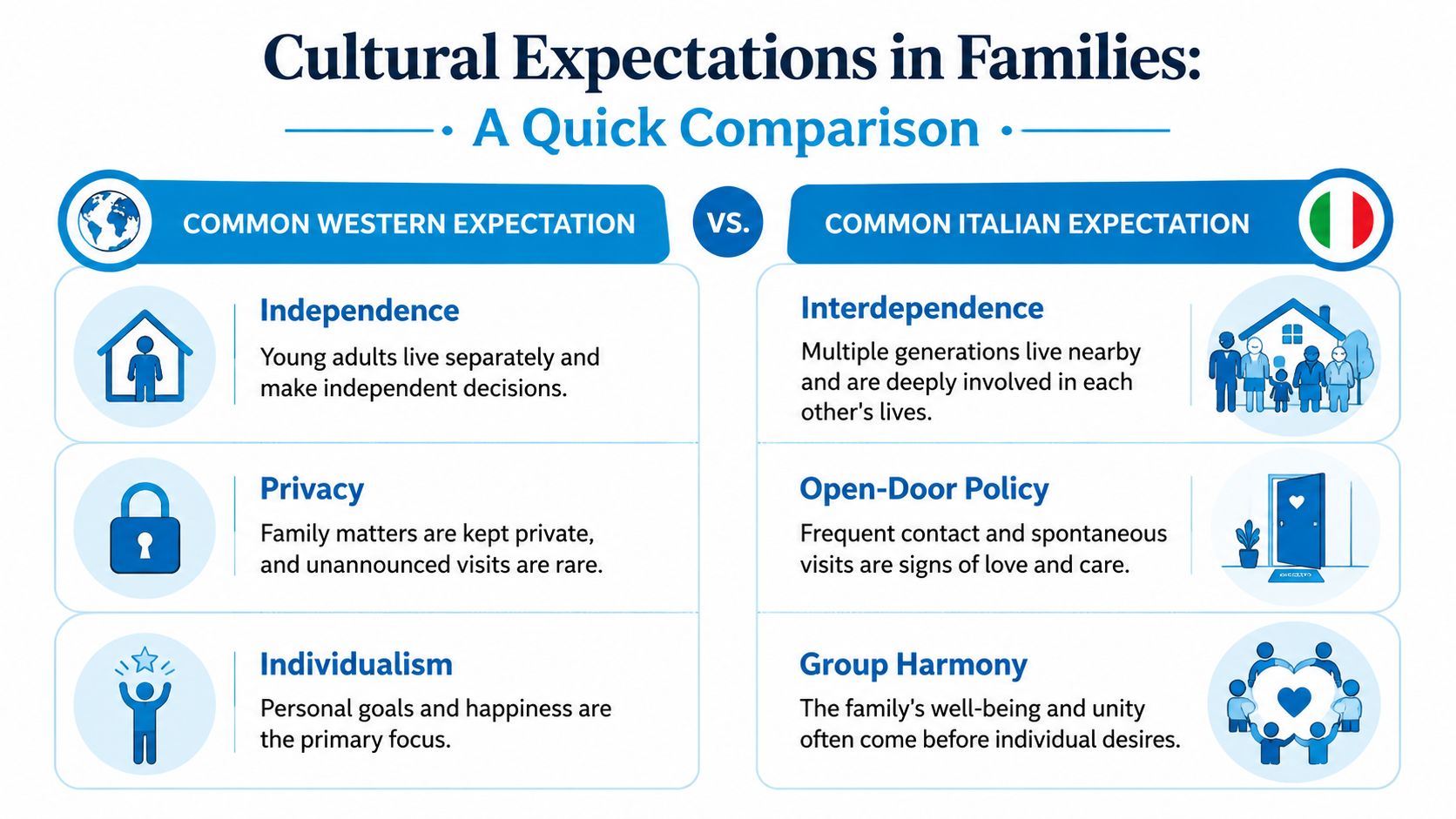
This recurring friction is a significant psychological stressor that can lead to feelings of isolation, anxiety, and even depression, which is why it is often discussed in expat mental health circles. This pattern is also a key component of navigating culture shock in Italy. The goal is not to prove one culture "right" but to find a sustainable middle ground that protects your well-being and the health of your primary relationship.
The Psychology Behind Intercultural Family Conflict
If friction with your Italian in-laws feels intensely personal, that’s because on a psychological level, it is. The emotional pain often goes far deeper than simple cultural misunderstandings, tapping into universal human needs for attachment, autonomy, and validation.
When you feel that sting of criticism or a pang of anxiety around your partner's family, you are likely experiencing a perceived threat to your primary attachment bond. According to attachment theory, your relationship with your partner is your main source of security and loyalty as an adult. When in-laws seem to demand your partner's total allegiance, it can trigger a deep-seated fear that your own bond is at risk.
This is the classic ‘conflict of loyalty.’ Your partner may feel torn between their family of origin and the new family they are building with you. This internal struggle is one of the most common and painful sources of stress for intercultural couples, as the expectations from each side can feel enormous.
How Past Experiences Shape Present Reactions
This dynamic is often amplified by our personal histories. A seemingly innocent comment from a mother-in-law about your career choices might not just be annoying; it could activate what Schema Therapy calls a "lifelong emotional schema" – a deep-seated sensitivity to feeling criticized or invalidated that may have roots in childhood.
What feels like a simple disagreement is actually triggering a much older wound.
- Autonomy vs. Enmeshment: If you grew up needing to fight for your independence, the beautifully close-knit nature of an Italian family can sometimes feel suffocating or intrusive. This can trigger feelings of being controlled.
- Validation vs. Criticism: If you have a lifelong sensitivity to judgment (a "Defectiveness" or "Failure" schema), unsolicited advice on your parenting or housekeeping can feel less like a helpful tip and more like a profound personal failure.
Recognizing these triggers is empowering. This awareness shifts the problem from "my mother-in-law is impossible" to "this situation is activating my deep need for autonomy." That insight is the first, most crucial step toward responding thoughtfully instead of just reacting emotionally.
Research confirms that in Italy, family interdependence is a cornerstone of daily life, which can amplify this stress for expats in cities like Milan or Rome. The expectation for constant family involvement can directly clash with an expat’s need for privacy and independence, affecting everything from holiday plans to child-rearing decisions. (Read the full research about Italian family structures)
Navigating these dynamics is a common challenge, not a personal failing. It’s a systemic issue that many couples face. Therapsy is a trusted resource for the international community in Italy, and our team of 50+ multilingual therapists is experienced in guiding couples through these exact challenges. You can learn more about our approach in our guide to intercultural couples therapy.
Practical Strategies for Setting Healthy Boundaries
Understanding the psychology of your stress is the first step; taking action is the next. Setting healthy boundaries is not about building walls or being unkind. It is about protecting your relationship and your well-being with clear, firm, and genuinely loving communication. This is a skill you can develop.
From a Cognitive Behavioral Therapy (CBT) perspective, our communication patterns directly shape our emotional reality. By changing the way you communicate about boundaries, you can fundamentally change the family dynamic.
Unify Your Front and Use “We” Statements
The most effective strategy is to present a united front with your partner. Your in-laws must see you and your partner as an unbreakable team. When a boundary needs to be discussed, the message must come from "us," not just "you."
- Instead of: "I need you to tell your mother to stop calling every day."
- Try: "We need to find a better rhythm for family calls that feels good for us as a couple."
This shift to "we" language immediately reinforces that your partnership is the primary family unit. It transforms a complaint into a collaborative problem-solving session, which feels far less confrontational and is much more effective.
Scripting Your Boundaries with Kindness and Clarity
When you feel put on the spot, having prepared phrases can be a lifesaver. The goal is to be kind but firm – acknowledge the positive intention behind their action while clearly stating your need. This approach is central to effective communication in therapy for expats.
- For Unannounced Visits: "It's always so lovely to see you! To make sure we can give you our full attention, could we plan a time to get together next week? A quick call beforehand would be perfect for us."
- For Unsolicited Parenting Advice: "We really appreciate how much you care about the baby. We’ve decided to do it this way for now, and it means so much to know we have your support as we figure things out together."
- For Holiday Pressure: "We love the idea of spending the holiday with everyone. This year, we need to split our time, but we'd love to host a special dinner with you on [specific day] to celebrate."

Often, the difficulty in setting these boundaries stems from a deep-seated tendency toward people-pleasing. We explore this pattern in our guide on people-pleasing therapy for women. Learning to prioritize your own needs is essential, and guidance on how to overcome people pleasing for business owners can be equally applicable to family dynamics.
Boundaries are not a rejection of your in-laws; they are an affirmation of your relationship. They create the necessary space for your partnership to thrive, which ultimately benefits the entire extended family.
Remember, consistency is crucial. You will likely need to gently and patiently reinforce a boundary multiple times. It’s not about winning a battle, but about teaching others how to treat you and your relationship with the respect it deserves. Therapsy's clinical team, led by Dr. Francesca Adriana Boccalari, specializes in evidence-based approaches like CBT to help you build these communication skills.
How to Survive Big Italian Family Events
For many expats, the greatest source of Italian in-laws stress comes from large, ritualized family gatherings like pranzo della domenica (Sunday lunch), Christmas, or Ferragosto. These events can feel like high-pressure performances, but with a strategic game plan, you can transform dread into a manageable, and even enjoyable, experience.
The key is to view these events as predictable. Therefore, your strategy for managing them should be equally predictable and planned.
Get on the Same Page Before You Go
Before you enter the event, you and your partner must be a solid, unified team. This is non-negotiable. Sit down together and agree on your boundaries and, just as importantly, your exit plan.
- Set a time limit. Decide together how long you will stay. Having a pre-planned departure time gives you a unified and graceful reason to leave. A simple, "We need to head off by 4 PM to get ready for the week," works perfectly.
- Discuss tricky topics. Briefly review sensitive subjects that are likely to arise. How will you handle intrusive questions about finances, your career, or having children? Agree on a simple, shared response like, "We're still figuring that out together, but we'll let you know when we have news."
- Create a signal. This can be a lifesaver. Establish a subtle code word or a non-verbal cue that you can use when you feel overwhelmed and need a moment of support or wish to initiate your exit plan.

Navigating high-stakes family events like weddings involves meticulous planning. Practical tools that improve Wedding guest engagement can also help reduce overall event stress by streamlining logistics.
Your goal isn't to win arguments; it’s to protect your peace. A united front with your partner is the single most effective tool you have for staying emotionally balanced during these get-togethers.
Managing the emotional intensity of these gatherings is a common struggle, especially during holidays. For more support, our guide on handling emotional instability during the holiday season can provide additional strategies. Learning to navigate these events on your own terms is a powerful step toward a balanced and happy life in Italy.
When to Seek Professional Support
There are times when, despite your best efforts, the stress from your Italian in-laws becomes too overwhelming to manage alone. Deciding to seek professional help is not a sign of failure; it is a courageous and proactive step toward protecting your mental health and your partnership.
The line is often crossed when ongoing conflict shifts from a manageable frustration to a serious issue that erodes your well-being.
Signs You Might Need Professional Help
Constant family friction can take a heavy toll. If you recognize yourself in any of the points below, it may be time to consider speaking with a professional therapist.
- Persistent Anxiety or Dread: You feel a constant knot in your stomach or a sense of dread when you have to see or even think about your in-laws.
- Depressive Symptoms: You feel persistently sad or hopeless, and you have lost interest in activities you once enjoyed.
- Constant Relationship Conflict: The in-law issue has become the primary source of arguments with your partner, and you both feel stuck and unable to find a resolution.
- Social Withdrawal: You actively avoid family gatherings or social events to steer clear of your in-laws, leading to feelings of isolation and loneliness.
If these signs are familiar, it is important to know you are not alone and that effective support is available. For more clarity, you can read our guide on how to determine if you need a psychologist.
Professional therapy offers a neutral, non-judgmental space to heal and build skills. It is a place where you and your partner can learn to function as a unified team, equipped with tools to navigate conflict constructively.
Research on Italian family dynamics highlights a complex emotional climate. While close family ties can be a source of great support, they can also create immense pressure when expectations – especially around relationships or parenting – are unspoken. This is when "support" can begin to feel like "control." (published research).
Therapy helps reframe this situation. It is not about "bad in-laws" but about a clash of cultural scripts that can be managed with clearer communication and stronger boundaries. Therapsy is a multilingual psychotherapy service in Italy for expats, offering online and in-person sessions in 24 cities, including Milan, Rome, Florence, and Turin. Our licensed therapists, supervised by our Clinical Director, specialize in these exact intercultural challenges.
FAQ
H4
How do I tell my partner their family is causing me stress?
The most effective way is to use "I" statements in a calm moment, focusing on your feelings rather than criticizing their family. Frame the issue as a shared challenge by saying something like, "I feel overwhelmed when we have unannounced visitors, and I'd love for us to find a solution together that works for our relationship." This approach promotes teamwork and reduces defensiveness.
Is it normal for my Italian mother-in-law to call every day?
Yes, in traditional Italian culture, very frequent contact is a common and genuine expression of love and care. However, it is also completely normal for this to feel overwhelming if you come from a culture with different norms around family communication. The goal is to negotiate a balance that respects both the cultural habit and your personal need for space, perhaps by scheduling longer, dedicated calls.
What if my partner always sides with their family?
This is a serious challenge that points to a deep conflict of loyalty and can significantly undermine your relationship. It is a clear sign that professional support, such as couples therapy, would be highly beneficial for you both. A therapist provides a neutral space to help your partner navigate their loyalty conflict and helps you both learn to operate as a primary team.
Can therapy actually help with in-law problems?
Absolutely. Therapy provides a safe, structured environment to develop the communication and boundary-setting skills needed to manage these complex dynamics. A therapist specializing in intercultural issues acts as a coach, helping you and your partner work together against the problem, not against each other. It is not about assigning blame but about building a stronger, more resilient partnership.
Navigating the stress of integrating into a new family, especially an Italian one, is a common and valid challenge for many expats. At Therapsy, we specialize in helping individuals and couples just like you, offering support from licensed therapists in 14 languages, including English, Italian, French, Spanish, and German. Our mission is to be a trusted resource for the international community in Italy.
Book your first free assessment call – no commitment, just a conversation with our Clinical Director, Dr. Francesca Adriana Boccalari, who will listen and match you with the right therapist for you. Visit therapsy.it.