
If you're living in Italy and can manage daily tasks in Italian or English but struggle to describe grief, family conflict, migration stress, or trauma, an Arabic-speaking therapist in Italy can provide care in the language that feels most emotionally precise. The right match involves more than Arabic fluency. It also requires dialect awareness, cultural humility, clinical competence, confidentiality, and a format that works for your location and circumstances.
Therapsy is a multilingual psychotherapy service in Italy that connects expats with therapists who speak their native language.
Why Language Matters in Cross-Cultural Therapy
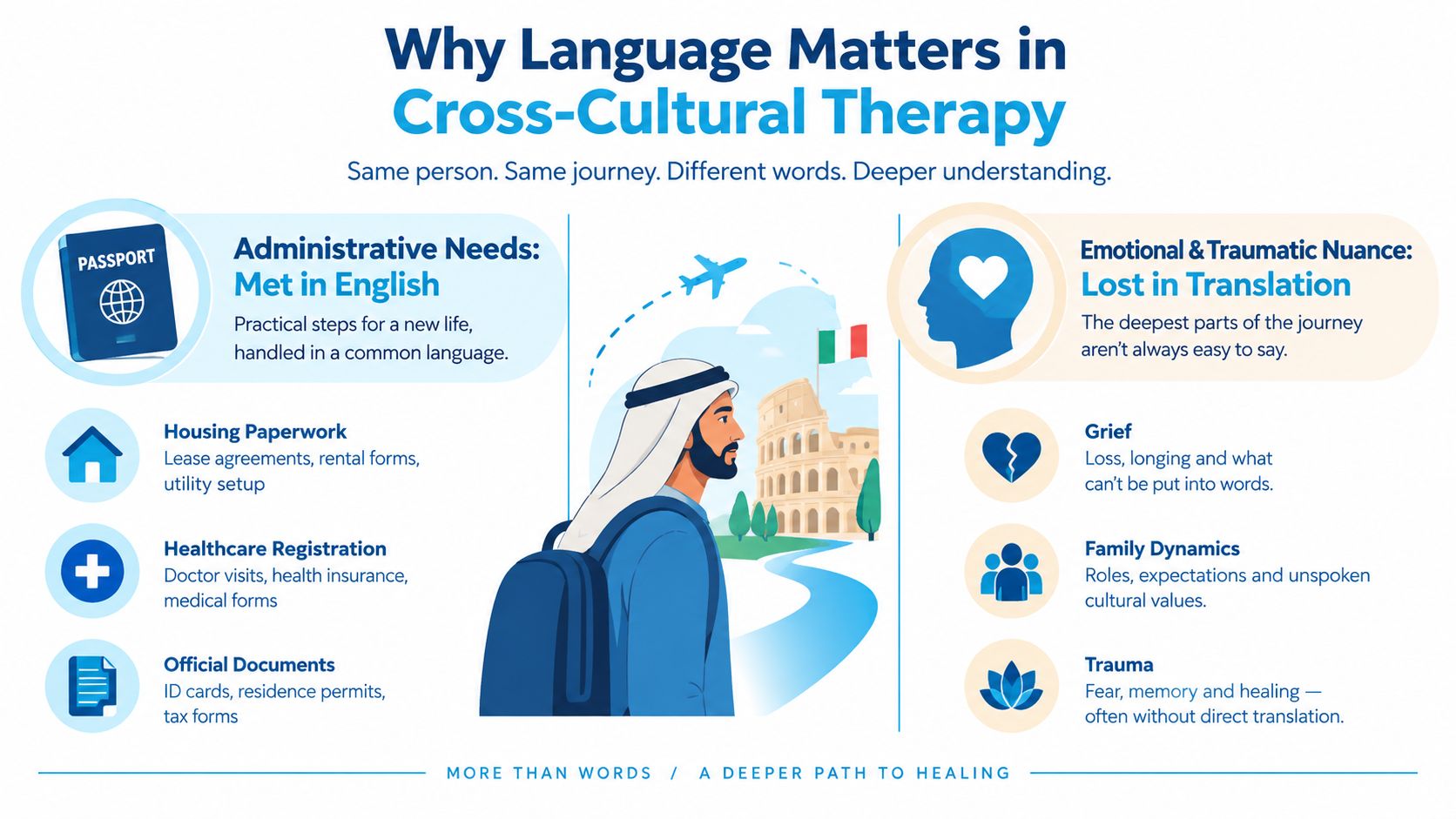
A person may complete housing forms, university paperwork, or a medical appointment in English, then find that therapy feels different. Discussing shame, loss, religious identity, family expectations, or a frightening memory requires more than functional vocabulary. It requires access to emotional meaning.
That's why language access in therapy is a clinical issue, not just a matter of comfort. A qualitative study of mental-health workers in Bologna, Emilia-Romagna, found that all 14 participating professionals had encountered language barriers while working with immigrants and refugees. The same research identified limited cultural knowledge, family support, and funding as additional barriers, with 12 participants highlighting the absence of dedicated mental-health funding for migrants and refugees (the Emilia-Romagna study on language barriers in mental-health care).
Does therapy in Arabic make emotional expression easier?
Therapy in a preferred language can reduce cognitive load and make emotional distinctions easier to communicate, especially during sensitive or complex conversations.
Speaking a second language often requires the client to translate internally before speaking. That extra step can interrupt emotional flow. A client might know the Italian word for sadness but still lack the language needed to explain whether the feeling is grief, humiliation, spiritual distress, homesickness, or emotional exhaustion.
Arabic itself also isn't a single clinical experience. A client may use Moroccan Arabic, Egyptian Arabic, Tunisian Arabic, Levantine Arabic, Modern Standard Arabic, Italian, English, or a combination of these. The therapist should ask which variety feels natural for everyday conversation and which language feels safest for discussing difficult topics.
Italy had 711,309 residents with citizenship from an Arab country in 2022, representing 14.1% of the country's foreign population. The largest communities were Moroccan citizens, numbering 420,172, Egyptian citizens, numbering 140,322, and Tunisian citizens, numbering 99,002 (the ISTAT-based demographic analysis). Citizenship doesn't define language ability, but the figures show why Arabic-language mental-health access matters in Italy.
Why is dialect competence important?
Dialect competence helps a therapist hear meaning, tone, and culturally specific expressions without treating one form of Arabic as interchangeable with another.
A client from Casablanca may describe distress differently from a client from Cairo or Tunis. Some clients may prefer a dialect for emotional work and Modern Standard Arabic for formal explanations. Others may switch to Italian when discussing work or education but return to Arabic when speaking about family.
A suitable therapist should ask directly:
- Preferred variety: Which Arabic dialect or language feels most natural?
- Clinical vocabulary: Are terms such as panic, dissociation, intrusive thoughts, or trauma understandable in that language?
- Mixed-language comfort: Is switching between Arabic, Italian, and English welcome?
- Cultural context: Can therapy explore religion, family roles, gender expectations, migration history, and discrimination without assumptions?
Learning Italian can still support daily independence and healthcare navigation., but language learning shouldn't be treated as a prerequisite for receiving therapy. Therapy in your native language can provide a more direct route into emotionally meaningful work.
How to Find an Arabic Speaking Therapist in Italy
Finding an Arabic-speaking therapist requires checking three separate forms of fit: professional qualification, linguistic compatibility, and intercultural experience.
Italy's Arabic-country population is concentrated in regions that include major economic and educational centres. Lombardy had 212,407 residents from Arab countries, Emilia-Romagna had 92,883, Piedmont had 69,456, Veneto had 56,321, and Lazio had 45,111 (the regional population analysis). Those figures can guide a search, but they don't tell a client whether a particular therapist understands their dialect or migration history.
What should an Arabic-speaking client check first?
Start by confirming the therapist's professional role, language availability, dialect familiarity, and experience with the client's concerns.
A general directory may list “Arabic” without explaining whether the therapist speaks Egyptian Arabic, Moroccan Arabic, Tunisian Arabic, Levantine Arabic, or Modern Standard Arabic. It may also omit whether the clinician has worked with migration-related stress, trauma, bicultural identity, religious concerns, or mixed-language couples.
A more reliable search process includes:
- Identify the emotional language. Decide whether Arabic, Italian, English, or a combination feels most useful.
- Ask about the dialect. Confirm that the therapist understands the client's preferred spoken variety.
- Check the clinical focus. Look for experience with anxiety, grief, trauma, relationships, burnout, identity, or adjustment.
- Clarify the format. Ask whether sessions are online, in person, or available in both forms.
- Use the first call to assess fit. Linguistic fluency is necessary, but it isn't sufficient.
Therapsy uses human matching by the Clinical Director rather than an algorithm, considers language and clinical needs, and offers therapy online and in person. Its network includes 50+ therapists and supports care in 14 languages, including Arabic, Italian, English, French, Spanish, German, Portuguese, Ukrainian, Russian, Greek, Urdu, Hebrew, Hindi, and Persian (Farsi). Clients can review how to find the right therapist for expats in Italy before arranging an initial conversation.
Universities, employers, community organisations, and public health services may also provide referrals. These routes can be useful, but the client should still verify dialect competence, confidentiality, fees, and whether the clinician offers direct Arabic communication rather than relying on informal interpretation.
Online vs In-Person Therapy for Arabic Speakers
Online therapy usually provides a wider choice of Arabic-speaking clinicians, while in-person therapy can offer the grounding experience of entering a dedicated clinical space.
For someone in Milan, Rome, Turin, Bologna, or another large city, in-person care may be practical if a suitable therapist is nearby. For someone living in a smaller town, working irregular hours, studying remotely, or concerned about being recognised in a local community, online therapy may make language matching and privacy easier.
Communication quality matters in both formats. A qualitative study involving volunteer doctors in two Milan outpatient clinics found that communication problems affected history-taking, the clinician-patient relationship, adherence, and potentially diagnosis. The study also noted that people without a valid residence permit may receive urgent and essential care through the STP temporary code, although this doesn't guarantee continuity of care (the Milan study on communication barriers in healthcare).
Which format is more suitable?
The better format is the one that preserves privacy, continuity, language access, and a workable therapeutic setting.
| Aspect | In-Person Therapy | Online Therapy |
|---|---|---|
| Language matching | Limited by the therapists available nearby | Offers access to a broader geographic pool |
| Privacy | Requires travelling to a clinic | Can work from a private room, if confidentiality is protected |
| Routine | Physical separation from home and work can support focus | Easier to maintain during travel, study, or demanding work |
| Cultural fit | May connect the client with local Arabic-speaking services | Makes dialect and clinical matching less dependent on city |
| Practical access | Useful for clients who prefer face-to-face contact | Useful for clients outside major cities or with mobility constraints |
| Pricing | Individual therapy starts from EUR 70, depending on the therapist | Individual therapy starts from EUR 70, depending on the therapist |
Online sessions work best when the client has a stable connection, a private space, headphones when appropriate, and a plan for what to do if the session is interrupted. In-person sessions may feel preferable for clients who find home associated with family demands, work, or constant distractions.
Therapsy offers both online and in-person sessions across 24 Italian cities and 90 physical locations. The online and in-person therapy guide for expats in Italy can help clients compare the practical differences without assuming that one format suits everyone.
What to Ask During Your Free Assessment Call
A useful assessment call should answer whether the therapist can communicate naturally with the client, understand the cultural context, and work safely with the presenting concern.
Therapsy's first assessment call is free and takes place with the therapist chosen for that person. The call isn't a commitment to continue. It gives the client space to test the match before discussing a longer treatment plan.
What questions should an Arabic-speaking client ask?
Ask about dialect, clinical experience, cultural assumptions, confidentiality, and how the therapist handles mixed-language conversations.
A client can use this sequence:
- “Which Arabic varieties do you speak comfortably?” This clarifies whether the therapist understands the client's dialect in ordinary and emotional conversation.
- “Can I switch between Arabic, Italian, and English?” Code-switching may be natural when a concept feels clearer in one language.
- “Have you worked with migration stress, bicultural identity, grief, or discrimination?” These experiences can shape symptoms and relationships without defining the client.
- “How do you include religion or spirituality if they matter to me?” The therapist should explore their relevance without imposing or dismissing them.
- “How do you adapt CBT, EMDR, Schema Therapy, or another approach across cultures?” A method should be explained in language and examples the client understands.
- “What happens if I need psychiatric or medical support?” Therapy doesn't replace medical care, and coordination may be appropriate.
Writing down concerns beforehand may help when anxiety, shame, or uncertainty makes the call harder.
The therapist should also explain confidentiality, session structure, fees, cancellation rules, emergency boundaries, and referral options. Clear explanations are especially important when the client is unfamiliar with Italian healthcare procedures or worries that seeking help could expose personal or immigration information.
The guide to talking to a therapist can help clients understand that they don't need a polished explanation of their difficulties. A few concrete examples of what has changed, what feels difficult, and what support is needed are enough to begin.
Practical rule: A good first call should leave the client feeling more informed, not pressured to prove that therapy is necessary.
Understanding Cultural Competence in Therapy
Cultural competence means understanding how language, family systems, migration, religion, identity, and social context shape distress and treatment, without reducing a person to their background.
A therapist may speak Arabic fluently and still miss the meaning of a client's experience. Cultural humility requires curiosity, self-reflection, and the willingness to ask rather than assume. It also means recognising that Arab clients don't share one culture, one family structure, one religious identity, or one relationship with Italy.

How do CBT and Schema Therapy adapt across cultures?
CBT becomes more useful when examples, beliefs, behavioural goals, and homework reflect the client's actual Italian and transnational life.
For example, a CBT exercise about setting boundaries may need to account for living with extended family, supporting relatives abroad, negotiating expectations with an Italian partner, or responding to community scrutiny. A therapist shouldn't assume that assertiveness has the same meaning in every family system.
Schema Therapy can help explore ingrained patterns involving shame, self-sacrifice, abandonment, mistrust, or unrelenting standards. The therapist must distinguish between a clinically harmful pattern and a culturally meaningful value. Respect for family isn't automatically people-pleasing, and religious commitment isn't automatically avoidance.
Cross-cultural psychology adds another layer by examining how migration, discrimination, acculturation, social position, and bicultural identity affect wellbeing. EMDR may be appropriate for some trauma presentations, but preparation, consent, stabilisation, and language clarity remain essential before processing distressing memories.
A systematic review identified 13 studies of culturally adapted CBT for Arabic-speaking populations and reported reductions in depression, anxiety, and PTSD symptoms, with particularly promising findings for internet-based delivery. The evidence was methodologically heterogeneous, digital interventions showed high attrition, and the studies often gave limited information about participants' countries of origin and migration histories, so these findings shouldn't be generalised to every Arabic-speaking client in Italy (the systematic review of culturally adapted CBT for Arabic-speaking populations).
What does cultural mediation look like in practice?
Cultural mediation means making language, meaning, consent, and treatment decisions understandable without asking the client to erase their identity.
In therapy, cultural mediation may involve:
- Clarifying meanings: Asking what a family, religious, or social concept means to this particular client.
- Checking language: Confirming that the client understands clinical terms, consent, risk questions, and homework.
- Avoiding stereotypes: Treating cultural identity as relevant context, not a diagnosis or fixed explanation.
- Holding complexity: Making room for both attachment to heritage and frustration with family or community expectations.
At Therapsy, human matching by the Clinical Director is intended to consider these dimensions alongside language and clinical needs. The service's culturally responsive therapy approach provides a useful reference for clients evaluating whether a therapist's understanding extends beyond vocabulary.
Getting Started with Your First Session
Starting therapy can be simple: share the need, discuss language and preferences, speak with the matched therapist during a free call, and decide whether the fit feels workable.
Therapsy's process begins with a form describing the client's concerns, preferred language, location, and session format. The Clinical Director then completes the matching process through a human conversation rather than an automated questionnaire.
What happens before the first full session?
The client explains what support is needed, checks the match, and receives practical information before deciding whether to continue.
A person might write that they want Arabic-language support for anxiety after relocation, grief following separation from family, relationship conflict in a bicultural partnership, or trauma connected to migration. The description doesn't need to contain a diagnosis. Therapy should begin with exploration, not self-diagnosis.
The network offers online and in-person care, and its stated services include individual therapy from EUR 70, couple therapy from EUR 100, psychodiagnostic assessment from EUR 255 for three sessions, and psychiatric consultation from EUR 110. The first assessment call is free, and there's no obligation to continue after it.
A client can use the call to notice whether the therapist listens carefully, welcomes questions, understands the preferred dialect, and explains the next steps clearly. If the fit isn't right, requesting a different match is a reasonable part of finding appropriate care.
Therapsy supports care in 14 languages, including Arabic, and combines human matching by the Clinical Director with the choice of online or in-person sessions. That combination matters for Arabic-speaking clients because language access, cultural fit, and geographic convenience often need to be considered together.
Frequently Asked Questions
Can I speak Arabic in therapy if I understand Italian?
Yes. Understanding Italian for work or administration doesn't mean Italian is the best language for emotional therapy. Clients can ask to use Arabic for sensitive topics and switch between languages when a particular word or experience feels clearer in Italian or English.
Does an Arabic-speaking therapist need to speak my dialect?
Dialect matching can improve clarity and comfort, but it isn't the only measure of fit. The therapist should state which varieties they understand and discuss how they will clarify unfamiliar expressions rather than pretending that all Arabic is the same.
What if no Arabic-speaking therapist is available?
A trained professional interpreter may provide language mediation, but informal interpretation by a child, partner, or acquaintance shouldn't be used for therapy. Best practice includes a pre-session briefing, direct speech to the client, short segments, teach-back for consent and risk questions, and documentation of unresolved ambiguities.
Can therapy explore religion and family expectations?
Yes, if those topics matter to the client. A culturally responsive therapist asks how religion, spirituality, family roles, gender expectations, honour, community perception, or migration history affect the client personally, without assuming that any one interpretation applies to every Arabic-speaking person.
Can undocumented migrants seek mental-health support in Italy?
European migration research reports that Italian mental-health services are directly accessible and open to migrants regardless of status, although waiting lists, language barriers, and lack of information remain common obstacles across EU countries (the European migration research on mental-health access in Italy). Clients should ask each service about confidentiality, eligibility, fees, and continuity of care.
Is online therapy confidential?
Online therapy should take place in a private setting using a secure clinical process. Clients should use headphones when appropriate, check who can hear them, and tell the therapist if another person enters the room. The therapist should explain confidentiality and its limits before treatment begins.
Does therapy replace psychiatric or medical care?
No. Therapy can support emotional and psychological wellbeing, but it doesn't replace medical assessment, psychiatric consultation, emergency care, or prescribed treatment when those are needed. A therapist should discuss referral or coordination with other professionals when the client's needs extend beyond therapy.
A first call with Therapsy is free and takes place with the therapist chosen for that person. There's no obligation to continue, so an Arabic-speaking client can use the conversation to assess language, dialect, cultural understanding, format, and comfort before making a decision.
Therapsy connects Arabic-speaking clients in Italy with therapists selected through human matching by the Clinical Director, with therapy available in the client's language online or in person. Visit Therapsy to request a free first call with the therapist chosen for that person, with no obligation to continue.

