Moving to a new country like Italy is an incredible adventure, a chance for genuine growth and discovery. But alongside the excitement, it’s not uncommon to feel a persistent sense of worry or unease. That feeling is anxiety, and it’s a very common—yet deeply challenging—experience for expats, international students, and young adults trying to find their way in an intercultural context.
Problem: Adapting to Italian life can trigger persistent anxiety, affecting your well-being and ability to thrive. This isn’t just fleeting worry; it’s a feeling that can interfere with daily life, work, and relationships.
This article is designed to be your supportive guide—to bring clarity to what anxiety is, why it’s happening in the specific context of living abroad in Italy, and what you can actually do to find your footing again.
The Expat Experience and The Rise of Anxiety

Living abroad, especially somewhere with a culture as rich and distinct as Italy, is a profound life change. You’re essentially building a new life from scratch—navigating a different language, figuring out new social rules, and trying to create a support system. That’s emotionally and mentally taxing.
Insight: Anxiety in expats is not a sign of weakness. It is a predictable psychological response to the immense and constant pressure of adapting to a new culture, language, and social environment.
For many, this adjustment period can trigger anxiety or make existing feelings much more intense. The constant, low-level stress of decoding unfamiliar situations, from ordering a coffee to dealing with Italian bureaucracy, can build up over time. This is a shared experience in the international community, and simply acknowledging it is the first step toward managing it.
Understanding Anxiety in the Italian Context
In Italy, a country celebrated for its vibrant and social lifestyle, anxiety has become a surprisingly common mental health issue for locals and newcomers alike. Recent data shows just how widespread the challenge is.
According to studies adapted for European contexts, approximately 4.8% of the Italian population—that’s nearly 2.9 million people—grappled with anxiety disorders in recent years. This figure marks a clear increase from pre-pandemic levels, which were closer to 4.2%. Learn more about these mental health findings.
For expats and international students, these figures often reflect a reality that feels even more amplified. The feeling of being an outsider, language barriers, and the distance from your established support networks can create a perfect storm for anxiety to take hold. You can explore more about the specific mental health challenges for expats in our related guide.
Quick Overview of Anxiety Triggers for Expats in Italy
The constant pressure of adapting can come from all directions. These stressors often fall into a few common categories:
- Social & Cultural: Feeling isolated or lonely; struggling to form deep friendships; misunderstanding social cues or etiquette; feeling like a perpetual outsider.
- Language & Communication: Difficulty expressing yourself; frustration with not being understood; anxiety around phone calls, appointments, or simple errands.
- Logistical & Bureaucratic: Navigating the Permesso di Soggiorno process; dealing with housing contracts, utilities, or the healthcare system (Tessera Sanitaria).
- Personal & Professional: Work or study pressure in a new environment; financial stress; homesickness and missing family and friends back home.
Seeing these triggers laid out can help normalise your experience. It’s a lot to handle, and it makes sense that you might feel overwhelmed.
Solution: Therapsy provides a crucial bridge for the international community in Italy. We offer accessible, multilingual psychotherapy with licensed professionals who understand the unique challenges of expat life. Our goal is to provide a safe space where you feel understood and empowered to find your balance again.
Recognising The Physical and Emotional Signs of Anxiety
Anxiety is far more than just a feeling of worry. It is a full-body experience that manifests in physical, emotional, and cognitive ways. Learning to recognise these signs is the first step toward understanding what you’re going through and finding the right support.
Insight: For expats in Italy, the symptoms of anxiety can be particularly confusing. They are often mistaken for simple stress or the expected difficulties of adjusting to a new life, delaying the search for effective support.
When anxiety takes hold, it’s like your body’s internal alarm system has become overly sensitive. It starts reacting to perceived threats—like navigating a crowded market or making a phone call in Italian—as if they were life-or-death situations. This triggers a wave of physical and mental responses that can be utterly exhausting.
The Physical Sensations of Anxiety
Often, your body is the first to tell you that anxiety is building. These physical symptoms are the direct result of the “fight or flight” response, your body’s ancient mechanism for preparing to face a threat. Even if the “threat” is just a persistent worry, the physical reaction is very real.
Common physical signs you might notice include:
- A racing or pounding heart
- Shortness of breath or a choking feeling
- Chest tightness or pain, which is often a source of great concern. You might find our guide on the link between anxiety and chest pain helpful.
- Dizziness or light-headedness
- Shaking, trembling, or muscle tension
- Upset stomach, nausea, or digestive issues
Emotional and Cognitive Symptoms
Beyond the purely physical, anxiety has a profound effect on your thoughts and feelings. It can color your entire perspective, making the world seem like a more dangerous and unpredictable place.
- Emotional Signs: This can look like constant, uncontrollable worry, a persistent feeling of being on edge or restless, irritability, and a vague but powerful sense of impending doom.
- Cognitive Signs: This often involves racing thoughts you can’t seem to turn off, difficulty concentrating or focusing (often called “brain fog”), and getting stuck fixating on worst-case scenarios.
Anxiety is not a personal weakness or a flaw in your character. It is a treatable medical condition, much like asthma or diabetes, that stems from a mix of biological, psychological, and environmental factors. Recognising its signs is an act of self-awareness and strength.
Common Anxiety Disorders for Expats in Italy
While feeling anxious is a normal part of life, these feelings can sometimes intensify and develop into specific, diagnosable conditions. The unique pressures of living abroad can often act as a catalyst.
- Generalised Anxiety Disorder (GAD): This is defined by persistent and excessive worry about a whole host of things, from health and money to minor daily tasks. For an expat, this can be constantly fueled by the uncertainty of life in a new country—things like visa renewals, job security, or figuring out the healthcare system.
- Social Anxiety Disorder: This involves an intense fear of being judged, scrutinised, or embarrassed in social situations. Living in Italy, this can be amplified by language barriers, making you feel self-conscious when trying to speak Italian, or by a deep-seated fear of accidentally breaking unspoken social rules.
- Panic Disorder: This involves recurrent, unexpected panic attacks—sudden, overwhelming episodes of intense fear that come with severe physical symptoms. The fear of having another attack can cause people to start avoiding places or situations, which can severely shrink their world and limit their life.
Why Living Abroad Can Trigger Anxiety
It’s one thing to recognise the signs of anxiety, but it’s far more powerful to understand why those feelings are surfacing in the first place. If you’re an expat or international student in Italy, your anxiety isn’t just a random event. It’s a completely normal psychological response to the unique and intense pressures of living abroad.
Problem: Your brain isn’t broken; it’s simply reacting to a new, and often overwhelming, world. Think of your brain’s threat response system as a sensitive smoke alarm. Back home, it was perfectly calibrated. Now, in a new culture, it goes off for non-threatening situations, like making small talk in Italian. This state of constant high alert is exhausting and a primary reason why anxiety takes root.
The Weight of Cultural Adaptation
Adapting to a new culture is so much more than learning the language. It’s a deep, psychological process that can put you under incredible mental and emotional strain. Experts call this phenomenon acculturative stress.
Insight: Acculturative stress is the persistent, low-level cognitive work required just to operate in a world where the unwritten rules have all changed. Every small interaction requires draining mental effort, from translating conversations in real-time to second-guessing your own behavior. This can lead to chronic stress, creating the perfect conditions for a more persistent anxiety disorder to develop.
This stress doesn’t just stay in your head. As the infographic below shows, the brain’s response can manifest across different symptom categories, creating a ripple effect.
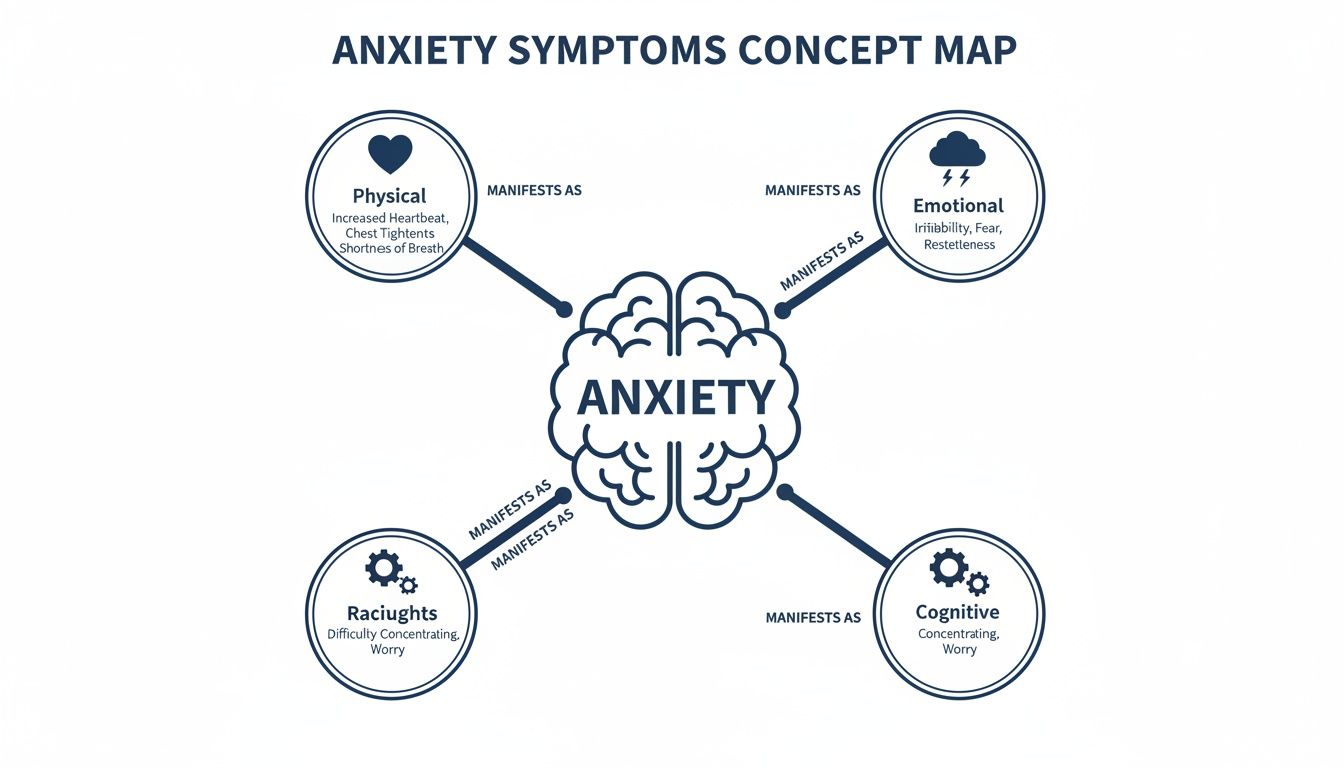
This visual highlights how interconnected anxiety is, showing how the cognitive strain from cultural adjustment can directly set off both physical and emotional responses.
Common Triggers for Expat Anxiety in Italy
Beyond the general stress of adapting to a new culture, several factors specific to life in Italy can dial up feelings of anxiety.
- Identity Crisis and Loneliness: When you move away from everything that’s familiar, you also leave behind the roles and relationships that once defined you. This can trigger a profound sense of, “Who am I now?” This identity crisis, combined with the real difficulty of forming deep, meaningful connections in a new place, frequently leads to intense loneliness and isolation—two powerful triggers for anxiety.
- Academic and Professional Pressure: For international students, the pressure to succeed is often enormous. Recent data from university health surveys reveals that international students in Italy carry a much higher anxiety burden than their local counterparts. The numbers show that 8.3% report clinically significant symptoms, a rate 2.1 times higher than Italian students (3.9%). This anxiety often spikes during the autumn semester, when academic demands collide with visa worries and social isolation. If this is something you’re going through, you might find our guide on exam stress among international students in Italy helpful.
- The Stress of Italian Bureaucracy: Anyone who has tried to navigate the infamous Italian bureaucracy knows how stressful it can be. From securing the Permesso di Soggiorno to opening a bank account, the process can be a true test of patience. Vague instructions, language barriers, and endless waiting often create a sense of powerlessness and deep uncertainty, which are direct fuel for an anxious mind.
Proven Therapeutic Approaches for Managing Anxiety
Realising your anxiety is more than just ‘stress’ is the first big step. The next is knowing you don’t have to face it alone. Professional therapy provides structured, evidence-based ways to manage anxiety and regain control.
Solution: Therapsy connects you with licensed psychologists skilled in a range of proven methods. We focus on matching you with a therapist who specialises in the right approach for you, making sure your journey to feeling better is both personal and effective.
Cognitive Behavioural Therapy (CBT)
Cognitive Behavioural Therapy (CBT) is a cornerstone of modern anxiety treatment. It is practical and effective.
Insight: CBT is built on the idea that our thoughts, feelings, and actions are all connected. By changing unhelpful thought patterns, you can change how you feel and what you do.
CBT is a hands-on, goal-oriented therapy. Your therapist helps you identify and challenge the automatic negative thoughts that fuel your anxiety. For an expat, a thought like, “If I stumble over my Italian, everyone here will think I’m an idiot,” can be reframed into something more realistic, like, “Learning a language is tough. People will see I’m making an effort.” You can dive deeper into this process in our comprehensive guide to Cognitive Behavioural Therapy.
Acceptance and Commitment Therapy (ACT)
Acceptance and Commitment Therapy (ACT) is another incredibly effective approach. Where CBT focuses on changing thoughts, ACT teaches you to change your relationship with them.
Insight: ACT helps you accept difficult feelings, like anxiety, without letting them control your life. You learn to notice anxiety without immediately fighting it, allowing you to take meaningful action based on your values, even when anxiety is present.
With ACT, you learn to observe your thoughts from a distance instead of getting tangled up in them. The “commitment” piece is about figuring out what truly matters to you—your core values—and taking steps toward them. It’s about building a rich, fulfilling life alongside your uncomfortable feelings.
Comparing Therapeutic Approaches for Anxiety
Understanding the differences between these therapies can help you feel more confident in choosing a path. Here’s a simple breakdown of the main approaches we use at Therapsy:
- Cognitive Behavioural Therapy (CBT): Best for individuals who want a structured, goal-oriented approach to challenge specific negative thoughts.
- Acceptance and Commitment Therapy (ACT): Ideal for people who feel “stuck” fighting their anxiety and want to build a meaningful life despite it.
- Integrated Care (Therapy + Medication): Suitable for those whose anxiety is so intense it interferes with daily functioning and the ability to engage in therapy.
Often, our therapists integrate elements from different approaches to create a plan that’s tailored just for you.
Integrated Psychiatric Care and Medication
For many, talk therapy is all that’s needed. For others, especially when symptoms are severe, combining therapy with medication can be the most helpful route.
Solution: At Therapsy, we offer a truly integrated pathway. If you and your psychologist feel that medication might be a useful tool, we can seamlessly arrange a consultation with one of our trusted psychiatrists. A psychiatrist can evaluate whether medication like Propranolol for anxiety could help reduce your symptoms, making it easier for you to dive into the work of therapy. This joined-up approach means all aspects of your care are coordinated under one roof.
Self-Help Strategies You Can Use Today

While therapy is the most effective long-term solution for persistent anxiety, you can start using practical strategies right now to manage symptoms and build stability.
Insight: Think of these techniques not as a cure, but as anchors in a storm. They are tools you can use to keep yourself steady when the waves of anxiety feel overwhelming.
Grounding Techniques for Moments of Panic
When anxiety spikes, grounding techniques can pull you back into the present moment. One of the simplest and most effective is the 5-4-3-2-1 technique.
Gently notice:
- 5 things you can see
- 4 things you can feel
- 3 things you can hear
- 2 things you can smell
- 1 thing you can taste
This exercise forces your brain to shift its focus from the whirlwind of panic to your immediate sensory experience, interrupting the cycle of racing thoughts.
Mindfulness and Breathing to Calm Your Mind
Mindfulness is the practice of observing your thoughts with gentle curiosity, without getting swept away by them. When paired with deep breathing, it can quickly calm your body’s physical stress response. A simple yet powerful exercise is Box Breathing:
- Breathe in slowly through your nose for a count of four.
- Gently hold your breath for a count of four.
- Breathe out slowly through your mouth for a count of four.
- Pause and hold your breath for another count of four.
- Repeat this cycle until you feel your heart rate begin to slow.
Self-help strategies are a powerful complement to professional therapy, not a replacement for it. When anxiety is persistent, these techniques are most effective when used alongside the guidance of a licensed therapist.
Building Stability in Your Expat Life
For expats in Italy, the uncertainty of a new environment can be a major source of anxiety. Creating a sense of routine and predictability is a powerful antidote. For those looking for actionable steps you can take on your own, consider learning effective ways for how to reduce anxiety naturally.
Here are a few strategies specifically for the expat experience:
- Establish a Simple Routine: Even small, consistent rituals can create an anchor for your day, like a morning coffee at the same café.
- Practice Italian in Low-Pressure Situations: Small, successful interactions build confidence and can ease social anxiety.
- Find Your Community: Focus on finding one or two people you can connect with through an expat group, a language exchange, or a hobby class.
- Schedule Regular Calls Home: Set aside dedicated time to connect with loved ones. Having that connection to look forward to can be a comforting buffer against loneliness.
How to Get Professional Support with Therapsy
Self-help strategies can offer real relief, but recognising when you need more support is an act of strength. If anxiety is consistently getting in the way of your life in Italy, it’s time to reach out.
Problem: For expats, finding the right support can feel like another overwhelming task. Language barriers, cultural differences, and logistical hurdles often prevent people from getting the help they need.
This is exactly where Therapsy comes in. We built our service specifically to remove these barriers for the international community.
When to Seek Help for Anxiety
It might be time to consider support if you notice any of the following:
- Your feelings of anxiety are persistent and have lasted for several weeks or months.
- The worry feels uncontrollable or out of proportion to the situation.
- You’ve started avoiding social events, places, or responsibilities.
- Physical symptoms like a racing heart, stomach problems, or constant tension are causing significant distress.
- Your sleep, appetite, or ability to focus have been consistently disrupted.
Insight: In Italy’s major cities, recent surveys found that 7.2% of working-age adults meet the criteria for generalised anxiety disorder (GAD). Yet, only about 32% of them are receiving treatment. You can read the full research about these local findings, which underscore the urgent need for more accessible services like Therapsy.
Your First Step: A Human Conversation
At Therapsy, we believe the path to feeling better should start with a genuine human connection. That’s why your journey with us begins with a free first assessment call with our Clinical Director.
Solution: Our free assessment call is a confidential, no-obligation conversation designed to understand you and your challenges. Based on this call, we personally match you with a licensed psychologist on our team who has the right expertise, therapeutic style, and language to support you. It is a risk-free, supportive space to gain clarity from the very beginning.
Therapy That Speaks Your Language
For therapy to be effective, you need to express yourself fully without language barriers.
Solution: Therapsy offers sessions in over 10 languages, including English, Italian, French, Spanish, and German. Our carefully selected, multilingual therapists ensure you can explore your thoughts and feelings in the language that feels most natural to you. We offer flexible online psychotherapy sessions or in-person meetings in major Italian cities, bridging the gap between your life in Italy and global standards of mental health support.
Reaching out is a sign of resilience, and we’re here to guide you toward finding your balance again.
Frequently Asked Questions (FAQs)
Is my anxiety just culture shock or something more serious?
Culture shock and anxiety can feel very similar. Culture shock is typically a temporary adjustment phase, while anxiety is a more persistent condition where feelings of dread and worry interfere with your daily life. If your feelings don’t fade and consistently impact your work, studies, or relationships, it’s a strong sign it’s more than culture shock and worth exploring with a professional.
How do I find an English-speaking therapist in Italy?
Therapsy was created to solve this exact problem. We are a leading psychotherapy service in Italy for the international community. All our therapists are licensed, carefully selected, and offer sessions in English and over 10 other languages. Your journey starts with a free assessment call in English where we match you with the right professional for you.
What if I can’t afford therapy?
We are committed to making mental healthcare accessible. Our sessions are competitively priced, and your journey with us starts with a completely free, no-obligation first assessment call. This allows you to understand our process and see if it’s the right fit without any financial pressure.
Do I need a formal diagnosis to start therapy?
No, you do not need a formal diagnosis. Many people seek therapy to manage stress, navigate life transitions, or simply have a confidential space to talk. Our focus is on you and your well-being, not on a label. Our free assessment is a human conversation about what’s on your mind.