You can love Bergamo and still feel lost in it.
That tension is common. A move that looks beautiful from the outside can feel disorienting from the inside. You may be managing work in a second language, missing home at odd hours, trying to decode Italian bureaucracy, and wondering whether searching for an English-speaking therapist in Bergamo is even realistic.
For many expats, the problem isn't deciding to get support. The problem is finding support that feels fluent, culturally aware, and available without weeks of confusion. In smaller cities, therapy access often exists on paper long before it feels accessible in real life. When you're anxious, isolated, burned out, or stuck in culture shock, that gap matters.
The Challenge of Finding Mental Health Support in Bergamo

Bergamo is often easier to move to than to settle into emotionally. Many expats arrive for a partner, a degree, a short-term contract, or a role near Milan. The practical side starts immediately. So does the emotional cost.
A typical week can look functional from the outside and exhausting from the inside. You go to class or work, answer messages from home, try to understand local systems, and tell yourself you'll adjust soon. Then a small problem lands badly. A visa issue, a landlord conversation, a difficult school meeting, or a conflict with a partner suddenly feels much bigger than it should.
That doesn't mean you're failing to adapt. It usually means you're carrying too much without enough support.
Why Bergamo feels different from a major international city
In a large global city, it's often easier to find an established pool of clinicians who regularly work with expats. Bergamo doesn't always offer that same immediate visibility. You may find providers, but not necessarily someone who works comfortably in English, understands intercultural stress, and has room for new clients.
Italy has over 40,000 qualified psychotherapists, but finding a native or fluent English-speaking professional in regional hubs like Bergamo is a major obstacle. This linguistic gap means expats often turn to specialized multinational services offering support in up to 14 languages to bridge the divide between local availability and their need for care (peer-reviewed research on psychotherapy access in Italy).
The challenge is not only language. It's also emotional precision. Many people can manage everyday Italian or conversational English, but therapy asks for more. You need words for shame, grief, resentment, panic, homesickness, identity strain, and relationship fatigue. Those are hard enough to say in your first language.
What often brings expats to therapy in Bergamo
The most common reasons are rarely dramatic at first. They build slowly.
- Culture shock: The early excitement fades and daily life becomes heavier.
- Isolation: Friendly contact isn't the same as feeling known.
- Burnout: Work, relocation, and administrative stress pile up together.
- Relationship strain: Moving countries changes roles, dependence, and conflict patterns.
- Identity loss: You may feel less competent, less expressive, or less like yourself.
From a cross-cultural psychology perspective, this makes sense. A relocation can unsettle routines, attachment bonds, and self-image all at once. CBT helps many expats notice the thought loops that grow around uncertainty. Schema Therapy can be useful when the move activates older patterns like abandonment, perfectionism, or not feeling good enough. When trauma is part of the story, EMDR may also be relevant.
The practical truth
When seeking support in English late at night, you're not overreacting. You're responding to a real access problem.
Therapy for expats in Bergamo isn't only about finding any therapist. It's about finding someone you can understand quickly, trust gradually, and speak to without translating yourself.
Where to Start Your Search for a Therapist
When you're already overwhelmed, a messy search process can stop you before therapy even starts. The easiest way to make this manageable is to sort your options into categories instead of opening endless tabs.
Three places most people start
International directories
These can be useful because they give you breadth. You may see therapists who list English, online sessions, or work with expats.
The downside is that directories usually leave the hard part to you. You still need to figure out:
- Who is fluent enough for therapy
- Who understands intercultural adjustment
- Who is licensed and currently available
- Who works with your specific concern, such as panic, trauma, burnout, or couples work
That can be tiring when you're already low on energy.
Local Italian listings
These may show clinicians physically based in or near Bergamo. If your Italian is strong, this can widen your choices.
For many new arrivals, though, local listings create friction. Profiles may be brief, terminology may be unfamiliar, and it isn't always easy to tell whether a therapist can work naturally in English or accepts English-speaking clients. That's an important difference.
Specialized multilingual services
This route is often the most practical when language, culture, and fit all matter. Instead of starting with a huge pool and doing all the filtering yourself, you begin with a service built for international residents.
A helpful starting point is this guide on finding the right therapist for expats in Italy, which explains what to screen for before you book.
What works and what tends to waste time
A focused search usually works better than a broad one. Start with your real needs, not with the first profile that appears.
Ask yourself:
- Do I need someone fluent in English, or do I need native-level emotional nuance?
- Do I want support for anxiety, trauma, burnout, relationship conflict, or adjustment?
- Do I need online flexibility, or am I set on in-person work?
- Do I want a therapist who understands expat life, not just general therapy?
Practical rule: If a search process makes you do all the matching alone, expect more trial and error.
One option in this category is Therapsy, which offers multilingual psychotherapy in Italy with human matching by a Clinical Director rather than automated questionnaires. For many expats, that reduces the stress of guessing which therapist might be the right fit.
A simple search strategy
- Start narrow: Search by language, problem, and preferred format first.
- Check for intercultural experience: This matters if your distress is tied to relocation, mixed identities, or cross-cultural relationships.
- Avoid urgency-based booking: The first available slot isn't always the best fit.
- Look for a real matching process: Good matching saves emotional energy.
The best search isn't the widest. It's the one that gets you to a therapist you can talk to.
In-Person vs Online Therapy for Expats in Bergamo
For someone living in Bergamo, this is often the key decision. Not in theory. In practice.
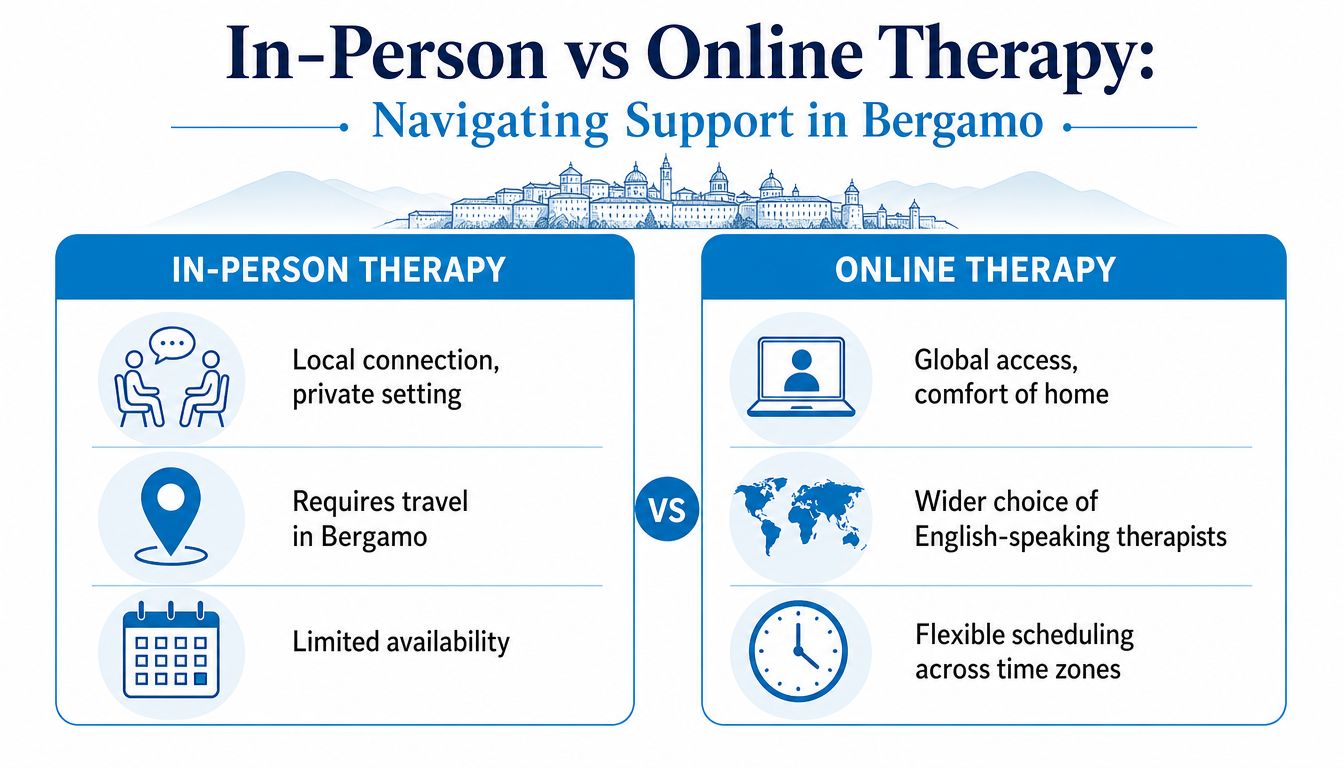
Some people imagine online therapy as a backup plan. In a smaller city, that usually isn't the right frame. Online care often gives you access to the therapist you need, rather than the only one who happens to be nearby.
A side-by-side view
| Format | What helps | What can be limiting |
|---|---|---|
| In-person therapy | Dedicated physical space, embodied presence, local routine | Smaller pool, less choice in fluent English, more travel and scheduling constraints |
| Online therapy | Wider access to English-speaking therapists, more flexibility, easier continuity during travel | Requires privacy at home and some comfort with video sessions |
When in-person makes sense
In-person sessions can feel grounding. Some people focus better in a room that's set apart from daily life. If you're craving a structured weekly ritual outside your apartment, that matters.
In-person care may also appeal if you feel digitally saturated already. After a full day on screens, you might want a human encounter that feels more tangible.
But in Bergamo, the trade-off is usually narrower choice. You may find yourself choosing between proximity and fit. That's not ideal when the quality of communication is central to the work.
Why online is often the stronger option here
For expats in Bergamo, online therapy usually improves three things at once:
- Language fit: You can look for fluent or native English, not just basic conversational ability.
- Clinical fit: You can search for someone who works with your actual issue.
- Life fit: Sessions can fit around travel, commuting, university schedules, and international work hours.
A deeper explanation of that trade-off appears in this overview of online vs in-person therapy in Italy for expats.
If privacy is what worries you, take that concern seriously. Therapy should feel confidential and emotionally contained.
Online therapy for expats in Bergamo isn't a lesser version of therapy. It's often the route that gives you the best linguistic, cultural, and therapeutic match.
A useful decision test
Choose in-person if the room itself is the main thing you need.
Choose online if the therapist's language, method, and intercultural understanding matter more than the room.
For most expats in Bergamo, the second question ends up carrying more weight.
Choosing the Right Therapist and Therapeutic Approach
Finding a therapist is one decision. Choosing the right one is another.
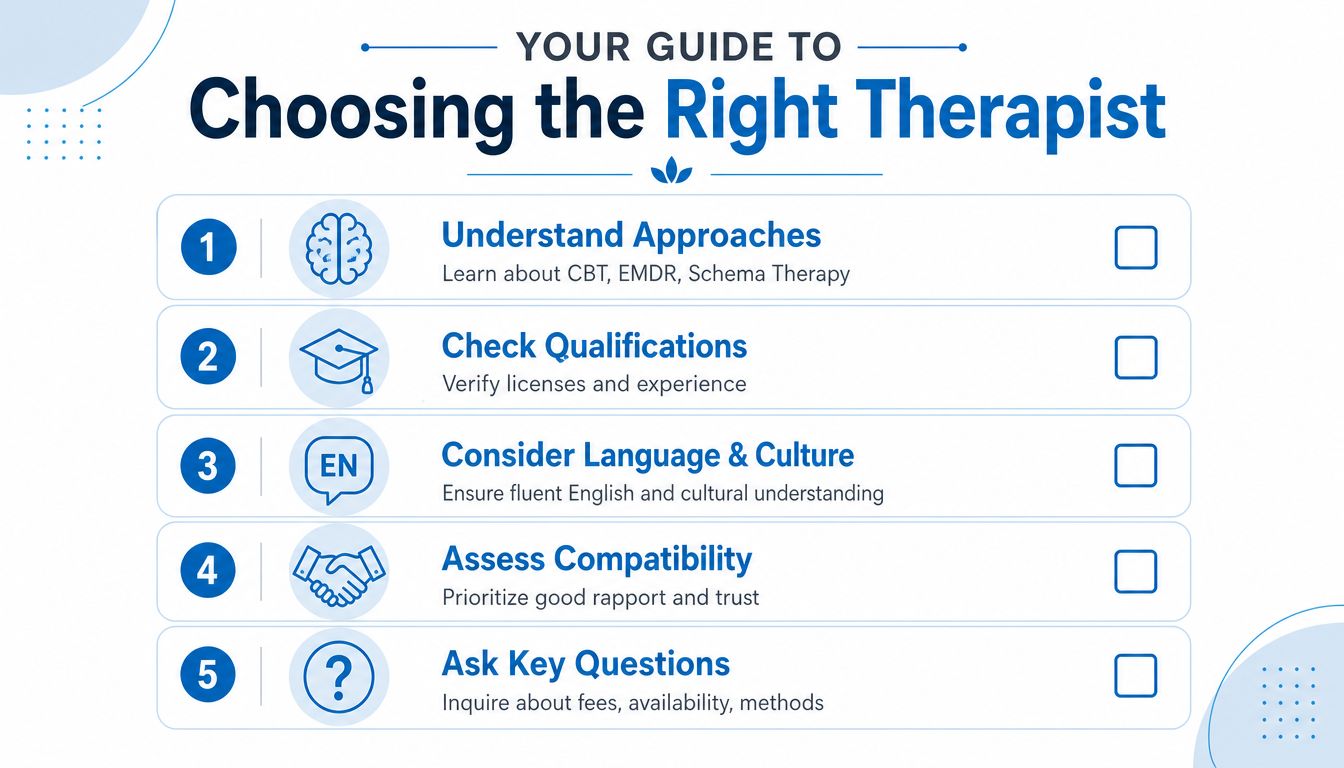
People often try to solve this by looking for the "best" method. That's understandable, but it's too simple. A good therapeutic approach matters. The relationship with the therapist matters just as much.
What the main approaches actually mean
CBT
Cognitive Behavioural Therapy helps you notice links between thoughts, feelings, and actions. It's often useful for anxiety, panic, overthinking, perfectionism, and adjustment stress. If your mind keeps predicting disaster or replaying mistakes, CBT gives structure.
EMDR
EMDR is often used when distress is tied to trauma or experiences that still feel emotionally unfinished. Some expats seek it after relocation shocks, medical events, difficult breakups, or older trauma that becomes more active during a major life transition.
Schema Therapy
Schema Therapy looks at long-standing emotional patterns. These may include fear of abandonment, self-criticism, mistrust, or feeling that you must always perform. A move abroad can intensify these patterns because familiar supports disappear.
These models don't compete with each other in a simple way. A skilled clinician chooses an approach based on your history, goals, and emotional style. If you want a plain-language explainer for the wider lens therapists often use, this introduction to understanding the biopsychosocial framework is a helpful companion.
The relationship matters more than most people expect
Research indicates that people experience better therapeutic outcomes when the relationship with their therapist is strong. It's important to know that building this necessary trust typically takes about 3 to 4 sessions, so the initial meetings are about finding the right fit.
That point reassures many expats. If the first session feels tentative, that doesn't mean therapy isn't working. Early sessions are often about safety, rhythm, and whether you feel understood.
What to look for beyond credentials
- Fluent communication: You shouldn't have to simplify your inner life.
- Cultural understanding: They don't need your exact background, but they should understand migration stress.
- Method clarity: A good therapist can explain how they work in plain language.
- Emotional fit: You feel respected, not managed.
If choosing feels paralyzing, a human matching process can help. That is especially useful when you're balancing several factors at once, such as language, trauma history, scheduling, and whether you want individual, couple, or family support.
Navigating Costs Insurance and Payments
Money is one of the most common reasons people delay therapy. Not because they don't value it, but because the path to paying for it in Italy can feel unclear.
The private cost range in Italy
The cost for a private therapy session in Italy generally ranges from €50 to €150. While some expats attempt to use the public health system (SSN), navigating it in English for mental health referrals is a significant bureaucratic challenge, making specialized private services a more direct and accessible route for care.
That range helps you orient yourself. It also explains why pricing questions matter so much when you're comparing services.
If you want a breakdown of how pricing works in practice, this page on how much therapy costs in Italy is a useful reference point.
Private care versus the SSN
The Italian public system can be valuable, but for expats seeking therapy in English, it often creates practical obstacles.
Common difficulties include:
- Language barriers: The system may be navigable in Italian but harder in English.
- Referral complexity: Even knowing where to begin can be confusing.
- Uncertain language access: Public access doesn't automatically mean English-speaking availability.
- Pace: When you're struggling now, a complicated route can feel discouraging.
This doesn't mean the SSN is impossible. It means many expats find it hard to use specifically for English-speaking mental health care.
How to think about insurance
If you have international private insurance, don't assume coverage and don't assume exclusion. Check directly.
A useful checklist:
- Ask whether outpatient psychotherapy is included.
- Ask whether you need a referral or pre-authorization.
- Ask whether online sessions are reimbursable.
- Ask what documentation is required for reimbursement.
- Ask whether the provider must meet any registration criteria.
Keeping the process manageable
Financial uncertainty becomes less stressful when you separate the questions.
One question is clinical: who is the right therapist for me?
The second is administrative: can I use insurance, tax deduction, or private payment for this?
Don't let the second question block the first entirely. Many people get stuck because they try to solve every reimbursement detail before they even know what kind of support they need. Often it's better to identify the right care path first, then verify the payment route.
What to Expect From Your First Therapy Session
Starting therapy often feels bigger before the first session than during it.
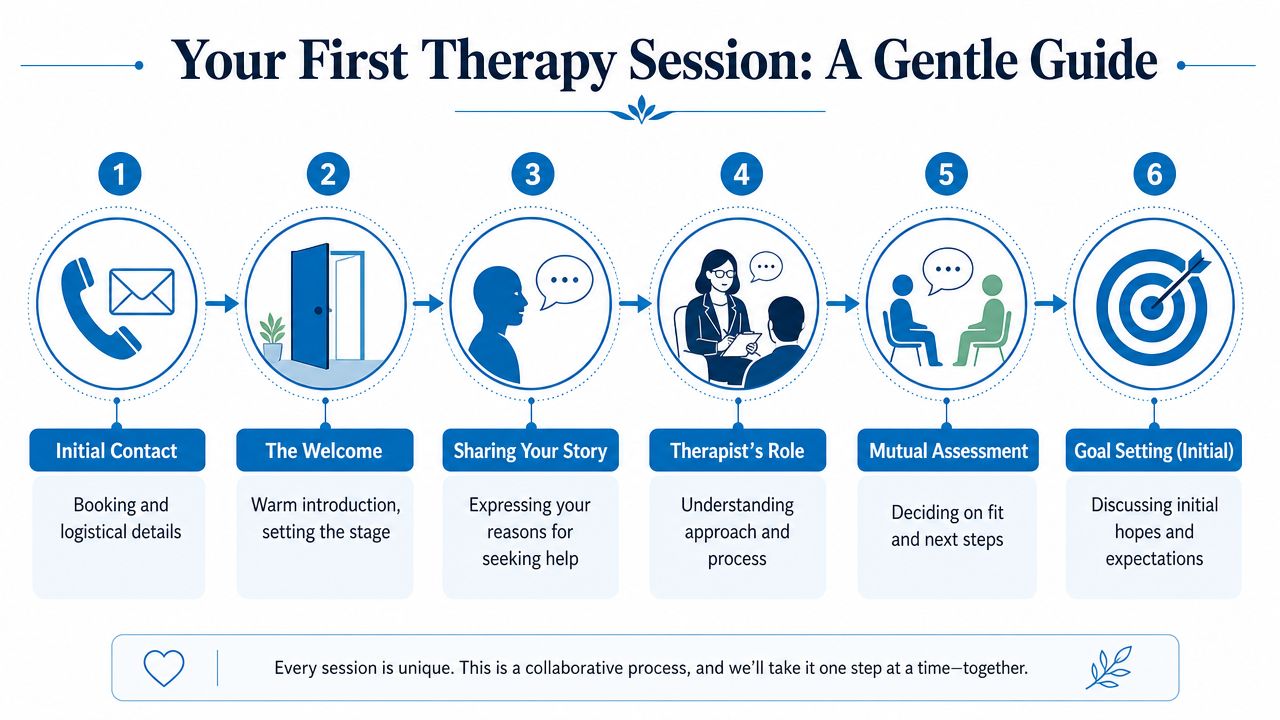
Most first sessions are not intense interrogations. They're structured conversations. The therapist is listening for what brought you here, what feels hard right now, what you've already tried, and what kind of support might help.
You don't need a perfect summary of your life. You don't need to tell everything immediately. It's enough to start with what feels most present.
What usually happens in the room
A first session often includes:
- Your reason for coming now: Why support feels needed at this moment.
- Current symptoms or pressures: Anxiety, sleep problems, sadness, overwhelm, conflict, numbness, or stress.
- Relevant background: Important history, previous therapy, medical context, family or relationship factors.
- Your goals: Sometimes clear, sometimes still emerging.
The therapist may also explain confidentiality, session structure, and their way of working. That's a good sign. Clarity usually reduces anxiety.
The first session is less about performing well and more about noticing whether you feel safe enough to keep talking.
Good questions to ask your therapist
You are allowed to assess the fit too.
Try questions like these:
- What is your approach when someone is dealing with relocation stress or culture shock?
- Do you work more short-term, longer-term, or both?
- How do you usually structure early sessions?
- What happens if I don't feel this is the right fit?
Those questions are not awkward. They're mature.
A note for expat families
One issue families often discover too late is that children and teenagers need a different kind of support from adults. That can be especially difficult in a smaller city.
A critical, often overlooked gap in Bergamo is the near-total absence of in-person English-speaking child and adolescent therapists. This leaves expat families struggling to find support for their children's unique developmental and school integration challenges, highlighting the importance of services that cater to all members of the international community.
If you're seeking help for a child, ask early whether the therapist works with minors, families, school-related stress, and bicultural adjustment. Don't assume adult services automatically extend to younger clients.
A gentle first step for many adults is a free assessment conversation before regular sessions begin. That lowers pressure and gives you space to ask questions before committing.
How Therapsy Provides a Solution for Expats in Bergamo
The core difficulty in Bergamo is not the abstract idea of mental health care. It's the mismatch between what expats need and what local access often makes easy.
A practical solution needs to solve several problems at once. Language. fit. modality. speed. and cultural understanding.
A multilingual service designed for international residents can address those issues more cleanly than a fragmented search. For Bergamo-based expats, that matters because the problem is often one of coordination, not just motivation.
What this model changes
Instead of asking you to sort through scattered profiles alone, the process starts with human matching. That matters when you're not sure whether your main issue is anxiety, trauma, burnout, relationship strain, or a mix of several things.
It also helps when language isn't the only factor. Many expats need a therapist who understands intercultural relationships, identity strain, or the emotional fatigue of functioning outside a first language.
A useful place to see how this works is the therapy centre, where the service structure is laid out clearly.
Why it can work well for Bergamo residents
The relevant facts are straightforward.
Multilingual platforms such as Therapsy have served over 1,500 international clients since 2023, with a 4.8/5 "Excellent" Trustpilot rating. By operating in 24 cities, including online access for residents in Bergamo, they effectively bridge the gap for the 72% of clients aged 20-39 who are expats and students (multilingual therapy for expats in Italy).
For a Bergamo-based reader, the important part isn't just reputation. It's access. If care is available online and in person across multiple Italian cities, the local shortage becomes less limiting.
This model also supports a wider range of needs through therapy in 14 languages and evidence-based approaches including CBT, EMDR, Schema Therapy, TMI, systemic-relational therapy, humanistic approaches, and ethnopsychotherapy. For many young adults, international students, cross-cultural couples, and multilingual communities, that creates a more realistic path into care.
The English-speaking therapists we work with in Bergamo
Therapsy works with two therapists who receive in person in Bergamo and also see patients online. Both hold sessions in English.
Dr. Egle Carobbio is a clinical psychologist in Bergamo, working in English and Italian. She graduated with top honours from the University of Bergamo and specialises in psychocorporeal relaxation techniques: autogenic training, progressive neuromuscular relaxation, visualisation and mindfulness, which she uses for anxiety, panic attacks and stress. She also supports patients and caregivers facing illness and bereavement, and co-founded InfoAlzheimer.eu.
Dr. Svetlana Loginova is a clinical psychologist and systemic psychotherapist who receives in Bergamo and in Milan, and offers sessions in Russian, English and Italian. Her main areas are eating disorders and body image, and international couples and intercultural relationships. She is originally from Saint Petersburg and moved country herself, which is the same ground many of her patients are standing on.
You do not have to choose between them. You tell Therapsy what you are looking for, a member of our clinical team reads your request, and they introduce you to whoever fits. The first call is free.
The practical next step
If you're stuck between wanting support and not knowing where to begin, don't force yourself to solve everything alone. Start with a conversation that clarifies fit, language, and format.
That is often the point where therapy begins to feel possible rather than complicated.
FAQ
Do I need to speak Italian to get therapy in Bergamo?
No, you don't need to speak Italian to get therapy in Bergamo. Local Italian-language options are more common, but many expats use multilingual services to access fluent English-speaking therapists online or, in some cases, in person. The key is finding a clinician you can speak with naturally, not just functionally.
Is online therapy as effective as in-person therapy?
Yes, online therapy can be an effective option for many common concerns. For expats in Bergamo, it often improves access to the right language and the right clinical fit, which are both central to good therapy. The main requirement is a private space where you can speak comfortably.
How long does therapy usually take?
It depends on your goals, your history, and the kind of issue you're bringing. Some people use therapy for a defined period around a specific transition, while others stay longer for deeper work. Early sessions usually help clarify whether you're looking for focused support or a broader therapeutic process.
Can I use the Italian National Health Service for an English-speaking therapist?
It may be possible in theory, but it can be difficult in practice. Many expats therefore choose private care because it's usually more direct and easier to arrange in English.
What if I don't know which type of therapy I need?
That's normal, and you don't need to decide that on your own before reaching out. A good matching or assessment process should help you figure out whether CBT, EMDR, Schema Therapy, or another approach fits your situation. Your job is to describe what feels hard. The clinician's job is to help translate that into a care plan.
Can expat families find English-speaking therapy for children in Bergamo?
This is one of the hardest areas locally. Bergamo has a significant gap in in-person English-speaking support for children and adolescents, so families often need to widen the search beyond strictly local options. Asking specifically about minors, school integration stress, and bicultural family work can save time.
Book your first free assessment call – no commitment, just a conversation with our Clinical Director who will listen and match you with the right therapist for you. Visit THERAPSY.