If you're searching for an English-speaking therapist in Como, you're probably already feeling the gap between the life you imagined in Italy and the practical reality of living in a smaller city. Como is beautiful, calming, and internationally known. It can also feel isolating when you're dealing with anxiety, culture shock, relationship strain, burnout, or the low-grade loneliness that often comes with building a life far from home.
For many expats and international residents, a key challenge isn't deciding to start therapy. It's finding someone who can understand both your language and your context. In Como, that search often leads to outdated directories, vague listings, or professionals who may speak some English but don't necessarily offer therapy at the level of emotional precision that good clinical work requires.
Young adults living in Italy, especially those in their twenties and early thirties, often reach this point after months of trying to cope alone. Work stress, identity shifts, academic pressure, homesickness, and the emotional fatigue of living between cultures tend to build slowly. Therapy helps when it gives you a place where nothing has to be translated twice.
Finding Your Footing Why Expats in Como Seek English-Speaking Therapy

Searching for an English-speaking therapist in Como isn't a luxury. It's often the difference between feeling partially understood and feeling fully safe enough to speak openly.
That matters because therapy doesn't only depend on words being technically understood. It depends on emotional accuracy. People usually reach for their deepest language when they talk about grief, shame, panic, trauma, family dynamics, or the parts of themselves they don't show in daily life.
Why language matters in therapy
A useful concept here is the language-congruence effect. In simple terms, therapy tends to work better when the person can speak in their native or most emotionally fluent language.
Practical rule: If you have to simplify your emotions to be understood, therapy becomes harder than it needs to be.
This is especially relevant in a place like Como. The city offers beauty, pace, and proximity to Milan. But expat life there can still be emotionally complicated. Smaller cities often make people feel visible socially and invisible psychologically at the same time.
Young adults in Italy often come to therapy with concerns such as:
- Adjustment fatigue – You're functioning on the outside, but daily life in another system keeps draining you.
- Identity disruption – You were confident in your home country, and now simple tasks make you doubt yourself.
- Relationship pressure – Cross-cultural dating or family life can expose differences in communication, gender roles, conflict style, and expectations.
- Isolation from support – You may have friends, colleagues, or a partner nearby, but still miss the feeling of being deeply known.
More than translation
Cross-cultural psychology has shown for decades that distress is shaped by context, belonging, and meaning, not only symptoms. A panic episode after relocation doesn't happen in a vacuum. Neither does burnout, sadness, or emotional numbness.
CBT, or cognitive behavioral therapy, can help identify thought patterns that intensify anxiety. Attachment theory helps explain why distance from familiar people and routines can trigger insecurity or emotional withdrawal. Schema Therapy looks at older life patterns that become more visible under stress, especially during transitions like moving abroad.
For many people, the search for support starts when they realize the problem isn't weakness. It's overload.
If that's where you are, it helps to know that expat mental health support in Italy often works best when language, culture, and clinical skill are all considered together.
Wanting therapy in English doesn't mean you aren't adapting to Italy. It usually means you want one place where you don't have to adapt at all.
The Reality of Finding Local vs Online Therapy in Como
Local sounds ideal. In practice, it often isn't.
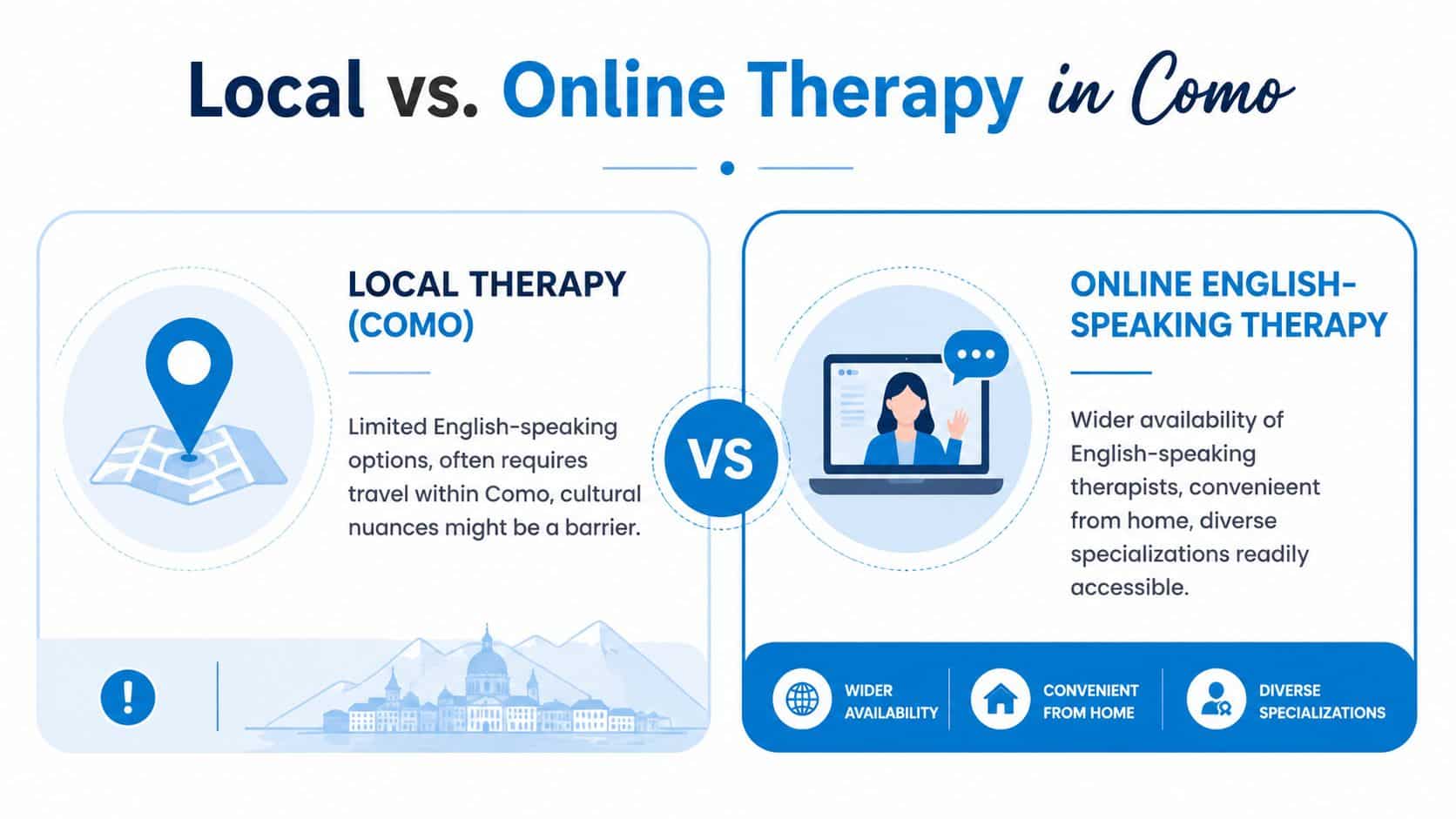
Those seeking an English-speaking therapist in Como usually assume the answer will be a short list of in-person professionals nearby. The problem is that this search often hides the most important reality. Como has virtually no dedicated in-person English-speaking therapists, which means many residents end up relying on online care or traveling to larger cities.
Why the local search often stalls
Most listings don't answer the question people are asking.
They answer a narrower one. They show that a therapist is located near Como. That's not the same as offering therapy in fluent clinical English, understanding expat adjustment, or having availability that fits a working adult's life.
Here's what often doesn't work well:
- Directory hunting – You spend hours contacting individual practices and still don't know whether the therapist works comfortably in English.
- Settling for conversational English – Everyday fluency isn't the same as being able to process trauma, shame, or complex emotional history.
- Commuting for care – Traveling to Milan can be feasible once. It's much harder when therapy needs to become regular and sustainable.
Why online therapy is often the better option
For expats in smaller Italian cities, online therapy isn't second best. It's often the most practical route to consistent, high-quality care.
The strongest advantages are usually these:
-
Better clinical fit
You can look for the right experience, not just the nearest office. That matters if you want support for trauma, intercultural relationships, panic, burnout, or identity issues. -
More flexible scheduling
People living around Como often juggle commuting, remote work, university, caregiving, or cross-border routines. Online sessions remove travel time from the equation. -
Continuity
If you move, travel, split time between cities, or spend periods abroad, your care doesn't have to stop. -
Greater privacy
In smaller communities, some clients feel more comfortable speaking from home than entering a visible local office.
Local is only better when local actually meets your needs. If it doesn't, convenience becomes a trap.
Many people feel relief. They stop asking, “Who is physically closest to me?” and start asking, “Who can help me in the language I think and feel in?”
That shift matters. It moves therapy from a frustrating search into a realistic care plan.
Common Issues Addressed in Therapy for Expats
Many expats don't arrive in therapy saying, “I'm experiencing intercultural stress.” They say, “I'm exhausted all the time,” “I cry for no reason,” “My relationship is getting harder,” or “I don't feel like myself anymore.”
Those are often the emotional surface of a deeper adjustment process.
What expat distress often looks like
Living abroad can magnify ordinary life stress. Tasks that used to be automatic suddenly require more energy. You may need to adjust to a different health system, legal language, work culture, social code, and communication style, all while trying to maintain performance.
Common themes include:
- Anxiety and overthinking – Worry about mistakes, future plans, paperwork, money, or belonging.
- Depressive feelings – Emptiness, low motivation, homesickness, or loss of pleasure in daily life.
- Burnout – Emotional exhaustion linked to work pressure, relocation strain, or long-term adaptation fatigue.
- Relationship strain – Misunderstandings in intercultural couples, conflict around commitment, family roles, or where to build a future.
- Trauma activation – Old wounds can resurface when your usual coping systems disappear.
- Isolation – You may be socially connected and still feel emotionally alone.
How therapy approaches help
CBT helps people notice the link between thoughts, emotions, and behavior. If your mind constantly jumps to “I'm failing,” “I don't belong here,” or “I'll never figure this out,” CBT gives those thoughts structure instead of letting them run the day.
Schema Therapy goes deeper. It looks at long-standing patterns, such as fear of abandonment, harsh self-criticism, people-pleasing, or perfectionism, that become sharper during major life transitions.
EMDR is often used for trauma. It helps people process distressing memories that still feel emotionally “stuck,” so the body and mind don't react as if the past is still happening now.
Attachment theory can also be useful in expat work. Moving abroad often changes how secure people feel in relationships. The loss of familiar anchors can make closeness feel more urgent, or harder to trust.
Therapy for expats isn't only about symptom relief. It's also about rebuilding stability, meaning, and a sense of self in a changed environment.
A good therapist won't reduce your experience to a generic label. They'll help you understand why this period of life feels so intense, and what kind of support matches the actual problem.
How to Start Your Therapy Journey with Therapsy
When local options are scarce, the next step needs to feel simple, human, and clear. That's what usually makes the difference between thinking about therapy and starting the process.
One practical route is this guide on how to start therapy in Italy, which explains the process in straightforward terms for people who may be new to the Italian system.
What a good starting process should include
A strong therapy intake process doesn't rush you. It also shouldn't make you do all the clinical sorting by yourself.
Useful signs include:
- A human conversation early on – Not just a form or automated questionnaire.
- Attention to language fit – Especially if you need English at a clinical level, not casual fluency.
- Clarity about modality – Online, in person, or flexible options depending on where you live.
- Room for rematching – Because fit matters, and sometimes the first match isn't the right one.
In healthcare more broadly, well-designed intake systems reduce confusion and help people get to the right professional faster. In therapy, the same principle applies. The smoother the first steps are, the easier it is for clients to begin.
A practical option for expats in Como
Therapsy is a multilingual psychotherapy service in Italy, founded in 2023 and serving over 1,500 international clients through a team of 50+ licensed therapists across 24 Italian cities and 90 physical locations, including Como, as outlined on its therapy in Italy for expats page. The service offers therapy in 14 languages: Italian, English, French, Spanish, German, Portuguese, Ukrainian, Russian, Greek, Arabic, Urdu, Hebrew, Hindi, and Persian (Farsi).
For someone living in or near Como, that matters because it widens the range of possible matches beyond the local area. It also means you can look for a therapist based on need, not geography.
What the process looks like
Simpler first steps often lead to better outcomes.
-
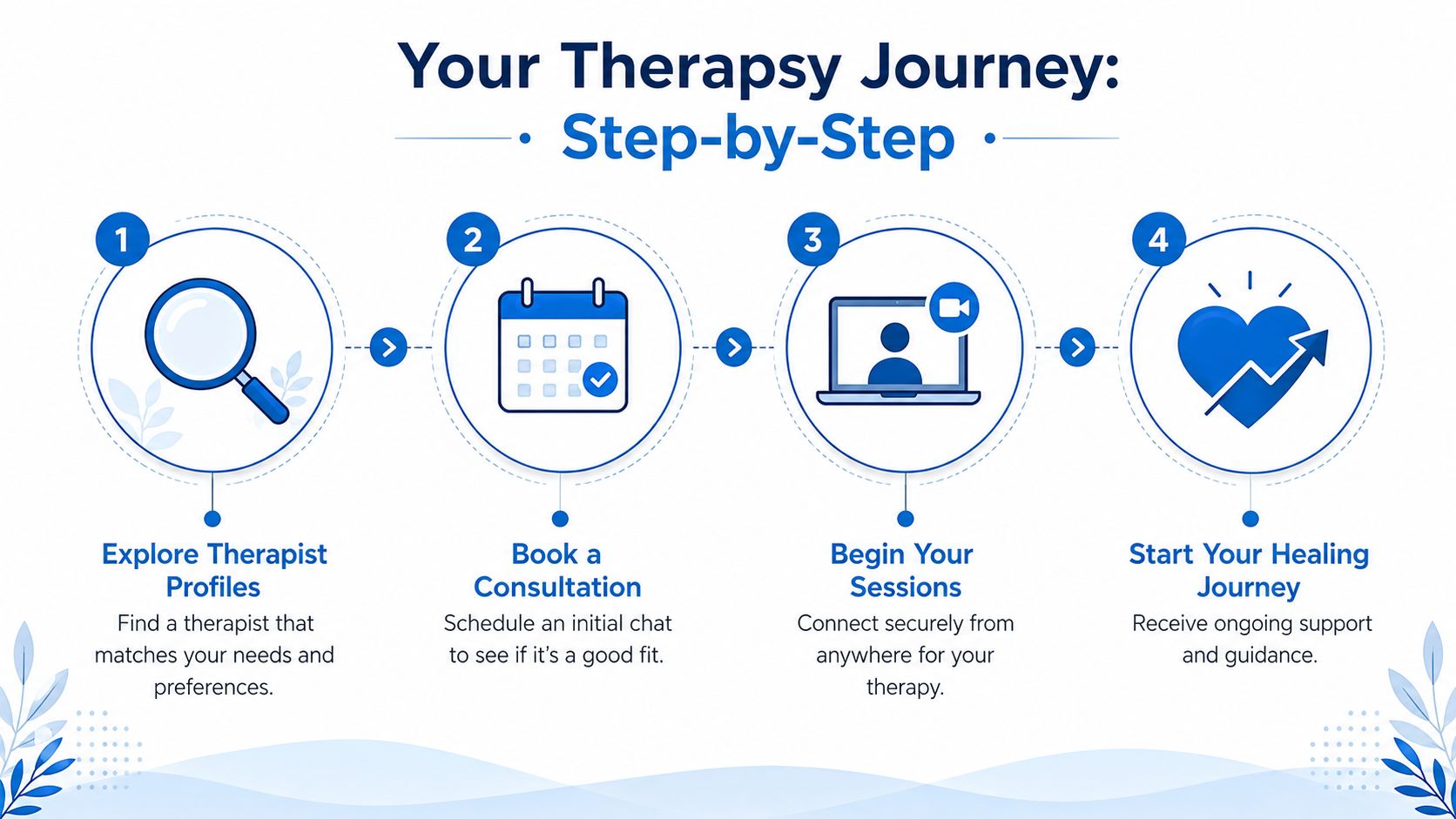
You make contact
The goal at this stage is not to commit to therapy immediately. It's to explain what's been going on and what kind of support you're looking for. -
A clinician helps with the match
Human matching is often more helpful than automated sorting because people rarely fit into one neat category. Anxiety may be mixed with grief, relationship stress, trauma, or relocation fatigue. -
You have a free assessment call with the assigned therapist
The relationship is central to the treatment process. You need to feel understood, not just scheduled. -
You begin sessions in a format that fits your life
For many expats in Como, that means online therapy from home, with the option of continuity even if work, travel, or family life changes.
The best first step in therapy is often a conversation that lowers pressure, not one that adds it.
This kind of model tends to work well for young adults, international students, intercultural couples, and professionals who need support that fits both their schedule and their emotional reality.
Understanding Therapy Costs and Practicalities
Cost matters. So do logistics. Many people delay therapy because they don't know what to expect, and uncertainty tends to make the whole process feel heavier than it is.
What therapy usually costs
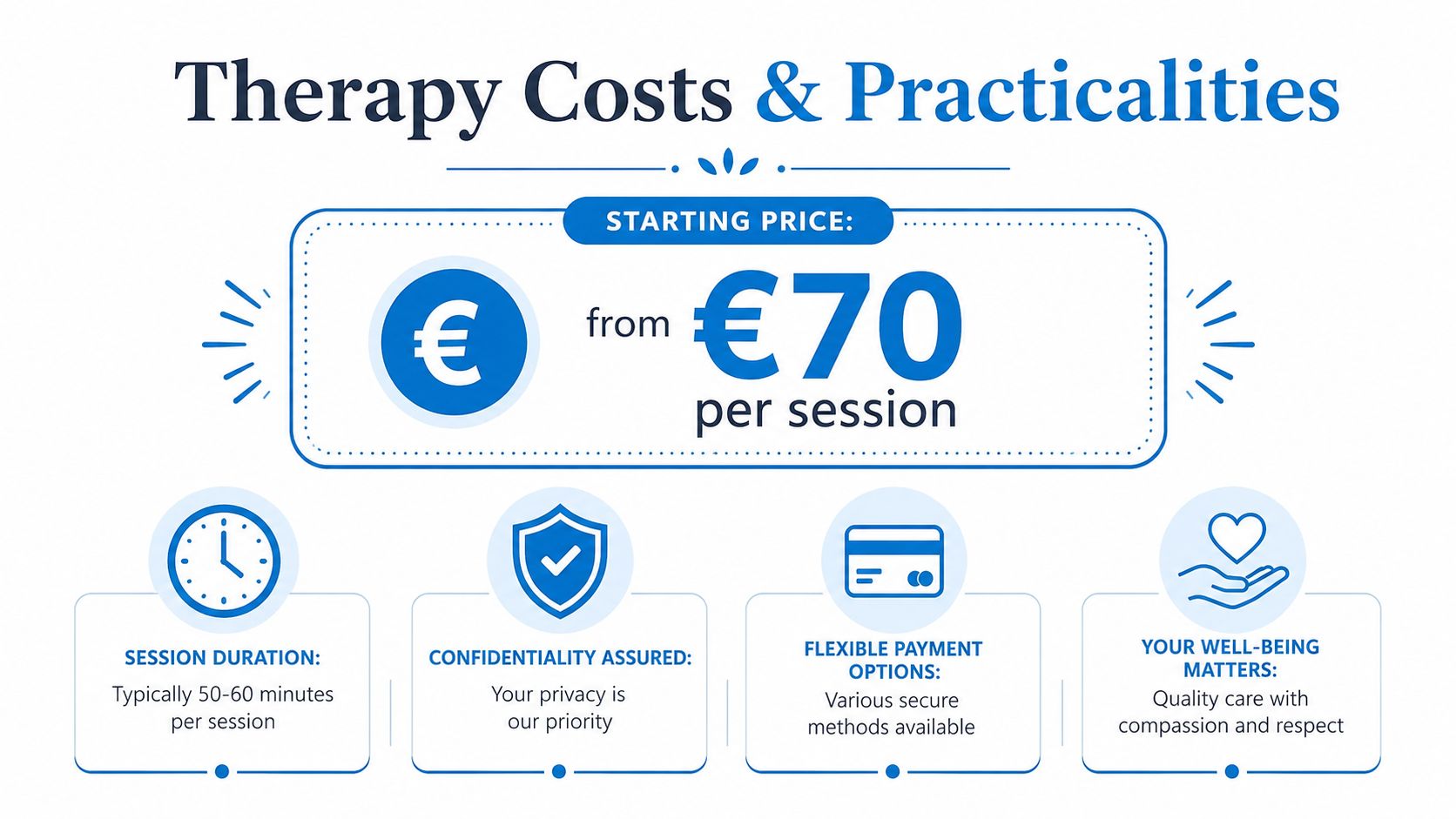
Therapy through Therapsy starts from €70 per session for individual therapy and from €100 for couples therapy. Therapsy has a 4.8/5 Trustpilot rating labeled “Excellent.”
If you want a more detailed overview of fees and service types, this therapy cost guide for Italy is a useful starting point.
What the practical trade-offs look like
For someone based in Como, the financial question usually isn't just the session price. It's the full cost of access.
That includes things like:
- Travel time – Going to Milan for regular therapy can turn one session into a half-day commitment.
- Energy cost – Therapy asks for emotional presence. Long travel before and after can make that harder.
- Consistency – The easier it is to attend sessions, the more likely you are to keep momentum.
Online therapy often solves these issues cleanly. You can attend from home, from a private office, or from any quiet place where you feel safe speaking openly. That usually makes weekly or regular therapy more realistic.
Questions worth asking before you begin
A practical first conversation should help you clarify:
- Language fit – Can you speak naturally, with emotional nuance?
- Clinical fit – Does the therapist work with the issues you're bringing?
- Format fit – Is online therapy the most sustainable choice for your routine?
- Pace – Can you start with one assessment conversation instead of making a big decision all at once?
Therapy is an investment, but it doesn't have to start with pressure. A free initial conversation helps you understand whether the fit feels right before committing financially.
The English-speaking therapists we work with near Como
Therapsy works with therapists in Milan and Bergamo, and all of them also see patients online, wherever in Italy you live.
Dr. Alexandra Kraslavski offers sessions in Hebrew as well as English and Italian, and works with a difficult relationship with food, weight and addiction.
Dr. Eleni Karliampa offers sessions in Greek, and works specifically on cultural identity and migration difficulties, which she knows from the inside.
Dr. Matteo Innocenti is a psychiatrist and psychotherapist, qualified in both, and a recognised expert in eco-anxiety.
You tell Therapsy what you are looking for, a member of our clinical team reads your request, and they introduce you to whoever fits, in person where possible and online where it works better. The first call is free.
FAQ
Is online therapy as effective as in-person therapy?
Yes, online therapy can be highly effective for many people. What matters most is usually the quality of the therapeutic relationship, the therapist's skill, and whether the format fits your life well enough to stay consistent. If you live in Como and local English-speaking options are limited, online care often becomes the most realistic way to access the right support, and you can explore that option through online therapy in English in Italy.
How do I know the therapist is properly qualified?
A properly qualified therapist should be licensed, clinically trained, and able to work within clear ethical standards. In this setting, therapists are licensed professionals, and English fluency is verified during a clinical interview with Clinical Director Dr. Francesca A. Boccalari to ensure therapeutic-level proficiency rather than casual conversation. That distinction matters because emotional work requires nuance, precision, and the ability to understand complex personal history.
What if I don't connect with the first therapist I'm matched with?
That can happen, and it's a valid concern. Therapy works best when you feel safe, understood, and comfortable enough to be honest, so fit matters from the start. A thoughtful matching process and a free assessment call reduce the chance of a poor fit, and if the connection doesn't feel right, rematching should be part of a responsible care process.
Is everything I say confidential?
Yes, confidentiality is a core part of therapy. Your sessions should take place within professional ethical standards and with clear respect for privacy, which helps create the safety needed for honest work. If you're starting therapy while living abroad, it's completely reasonable to ask how personal data, communication, and session platforms are handled before you begin.
I live just outside Como, can I still use this service?
Yes, if you live outside Como, you can still access support. Online therapy is especially useful for people in lake towns, nearby villages, or smaller communities where local English-speaking options are limited. If you want location-specific information, the Como therapy page explains how support works for residents in and around the area.
Book your first free assessment call with THERAPSY – no commitment, just a conversation with the Clinical Director who will listen carefully and help match you with the right therapist for your needs.