Trieste can be disorienting in a very specific way. You can spend the morning looking at the sea, walk past elegant cafés and old buildings, and still feel completely unanchored by late afternoon. Many expats arrive here for work, study, or a relationship and find that the city is beautiful but emotionally harder than expected. The routines are different, the bureaucracy is tiring, and even simple conversations can leave you feeling slightly outside the room.
When seeking an English speaking therapist in Trieste, you're usually not just looking for someone who speaks English well enough. You're looking for someone who understands what happens to the mind when daily life must be translated all the time. Anxiety, loneliness, culture shock, identity loss, burnout, and relationship strain often intensify when you're far from your usual support system.
For young adults living abroad, therapy works best when it reduces friction rather than adding more of it. That means clear communication, a therapist who understands intercultural stress, and a process that doesn't make you decode the Italian mental health system while already overwhelmed. Some people also pair therapy with broader lifestyle support, such as a guide to total well-being, but emotional care still needs to be specific, relational, and clinically grounded.
A practical starting point for local support is the Trieste psychotherapy page, which outlines in-person and online options for multilingual care in the city.

Finding Your Balance in the City of Winds
Trieste often suits people who are thoughtful, international, and curious. It can also leave those same people feeling cut off. That's not a personal failure. It's a predictable response when your external life looks interesting but your inner life has lost its usual language, rhythm, and support.
A common expat pattern is this: life abroad looks manageable from the outside, while inside you're carrying grief, self-doubt, overstimulation, or fatigue that never fully switches off.
In clinical terms, cross-cultural psychology proves useful. Relocation stress doesn't only come from big events. It builds through repeated small mismatches. You can't express yourself as precisely. You second-guess social cues. You lose the effortless competence you had at home. Over time, that can feed anxious thinking, low mood, conflict with a partner, or a numb sense of disconnection.
The right therapist doesn't just listen. They help you name what kind of distress you're dealing with.
- Adjustment stress often feels like restlessness, irritability, and emotional swings.
- Culture shock can look like exhaustion, resentment, and withdrawal.
- Identity strain often shows up when your professional, relational, or social self no longer feels stable.
- Trauma activation may intensify after a move because unfamiliar environments reduce your usual coping structure.
For many expats in Trieste, the search becomes difficult at the exact moment support is most needed. Smaller cities can feel intimate and welcoming, but the mental health search is often less transparent than in larger international hubs.
Why Finding Care in Trieste Can Feel Complicated
The hardest part is often not admitting you need help. The hardest part is figuring out where to begin.
The public system can be hard to enter
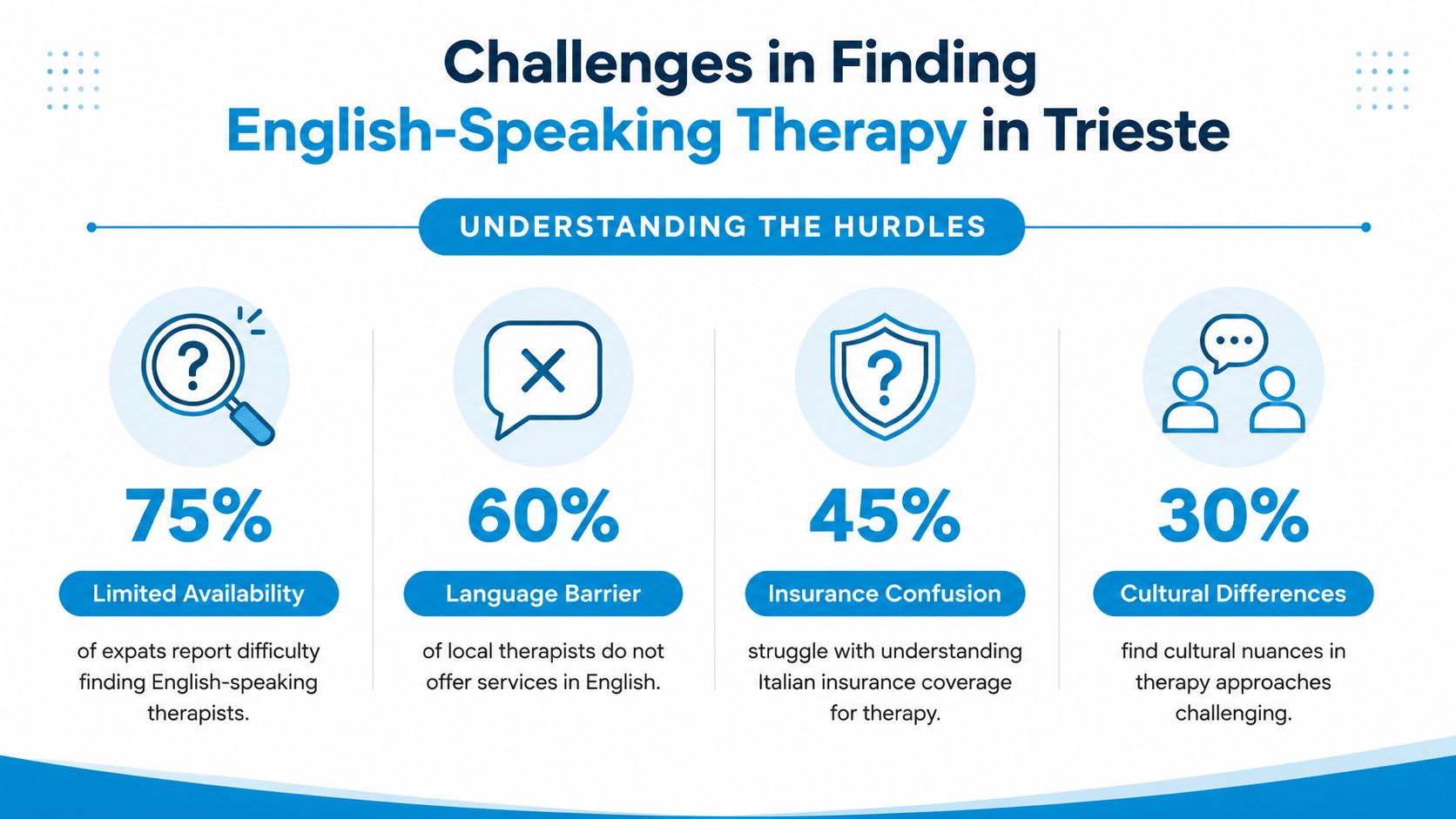
In Italy, mental health care through the public system often requires registration with the national health service, a referral from a general practitioner, and the ability to work through local procedures. For many expats, that's where things stall. If you don't yet have an Italian GP, don't speak Italian confidently, or don't know which office handles what, even the first step becomes confusing.
One reason this feels so frustrating is that the barrier isn't motivation. It's access.
That broader pattern appears in European data. 68% of adults in Europe with common mental disorders receive no treatment due to accessibility barriers including language and lack of knowledge about how to enter the system, according to this peer-reviewed overview on access barriers in Europe.
Private care can also feel uneven. The practical issue isn't only cost. It's uncertainty. You may find someone who mentions English, but it's often unclear whether they work comfortably in English for emotionally complex sessions, whether they understand expat adjustment, or whether they offer trauma-informed approaches.
Trieste has a specific expat challenge
Trieste is international in real life, but that doesn't always translate into easy mental health access. People often assume a border city will automatically have clear multilingual pathways. In practice, that's not always how care is organized.
Questions expats commonly have include:
- Can I access public therapy if I don't have an Italian GP yet?
- Who do I contact if the local portal is only in Italian?
- Is the therapist fluent enough for nuanced work, or only for basic conversation?
- Can I find support for trauma, identity stress, or intercultural relationships rather than only general counseling?
If you've felt stuck in that search, you're not overthinking it. You're responding to a real mismatch between what expats need and what local systems clearly explain. A useful overview of these emotional pressures appears in this page on mental health challenges faced by expats, especially if what you're experiencing feels bigger than ordinary homesickness.
Your Search Strategy for an English-Speaking Therapist
A good search is less about checking every directory and more about reducing noise. Start broad, then filter fast.
Begin with the fit, not the platform
A common starting point is to search availability. That's understandable, but not ideal. Start with your actual need.
Ask yourself which of these sounds most true right now:
- Anxiety and overthinking – racing thoughts, sleep disruption, dread, constant self-monitoring
- Low mood or isolation – loneliness, flatness, disconnection, loss of motivation
- Burnout – emotional depletion, irritability, inability to recover
- Relocation stress – identity confusion, homesickness, social disorientation
- Relationship strain – communication problems made worse by language or cultural differences
- Trauma symptoms – intrusive memories, hypervigilance, body tension, emotional shutdown
That first filter matters because a therapist who is decent for general support may not be the right person for trauma work, intercultural couples, or persistent panic symptoms.
Use three search channels
Don't rely on one route alone. In smaller cities, a strong therapist may be discoverable through one channel and almost invisible in another.
Professional service pages
Start with pages that clearly describe location, language, and format. If the site is vague, treat that as clinically relevant information. Clarity is part of good care.
Expat and student referrals
Ask international colleagues, student support offices, relocation contacts, or trusted community groups one practical question: "Did you feel understood in session, not just accommodated?" That question gets better answers than "Do you know anyone who speaks English?"
Curated therapy networks
A curated network can reduce guesswork if it explains how therapists are selected and matched. One practical option is this therapist near me resource, especially if you want to compare in-person and online access without starting from scratch.
Filter quickly with a short checklist
When you identify a possible therapist, screen for substance.
- Language depth – Can they work in English around shame, grief, anger, and relational conflict, not just intake questions?
- Expat competence – Do they explicitly understand relocation, culture shock, and identity disruption?
- Clinical method – Can they explain whether they use CBT, EMDR, Schema Therapy, or another approach in plain language?
- Practical access – Do they offer online sessions, in-person sessions, or both?
- First contact quality – Is the first response human, clear, and organized?
One detail that matters more than people think
If the process starts with a generic form and no meaningful clinical conversation, be cautious. Matching in therapy is not an administrative detail. It's part of treatment quality.
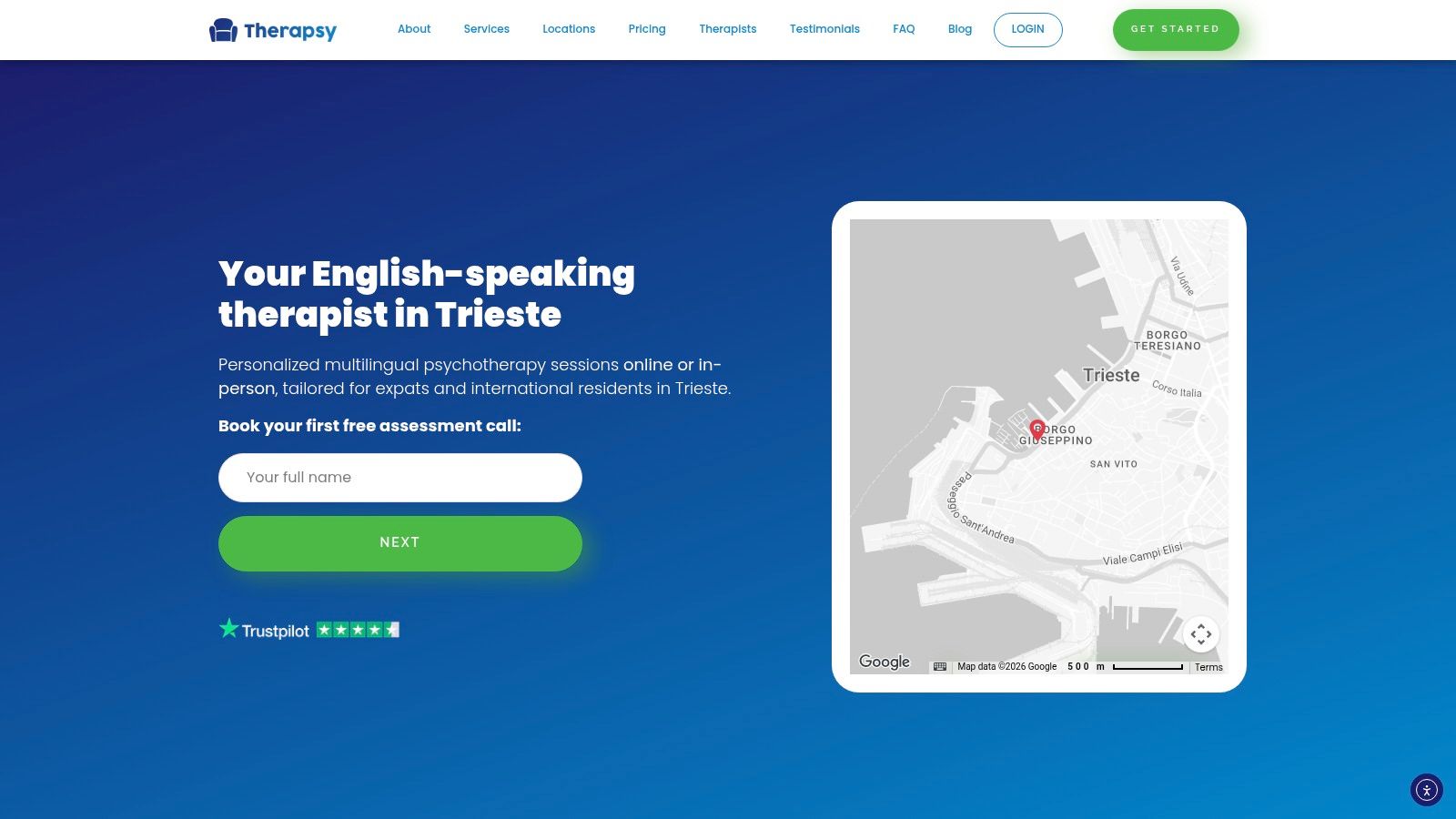
Therapsy operates in 24 Italian cities, including Trieste, with both online and in-person sessions at Riva Tommaso Gulli 12. The network includes 50+ therapists, has served over 1,500 clients since 2023, and works across 14 languages, with English as the primary language for 60% of its clientele. In Trieste, therapists' English fluency is rigorously verified during a clinical interview conducted by Clinical Director Dr. Francesca A. Boccalari, and each new patient is matched by a human rather than an algorithm, as described on the Trieste service page.
That kind of structure matters because the first goal isn't speed alone. It's reducing the chance that you end up with someone who is available, polite, and wrong for your actual problem.
How to Vet a Therapist Beyond English Fluency
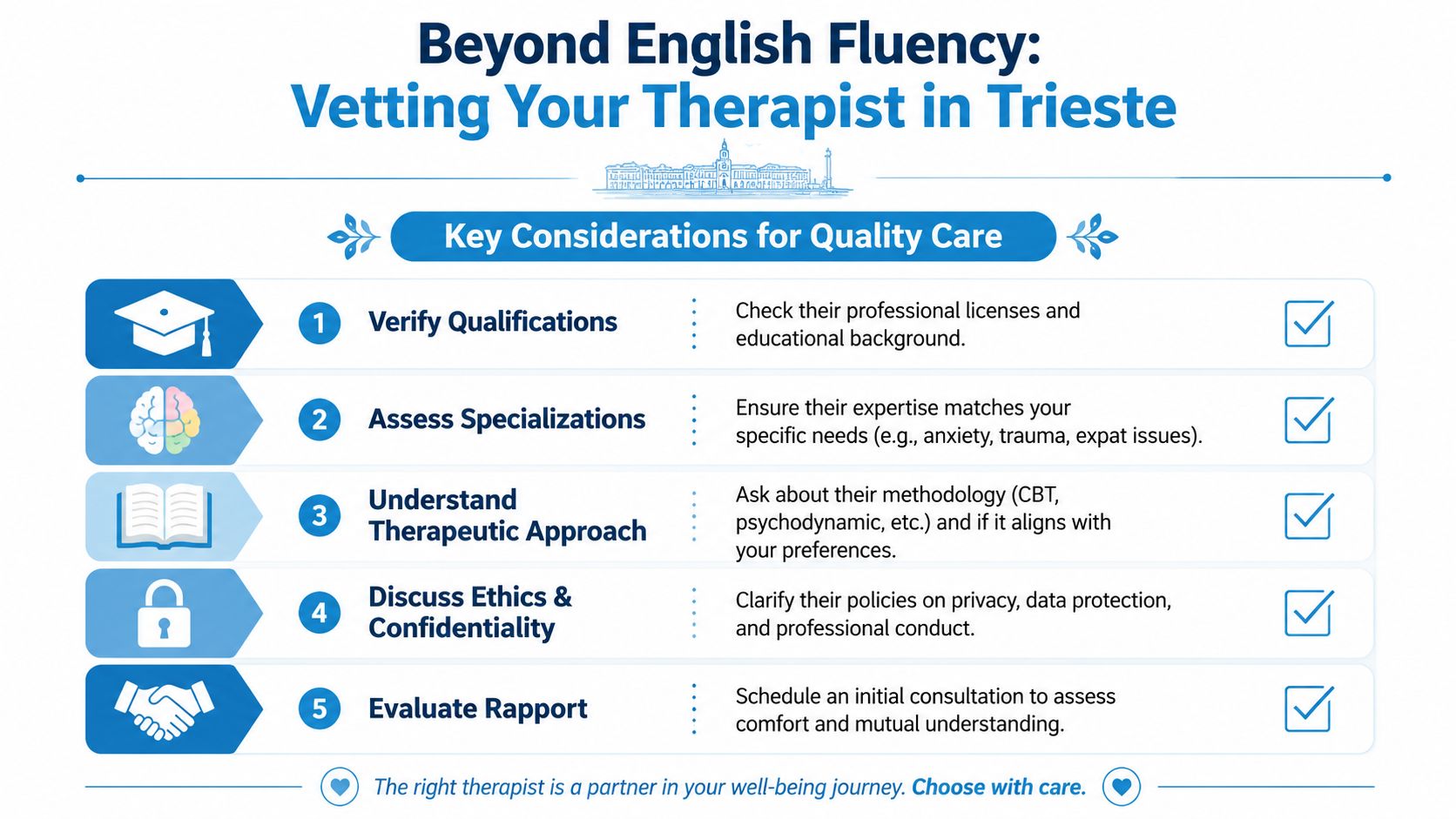
"Speaks English" is not the same as "can do therapy in English." Those are very different levels of skill.
Why fluency alone isn't enough
Therapy happens in nuance. People rarely enter session saying exactly what they feel in neat sentences. They circle it, contradict themselves, go quiet, or switch from thought to body sensation. A therapist must catch subtleties, not just vocabulary.
This matters even more for expats. The therapeutic relationship is one of the strongest predictors of treatment success, and clients receiving therapy in their native language report 23% higher satisfaction, according to this summary on therapist fit and language concordance. In practice, that means language fit is not a luxury. It's part of whether therapy feels usable.
Questions worth asking before you book
Use the first contact to assess quality, not just availability. You don't need to interrogate the therapist. You do need enough information to protect your time and energy.
Ask about intercultural experience
A helpful question is: "Do you regularly work with expats or international clients dealing with adjustment, isolation, or identity strain?"
You're listening for more than a yes. You're listening for whether they understand those experiences as psychologically meaningful, not as side notes.
Ask how they work
Different approaches help with different problems.
- CBT helps identify and change patterns of thought and behavior that maintain anxiety, depression, or avoidance.
- EMDR is often used for trauma and distressing memories. It aims to help the brain process experiences that remain emotionally stuck.
- Schema Therapy looks at deeper recurring patterns, especially those rooted in long-standing emotional needs and relational wounds.
- Attachment-informed work helps when current distress is tied to closeness, trust, abandonment, or conflict patterns.
Practical rule: if a therapist can't explain their approach in plain English, it will be hard for you to collaborate well once treatment starts.
Ask whether they can handle your specific issue
General support is valuable, but precision matters. If you need trauma-informed care, say so directly. If you suspect panic attacks, relationship ruptures, or burnout linked to relocation, mention that too.
In Trieste, this question is especially important for people seeking trauma-specific support such as EMDR. Public information often doesn't clearly show where English-speaking trauma specialists practice locally. That gap leaves people guessing when they most need clarity.
What a strong fit feels like
A strong therapist match doesn't mean instant comfort or emotional relief. It usually means something simpler and more reliable:
- You don't have to shrink your language
- The therapist understands both symptoms and context
- Their questions feel precise rather than generic
- You can imagine telling them the part you're currently avoiding
- The process feels ethically clear and emotionally safe
If you're unsure whether you need a psychologist or a psychiatrist, this guide on psychologist vs psychiatrist can help clarify the difference before you book.
Navigating Therapy Types and Costs in Trieste
People often delay therapy because they assume they need to decide everything in advance. You don't. You only need enough orientation to choose a reasonable first step.
Online or in person
Both formats can work well. The better choice depends on your life, your symptoms, and your capacity for privacy.
| Format | Often works well for | Potential trade-off |
|---|---|---|
| Online therapy | Busy schedules, travel, fatigue, living outside the center, preference for familiar surroundings | Harder if home isn't private or if screen fatigue is already high |
| In-person therapy | People who want embodied presence, routine, and a clearer separation from work or home stress | Less flexible, especially if work hours or transport are unpredictable |
| Hybrid care | Expats whose schedule changes often or who travel between cities | Needs consistency so the frame of therapy stays stable |
Some clients think in-person is automatically deeper. That's not always true. If getting to the appointment becomes stressful, online therapy may support better continuity.
Which therapy type fits which problem
You don't need to become an expert, but a basic map helps.
- CBT is often useful when your mind gets caught in loops of anxiety, self-criticism, avoidance, or low mood.
- EMDR may be appropriate if current distress is connected to trauma, intrusive memories, or a nervous system that stays on alert.
- Schema Therapy can help when the same painful pattern repeats across work, love, self-worth, or conflict.
- Systemic-relational therapy is often relevant for couples and family dynamics, especially in intercultural relationships.
- Humanistic and ethnopsychotherapy approaches can be particularly helpful when identity, migration, belonging, and cultural meaning are central to the work.
Costs and transparency
In Italy, private mental health care can be difficult to predict from one provider to another. For expats, that uncertainty adds stress.
A more transparent benchmark helps. Through its hybrid model in 24 Italian cities, Therapsy offers in-person sessions in Trieste at Riva Tommaso Gulli 12, and every English-speaking therapist is vetted for fluency and clinical fit by Dr. Francesca A. Boccalari through a dedicated interview, as outlined on the Trieste page. Pricing is listed as from €70 for individual therapy, from €100 for couple therapy, from €110 for psychiatric consultation, and from €255 for psychodiagnostic assessment.
If you're comparing costs, focus on three things:
- What the starting price includes
- Whether the first contact is paid or free
- Whether online and in-person pricing differs
Transparent pricing doesn't guarantee the right fit. It does remove one common source of anxiety.
What Happens in Your First Free Assessment Call
The first call shouldn't feel like an exam. It should feel like orientation.
For expats, that matters because uncertainty is often part of the problem. When you've already spent months deciphering paperwork, social codes, and healthcare logistics, you don't need a mysterious intake process on top of that.
What the call is for
A free assessment call is meant to answer one question first: does this seem like a clinically sensible match?
Expat-focused services often start this process with a real conversation rather than an automated system. In that model, the Clinical Director looks at your needs, language, and presenting concerns, then matches you with a therapist whose background fits the work. That approach is described in this overview of what to expect from a first psychological session.
What you'll usually be asked
The questions are often simple and practical.
- Why are you reaching out now
- What has been feeling hardest recently
- Have you had therapy before
- Do you prefer online or in-person sessions
- Is language or cultural background especially important for your care
- Are you looking for help with anxiety, trauma, burnout, relationship issues, or something harder to name
You don't need a polished narrative. "I've been functioning, but not well" is enough to start.
Sometimes the most useful first sentence is the least impressive one. "I don't feel like myself since moving here" gives a therapist a lot to work with.
What you should ask
The call is also for you to assess whether the process feels safe and grounded.
Consider asking:
- How are therapists matched
- What kind of experience does the therapist have with expats
- Can they work with my specific issue
- What approach do they use
- If the fit feels off, what happens next
A good first call lowers pressure. It doesn't push you to commit before you feel understood.
Frequently Asked Questions
Can I find an English-speaking therapist in Trieste for in-person sessions
Yes, in-person English-speaking therapy is available in Trieste. What matters most is confirming not only availability but also actual fluency, clinical qualifications, and whether the therapist regularly works with expats or international residents.
Is online therapy a good option if I live in Trieste
Yes, online therapy can be a very good option if it gives you more choice and better continuity. For many expats, online sessions make it easier to find the right language fit and maintain therapy during travel, workload changes, or periods of low energy.
How do I know if a therapist's English is good enough for therapy
Ask how they conduct emotionally complex sessions in English and whether their fluency has been formally assessed within their practice. Conversational English isn't the same as being able to work with grief, trauma, shame, or relationship conflict in a precise and clinically useful way.
Can I get trauma therapy such as EMDR in English in Trieste
Possibly, but it's worth asking directly because local public information is often unclear on this point. If trauma is part of your reason for seeking help, don't settle for a vague answer. Ask whether the therapist has specific training and whether they regularly use EMDR or another trauma-informed approach.
What's the difference between a psychologist and a psychiatrist in Italy
A psychologist or psychotherapist usually focuses on talking therapy, assessment, and emotional treatment. A psychiatrist is a medical doctor who can assess psychiatric conditions and prescribe medication when appropriate.
Do I need to know Italian before starting therapy in Trieste
No, you don't need to know Italian before starting therapy if you find a therapist or service that provides therapy in English. In fact, many expats do better when they begin therapy in the language that feels most natural during stress.
The English-speaking therapists we work with in Trieste
Therapsy works with two therapists who receive in person in Trieste and also see patients online.
Dr. Giovanni Matragrano is a clinical psychologist and cognitive behavioural psychotherapist working in English and Italian, with children, adolescents, adults and couples. He runs DBT skills groups, an approach built for people whose emotions arrive at full volume and who need something usable in the moment rather than an explanation a week later. He works with anxiety, ADHD, trauma, burnout and adolescent crises, and offers parent training.
Dr. Mario Cesareo is a clinical psychologist working in English, Italian and Spanish, with adults and young people. He works with anxiety, emotional distress, difficulties in relationships, stressful life transitions and low self-esteem, and with the sense of being stuck that is harder to name. He is completing advanced training in psychotherapy and Ericksonian hypnosis.
You tell Therapsy what you are looking for, a member of our clinical team reads your request, and they introduce you. The first call is free.
What should I prepare before a first assessment call
Prepare a short description of what has been difficult, any past therapy experience, and your preferences around language, format, and therapist style. You don't need to summarize your whole life. A few honest sentences are enough to start the matching process well.
If you're ready to talk, book your first free assessment call with THERAPSY. There's no commitment and no pressure. Just a conversation with our Clinical Director, who will listen carefully and match you with the right therapist for you.