Cagliari can feel gentle and expansive at the same time. The sea is close, the pace can be slower, and daily life may look beautiful from the outside. But many expats and international students discover that life on an island can also sharpen loneliness, language fatigue, and the stress of handling everything far from home.
When seeking an English-speaking therapist in Cagliari, you're usually not looking for a generic directory entry. You're looking for someone who can understand what happens when culture shock mixes with anxiety, when homesickness turns into low mood, or when a relationship starts carrying the pressure of relocation. Therapy for expats in Italy is not just about speaking English. It's about being understood accurately, safely, and without having to translate your inner life.
For young adults living in Italy, especially those navigating study, work, or a cross-cultural relationship, the search often feels harder outside major hubs. Cagliari has charm and quality of life, but the pool of clinicians available locally in English can be narrower than many people expect. That's why the right approach is usually to evaluate fit, fluency, and access together, not separately.
Starting Your Search for an English Speaking Therapist in Cagliari

You might be here after one difficult week, or after many months of trying to cope alone. For some people, the trigger is practical. A university deadline, a work conflict, a breakup, a visa issue, a conversation at the pharmacy or doctor that leaves you feeling small and exhausted. For others, it's quieter. You stop sleeping well, you don't feel like yourself, and even enjoyable places in Sardinia start to feel emotionally distant.
That experience is common in intercultural life. A relocation doesn't only change your address. It changes your support system, your routines, your language, and often your identity. The version of you that felt confident elsewhere may suddenly feel hesitant here.
A good therapist in Cagliari should help you think and feel more clearly, not make you work harder to explain yourself.
Many people encounter difficulty when they search "English therapist Cagliari," find a few names, and still don't know how to judge quality. Speaking English socially isn't the same as conducting therapy well in English. The difference matters most when you're discussing panic, grief, trauma, shame, relationship strain, or the sense that you've lost your footing in a new country.
One practical resource is a human therapist matching process designed for people who need language fit and clinical fit at the same time. That matters in a city where your options may be smaller, but your needs are no less specific.
Therapsy, a multilingual psychotherapy service in Italy, was founded in 2023 and has already served over 1,500 clients across 24 Italian cities, including Cagliari, with a team of 50+ licensed therapists offering sessions in 14 languages (Therapsy Cagliari services).
What people usually need help with first
In Cagliari, the presenting problem isn't always the root cause. A person may search for therapy because of stress, but the deeper issue may be one of these:
- Adjustment strain – daily life feels heavier than it should, even when nothing is "wrong"
- Isolation – you miss being known without needing to explain your background
- Relationship pressure – one partnership starts carrying the weight of relocation, language, and belonging
- Identity fatigue – you're functioning, but you no longer feel solid inside
The search becomes easier once you stop asking only "Who speaks English?" and start asking "Who can work with my situation well?"
Why English Speaking Is Not Enough When Choosing a Therapist

A therapist can hold a basic conversation in English and still not be the right person for therapy in English. That isn't a criticism. It's a clinical issue.
When people are distressed, they often speak less clearly, use layered emotional language, or switch between literal facts and implied meaning. Therapy depends on the clinician catching those shifts. If the therapist misses the difference between anger and humiliation, guilt and grief, numbness and calm, the work can become slower, flatter, or less accurate.
Conversational fluency and therapeutic fluency are different
Conversational English is enough for introductions, scheduling, and everyday life.
Therapeutic English fluency means the clinician can follow emotional nuance, attachment patterns, defensive language, trauma responses, and subtle changes in meaning.
That difference matters in sessions about:
- Anxiety – where thoughts race and language becomes imprecise
- Trauma – where a person may speak indirectly, fragmentedly, or with strong bodily emotion
- Cross-cultural conflict – where one word may carry family, class, migration, or identity meaning
- Depression – where flat language can hide intense suffering
If you leave a session feeling technically understood but emotionally missed, language may be part of the problem.
In smaller Italian cities, this is even more relevant. The local pool may include skilled clinicians, but the overlap between specialization, availability, and real therapeutic-level English can be limited. That's why fluency verification matters more than profile labels.
Accessing English-speaking psychotherapy in non-major Italian cities like Cagliari requires evaluating language verification protocols, as therapeutic-level English fluency is distinct from conversational ability; at premium multilingual services, fluency is verified during a clinical interview where a Clinical Director assesses the therapist's ability to process emotional content and clinical nuances (clinical fluency guidance for English-speaking therapy in Italy).
What to ask before booking
If you're choosing an English-speaking therapist in Cagliari, ask practical questions early:
How is English fluency assessed?
A listed language isn't enough. You want to know whether someone has been evaluated for therapeutic work in English.Has the therapist worked with expats or international students?
Cultural adaptation isn't a side issue. It often shapes the whole problem.Can the therapist work with your specific concern?
Anxiety, trauma, burnout, relationship issues, and identity strain don't all require the same approach.What happens if the match doesn't feel right?
Good services plan for rematching, because fit matters.
A smaller local pool can still work very well, but only if you judge quality by clinical communication, not by the words "English-speaking" alone.
Your Options in Cagliari In-Person vs Online Therapy
When you're looking for an English-speaking therapist in Cagliari, the real choice often isn't therapy or no therapy. It's local in-person care versus a broader online network based in Italy. Both can be good options. The right one depends on what you need most right now.
Some people regulate better when they physically enter a therapy room. Others need the flexibility and wider choice that online care offers. For expats in Sardinia, this isn't only a convenience question. It's often a question of access to the right specialization.
In-Person vs. Online Therapy in Cagliari: A Comparison for Expats
| Factor | In-Person Therapy in Cagliari | Online Therapy with an Italian-based Service |
|---|---|---|
| Atmosphere | A dedicated physical room can help some people feel grounded and contained | Familiar home surroundings can reduce stress and make attendance easier |
| Choice of therapists | The available English-speaking pool may be more limited | Access to a wider range of licensed therapists across Italy |
| Specialization | You may find a strong generalist, but niche specializations can be harder to match locally | Easier to find clinicians focused on expat issues, trauma, or intercultural relationships |
| Commute and scheduling | Travel time and local availability matter | More flexible for work, study, travel, or island logistics |
| Sense of presence | Face-to-face contact feels important for some clients | Strong therapeutic relationships can still develop well online |
| Privacy | Helpful if home isn't private | Helpful if going to a local office feels exposing or impractical |
| Continuity | Can be disrupted if you move or travel often | Easier to continue consistently from anywhere |
When in-person makes more sense
In-person therapy in Cagliari may suit you if:
- You feel calmer in a dedicated space – leaving home helps you switch into reflective mode
- Your home isn't private – shared flats or family homes can make emotional openness harder
- Face-to-face presence feels essential – especially if you're new to therapy and want that structure
When online is the better clinical choice
Online therapy is often the stronger option if:
- You need a specialist – for example in trauma work, EMDR, or cross-cultural adjustment
- Your schedule changes often – common with students, travel-heavy jobs, or shift work
- You want more choice in personality and fit – not just whoever is geographically closest
- You live outside the city center – or transport adds friction that makes consistency harder
A useful reference point is this guide to online versus in-person therapy for expats in Italy, which helps frame the trade-offs without assuming one format is always superior.
For many expats in Cagliari, the strongest option is the one that gives them the best therapist fit, not the nearest office.
There is also a practical middle ground. Some people start online to access a better match quickly, then choose in-person later if that becomes available and still feels important. Others begin in person and move online when travel, work, or emotional energy makes consistency difficult. What works is the format that you can sustain.
Therapy Approaches for Expat Challenges
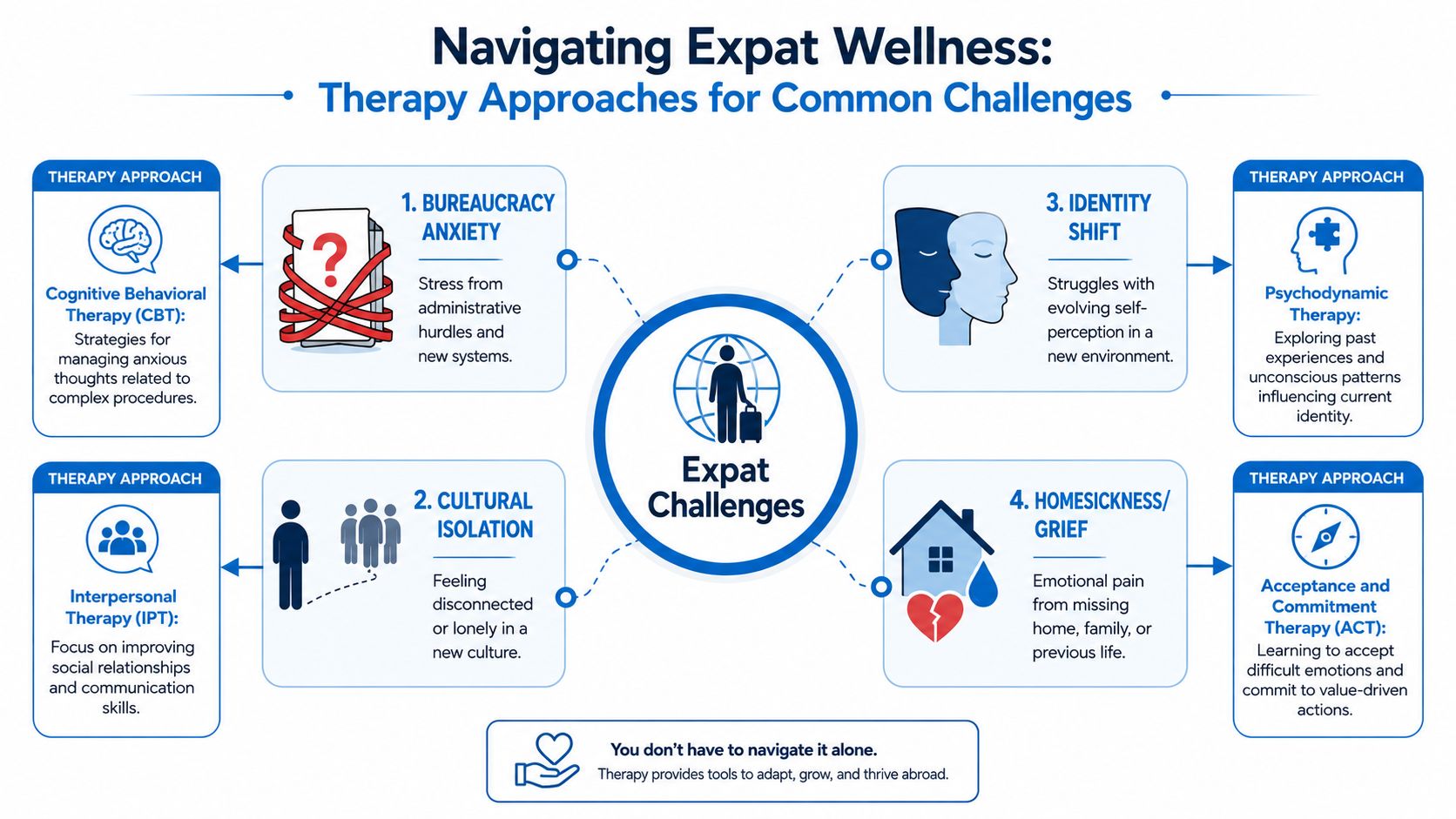
A relocation can activate more than stress. It can stir up old attachment fears, perfectionism, grief, or unresolved trauma that had stayed manageable in a familiar environment. That's why it helps to connect the problem to the right therapeutic approach instead of assuming all therapy works the same way.
Anxiety, isolation, and identity strain need different tools
If your main issue is anxiety, CBT, or Cognitive Behavioral Therapy, is often a practical starting point. CBT helps you identify unhelpful thought patterns, test them against reality, and build more stable responses. For expats, this can be especially useful when daily bureaucracy, uncertainty, or social fears trigger spirals of overthinking.
If your distress is linked to past trauma or overwhelming experiences, EMDR may be relevant. EMDR stands for Eye Movement Desensitization and Reprocessing. In plain terms, it helps the brain process stuck memories so they feel less intrusive in the present. That's often important when relocation lowers your usual coping capacity and old experiences resurface.
If your difficulties feel repetitive and deep-rooted, Schema Therapy can help. This approach looks at long-standing emotional patterns such as abandonment fear, self-criticism, or people-pleasing. Many expats notice that moving abroad doesn't create these patterns, but it does expose them.
Matching common expat problems to therapy styles
- Bureaucracy anxiety often responds well to CBT because it targets catastrophic thinking and avoidance.
- Relationship friction in cross-cultural couples may benefit from systemic-relational work, where communication patterns and expectations are explored together.
- Identity confusion after relocation can respond well to longer-form exploratory therapy, especially when the question is not only "How do I cope?" but also "Who am I becoming here?"
- Trauma reactions, panic, or strong body-based stress may call for EMDR or other trauma-informed methods.
A helpful resource for people navigating belonging, identity, and adaptation is therapy for third culture adults in Italy.
The most effective approach is the one that matches both your symptoms and the context you live in.
For young adults in Italy, that's often the missing piece. They don't need abstract advice. They need a therapist who understands that anxiety may be tied to residence paperwork, isolation may be amplified by language barriers, and burnout may come from building a life in a place that still doesn't fully feel like home.
How to Start Your Journey From a Free Call to Your First Session
Starting therapy can feel oddly vulnerable, even when you already know you need support. Many people postpone the first message because they don't know what happens next. Reducing that uncertainty matters.
What the process usually looks like
A clear therapy intake should feel human, not automated. If you're looking for an English-speaking therapist in Cagliari, the first contact should help you clarify your needs, not pressure you into booking blindly.
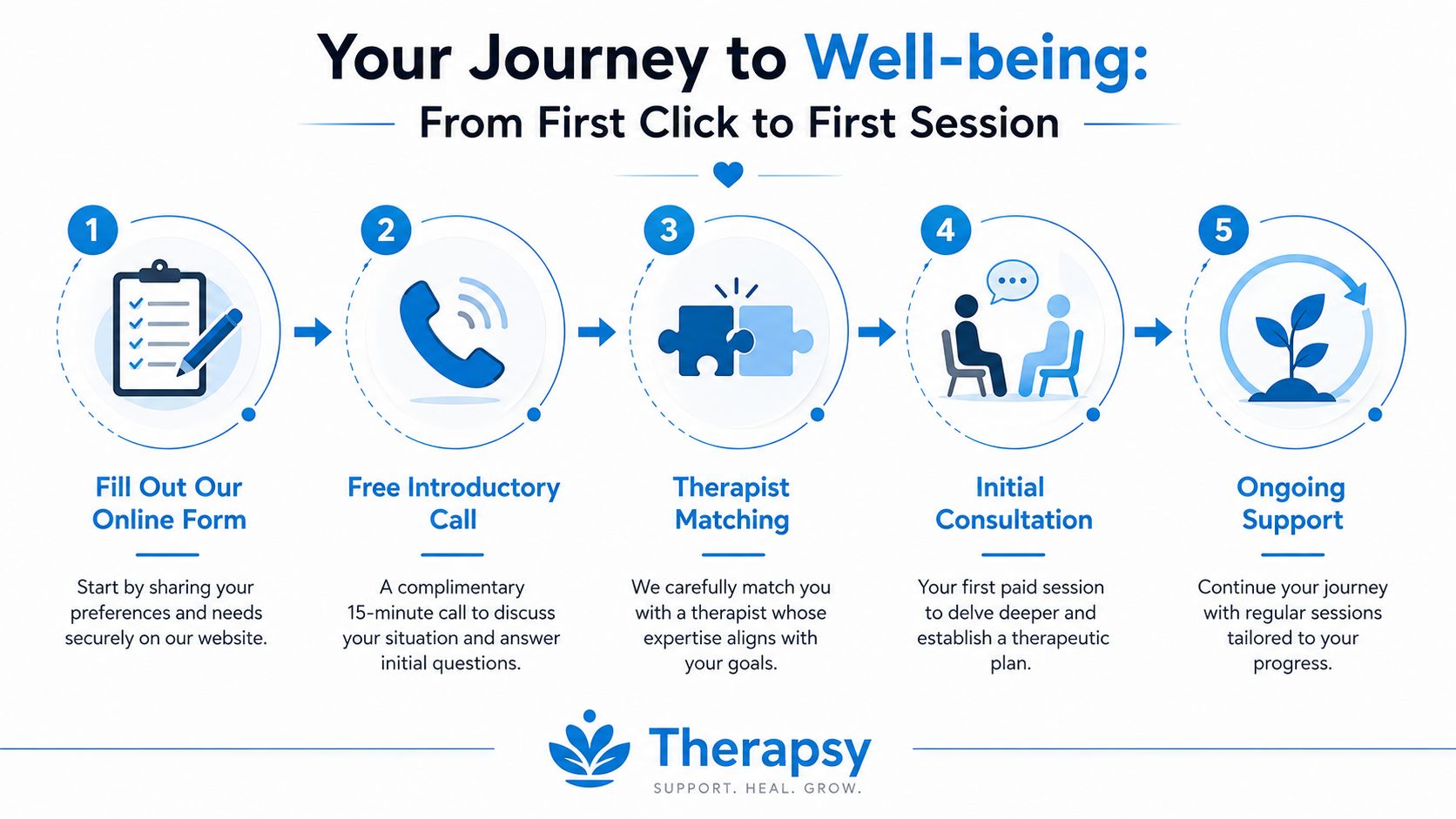
A straightforward process usually includes:
Initial contact
You share basic information about your situation, language needs, and preferences.A free assessment conversation
In this conversation, you can explain what's bringing you to therapy and ask practical questions.Thoughtful matching
The aim is to find a clinician whose style, language, and expertise fit your needs.First full session
During this session, the therapeutic work begins more fully.Ongoing review
Fit and progress are monitored. If the match isn't right, adjustments should be possible.
One useful orientation point is this guide to the first psychological session in Italy, which helps make the process less opaque.
What the first session should actually feel like
The first session isn't a test you need to pass. You don't need to summarize your whole life neatly. A skilled therapist will help structure the conversation.
You can expect the session to cover some combination of:
- What feels hardest right now – anxiety, low mood, relationship stress, trauma reactions, burnout, or confusion
- What has changed since moving to Italy – work, study, identity, support, family, sleep, or routine
- What you want from therapy – relief, clarity, emotional regulation, better boundaries, or deeper self-understanding
A first session should leave you feeling more oriented, not more overwhelmed.
It also helps to know what doesn't work well. Rushing into therapy with no chance to clarify language fit can create a false start. So can choosing solely by convenience. The strongest beginnings usually come from a calm matching process where your context is taken seriously.
Some people know exactly what they're seeking. Others only know that something feels off. Both are valid starting points. Therapy doesn't require perfect words before you begin.
Understanding Therapy Costs and Access in Cagliari
Cost matters, and so does clarity. If you're already emotionally stretched, unclear pricing and confusing healthcare pathways can make it even harder to reach out.
For private multilingual care in Cagliari, individual therapy starts from €70 per session, couple therapy from €100, and psychiatric consultations from €110. The first assessment call is free (expat therapy pricing and access in Italy). When people ask whether private therapy is worth considering, this is usually the key trade-off: you pay directly, but the process is clearer and easier to follow in English.
Why the public route can feel hard for expats
Italy's public healthcare system, the SSN, can be valuable, but accessing mental health support through it is often confusing for non-Italian speakers. The issue isn't only availability. It's also paperwork, referrals, and language.
A 2024 report by the European Commission on Health Access for Migrants notes that 68% of non-Italian EU residents in Italy remain unaware of their SSN eligibility, and 74% face challenges with the "prescrizione medica" requirement without Italian fluency (European Commission health access update).
That doesn't mean the SSN is impossible to use. It means many expats in Cagliari need to factor in:
- Administrative complexity – referrals and local procedures can be hard to decode
- Language barriers – even if care exists, access points may not be easy in English
- Less control over matching – the process may not prioritize therapeutic fit or language nuance
How to think about affordability realistically
If budget is your biggest concern, don't only ask "What's cheapest?" Ask:
- What will help me attend consistently?
- What reduces friction enough that I won't delay care?
- What gives me the best chance of a strong therapeutic match?
For people trying to balance finances with access, it can help to explore sliding scale therapy options in Italy. The practical goal is not perfection. It's finding a route that is sustainable, understandable, and emotionally doable.
Taking the First Step Towards Well-Being in Sardinia
Finding the right English-speaking therapist in Cagliari is possible, but the best decision usually comes from looking beyond the label. Language matters. Clinical fluency matters more. Format matters too, but only in relation to fit, privacy, consistency, and the kind of support you need.
If you're living in Sardinia and feeling emotionally overextended, that doesn't mean you've failed to adapt. It often means you've been carrying too much without enough support. Anxiety, isolation, burnout, low mood, trauma responses, and relationship strain can all intensify when life abroad asks you to function in a language and culture that still require effort every day.
A practical starting point is to make your decision using three filters:
- Fluency – can this therapist work at a real therapeutic level in English?
- Fit – do they understand expat, intercultural, or young adult concerns?
- Format – will in-person or online care make consistent attendance more likely?
When sleep starts deteriorating alongside mood or stress, small routines can help while you arrange support. These expert tips for restful sleep offer a useful companion resource for stabilizing evenings and reducing some of the background strain that often builds during relocation stress.
Reaching out for therapy isn't dramatic. It's a grounded decision. It says that your internal life deserves the same attention as work, study, paperwork, and relationships.
If you aren't sure whether you need therapy, a first conversation can still help. If you already know you need it, you don't have to wait until things get worse.
The English-speaking therapists we work with in Cagliari
Therapsy works with a therapist who receives in person in Cagliari and also sees patients online.
Dr. Silvia Cau is a licensed psychologist, cognitive-behavioural psychotherapist and Board Certified Behavior Analyst, working in English and Italian. She is a specialist in Acceptance and Commitment Therapy with over a decade of clinical experience in it, and works with anxiety, OCD, trauma and chronic illness and chronic pain. Her practice is explicitly neurodiversity-affirming and LGBTQIA+ affirming.
You tell Therapsy what you are looking for, a member of our clinical team reads your request, and they introduce you. The first call is free.
FAQ
How do I know if a therapist in Cagliari is truly fluent enough for therapy in English
A direct way to tell is to ask how their English was assessed for clinical work. A therapist may speak English well socially and still struggle with emotional nuance in session. Ask whether fluency was evaluated specifically for therapeutic conversations, not just listed as a language skill.
Is online therapy a good option if I live in Cagliari
Yes, online therapy can be an excellent option if it gives you access to a better match. For many expats and international students in Sardinia, online sessions widen the pool of clinicians and make it easier to find someone who understands intercultural stress, trauma, or relationship issues. The key question is whether you can attend consistently and speak privately.
What problems do expats in Cagliari usually bring to therapy
The most common themes are anxiety, isolation, culture shock, relationship strain, burnout, and identity confusion. These issues often overlap rather than appearing one at a time. A person may arrive because of stress and then realize that grief, belonging, or self-worth are also part of the picture.
What should I expect in a first therapy session
You should expect a structured, supportive conversation focused on what feels most difficult right now. You don't need to prepare a perfect life story. The first session usually helps clarify your main concerns, your context in Italy, and what kind of therapeutic work may be most helpful.
Can I get therapy in Cagliari if I don't speak Italian well
Yes, you can still access therapy even if your Italian is limited. The important part is finding a clinician or service that can work safely and accurately in your preferred language. For many expats, receiving therapy in English removes a major barrier and allows deeper emotional work sooner.
Is therapy confidential in Italy
Yes, therapy is confidential, and confidentiality is a core part of professional psychological practice. If you have concerns about privacy, it's reasonable to ask how information is handled before your first session. That question is especially common among expats who are unfamiliar with local systems and want to understand the boundaries clearly.
What if I start with a therapist and the match doesn't feel right
A mismatch can happen, and it doesn't mean therapy isn't for you. The therapeutic relationship matters a great deal, especially when you're already navigating stress in a foreign environment. If you feel misunderstood, it's appropriate to raise it directly or request a different match.
Book your first free assessment call – no commitment, just a conversation with our Clinical Director who will listen and match you with the right therapist for you. Visit THERAPSY.