You're in Genoa, you need support, and the search results look deceptively simple. “English speaking therapist Genoa” sounds like a straightforward query, but in practice you're trying to solve three problems at once, language, legal registration, and actual fit. If you've already spent too long opening profiles that look polished but tell you almost nothing useful, you're not alone.
The right answer is not “find someone who says English.” The right answer is find a therapist who is legally registered in Italy, works in English, and understands expat life well enough to treat the core issue, not just translate words. That's the standard I use with international residents, because it's the only one that avoids expensive mismatches.
Why Finding an English Speaking Therapist in Genoa Feels Harder Than It Should
A lot of people start with the same scene. You've moved, the days are full of admin, and your stress doesn't feel dramatic enough to justify panic, but it's persistent enough to affect sleep, concentration, and relationships. You search for therapy, see a few promising names, and then realise that the one thing you need most, being able to speak freely, isn't clear anywhere.
That uncertainty is exhausting. When you're already vulnerable, you don't want to decode a directory listing, guess whether a clinician is properly licensed, or wonder if “English available” means fluent enough for grief, shame, conflict, or trauma.
Practical rule: if you can't verify language fit and registration in a few minutes, keep looking.
Genoa makes this trickier because the city has the shape of a real international market, but not the feel of a fully saturated English-language therapy market. That gap is exactly why this guide exists, and why a structured approach beats random searching every time. For a broader city-level overview of what to expect from local options, use Therapsy's Genoa therapist page as a starting point, then verify the therapist behind the page, not just the page itself.
Understanding the Therapy Landscape for Expats in Genoa
Genoa does have a meaningful foreign-born population. That matters because a city with a sizeable foreign-resident base typically contains expats, students, and internationally mobile professionals who are likely to need care in a language other than Italian.
At the same time, the system around you wasn't built with easy multilingual access in mind. Italy’s mental-health workforce in the public sector is limited. In practical terms, public capacity is constrained, and multilingual specialists are scarcer still.
The local language gap is real
Everyday English in a city doesn’t erase the need for native-language support, especially when the work touches identity, family conflict, trauma, or migration grief. English-speaking therapy in Genoa is a niche service, not a default one.
That's why your search should be strategic, not hopeful. The local market does exist, and there are therapists and psychotherapists in Genoa who work with foreigners and non-Italian speakers. But the presence of listings doesn't solve the problem. It just proves there's enough demand to justify careful verification.
How to Verify That a Therapist Is Truly Qualified and English-Fluent
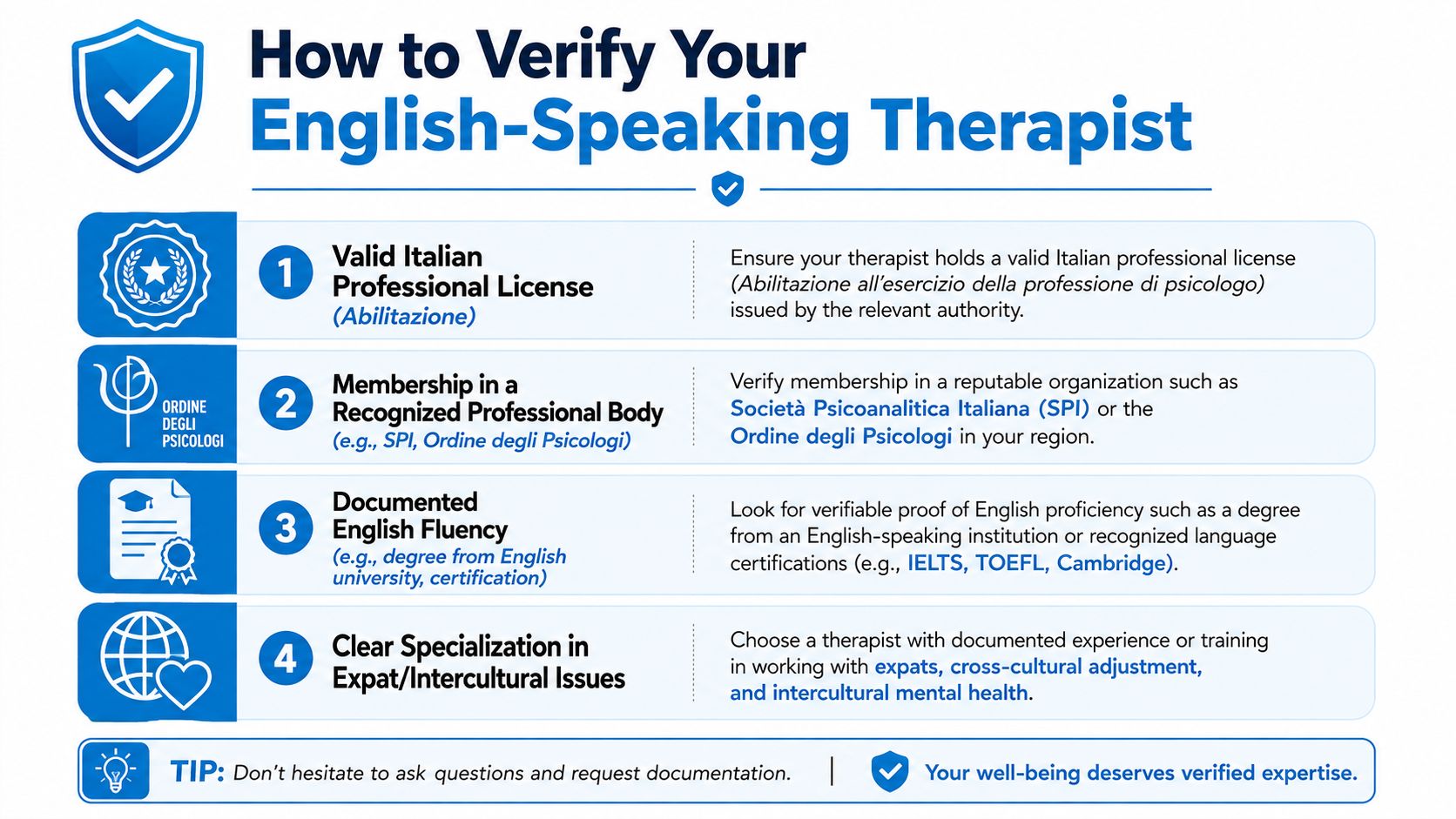
Start with registration, not charm. In Italy, a therapist should be able to show that they're legally authorised to practise, and you should ask for that directly if it isn't obvious on their profile. A polished website and an English bio don't mean much if the clinician can't prove they're registered in the Italian psychology system.
Then check whether English is their working language or just a second-language convenience. The difference shows up fast in the first contact, because fluent therapeutic English needs more than casual conversation. It has to carry emotional nuance, hesitation, humour, and the specific vocabulary of your life.
A therapist can be pleasant in English and still be the wrong therapist for English-language depth work.
Ask the questions that actually matter
You don't need a long interview. You need a few direct questions that separate serious candidates from merely searchable ones.
- Registration: Ask where they're registered and whether they practise in Italy under that registration.
- English fluency: Ask whether sessions are regularly conducted in English, not just whether they “speak” English.
- Expat experience: Ask if they routinely work with relocation stress, homesickness, identity shifts, workplace isolation, or intercultural relationships.
- Rematching policy: Ask what happens if the therapeutic fit isn't right after the first meeting.
- Format: Ask whether they offer online, in person, or both, because flexibility matters when your schedule is already stretched.
These questions protect you from the most common mismatch, which is not bad intent, but weak fit. Many therapists are competent and kind, yet still not the right match for someone processing migration, cross-cultural family dynamics, or the pressure of holding two identities at once. For a practical comparison of what kind of clinician you may need, see Therapsy's guide on psychologist versus psychiatrist.
Don't mistake directory language for clinical fit
A therapist showing up in an English-language listing is not enough. Search results often blur together independent clinicians, generic directories, and services that may or may not match your exact needs, which is why you should always verify both language and credentials yourself. The question isn't just “can I book this person?”, it's “can I do meaningful therapy with them?”
That's where a service like Therapsy's therapist matching page becomes useful, because it pushes you toward a human review of language, style, and need rather than a blind directory choice. If you're comparing options across Italy and still feeling unsure, Therapsy's expat therapy guidance is one of the clearest places to start.
Choosing the Right Therapeutic Approach for Expat Challenges
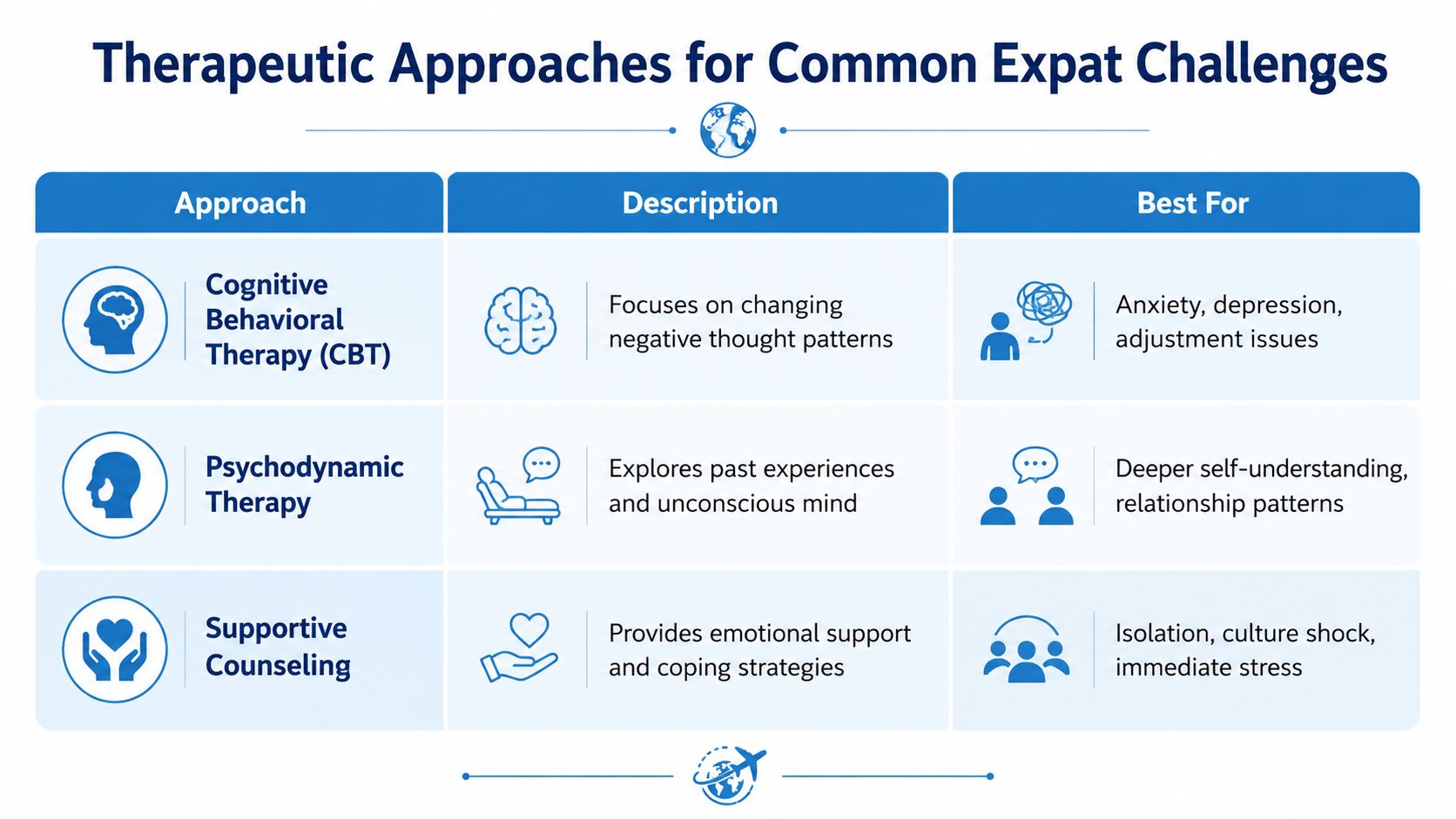
The right language is only half the decision. If you're dealing with anxiety, burnout, relationship strain, trauma, or identity loss after moving, the method matters just as much as the person. A competent therapist can still be ineffective if their approach doesn't fit the kind of problem you're carrying.
Match the method to the problem
CBT is usually the most practical fit when your mind is stuck in spirals, catastrophising, avoidance, or constant self-criticism. It's structured, concrete, and useful when you want to change the thought patterns that keep feeding anxiety or low mood.
EMDR is the one to ask about when a specific event, or a cluster of distressing memories, still feels live in your body. It's often relevant for people whose relocation triggered old wounds, accidents, losses, or experiences that now show up as reactivity, shutdown, or intrusive recall.
Schema Therapy makes sense when the pain feels older than the move itself. If you keep falling into the same relationship pattern, or if expat life has activated a deeper sense of being rejected, abandoned, or never quite enough, schema work can be a better fit than short-term coping alone.
Systemic-relational therapy is especially useful for couples and families. Cross-cultural relationships often fail not because love disappears, but because each person is speaking from a different rulebook, and nobody is naming the pattern.
Use the approach to sharpen your questions
Don't ask, “Do you do therapy in English?” and stop there. Ask, “What approaches do you use for adjustment stress, trauma, or couples conflict?” Then listen for specifics.
- CBT fit: best when you want tools for thought patterns, panic loops, and avoidance.
- EMDR fit: best when the issue feels trauma-linked, sticky, or body-based.
- Schema fit: best when the same relational wound keeps repeating.
- Systemic-relational fit: best when the problem lives between people, not just inside one person.
What to watch for in the first conversation
The first conversation should tell you whether the therapist understands expat stress as more than homesickness. The good ones can talk about isolation, role loss, cultural dissonance, and the strange mix of freedom and grief that comes with moving countries.
If you're looking for a service that already combines multilingual matching with evidence-based methods, Therapsy's therapy services page is worth reviewing. It's also one of the few places in Italy where the intake process is designed around language, fit, and clinical supervision rather than a one-size-fits-all listing.
The Smart Way to Book Your First Session Without Wasting Time or Money
Book the first contact as a test of fit, not as a commitment. That simple shift saves you from paying for multiple sessions with someone who seemed right on paper but feels wrong once you start talking.
Use a two-stage matching process
The best workflow is straightforward. First, screen for language, registration, and relevant experience. Then use a brief initial conversation to see whether the therapist's style fits your needs before you commit to ongoing work.
Best practice: a short assessment contact should happen before you decide on a full treatment path.
A free assessment call is especially useful because it lowers the cost of getting it wrong. You can hear how the therapist communicates, whether they understand your English naturally, and whether they seem grounded in the reality of expat life rather than just theoretically aware of it.
Ask practical questions before you pay
This is the point where many people get polite, vague, and then stuck. Don't do that. Ask about session format, availability, what the first meeting looks like, and what happens if you don't feel the fit after the call.
The most useful thing is clarity around logistics. Therapsy's Genoa service describes a flow that starts with a form, then a free conversation for matching, then a free assessment call with the assigned therapist, with sessions available online or in person in Genoa at Vico Assereto 3 and no surcharge for online versus in-person care (Therapsy Genoa). For a first-session overview that shows what to expect from an intake meeting, see Therapsy's first psychological session guide.
Red flags that mean you should keep looking
- Vague language about English: If they say they “speak English” but never say they work in English, assume nothing.
- No clear registration detail: If you can't verify their legal status, don't book yet.
- No mention of expat experience: If your main issue is migration stress and they only discuss generic wellbeing, the fit may be weak.
- Rigid process: If there's no room for rematching or clarifying the approach early, the risk of wasted sessions goes up.
Pricing should also be transparent. In the Therapsy model, individual therapy starts from €70, couple therapy from €100, and psychiatric consultation from €110. If budget is part of the decision, compare the structure rather than the headline number, and review Therapsy pricing before you decide.
Why Multilingual Matching Matters More Than English-Only Availability
English-only availability is useful, but it's not the whole story. For many expats, the deeper issue is not “Can I speak English with this therapist?” It's “Can I think, feel, and argue in the language that carries my emotional life?”
That's especially true in couples work. One partner may prefer English, another may feel more precise in Italian, and a third language may sit in the background of family history, shame, or migration. If the therapist can't work across those realities, the session may stay polite while the core issue stays untouched.
Language is not the same as emotional access
A person can speak English well and still miss the texture of what you're saying. Nuance matters when you're describing grief, resentment, fear, or the confusion that comes from feeling like a different person in a different country.
Multilingual matching also matters because expat problems are rarely just linguistic. They are about identity, belonging, power, and the strain of switching selves across contexts. A therapist who understands that can work better with your actual experience, not just your translated version.
The strongest match is cultural, not just grammatical
If you're in a mixed-background household, the right therapist may need to manage more than one language and more than one worldview. That's why a human matching process is so important, because the best fit often depends on subtler things than language alone, including therapeutic style and the specific shape of the family system.
That's also why a multilingual service can be more useful than a directory full of English profiles. Therapsy's multilingual psychotherapy for expats reflects that broader reality, where language, culture, and context all shape whether therapy becomes helpful or just technically possible.
The English-speaking therapists we work with in Genoa
Therapsy works with a therapist who receives in person in Genoa and also sees patients online.
Dr. Ludovica Bosetti is a clinical psychologist in Genoa who offers sessions in four languages: Italian, English, Spanish and German. She works with individuals and couples on emotional regulation, anxiety, depression, eating disorders and psychosomatic symptoms, and with what she calls profound emotional suffering: inner emptiness, disconnection, existential distress. Her approach combines CBT, DBT, mindfulness and guided imagery.
You do not have to work out on your own whether she is the right fit. You tell Therapsy what you are looking for, a member of our clinical team reads your request, and they introduce you to whoever fits. The first call is free.
FAQ
How much does an English-speaking therapist in Genoa usually cost
The exact fee depends on the clinician, but you should expect transparent pricing before you book. In the Therapsy model, individual therapy starts from €70, couple therapy from €100, and psychiatric consultation from €110.
Is online therapy as effective as in-person therapy for expats
Yes, when the therapist is a good fit and the work is structured well. Online sessions can be especially useful if you're short on time, travelling, or still deciding whether the local match is right.
What if the first therapist doesn't feel right
Say so early and ask about rematching. A strong service should make that process straightforward, because fit matters more than forcing yourself to continue with the wrong person.
Should I choose a psychologist or a psychiatrist first
Choose based on the problem, not the title. A psychologist or psychotherapist is often the right first step for talk therapy, while a psychiatrist is more relevant if medication or diagnostic evaluation may be needed.
Can therapy be reimbursed in Italy
Sometimes, yes, depending on your insurer or benefit plan. Check the reimbursement rules before you start, and confirm whether the clinician provides the documentation your plan requires.
If you want English-speaking therapy in Genoa without the usual guessing game, start with a service that matches you by language, registration, and fit before you pay for a full course of sessions. THERAPSY offers multilingual therapy online and in person in Italy, with a free assessment call and human matching, so you can speak to someone who will listen and direct you to the right support.