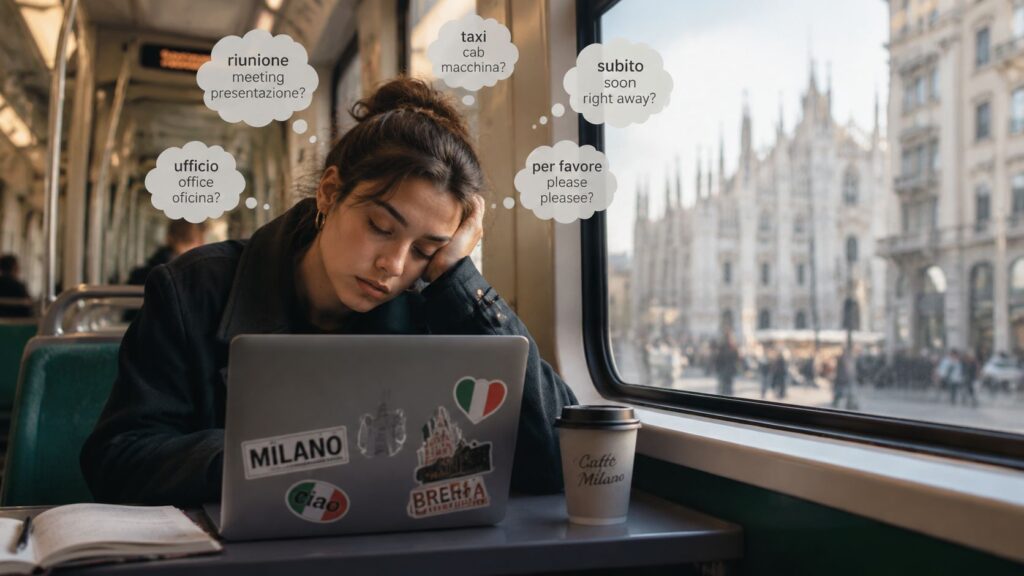
An expat identity crisis is the deep confusion and loss of self that can happen when the roles, routines, and relationships that once defined you disappear after a move abroad. It's especially understandable in expat life because 27% of expats leave family behind to avoid risking a partner's career, and only 20% of expat partners continue working after relocation, so the loss of professional identity is often part of the crisis.
You can be sitting in a beautiful piazza, drinking good coffee, surrounded by everything you thought would feel romantic and alive, and still feel strangely absent from your own life. Many American women in Italy feel guilty for that. They think, “I wanted this. Why do I feel so off?”
That inner split is one of the clearest signs of an expat identity crisis. You may look fine from the outside and still feel untethered inside. The move may have given you a new country, but it may also have taken away the familiar structure that told you who you were.

I'm Dr. Francesca Adriana Boccalari, Clinical Director at Therapsy. In my work with expats and international women in Italy, I see this pattern often. It isn't vanity, weakness, or a failure to “adjust properly.” It's what happens when a person's sense of self is stretched across languages, expectations, and losses that other people don't always see.
Introduction
What exactly is an expat identity crisis
An expat identity crisis is not just homesickness. It is a disruption in your sense of who you are. It happens when the external pillars of identity, such as work, social role, language, daily rhythm, and belonging, are suddenly changed or removed.
A move to Italy can unsettle identity in quiet ways. You may no longer be the capable professional who knew how to get things done. You may become “the foreign partner,” “the American wife,” or “the one who doesn't speak Italian well enough yet.” Those labels can start to feel larger than your actual self.
When the move changes more than your address
Identity is partly internal, but it is also reinforced by everyday life. Your colleagues reflect your competence back to you. Your friendships remind you how you're known. Your routines hold together your values, your time, and your energy. When those disappear, many people do not just miss home. They lose orientation.
A useful way to think about it: when the scaffolding around your life comes down, you don't just lose convenience. You lose mirrors.
For many women, professional identity is central here. If your move involved stepping away from your career, your identity crisis may be tied not only to place, but also to purpose.
Why it feels so personal
This experience often shows up as questions rather than statements:
- Who am I here?
- What counts as success now?
- Why don't I feel like myself, even when nothing is “wrong”?
- Do I still belong to the life I came from?
The confusion can also spill into your body. Appetite changes, fatigue, self-doubt, and feeling emotionally flat can all become part of the picture. If your relationship with food, control, or body image has shifted under stress, resources like Weight Loss And Mental Health can help you think more carefully about how emotional strain affects daily habits.
Many women first assume they only have culture shock. Sometimes that's true. Sometimes the deeper issue is identity. If that distinction feels blurry, this guide on culture shock in Italy can help clarify what belongs to adjustment stress and what points to something more profound.
What an expat identity crisis is not
It isn't a sign that you made the wrong move.
It isn't proof that you're ungrateful.
It isn't a failure to appreciate Italy.
It is often a sign that your old identity no longer fits cleanly, and your new one hasn't fully formed yet.
Why moving to Italy can trigger an identity crisis
Italy is beautiful, but beauty doesn't protect anyone from psychological disorientation. In fact, the gap between the fantasy of life in Italy and the experience of living here can make identity disruption sharper. When the outside world keeps telling you that you should feel lucky, you may judge yourself more harshly for feeling lonely, angry, or lost.

The career trade-off many women carry silently
One of the strongest triggers is the loss of professional identity. For many American women in Italy, that means the move is not only geographic. It is also a forced reorganisation of ambition, autonomy, and self-respect.
If you were used to being financially independent, mentally stimulated, and recognised for your skills, the shift can feel brutal. Even if you chose the move willingly, you can still grieve what it cost.
Italy changes the small things that hold identity together
An expat identity crisis rarely comes from one dramatic event. More often, it grows through daily friction.
Common triggers include:
- Language limitation. You can't express your humour, intelligence, nuance, or warmth as easily as you can in English.
- Role reduction. People meet you through your relationship status, visa status, or nationality before they know you as a full person.
- Invisible labour. Bureaucracy, paperwork, appointments, and practical adaptation consume energy that used to go elsewhere.
- Social asymmetry. Your partner may have work, colleagues, and local anchors while you are still trying to build a day that feels like yours.
- Cultural mismatch. Norms around friendship, family closeness, time, gender expectations, or work style may not align with what feels natural to you.
The emotional pattern often follows a recognisable arc
Many women find relief when they realise the experience is patterned. It doesn't always unfold neatly, but it often includes phases like these:
Arrival and projection
Italy feels vivid, meaningful, and full of possibility.Disorientation and disappointment
The practical realities arrive. You feel less capable, less visible, or less grounded than you expected.Identity questioning
You start asking whether the problem is the country, the relationship, or you.Rebuilding
You slowly begin to form a more realistic, more self-authored version of life abroad.
Practical rule: if your daily life has narrowed and your sense of self has narrowed with it, the problem is not “just stress.” Identity may be involved.
If you've recently arrived and want a more practical adjustment framework, this mental health checklist for moving to Italy can help you notice strain earlier.
Recognising the signs and stages of an identity crisis
Some women describe an expat identity crisis as feeling homesick. Others say they feel fake, split in two, or emotionally blurry. The exact language differs, but the pattern is usually recognisable.
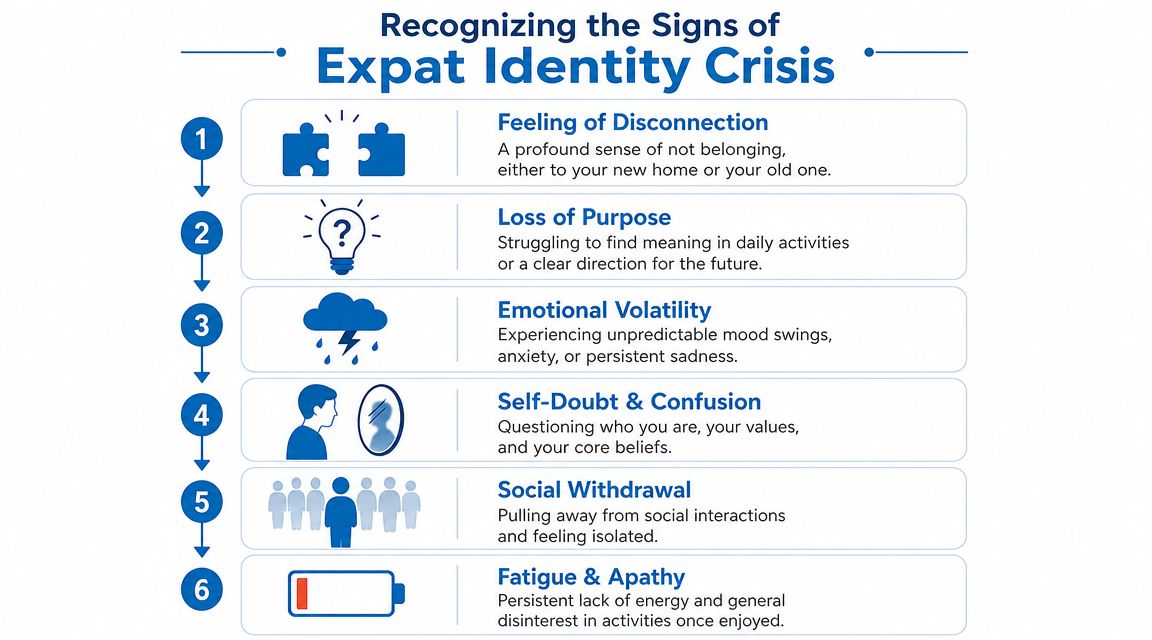
Common signs
Look for clusters rather than one isolated symptom.
- You don't feel like yourself. You may function outwardly, but internally you feel unfamiliar to yourself.
- Small decisions feel strangely hard. Choosing where to live, whether to work, whether to stay in Italy, or even how to spend a day can feel loaded.
- You feel invisible. Your qualifications, personality, and history seem to disappear in the new context.
- You withdraw socially. You stop reaching out because it's tiring to explain yourself or because you don't feel fully understood anywhere.
- You miss a previous version of yourself. Not only your old country, but your old confidence, voice, and energy.
- You question your purpose. Especially if your previous life had clear momentum and your current one feels undefined.
These experiences can overlap with depression. If you're unsure where that line is, this article on expat depression in Italy can help you recognise when the emotional burden has become heavier than adjustment alone.
A simple way to understand the stages
This isn't a strict clinical model. It's a practical map.
| Stage | What it often feels like | What usually helps |
|---|---|---|
| Arrival | Excitement, idealisation, intense comparison | Curiosity without pressure |
| Fracture | Frustration, grief, anger, confusion | Validation and structure |
| Negotiation | Experimenting with new routines and values | Consistency and reflection |
| Integration | A more stable, hybrid sense of self | Ongoing support and flexibility |
Two exercises you can try this week
These are simple tools drawn from evidence-based practice, especially CBT and mindfulness.
Thought tracking for identity triggers
Write down one moment each day when you feel “less like yourself.” Then note:- what happened
- what thought appeared
- what emotion followed
- what you needed in that moment
This helps separate the event from the meaning you attached to it.
Five-minute grounding in public spaces
If an Italian market, café, office, or social gathering makes you feel detached, pause and name:- five things you can see
- four things you can feel physically
- three sounds you can hear
- two things you can smell
- one thing you need right now
This doesn't solve the identity issue, but it reduces overwhelm so you can respond rather than shut down.
Feeling lost abroad doesn't always mean you're in the wrong place. It often means your nervous system and your identity are both trying to catch up with a life change.
Evidence-based coping strategies and self-help exercises
The most helpful response to an expat identity crisis is not to force yourself to “be positive.” The more effective approach is to rebuild identity on purpose. That means creating new anchors rather than waiting passively to feel normal again.

Rebuild your personal narrative
When identity feels unstable, your mind often fills the gap with harsh interpretations. “I've become dependent.” “I'm wasting my life.” “I had potential back there, not here.” CBT helps by identifying those thoughts and testing them rather than treating them as facts.
A useful prompt is this:
- What did this move interrupt?
- What parts of me are still intact?
- What values do I want my life in Italy to reflect now?
Write your answers by hand if possible. Identity becomes clearer when experience is turned into language.
Create new pillars of selfhood
What doesn't work is building your whole self around one role, especially “partner of someone who moved here for work.” What works better is spreading identity across multiple sources of meaning.
Try building at least three active pillars:
One competence pillar
A course, language class, freelance project, portfolio, or structured learning goal.One belonging pillar
A regular group, volunteering, creative community, walking group, book club, or spiritual practice.One pleasure pillar
Something not tied to productivity. Cooking, ceramics, swimming, drawing, singing, or a weekly train trip to explore somewhere new.
This is not about being busy. It's about becoming visible to yourself again.
Regulate before you analyse
When your nervous system is overloaded, identity questions become harder to think through. You can't reflect well when you're in survival mode.
Use brief regulation practices:
- Box breathing before a difficult conversation
- A sensory reset after a bureaucratic or language-heavy day
- A transition ritual between home and social life, such as music, tea, a walk, or journalling for ten minutes
The goal is not to become the person you were before moving. The goal is to become someone coherent in the life you have now.
Know what each therapeutic approach is good for
Research from Pepperdine University found that international assignments often involve significant identity transformation, including behavioural and attitudinal changes, and that this process can help people discover parts of identity they had not previously recognised according to Pepperdine research on expatriate identity transformation. That matters because it reframes the crisis. It is painful, but it is not meaningless.
Different therapies support different parts of this work:
- CBT helps when your thoughts have become self-critical, catastrophic, or rigid.
- EMDR can help if the move activated older memories of rejection, instability, loneliness, or previous losses.
- Schema Therapy is useful when the relocation keeps triggering deeper patterns such as abandonment, failure, or not belonging.
- If you want a plain-language introduction to one of these methods, this guide to cognitive behavioural therapy is a good place to start.
Self-help can help a lot. But if your identity feels fragmented for too long, professional support often gives the process shape, language, and safety.
When to seek professional help for an identity crisis
You don't need to wait until you're falling apart to ask for help. Therapy for expats in Italy is often most useful when confusion has become persistent, repetitive, or isolating.
A short difficult phase after relocation is common. The concern grows when the crisis stops moving and starts hardening.
Signs that support would be wise
Consider professional help if any of these feel true:
- You've been stuck for months and the same thoughts keep circling without resolution.
- Your daily functioning has dropped. Getting out of bed, making decisions, caring for yourself, or following through on basic tasks feels harder than usual.
- Your relationships are straining because you feel misunderstood, resentful, or emotionally unreachable.
- You no longer recognise what you want. Every option feels wrong, and indecision has become paralysing.
- Self-help tools give only temporary relief and the same inner collapse keeps returning.
Waiting for certainty before starting therapy is often ineffective. Individuals frequently seek support specifically because they are experiencing uncertainty.
Why therapy helps with identity, not just symptoms
Identity disruption needs more than reassurance. It needs a place where the inner contradictions can be organised. You may love Italy and hate your life in Italy. You may be grateful for your relationship and still resent what the move cost you. Both can be true.
Pepperdine research described expatriate identity transformation as a predictable developmental process rather than something pathological. That distinction is clinically important. It means therapy can focus not only on symptom reduction, but also on integration, meaning, and growth.
In practice, that often looks like:
- identifying what has been lost and what can be rebuilt
- separating your authentic values from pressure to adapt
- understanding which old emotional patterns the move has activated
- developing a coherent story about who you are becoming
The issue many services miss
Many resources are built around early culture shock. They assume the crisis belongs to the first phase of relocation and fades once you've learned the basics. For some women, that isn't what happens.
Long-term expats often develop a more complex hybrid identity. They don't feel fully at home in the United States anymore, but they also don't feel fully Italian. This is often described as a third culture identity, a form of selfhood that exists between worlds rather than inside one of them. That's why some women feel more confused after several years than they did in the beginning.
A service such as finding the right therapist for expats in Italy can be especially useful when you need a clinician who understands migration, language, and bicultural identity rather than treating your distress as generic anxiety alone. In that context, Therapsy offers multilingual psychotherapy in Italy with human matching, online and in-person care, and approaches such as CBT, EMDR, and Schema Therapy that are well suited to identity work.
Finding the right support in Italy with Therapsy
Finding psychological support in Italy can be harder than many expats expect. The problem is not only language. It is also fit. A therapist may speak English and still not understand what relocation does to identity, partnership dynamics, career grief, or long-term cultural ambiguity.
What to look for in practice
If you're searching for support, these criteria matter:
- Language comfort. You should be able to speak in the language that gives you emotional precision.
- Migration awareness. The therapist should understand that relocation stress is not a niche detail. It is central.
- Flexible format. Online sessions often make continuity easier, especially if you travel or live outside a major city.
- A good match. Technique matters, but so does feeling understood.
Some women also benefit from broader community structures alongside therapy. If part of your struggle is social isolation, models like community-driven coliving for remote workers can be a useful example of how intentional belonging can support emotional adjustment, even if your own version in Italy looks different.
Why long-term identity work needs a different lens
Many services still approach expat distress as a short-term adaptation issue. That misses what happens when you've been abroad for years and your life no longer fits either country cleanly.
That experience often needs deeper identity integration, not just coping tips for the first year.
Practical details that often matter
Therapsy provides therapy in 14 languages, with online and in-person sessions across 24 Italian cities and 90+ physical locations. Individual therapy is available from €70/session, couple therapy from €100/session, psychiatric consultation from €110/session, and psychodiagnostic assessment from €255.
The first assessment call is free and there's no commitment. Matching is done by the Clinical Director rather than by an automated questionnaire, which often matters when your issue is nuanced and tied to identity, migration, and personal history rather than a simple symptom checklist.
Who works with identity and migration at Therapsy
Not knowing who you are in either country is not a failure to adapt. These clinicians work on it specifically.
Dr. Anna Valfredi has extensive experience with expatriates, migrants and refugees, and her declared focus is identity, cultural transitions and the psychological impact of migration. She is in Milan and works online.
Dr. Maria Gonaria Demontis works in transcultural psychotherapy and offers psychological support through the migration process in both directions: to people who moved to Italy, and to Italians who moved abroad.
Dr. Tehreem Qureshi wrote her research thesis on identity development and cultural belonging among young adults with migrant backgrounds, and offers sessions in Urdu and Hindi as well as English and Italian.
You do not have to work out who fits on your own. You tell Therapsy what you are looking for, a member of our clinical team reads your request, and they introduce you. The first call is free.
FAQ
Is expat identity crisis a real psychological experience
Yes, expat identity crisis is a real psychological experience. It describes the confusion and loss of self that can happen when relocation disrupts the roles, routines, language, and relationships that used to anchor identity.
How long does an expat identity crisis last
It varies from person to person. For some women it eases as they build new routines, while for others it becomes more complex over time, especially if they develop a hybrid identity and feel they no longer fully belong in either country.
Is expat identity crisis the same as depression
No, they are not the same, though they can overlap. An identity crisis centres on confusion about self and belonging, while depression usually involves a broader lowering of mood, motivation, and functioning that may need direct clinical attention.
Can I work through an identity crisis without therapy
Yes, sometimes you can, especially if you have strong support, self-awareness, and room to rebuild your life actively. But if you feel stuck, isolated, or emotionally worn down, therapy often helps you move from confusion to clarity faster and with less self-blame.
Why do I feel worse after living in Italy for years, not better
Because long-term expat life often raises deeper identity questions than the early relocation period. Once the practical adjustment is over, many people start confronting the more painful issue of where they belong and who they are becoming.
What should I do if my partner doesn't understand what I'm going through
Start by describing the losses, not just the feelings. It's often easier for a partner to understand that you've lost work, familiarity, language ease, and social recognition than to understand “I don't feel like myself” without context.
What kind of therapy helps with expat identity crisis
CBT, EMDR, and Schema Therapy can all help, depending on what is driving the distress. CBT is helpful for harsh thought patterns, EMDR can support unresolved emotional activation, and Schema Therapy is useful when relocation touches older wounds around belonging, rejection, or self-worth.
If this feels familiar, you don't have to sort it out alone. Book your first free assessment call with THERAPSY, no commitment, just a conversation with our Clinical Director who will listen carefully and help match you with the right therapist for your situation.
Dr. Francesca Adriana Boccalari, Clinical Director at Therapsy