You moved to Italy for love, work, study, or reinvention. On paper, your life may even look impressive. You manage a job in Milan, a relationship across languages, family WhatsApp calls across time zones, and the endless logistics of appointments, documents, and adaptation. Yet privately, you may feel as if everything takes you more effort than it seems to take other people.
You forget small things that matter. You procrastinate on tasks that are urgent and important. You start the day with good intentions and end it exhausted, ashamed, and strangely confused about where the time went. You may have been told that you're anxious, overly sensitive, messy, dramatic, lazy, or burned out from expat life.
Sometimes that explanation fits. Sometimes it doesn't.
Female adhd late diagnosis often describes women who spent years functioning through intelligence, perfectionism, and overcompensation, while the underlying ADHD remained unrecognised. In adult women, ADHD does not always look like visible hyperactivity. It can look like chronic overwhelm, internal chaos, emotional intensity, missed deadlines, relationship strain, and a lifelong sense of underperforming despite trying very hard.
If you're an expat woman in Italy, that picture can become even harder to recognise. Culture shock, language fatigue, reduced support, bureaucratic stress, and isolation can make ADHD look like adjustment stress. The reverse is also true. Real adjustment stress can hide ADHD until your usual coping systems stop working.
As Dr. Francesca Adriana Boccalari, I want to say this clearly. What you've been struggling with may not be a personal failure. It may be an overlooked neurodevelopmental pattern that finally became impossible to ignore. The good news is that there is a way to make sense of it, seek a culturally sensitive assessment, and build support that suits your life in Italy.
Introduction The Unseen Struggle of High-Functioning Women in Italy
A common story goes like this. A woman arrives in Italy and keeps going through sheer force of will. She learns enough Italian to survive appointments. She performs well at work, or at least well enough that nobody sees the hours of last-minute panic behind the scenes. She appears organised from the outside because she relies on alarms, lists, colour-coded calendars, and a constant low hum of self-pressure.
Inside, it feels very different.
She loses track of routine admin. She avoids emails that require decisions. She feels flooded by simple tasks, then blames herself for being childish or incapable. If she cries after criticism, forgets deadlines, or shuts down in front of bureaucracy, she may conclude that she's just not coping well abroad.
A female adhd late diagnosis often arrives when a woman can no longer compensate for symptoms she has managed, hidden, or normalised since childhood.
For many women, the tipping point isn't childhood. It is adulthood under pressure. Moving country. Starting university. Becoming a parent. Entering a demanding workplace. Losing the structure that once held everything together.
When expat stress and ADHD overlap
Expat life in Italy can make the picture more confusing because the environment is demanding.
You may be dealing with:
- Language load that makes every phone call, form, and appointment feel harder than it should.
- Administrative burden that requires planning, follow-through, and patience.
- Social dislocation because your support network isn't physically nearby.
- Identity strain if your usual competence feels less accessible in a new culture.
None of that means you have ADHD. But if these challenges don't just feel stressful, and instead seem to expose a lifelong pattern of disorganisation, inattention, emotional reactivity, and chronic self-criticism, it is worth looking more closely.
What recognition often sounds like
Women considering ADHD later in life often say things like:
- "I've always felt capable, but never consistent."
- "I can do difficult things, but not simple routine things."
- "Everyone thinks I'm high-functioning, but I am constantly compensating."
- "I was treated for anxiety, but the anxiety never explained the whole picture."
That last point matters. Late-recognised ADHD in women is often hidden behind more familiar labels. Anxiety. Depression. Burnout. Perfectionism. Overwhelm. These can all be real. They can also be secondary to a brain that has spent years trying to self-manage unsupported executive difficulties.
The Hidden Face of Female ADHD
ADHD in women is often missed because the presentation is frequently quieter, more internal, and easier for others to misread. The stereotype remains a disruptive, hyperactive boy. Many adult women with ADHD never matched that picture, so nobody looked beneath the surface.
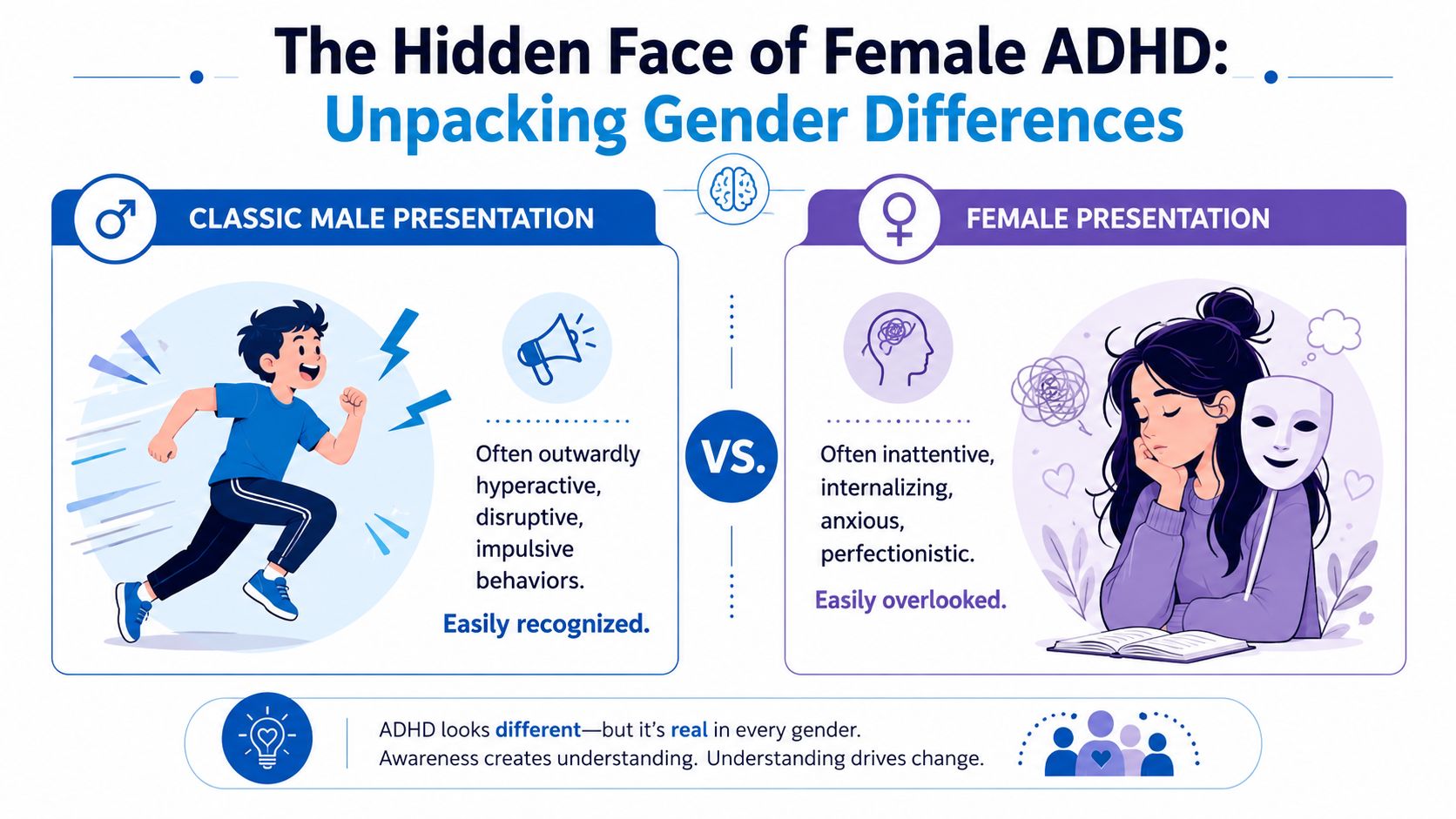
Internalising instead of externalising
Girls and women are more likely to show struggles that stay inside. Rather than obvious behavioural disruption, they may present with distractibility, chronic daydreaming, disorganisation, mental restlessness, and emotional intensity. In school, that often looks less alarming to adults, especially if the girl is bright, polite, and trying hard.
In clinical practice, this matters because what gets noticed is not always what causes the most suffering.
A woman may not interrupt the class. She may interrupt herself internally all day. She may not climb on furniture. She may sit still while her mind races, then go home and collapse from the effort of holding it together.
What adult women often recognise in themselves
Female ADHD can include:
- Inattention such as zoning out in meetings, rereading the same paragraph, or missing details in routine tasks.
- Executive dysfunction such as difficulty starting, sequencing, prioritising, or finishing tasks.
- Time blindness which means underestimating how long things take and feeling chronically late or rushed.
- Disorganisation that isn't about intelligence, but about managing competing demands in real time.
- Emotional dysregulation including fast shifts from calm to overwhelmed, especially under stress or criticism.
- Masking through perfectionism where the woman appears competent because she has built elaborate coping systems.
Emotional dysregulation means emotions can feel harder to modulate, recover from, or put into perspective, especially when stress, shame, or overload are already high.
Many women also describe what is often called rejection sensitive dysphoria, or RSD. This is not a formal diagnosis on its own, but a term people use to describe a very intense response to perceived rejection, criticism, or disapproval.
A small comment can feel emotionally huge, not because you're weak, but because your nervous system reacts quickly and deeply.
Why hormones can complicate recognition
For some women, symptoms become more obvious around puberty, menstrual cycle changes, pregnancy, postpartum, or other hormonal transitions. In assessment, I encourage women to notice whether concentration, irritability, overwhelm, or mental fatigue shift with these phases.
That said, hormones don't create ADHD from nowhere. They may make an existing pattern more visible.
What does not work
What usually doesn't help is reducing the issue to motivation or discipline. Women with ADHD often know exactly what they need to do. The problem is not insight. The problem is consistent execution under real-life conditions.
That distinction is essential. It is also profoundly relieving once understood.
Why So Many Women Are Diagnosed Late or Never
A woman moves to Italy for work or family, spends months feeling disorganised, emotionally flooded, and behind on ordinary tasks, then hears a familiar explanation: stress, language fatigue, burnout, adaptation. Sometimes that explanation is accurate. Sometimes it covers only the surface of a much older pattern.
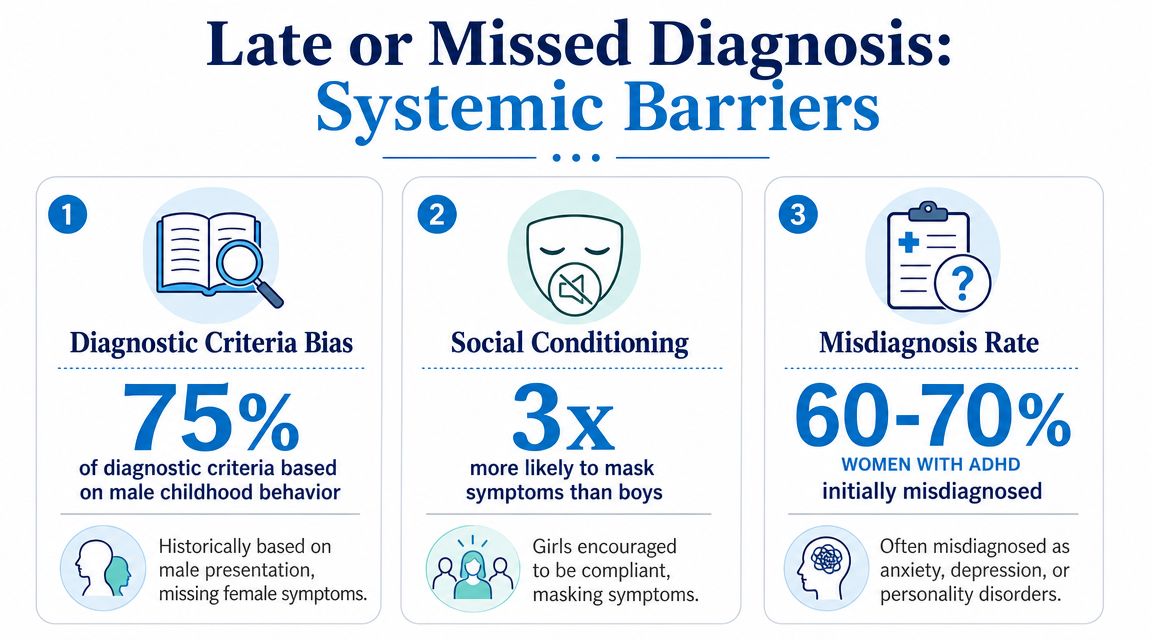
Women are often diagnosed late because the signs were filtered through other people's expectations for years. Families may see the child as dreamy or sensitive. Schools may notice inconsistency but not impairment. Clinicians may focus on anxiety, low mood, or relational strain, especially if the woman is articulate, employed, and outwardly capable.
The referral pattern starts early
In practice, this means many women arrive in adulthood with no language for what has been happening. They know they work harder than other people for the same outcome. They know they can perform well under pressure and still fail at consistency. What they often do not know is that these are common ADHD presentations, especially in women who learned early to compensate.
Masking often looks responsible from the outside
Many girls discover that visible struggle attracts criticism, while overperformance attracts approval. So they become the reliable one, the bright one, the helpful one, or the perfectionist. Those adaptations can hide significant executive dysfunction for years.
Masking may include:
- Overpreparing so nothing is forgotten in public
- Memorising social rules rather than responding naturally
- Using perfectionism to prevent mistakes
- Depending on urgency or panic to start tasks
- Borrowing organisational systems that never quite fit real life
I often see this break down at predictable pressure points. University. A first demanding job. Motherhood. A move abroad. In an expat context, life in Italy can add bureaucracy, language switching, isolation from familiar support, and a loss of routines that used to hold everything together. The symptoms were usually there before. The relocation removes the margin that was keeping them hidden.
Misdiagnosis happens because the first story sounds plausible
A woman may seek help for anxiety, exhaustion, procrastination, tearfulness, shame, or chronic overwhelm. Those symptoms are real. They may also be secondary to untreated ADHD.
CHADD notes that adult women are more likely than men or boys to be misdiagnosed or receive incomplete diagnoses, and many leave healthcare visits with anxiety and/or depression diagnoses but no ADHD mention (CHADD on bias and late diagnosis in women).
This matters clinically. If treatment addresses only anxiety, some relief may follow, but the daily pattern often stays the same. Missed deadlines. Lost paperwork. Mental clutter. Difficulty starting. Difficulty stopping. A persistent sense of failing at things that look simple to everyone else.
A better assessment asks a longer question. Were these difficulties present before the move to Italy, before this relationship, before this job, and across more than one setting?
Why expat women in Italy are missed so often
For expat women, the diagnostic picture can become blurred for understandable reasons. Relocation stress can produce distractibility, fatigue, irritability, poor sleep, and a feeling of cognitive overload. Italian systems can also be hard to manage if you are already stretched. Booking appointments, understanding referrals, explaining subtle symptoms in a second language, and finding a clinician who recognises female ADHD all require executive capacity.
That creates a real trade-off. Some women delay assessment because they are trying to stabilise work, visas, housing, children, or finances first. Others pursue help quickly but meet professionals who interpret the problem only through the lens of adjustment, motherhood, anxiety, or cultural transition.
A culturally aware assessment should separate state from pattern. Stress after migration can worsen attention and organisation. It does not explain a lifelong history of losing track, underestimating time, overcompensating, and feeling chronically out of step with ordinary demands.
That distinction can change the whole course of care.
The Emotional Toll of an Undiagnosed Life
By the time a woman reaches late diagnosis, she often carries much more than symptoms. She carries an interpretation of herself. That interpretation is usually harsh.
Many women have spent years believing they are inconsistent, overdramatic, careless, too much, not enough, or somehow failing at adulthood despite obvious effort. The emotional burden comes not only from ADHD itself, but from living without a framework that makes your experience coherent.
The cost of constant self-correction
When you live with unsupported ADHD traits, ordinary life can become a cycle of effort, collapse, guilt, and repair. You promise yourself to be more organised. You build a new system. It works briefly. Then something slips, and the old shame returns.
Over time, that pattern can erode self-trust.
A Welsh study found that girls and young women with a later ADHD diagnosis had higher rates of anxiety, depression, self-harm, school absences, and greater use of emergency services by adolescence.
If you or someone near you is in immediate danger, call 112, the emergency number in Italy and across the EU. Therapy is not an emergency service.
How it can show up in adult life
The emotional toll often appears in areas that people don't immediately connect to ADHD:
- Imposter syndrome despite real competence
- Relationship conflict because forgetfulness, overwhelm, or sensitivity are misread as not caring
- Workplace burnout from doing everything at the last minute under intense pressure
- Social withdrawal because keeping up feels exhausting
- Persistent low mood tied to self-criticism rather than only sadness
Sometimes a woman starts exploring ADHD after reading about burnout or high-functioning depression and recognising parts of herself there. If that resonates, this guide on signs of high-functioning depression may help you think through overlap without collapsing everything into one explanation.
A late diagnosis often brings relief and grief at the same time. Relief because things finally make sense. Grief because support could have arrived earlier.
Reframing the past without erasing the pain
A good diagnostic process doesn't rewrite your history into something neat. It gives language to patterns that were there all along. That can change how you relate to old memories of school, friendships, work, or family conflict.
Self-compassion becomes more possible when the question changes from "Why am I like this?" to "What was I trying to manage without understanding it?"
Navigating an ADHD Assessment in Italy as an Expat
You book a medical appointment in Italy to ask about attention problems, and within ten minutes the conversation turns to stress, relocation, or anxiety. Sometimes that is accurate. Sometimes it misses a much older pattern.
For expat women, the central question is not only, "Am I struggling now?" It is, "Have these difficulties followed me across countries, life stages, and roles?" A careful ADHD assessment separates long-standing neurodevelopmental patterns from the significant strain of migration, language fatigue, bureaucracy, isolation, and starting over in a different culture.
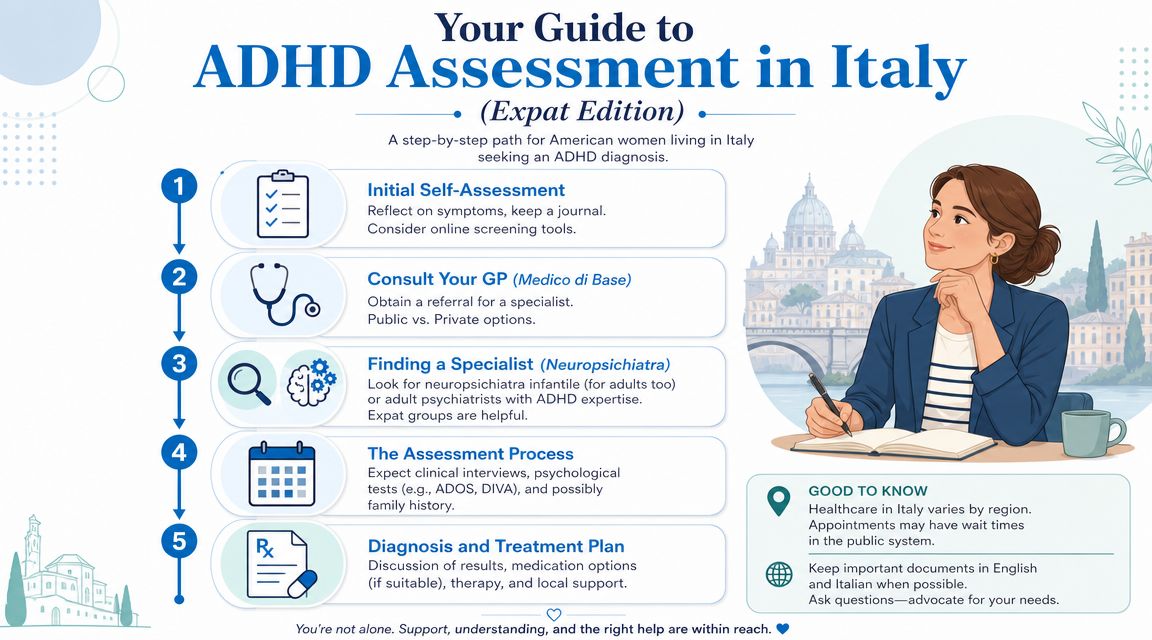
Start with your timeline
A strong adult ADHD assessment in Italy should begin with history. Current overwhelm matters, but it is not enough on its own. The clinician should ask what was present in childhood, how you managed at school, what strategies you used to compensate, and whether the same difficulties keep resurfacing under different external conditions.
European guidance on delayed diagnosis in girls and women supports this developmental-history approach, including attention to masking and to women who were treated for anxiety or depression before ADHD was considered (European clinical guidance on delayed diagnosis and developmental history).
Before a first appointment, prepare notes on:
- Childhood patterns such as distractibility, losing things, daydreaming, emotional intensity, or inconsistency
- School and university history including procrastination, unfinished work, last-minute performance, or doing well only under pressure
- Adult functioning at work, at home, in relationships, with money, and with routines
- Compensation strategies such as perfectionism, overpreparing, people-pleasing, or relying on urgency to get things done
- Collateral observations from a parent, sibling, or someone else who knew you well early on
Written notes help. Many women remember far more once they stop trying to explain everything on the spot in a second language.
Know who does what in Italy
The Italian system can feel opaque if you are used to a different referral route. Public and private options both exist, and the right choice often depends on language needs, waiting time, cost, and whether you may want medication review later.
| Professional | Usual role |
|---|---|
| Psychologist or psychotherapist | Assesses symptoms, developmental history, daily functioning, and differential diagnosis through interviews and psychodiagnostic work |
| Psychiatrist | Reviews psychiatric and medical factors, confirms diagnosis within clinical care when appropriate, and prescribes medication if indicated |
| GP or medico di base | Can advise on referrals, but many expats choose private care for faster access and English-language availability |
In practice, some women need both a psychologist and a psychiatrist. One may clarify whether the pattern fits ADHD, trauma, burnout, anxiety, or a combination. The other may assess medication options and monitor side effects.
What a careful assessment should include
Adult female ADHD is often missed when the clinician focuses only on visible hyperactivity or only on your current stress level. A better assessment is broader and more specific at the same time.
Look for someone who asks about:
- Lifelong consistency of symptoms across settings and life phases
- Masking and overcompensation
- Anxiety, depression, trauma, and burnout as possible overlaps, consequences, or co-occurring conditions
- Hormonal changes if you notice symptom shifts around your cycle, pregnancy, postpartum, or perimenopause
- Expat stress including homesickness, cultural dislocation, bureaucratic overload, language strain, and loss of support systems
This distinction matters clinically. Expat stress can worsen concentration, sleep, and emotional regulation. ADHD usually shows a longer pattern that predates the move, even if relocation is what finally makes coping strategies collapse.
Practical advice for English-speaking expat women
Ask direct questions before you book. Do you assess ADHD in adult women? Do you work in English? How do you distinguish ADHD from anxiety, trauma, or relocation stress? Will the assessment include developmental history?
Those questions save time, money, and self-doubt.
Useful signs include a clinician who takes inattentive symptoms seriously, understands high-masking presentations, and does not dismiss the possibility of ADHD because you had good grades, a demanding job, or periods of high achievement. Less helpful routes include relying on one online checklist, accepting "it is just stress" without a developmental review, or working with someone who expects childhood ADHD to look only like disruptive behaviour.
If you want an English-speaking starting point, this page on adult ADHD assessment and support in Italy explains available psychodiagnostic and therapy options.
Holistic Treatment Pathways After Diagnosis
A diagnosis can be clarifying, but clarity is only the beginning. Most women need support in at least two areas after diagnosis. First, they need help with current functioning. Second, they need help processing the meaning of having gone so long without recognition.
That is why the most effective treatment approach is usually holistic rather than single-track.
Medication can help, but it is not the whole treatment
For some adults, medication reduces core symptoms enough to make daily life more manageable. It can support attention, task initiation, and impulsivity regulation. It may also reduce the level of effort required for basic organisation.
But medication doesn't automatically heal years of shame, rebuild self-trust, or teach planning systems that fit your life. It is one tool, not a complete answer.
Therapy matters because late diagnosis affects identity
Women diagnosed later often need therapy not only for ADHD symptoms, but for the emotional consequences of years spent misunderstanding themselves.
Useful therapy goals often include:
- Separating ADHD from character judgement
- Reducing perfectionism and panic-driven productivity
- Building realistic systems for planning and follow-through
- Working through grief, anger, or relief after diagnosis
- Addressing anxiety or depression that developed secondarily
The right therapy for adult ADHD is practical and compassionate. It should help you function better now and understand yourself more accurately over time.
Which approaches tend to help
Different methods support different parts of recovery.
CBT can be excellent for practical change. It helps identify unhelpful thought patterns, build routines, and develop strategies around procrastination, avoidance, and task paralysis.
Schema Therapy is often valuable when late diagnosis has left deep beliefs such as "I am lazy," "I always fail," or "I must overperform to be acceptable." Those beliefs don't disappear just because you finally have a name for the pattern.
EMDR may be relevant if repeated experiences of humiliation, criticism, or failure carry a traumatic charge. This is especially important when the emotional response to mistakes feels much larger than the current event alone would explain.
Lifestyle tools belong in the plan, but they are not substitutes
Women often ask about sleep, food, exercise, supplements, and routines. These matter. They can support attention, energy, and regulation.
The key is sequence. Lifestyle tools help most when they are integrated into a broader treatment plan rather than used as a way to avoid proper evaluation.
What support can look like in practice
A thoughtful post-diagnosis plan may include:
- Psychiatric consultation if medication is being considered
- Weekly psychotherapy to address function, identity, and comorbidity
- Environmental changes at home and work
- Psychoeducation for partners or family if ADHD is affecting relationships
- Review over time because what helps in one life phase may need adjustment later
If you want a practical overview focused on day-to-day adult functioning, this page on ADHD in adults can help frame the next questions to ask.
Practical Strategies for Thriving with ADHD in Italy
Diagnosis matters, but daily life is where change becomes real. Living in Italy with ADHD as an expat means building systems that support your brain in a context that may already feel stimulating, beautiful, chaotic, and administratively demanding.
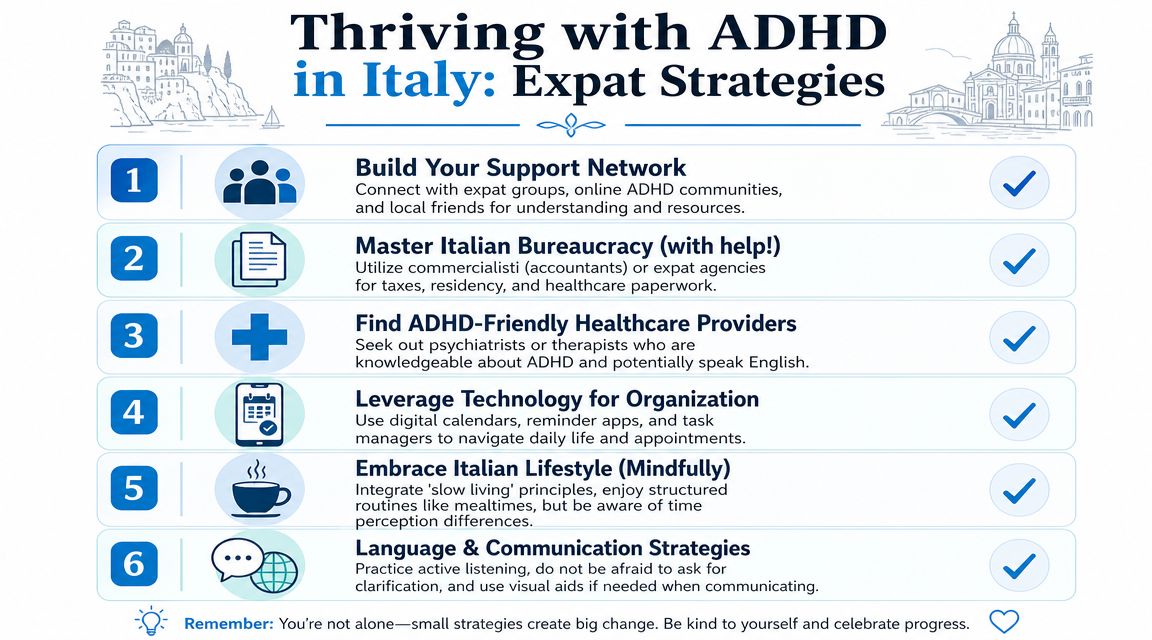
Use smaller units than you think you need
Italian bureaucracy is often hardest when the task is vague. "Sort out my residency documents" is too large for an ADHD brain under stress. Break it into pieces that are concrete and visible.
Try this:
- Open one document folder
- List missing items
- Send one email
- Book one appointment
- Prepare one photocopy set
This sounds simple. It is simple. That is why it works.
Reduce decision friction
Many women with ADHD lose energy not only in doing tasks, but in deciding when and how to begin them. Build defaults.
Useful examples include:
- One place for keys, wallet, and documents
- One digital calendar for all appointments
- One weekly admin slot
- One shopping list app
- One notebook for stray thoughts
When possible, don't create a perfect system. Create a repeatable one.
Protect attention in a high-stimulation environment
Italian city life can be wonderful and overloading at once. Noise, crowds, transport changes, and sensory density can drain focus quickly.
A few supports can help:
- Noise-cancelling headphones during admin or transit
- Visual reminders rather than mental reminders
- Body doubling with a friend, colleague, or online co-working session for boring tasks
- Recovery time after bureaucratic or social overload
Some women also benefit from gentle attention training practices. If that interests you, these ideas on Reclaim your attention may offer practical reflection points that pair well with therapy.
Mindfulness can help when adapted properly
Mindfulness is useful for ADHD when it is concrete and realistic. It is not about forcing a blank mind. It is about noticing distraction earlier, returning with less judgement, and reducing the emotional spiral that follows mistakes.
A grounded starting point is this guide to mindfulness support for everyday stress, especially if your nervous system feels constantly "on."
Thriving with ADHD does not mean becoming flawlessly organised. It means building a life where support is stronger than self-blame.
Build your Italy around your actual brain
This may mean choosing digital reminders over memory, asking for written confirmations, scheduling fewer major tasks in one day, or seeking English-speaking clinical support rather than trying to "push through" in Italian when discussing mental health.
That isn't weakness. It is adaptation. And adaptation is often the difference between surviving and living well.
FAQ
Can female ADHD be mistaken for anxiety or burnout
Yes. Female ADHD late diagnosis is often confused with anxiety, depression, or burnout because the visible symptoms are overwhelm, exhaustion, and emotional distress rather than obvious hyperactivity. The key difference is that ADHD usually reflects a longer developmental pattern involving attention, organisation, time management, and regulation difficulties across life stages.
How do I know whether my struggles are from expat stress or ADHD
The shortest answer is to look at history, not only current pressure. If the same core patterns existed before Italy, before this job, or before this relationship, ADHD becomes more relevant. A clinician who understands both intercultural stress and neurodivergence can help separate overlap from origin.
Can I get assessed for ADHD in English in Italy
Yes. English-language assessment is possible in Italy, especially through private care and online services. What matters most is not only language fluency, but whether the clinician understands adult female presentation and masking.
Do I need a psychologist or a psychiatrist for ADHD in Italy
Usually, you may need both at different points. A psychologist or psychotherapist can help with assessment and therapeutic support, while a psychiatrist evaluates medication and medical aspects. This guide on the difference between a psychologist and psychiatrist can make the choice clearer.
Is medication the only useful treatment after diagnosis
No. Medication can help some people, but therapy is often essential after a late diagnosis. Many women need support with executive functioning, self-esteem, grief, perfectionism, and the emotional impact of years spent misunderstood.
Will an ADHD diagnosis affect my visa or legal status in Italy
In ordinary clinical care, mental health support is confidential. If you have a specific visa, work, or insurance concern, ask the treating professional how records and documentation are handled. Most women find that the larger issue is access to informed care, not legal risk.
If this article felt uncomfortably familiar, you don't have to keep figuring it out alone. Book your first free assessment call with THERAPSY. There is no commitment, just a conversation with our Clinical Director, Dr. Francesca Adriana Boccalari, who will listen carefully and match you with the right therapist for you, in your language, online or in person across Italy.