Finding an American Therapist in Italy: A 2026 Guide
Finding an American therapist in Italy can feel less like a clinical search and more like a hunt for a cultural interpreter. The postcard version of la dolce vita rarely includes the reality of expat life: the culture shock, the loneliness, or the confusing sense of losing your identity. When those moments hit, you need support from someone who not only speaks your language but understands your world.
This article is your guide to navigating Italy's mental health landscape as an American. I'm Dr. Francesca Adriana Boccalari, Clinical Director at Therapsy, and my work focuses on helping expats and international students thrive in Italy. I will explain why finding the right fit is so challenging, how to verify a therapist's credentials, the pros and cons of online versus in-person sessions, and what to expect financially. The goal is to empower you to find a professional who truly gets it.
Why It's Hard to Find the Right Therapist in Italy
Adjusting to life in Italy as an American is more than learning the language or navigating bureaucracy; it's a deep psychological process. You might experience profound isolation even in a crowded piazza, or question your career and identity in ways you never expected. These are classic expat challenges, but they can feel intensely personal.
Your first instinct might be to find any therapist who speaks English. But effective therapy requires more than shared language – it demands cultural fluency. A therapist unfamiliar with American communication styles or cultural pressures can easily misinterpret your experiences. You might spend your session explaining the context of your feelings, leading to frustration and feeling profoundly misunderstood.
The core challenge is not just finding a therapist who speaks English. It is finding a professional who understands the nuances of the American psyche within an Italian cultural context, and who is trained in evidence-based methods like CBT or EMDR.
For instance, expressing ambition or discussing personal achievements openly might be perceived differently by a therapist not accustomed to American directness. The inner conflict between assimilating into Italian culture while preserving your own identity is a delicate balance. A culturally attuned therapist can help you navigate this tightrope walk. You can learn more in our deep-dive on finding the right therapist for expats in Italy.

This is the exact gap Therapsy was created to fill. We connect the international community in Italy with licensed, verified psychotherapists who possess both linguistic skills and deep intercultural competence. Our entire model is designed so you don't have to choose between getting help and feeling truly understood.
How to Verify a Therapist's Credentials in Italy
When searching for a therapist in Italy, verifying their qualifications is the most critical step for your safety and the quality of your care. The Italian system has specific, legally protected professional titles. Understanding them is crucial to avoid "counselors" or "coaches" who are not legally authorized to provide psychotherapy.
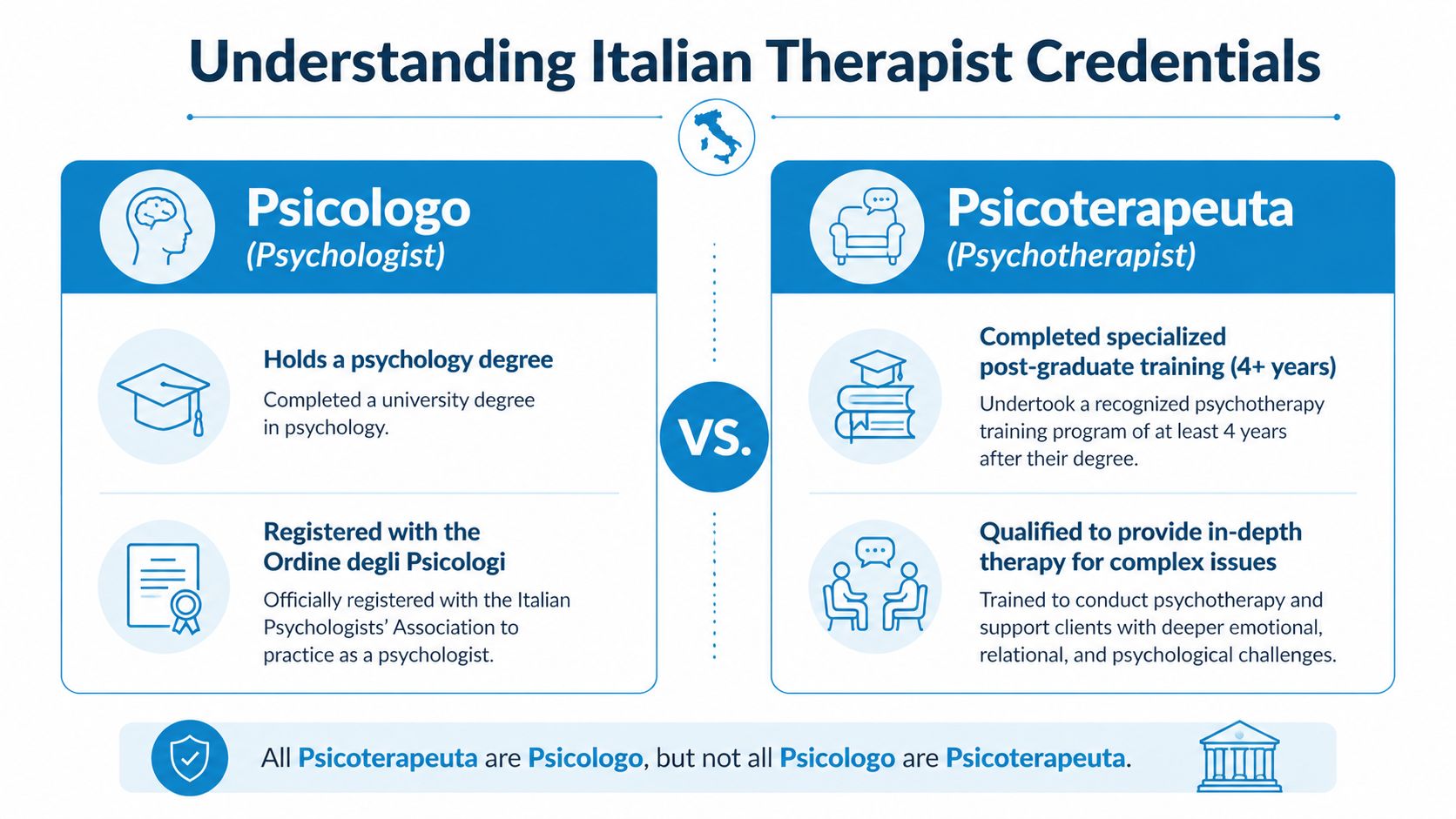
The key distinction is between a psicologo (psychologist) and a psicoterapeuta (psychotherapist). While both are protected titles, they represent vastly different levels of training and scope of practice.
- A psicologo holds a master’s degree in psychology, has passed a state exam, and completed a one-year internship. They are qualified to provide psychological support, diagnosis, and counseling.
- A psicoterapeuta is a licensed psychologist or medical doctor who has completed an intensive, four-year post-graduate specialization in psychotherapy. This is the highest clinical qualification, legally authorizing them to treat mental health conditions using recognized models like CBT, EMDR, or Schema Therapy.
For in-depth therapeutic work on issues like anxiety, trauma, depression, or complex relational patterns, look for a licensed psicoterapeuta: the postgraduate specialization is what Italian law requires in order to treat mental health disorders with psychotherapy. For assessment, psychological support or a first orientation, a licensed psychologist is the right person to speak to.
Confirming a Therapist’s Licence
Thankfully, the Italian system is transparent once you know where to look. Every legitimate psychologist and psychotherapist must be registered with the Ordine degli Psicologi (The Order of Psychologists), the official national board governing the profession.
To verify a therapist’s credentials, ask for their full name and registration number (numero di iscrizione all'Albo). You can then search for them on the national registry's website (Consiglio Nazionale Ordine Psicologi or CNOP) or the specific regional site (e.g., Ordine Psicologi Lombardia for Milan). The registry will confirm if they are a registered psicologo and, crucially, if they hold the additional qualification of psicoterapeuta.
At Therapsy, we handle this rigorous vetting for you. Every single therapist in our network is a licensed professional, personally verified and supervised by me as the Clinical Director. We do this to remove any uncertainty, ensuring you are connected with a highly qualified, ethical, and experienced professional. For more on these roles, see our guide on the differences between a psychologist and a psychiatrist.
Deciding Between Online and In-Person Therapy
One of the first decisions you'll face is whether to meet your therapist online or in person. As an expat in Italy, there isn't a single "best" answer. The right choice depends on your lifestyle, location, and personal comfort.
For many, online therapy is a lifeline. If you live in a small town or travel frequently, teletherapy removes geographical barriers. It means you can connect with a qualified American therapist in Italy from anywhere, accessing a much wider pool of specialists. You are no longer limited to whoever practices nearby; you can find an expert in EMDR or Schema Therapy regardless of location.
When In-Person Sessions Make a Difference
However, for some, the physical act of going to a therapist’s office creates a protected, dedicated space for this important work. The ritual of travel can help create a mental boundary between therapy and daily life. There is also an undeniable power in sharing a physical room – the non-verbal cues can foster a different kind of connection and deepen the therapeutic bond.
Here is a simple comparison to help you decide:
| Factor | Online Therapy | In-Person Therapy |
|---|---|---|
| Accessibility | Accessible from anywhere in Italy with an internet connection. Ideal for remote areas. | Limited to therapists practicing within a commutable distance of your city. |
| Flexibility | Easier to schedule around work, travel, or childcare. No commute time needed. | Requires travel and offers less flexibility for last-minute schedule changes. |
| Therapist Choice | A wider pool of specialists available from across Italy and beyond. | Limited to the therapists available in your local area and their specializations. |
| Comfort | Sessions from the privacy and comfort of your own home, which can feel safer. | Provides a neutral, dedicated space away from home and potential distractions. |
| Connection | Highly effective for most, though some may miss the subtleties of in-person presence. | Allows for full observation of body language and a different sense of shared presence. |
The most important factor is not which format is "better" in general, but which format is better for you right now. Your needs can change, and a flexible service should accommodate that evolution.
This is precisely why Therapsy offers both. We have a network of therapists providing in-person sessions in over 90 physical locations across 24 Italian cities– including Milan, Rome, Florence, Turin, and Bologna – alongside secure online therapy. This hybrid approach means you don’t have to choose. You can start online and switch to face-to-face later, or combine both, ensuring your support remains consistent and seamless.
Cost, Insurance, and Paying for Therapy in Italy
Navigating the cost of therapy and insurance in Italy can feel like another bureaucratic hurdle. For most Americans and other expats, this financial uncertainty is a significant barrier to seeking help. Let's demystify it.
For the vast majority of expats, private therapy is the most practical and often only way to get timely support in English. The public system, while excellent for many physical health needs, is ill-equipped for non-Italian-speaking mental healthcare.
At Therapsy, individual sessions start from €70/session, ensuring access to high-quality care. You can see a full breakdown on our pricing page.
Why Private Care Is the Go-To for Expats
You might wonder about using Italy's public healthcare system, the Servizio Sanitario Nazionale (SSN). While it is an option in theory, it is severely underfunded and understaffed for mental health services. Waiting lists can stretch for months, and finding an available therapist who is truly fluent in English is nearly impossible.
This reality makes private therapy the only timely and reliable option for most of the international community.
Private therapy in Italy is not a luxury for the international community. It is often the most direct and effective path to receiving timely, culturally competent mental health support from a qualified professional.
Using International Health Insurance
Many expats have international health insurance plans that cover psychotherapy. Americans in Italy are often covered by providers like Cigna, a trusted partner of Therapsy. These plans are designed for expats, but it is crucial to verify the details of your specific policy.
Here is my recommended process:
- Call your provider directly. Ask specifically about coverage for "outpatient mental health" or "psychotherapy."
- Ask about pre-authorization. Some insurers require approval before you begin sessions.
- Clarify the reimbursement process. Most often, you will pay for sessions upfront. Your therapist will then provide an official invoice (fattura sanitaria) for you to submit to your insurer for reimbursement.
It is also wise to inquire about any expat medical policy exclusions, particularly regarding pre-existing conditions. Our team at Therapsy is very familiar with this process and provides all necessary documentation to make your insurance claims as smooth as possible.
What to Ask a Potential Therapist in Your First Call
The first call with a potential therapist can feel intimidating, but it is best viewed as a "vibe check." This is your opportunity to see if you connect – if their personality, professional style, and experience feel right for you.
This conversation is about more than logistics; it's about determining if this person truly understands the unique psychological landscape of being an American in Italy. A good therapist sees you not just as a client, but as a whole person navigating a complex cross-cultural journey. A great therapist will welcome your questions as a sign of your engagement and readiness for the work. Feeling heard from the very first interaction is a powerful green flag.
Here are a few questions I recommend asking a potential American therapist in Italy or any English-speaking psychotherapist:
- Can you describe your experience working with American expats or individuals facing intercultural challenges?
- What is your therapeutic approach to helping clients with culture shock, isolation, or identity loss?
- How do you apply evidence-based methods like CBT or EMDR to the specific issues faced by the expat community?
- What can I expect from our first session together?
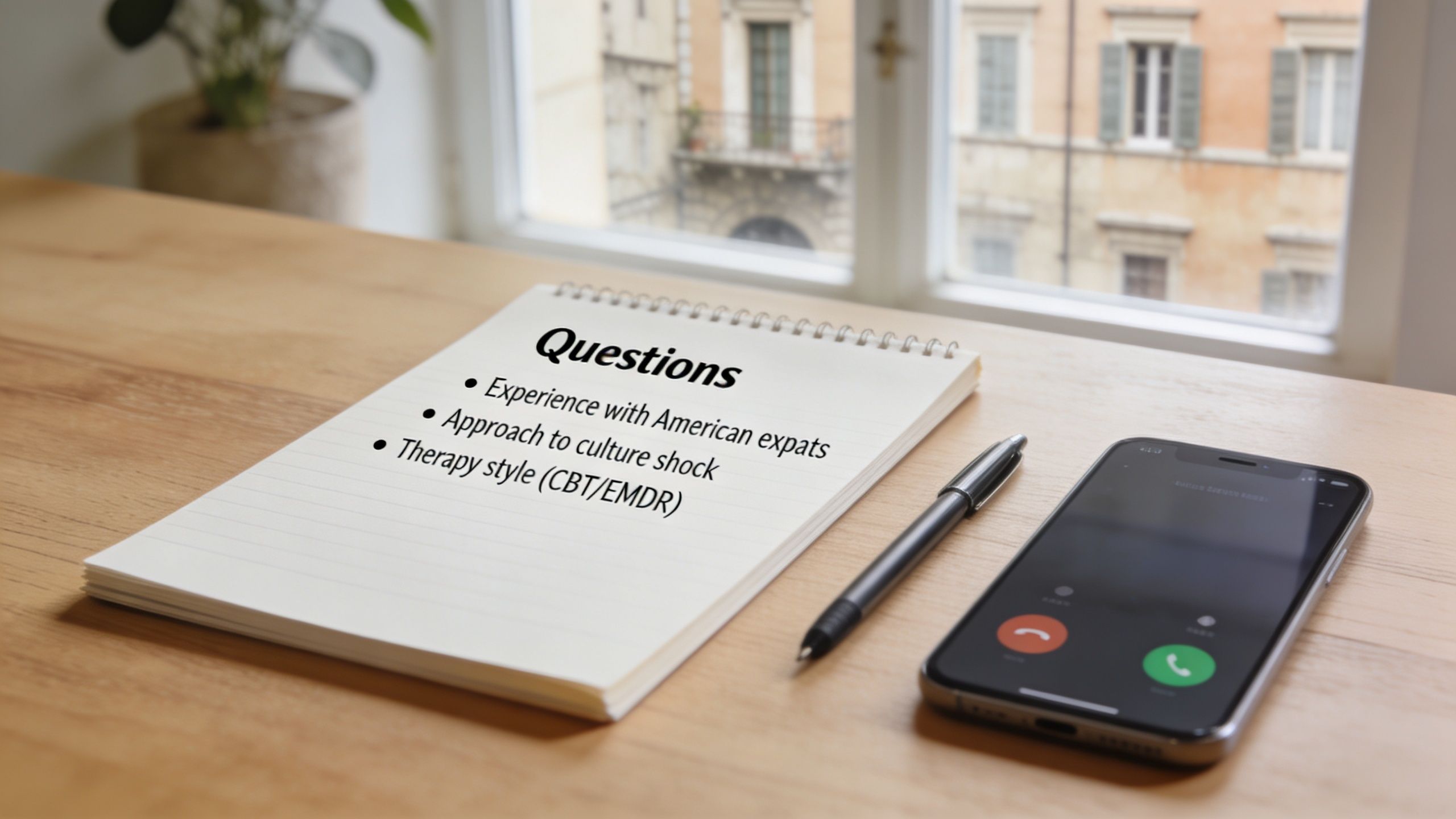
These questions help you gauge their expertise and therapeutic style, ensuring alignment with your needs. If you're unsure how to begin, our guide on how to talk to a therapist offers more helpful pointers.
At Therapsy, we built this principle into our core process. Our free first assessment call is designed to be this exact kind of warm, human-centered conversation, ensuring we find the ideal professional for you from the very start.
Your Questions Answered
FAQ
Is therapy in Italy covered by public health insurance?
For most expats, the practical answer is no. While residents can technically access public mental health services (SSN), the system is overwhelmed with long waiting lists and has a severe shortage of English-speaking therapists. For timely and effective support, private care is the most realistic path for the international community.
What is the average cost of a therapy session in Italy?
At Therapsy, we strive for accessibility, with our individual therapy sessions starting from €70. The final fee depends on the therapist's experience and specialization, allowing you to find a match that fits your needs and budget.
How do I know if a therapist is qualified in Italy?
To ensure a therapist is qualified, verify they are a licensed psicoterapeuta, not just a psicologo. A psicoterapeuta has completed an additional four years of specialized postgraduate training, which is legally required to provide psychotherapy in Italy. You can verify their status by asking for their registration number and checking it on the official Ordine degli Psicologi (Psychologists' Register) website.
Can I use my American health insurance for therapy in Italy?
Yes, it is often possible, but you must check your specific policy. Many international health insurance plans cover "outpatient mental health services" abroad. The standard process involves paying for your sessions and then submitting the therapist's official invoice (fattura sanitaria) to your insurance company for reimbursement.
What happens in the first free assessment call with Therapsy?
The first call is a warm, no-commitment conversation with me, Dr. Francesca Adriana Boccalari, the Clinical Director. It is not a therapy session but a chance for you to share what's on your mind and what you're looking for. Based on our discussion, I will personally match you with the therapist on our team best suited to your unique situation, personality, and needs.
Book your first free assessment call – no commitment, just a conversation with our Clinical Director who will listen and match you with the right therapist for you. Visit therapsy.it.