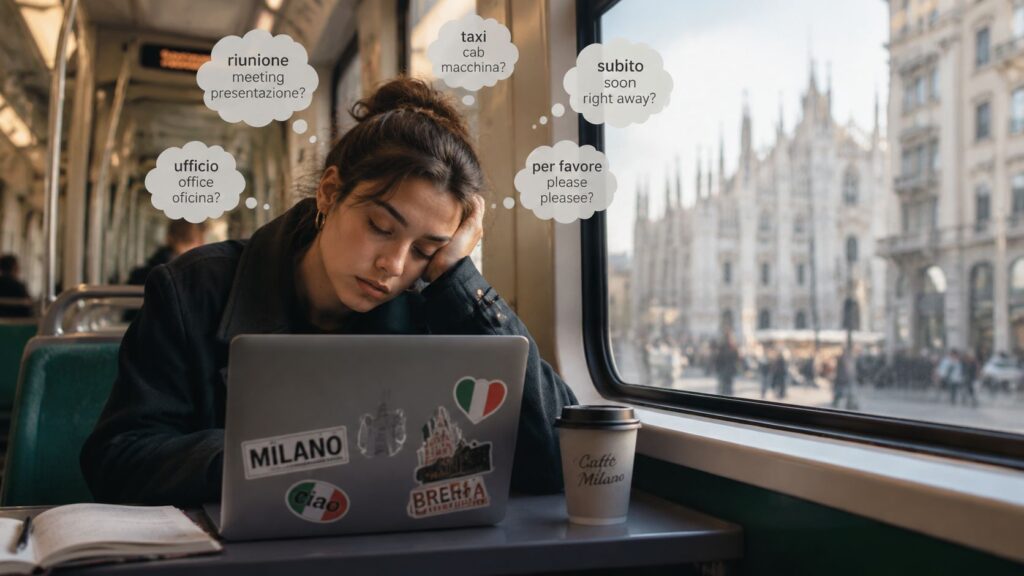
You land in Milan with a full calendar, a new apartment, and a phone full of contacts who keep telling you that Italy will be amazing once you settle in. Then the hard part starts. You're tired, your Italian isn't yet strong enough for emotions as well as errands, and finding online therapy for expats turns out to be more complicated than typing a few words into a search bar.
For many people, the first shock is not the move itself. It's the gap between needing support now and realizing that the local mental health system, your language, your time zone, and your privacy concerns all matter at once. Online therapy for expats in Italy is a structured way to get licensed psychological support across borders, in a language you can use, without pretending that relocation stress is a minor inconvenience.
That matters in practical life. Someone comparing international expenses in a new city might already be using a service like NomadCards Korean credit card overview to manage cross-border spending, but therapy is different. It isn't just another app or account. It's care, and the way it's set up changes whether you'll stay with it.
If you've just arrived, or if you've been in Italy long enough to know that “I'm fine” is getting thin, this guide walks through the questions that matter. What online therapy is, who it helps, why language match matters, how pricing and insurance work in Italy, what privacy means, and how to choose a therapist you'll keep seeing after the first session. For readers who want an Italy-based starting point, Therapsy's overview for mental health support for expats in Italy is a useful place to begin.
Why Online Therapy Matters for Expats in Italy
The first weeks in Italy can feel deceptively full. You're registering with HR, finding the right café, learning train routes, and trying not to get lost in administrative language. Then a quiet problem appears, you need psychological support, but the easiest therapist to reach may not speak your language, may not understand expat stress, and may not be reachable when your workday ends.
That's where online therapy for expats becomes more than convenience. It bridges the gap between a real psychological need and a fragmented system, especially in cities like Milan, Rome, and Florence where international life is busy but support can still feel hard to access. For many people, the alternative isn't between online and in-person therapy, it's between online therapy and no therapy at all.
What changes when therapy moves online
Remote sessions remove some of the barriers that often stop people from starting. You don't have to cross the city after work, explain yourself in a second language while tired, or keep postponing the first appointment because the logistics feel too heavy. For expats, that can be the difference between waiting months and getting help.
Practical rule: if getting to therapy is harder than talking about the thing that hurts, the format is already part of the problem.
Online therapy also helps when relocation has made your life temporarily unstable. If you're sorting out housing, banking, or health coverage, you may not yet know which neighborhood you'll live in next month. In that phase, virtual care can be a stable anchor while everything else is still moving.
Why this is especially relevant in Italy
Italy has its own strengths and friction points. Major cities have excellent professionals, but international residents still run into language mismatch, different booking norms, and varying expectations about privacy and continuity.
That same cross-border logic applies to mental health. If you're building a life here, therapy has to fit the life you're living, not the life you had before the move. For that reason, online support is often the most realistic first step for expats, international students, and internationally mobile professionals.
What Online Therapy for Expats Actually Means
A newly relocated professional in Milan may know how to handle work, housing, and transit, then feel stuck the moment emotional support is needed. Online therapy for expats fills that gap by giving a client living abroad a licensed clinician, a protected setting, and a regular therapeutic frame in a language that feels workable. It is therapy delivered remotely, usually by secure video, so the care stays structured even when everyday life is scattered across countries and time zones.
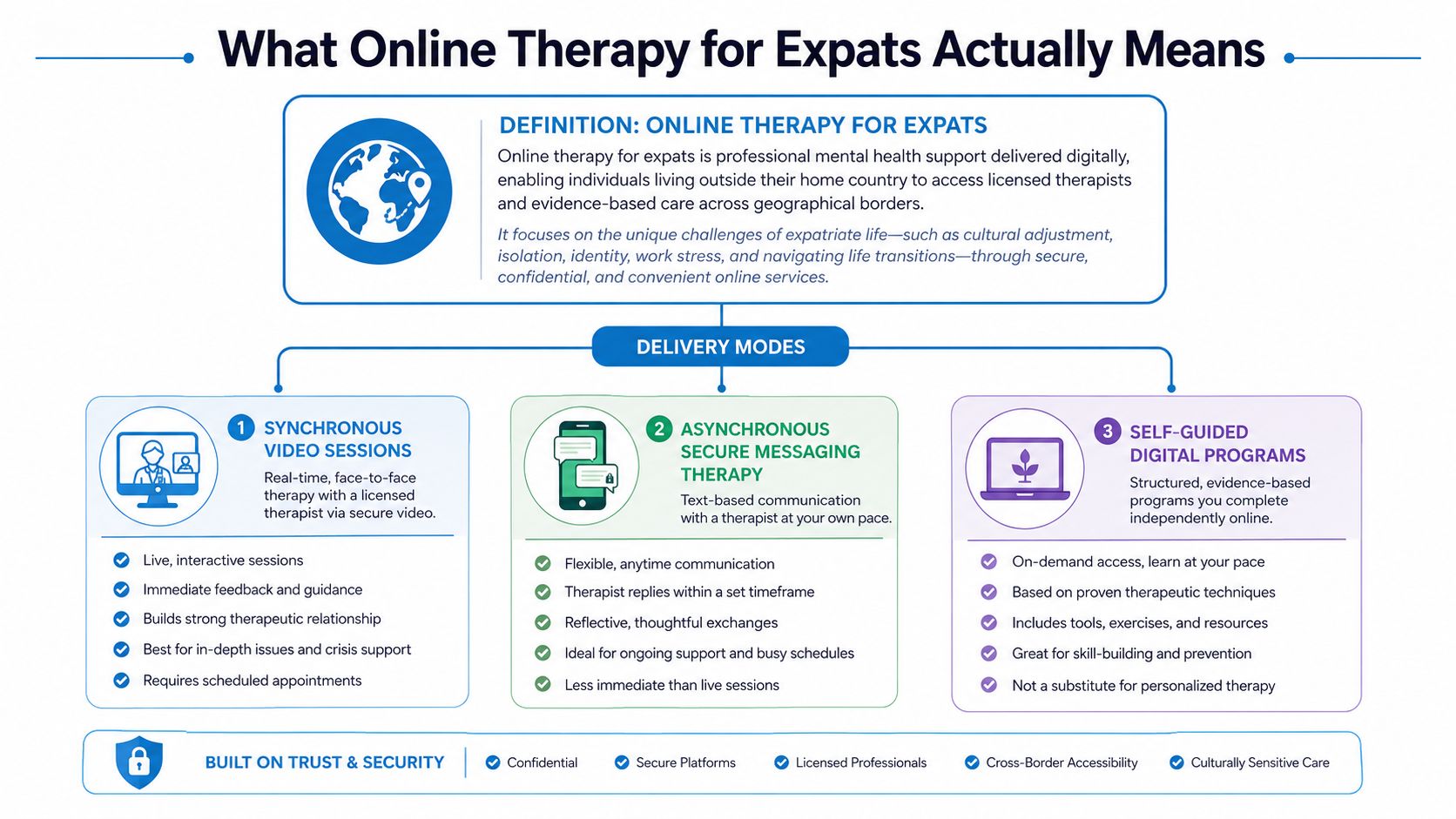
The three delivery modes
The field makes more sense when you separate it into three formats.
- Synchronous video therapy uses a scheduled live session, which is the closest match to traditional psychotherapy.
- Asynchronous messaging therapy relies on secure written exchanges rather than real-time conversation, and it can suit lighter support or contact between sessions.
- Self-guided digital programs give people structured exercises to complete on their own, usually with limited therapist involvement.
For moderate concerns, the strongest core remains video-based psychotherapy with a licensed clinician. The live relationship matters when the issue involves anxiety, depression, trauma, or the strain of adaptation. The format also matters because the therapist has to hear more than the words themselves, including pauses, emotion, and contradictions that often show up only in conversation.
Direct answer: online therapy for expats works best when it keeps the parts that make psychotherapy real, a licensed clinician, a secure platform, and a predictable frame, even when the client is abroad.
A useful way to think about the service is as a care pathway, not a convenience feature. The pathway starts with the right clinical match, then moves through the right language, the right scheduling, and the right way of handling data. For a practical starting point, see how to start therapy in Italy, because the first session is only useful if the basic setup makes sense in the Italian context.
Why the evidence base matters
The infrastructure is no longer experimental. The WHO Mental Health Atlas 2024 summary reports that telehealth services are available and in use in a large share of responding countries globally, and even more often in the WHO European Region For expats in Europe, that matters because online care is already part of ordinary service delivery rather than an add-on at the edge of the system.
The practical conclusion is straightforward. Online therapy for expats is a regulated, evidence-based way to access care across borders.
The Most Common Reasons Expats Seek Online Therapy
Relocation rarely creates one problem at a time. It can bring anxiety, low mood, loneliness, identity strain, and relationship tension into the same week. Many expats look composed at work and still feel as if their private life is coming apart.
A review of expat therapy evidence notes that depression and anxiety are often higher in expat populations than in matched non-migrating peers, with distress commonly peaking after the early excitement of relocation has worn off. That timing fits what clinicians see in practice. The move feels manageable at first, the day-to-day frictions slowly build, and the original support network still feels far away.
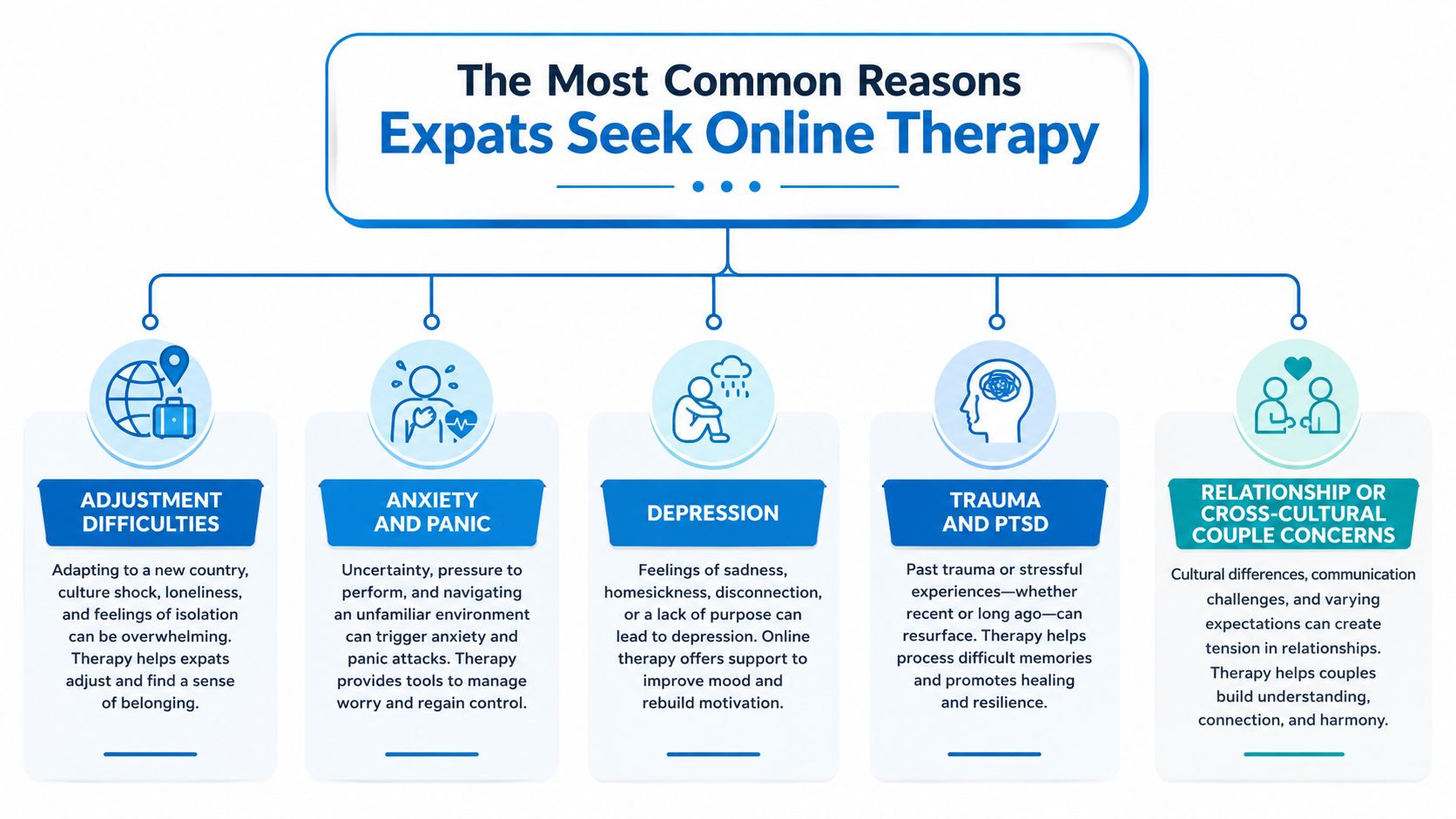
Adjustment stress and identity loss
The first sign is often not a major crisis. It is the quieter feeling that the self you used to rely on no longer fits as cleanly as it did before the move. Someone who was confident at work may suddenly feel awkward, cautious, or oddly unseen in a new city.
Cross-cultural psychology helps explain that reaction. Relocation asks a person to rebuild routines, social meaning, and identity at the same time, so adjustment stress can feel larger than a simple mood shift. Online therapy gives clients space to sort what is normal adaptation from what is becoming withdrawal or depression.
Anxiety, panic, and the constant alert state
Expats often describe anxiety as something they feel in the body before they can put it into words. Sleep becomes lighter, meetings feel heavier, and ordinary tasks start to seem loaded because so little is familiar yet.
CBT, or Cognitive Behavioral Therapy, fits this pattern well because it helps people notice the link between thoughts, body sensations, and avoidance. A therapist can use it to work on spirals such as “I'm not coping” or “I'll never settle here,” which tend to grow stronger when daily life is already uncertain.
Depression and emotional exhaustion
Depression in expat life often hides behind high functioning. People keep working, replying, and attending events while feeling flat, detached, or ashamed that the move has not matched what they hoped for. The earlier evidence review matters here too, because the low point often arrives after novelty fades.
A therapist may use CBT for the thinking patterns, but also keep an eye on the loss underneath them. Sometimes the problem is not laziness or failure. It is grief for a life that no longer exists in the same way.
Trauma, PTSD, and repeated stress
Some expats arrive with a trauma history already in place, and relocation can reactivate it. Others go through something stressful after the move, then find that the foreign setting makes recovery harder because they do not yet feel anchored.
EMDR, or Eye Movement Desensitization and Reprocessing, is often used when the concern is trauma-related. It can be especially relevant for people whose distress gets triggered by particular places, conversations, or body sensations that keep showing up in daily life.
Relationship strain and cross-cultural couples
Living abroad changes how couples talk, argue, and make decisions. One partner may adapt faster, one may feel lonely sooner, and a shared language can still hide very different cultural assumptions. Systemic-relational therapy and Schema Therapy can help when the same conflict keeps returning in new forms.
A couple may not be fighting about one dinner or one plan. They may be fighting about belonging, power, family roles, or what “home” means now.
Even practical habits outside therapy can be affected by this. Some people start comparing notes with guides for traveling pet sitters because once life becomes mobile, every routine has to be considered in relation to the next move.
Language Matching and Cultural Fit as Clinical Variables
An expat in Milan may arrive thinking therapy is mostly about finding a slot that fits a busy calendar. The harder part often appears later, when the first real feeling needs to be said clearly and the right words do not come in time.
Language is not a cosmetic feature in therapy. It shapes how quickly people can name feelings, how much nuance they can keep in view, and how safely they can tell the truth. When someone speaks in a non-native language, emotional material often gets simplified, delayed, or softened before it reaches the therapist.
Why fluent language changes the session
A person may be able to run a meeting in English, but therapy asks for a different kind of speech. You need words for shame, anger, ambivalence, family history, and mixed feelings, not just work vocabulary. In a second language, many clients feel one step removed from the emotions they are trying to describe.
Mother-tongue therapy, or therapy in a language a client uses fluently, often feels faster and more precise. The therapist hears the story more cleanly, and the client does not spend the whole hour translating themselves. Like trying to discuss a legal contract through a poor audio connection, the point may still get across, but the detail drops out exactly where it matters most.
Multilingual care versus generic English-only telehealth
Many online therapy services for international residents still default to English only. That leaves French, Spanish, German, Portuguese, Ukrainian, Russian, Greek, Arabic, Urdu, Hebrew, Hindi, and Persian (Farsi) speakers with fewer good options, even when they live in a major European city.
Therapsy addresses that gap by offering therapy in 14 languages with human matching, not automated questionnaires. That matters because cultural fit is not just about translation. It is about whether the therapist understands migration pressure, family systems, identity shifts, and the social rules you brought with you from home. For some people, the first sign of that mismatch is not obvious conflict, but a quiet sense that they are explaining themselves twice. The pressure can build into the kind of isolation described in this guide to expat loneliness in Italy.
The same issue can show up in more practical ways. Someone may arrive in Milan and still function well at work, yet feel stuck the moment therapy touches family expectations, grief, or identity. A session can feel technically correct and still miss the person in front of it.
Cultural fit as part of clinical work
Cultural fit is not a soft extra. It changes what the therapist notices, what they ask, and what they do not assume. A therapist who knows the rhythm of relocation, the strain of building a life around residence permits, work demands, and social distance, is more likely to hear what is underneath the complaint.
That is why multilingual psychotherapy for expats in Italy is not just a language service. It is a care pathway that reduces the friction between inner experience and clinical conversation. When the match is right, the client spends less energy translating and more energy thinking.
| Dimension | Multilingual matched therapy | Generic English-only telehealth |
|---|---|---|
| Rapport | Faster emotional trust because the client can speak naturally | Slower rapport when the client has to translate feelings |
| Cultural framing | Better chance of understanding migration, family, and identity context | More likely to miss culturally specific meaning |
| Dropout risk | Often lower when the client feels understood and precise | Higher when the fit feels blunt or effortful |
| Access for underserved language communities | Better for clients who need more than English | Narrower access, especially for non-English speakers |
Bottom line: language match is not a bonus feature. It changes the clinical quality of the work.
For a newly relocated professional in Milan, this can decide whether therapy becomes useful or exhausting. If you are already spending energy on work, housing, and adaptation, you do not need therapy to become another translation task. You need a space where your words land the first time. The same logic applies when people compare notes with guides for traveling pet sitters, because once life becomes mobile, every routine has to be considered in relation to the next move.
How Online Therapy Works in Italy, Pricing, and Insurance
The practical side matters because many expats don't stop at “Does therapy help?” They ask, “Will this fit my schedule, my budget, and my insurance?” That's the right question. If the system is too fragile, people drop out before the work has a chance to begin.
The usual setup
A standard online session is usually 50 minutes, scheduled weekly, on a secure platform. UKCP guidance says the therapist should use a secure, reputable platform, make sure internet and software are adequate, and have a backup plan for technical interruptions (UKCP online therapy guidance).
That backup plan matters more than people think. If the connection drops, the session should have a clear fallback, such as switching devices, moving to a different line, or rescheduling according to an agreed protocol. In cross-border care, predictability is part of safety.
Pricing reference points in Italy
Therapsy's current reference points are straightforward:
- Individual therapy, from €70 per session
- Couple therapy, from €100 per session
- Psychiatric consultation, from €110 per session
- Psychodiagnostic assessment, from €255 across 3 sessions
These are from prices because the final fee depends on therapist experience and specialization. For many expats, that clarity is helpful, since it avoids the confusion of hidden fees or unclear package rules.
Insurance and workplace coverage
Some international health plans reimburse out-of-network online sessions, and employers may offer EAP coverage through international organizations and universities. If you live in Italy and your insurance is tied to a global plan, ask two things first: whether online psychotherapy is covered, and whether the provider accepts invoices in a form your insurer can process.
Italian coverage is also evolving, with psychology becoming more visible in public pathways through the national system and primary care structures. The important point for a client is simple, local and international routes can both matter, but they work differently.
What the first session usually covers
The first meeting is not meant to solve your whole life. It usually focuses on your history, your current stressors, your goals, and whether the therapist is the right fit. A good therapist also talks through the frame, frequency, privacy, and what the next step looks like.
Therapsy's process begins with a free assessment call, which is useful when you want a low-risk way to test fit before committing to ongoing work.
For a clear pricing overview in Italy, see how much therapy costs in Italy.
A Practical Checklist for Choosing the Right Therapist
Choosing a therapist abroad is not about finding the most polished profile. It's about checking whether the person can hold your language, your context, and your logistics without making you do extra labor. That matters even more when you're far from home and don't want to start over twice.
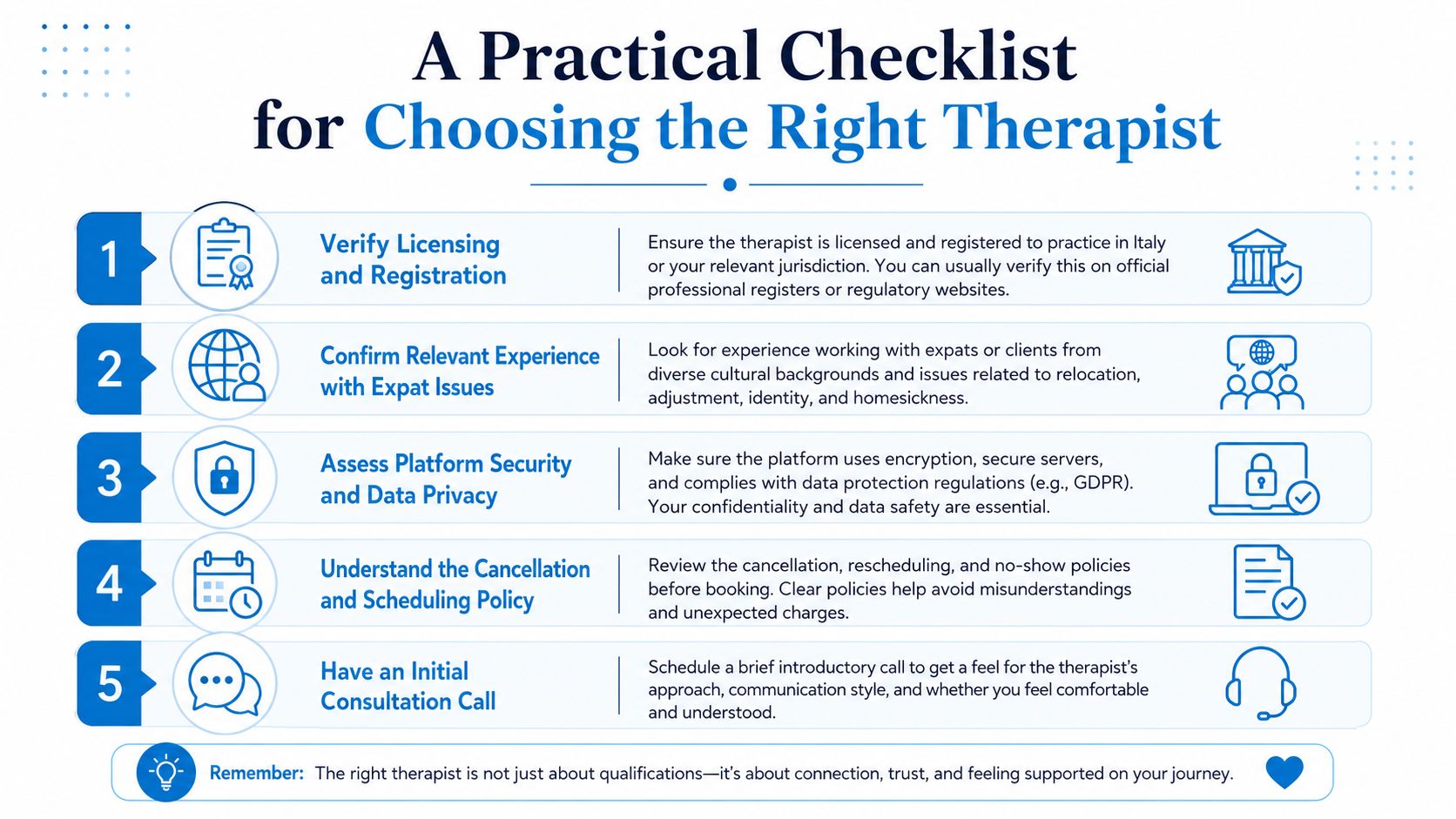
What to ask before you start
Is the therapist licensed and supervised?
Ask where they are registered and who oversees their practice. In a cross-border setup, this question matters because licensing and accountability are part of clinical safety.Do they work with expat issues?
A therapist can be excellent and still miss relocation stress, identity loss, or second-language fatigue if they don't work with international clients often.Which methods do they use?
Look for evidence-based approaches like CBT, EMDR, or Schema Therapy when those fit your needs. The point is not jargon, it's whether the method matches the problem.How secure is the platform?
Ask about privacy, encryption, and what happens if the connection fails. UKCP guidance is clear that secure tools and a backup plan are part of responsible online work.What happens if you move again?
This is the question many people forget. Cross-border continuity matters, especially if your time zone changes or you need records transferred to another clinician later.
Useful rule: if a provider can't explain continuity, privacy, and rescheduling in plain language, keep looking.
Why the first call is so useful
The simplest way to test fit is a short assessment call. A real conversation tells you more than a profile page. You can hear whether the therapist understands your story, whether their language feels natural, and whether the arrangement is realistic for your life.
If you also need practical support around a relocation issue, such as paperwork or residence questions, a separate specialist may be needed alongside therapy. For example, people handling Spanish-related migration matters sometimes start with a resource like this Spanish immigration lawyer for expats when legal questions sit next to emotional strain.
Therapsy's model is especially relevant here because the matching is human, not automated, and the first assessment call is free. That lowers the pressure on a client who is still deciding whether this therapist feels right.
Privacy, Data, and What the Evidence Actually Says
A lot of expats worry about whether online therapy is private enough, especially when they're living in a country that isn't home and may move again soon. That concern is reasonable. If you're going to talk about trauma, relationships, or work stress, you want to know what happens to your information and how seriously the provider treats it.
Privacy is part of the treatment frame
For clients in the EU, GDPR is not just a legal detail. It affects how consent is handled, where data is stored, and whether records can be transferred if you change providers. A good therapist should be able to explain data handling in plain language, including what is saved, who can access it, and how records can be shared if needed.
Cross-border portability matters too. If you move from Milan to another country, or if your next clinician is in a different system, you should be able to ask what can be transferred and how that transfer is secured. That is especially important for expats, where continuity is often the difference between steady progress and starting over.
What the research says about effectiveness
The current evidence is reassuring. A 2024 systematic review found telehealth interventions were generally non-inferior to face-to-face treatment for depression and anxiety, with standardized mean differences of -0.03 for depression and -0.06 The same review found a small but significant advantage for PTSD, with SMD = -0.21.
That doesn't mean every online session works equally well. It means the format itself is credible when the therapist, method, and fit are right. Dropout was somewhat higher in telehealth in the review, which matches common sense, people leave when the setup feels impersonal, confusing, or poorly matched.
What skilled remote therapists do differently
The biggest practical challenge is reduced non-verbal information. In one therapist survey, reduced interpersonal cues were the most frequently reported issue at 24%, ahead of technical issues at 14% and isolation or loneliness of practice at 10% (therapist survey on remote work challenges).
Experienced therapists compensate by being more explicit, checking emotion more often, slowing the pace, and clarifying meaning instead of assuming it. That becomes even more important for expats, because cultural adaptation already makes communication less automatic.
The conclusion is simple. Online therapy for expats is credible care, not a shortcut, when privacy, continuity, and therapeutic skill are treated as part of the service itself.
Frequently Asked Questions About Online Therapy for Expats
How quickly can I start online therapy in Italy?
You can often start much faster than with a traditional local search. A strong provider should be able to make contact quickly, then use a short assessment call to decide fit and match you with the right therapist. That speed matters when you're dealing with loneliness, work stress, or a recent move, because waiting too long often makes people disengage.
Is online therapy enough for loneliness and culture shock?
Yes, it can be enough for many people, especially when the main issue is adjustment stress, anxiety, or feeling cut off after relocation. It's often most useful when the therapist understands migration, identity, and cross-cultural pressure, not just generic stress. Some people also benefit from in-person social support alongside therapy, but the therapy itself can still be online.
What happens if I move to another country during treatment?
Good therapy can continue if the clinician is able to work across time zones and the legal setup allows it. What matters is continuity, what can be transferred, how scheduling will change, and whether your therapist can still legally and ethically treat you after the move. That's why it's smart to ask about records, consent, and portability before you begin.
Do insurers like Cigna reimburse online sessions from Italy?
Sometimes they do, depending on your plan and the way the invoice is issued. The safest approach is to ask your insurer before the first paid session and confirm what documents they need. Many international plans cover out-of-network care in some form, but the details are plan-specific.
What if I'm not sure the therapist understands expat life?
That's exactly what the first assessment call is for. You should use it to hear whether the therapist understands relocation stress, language fatigue, and the difference between a bad week and a deeper adjustment problem. If the fit feels off, keep looking until the conversation feels clear and steady.
Is online therapy private enough for sensitive topics?
It can be, if the therapist uses a secure platform and handles data according to GDPR-aware practice. Ask where records are stored, how consent works, and what happens if you need continuity after a move. Privacy should feel explained, not assumed.
If you're trying to build a stable life in Italy and your mental health needs a proper place to land, THERAPSY offers multilingual psychotherapy online and in person, with human matching, free assessment calls, and clinicians who understand expat life in concrete terms. Visit THERAPSY if you want a first conversation that's low-pressure, practical, and focused on finding the right therapist for you.