You're probably not looking for a motivational slogan. You want a straight answer because you're tired, stressed, or stuck, and you need to know whether therapy vs coaching is the right call. The cleanest answer is this, therapy is for emotional pain, clinical symptoms, trauma, anxiety, depression, grief, and relationship distress that needs treatment. Coaching is for goal-setting, performance, accountability, confidence, and forward movement when you're basically functioning and want to do better.
For expats and young adults in Italy, the decision gets messy fast. Relocation stress, language fatigue, identity shifts, and work pressure can sit right in the middle of that divide, which is why people often ask the wrong question, “Which one is better?” The better question is, “Am I trying to heal something, optimize something, or do both in sequence?”
| Criterion | Therapy | Coaching |
|---|---|---|
| Primary aim | Treat distress, symptoms, and patterns | Support goals, performance, and growth |
| Time focus | Past and present | Future and next steps |
| Clinical scope | Clinical concerns, diagnosis, treatment | Non-clinical development |
| Regulation | Licensed profession | Usually not licensed |
| Session style | Emotional processing, insight, healing | Accountability, action, strategy |
| Best fit | Anxiety, depression, trauma, grief | Career shifts, confidence, productivity |
Practical rule: if the issue is making daily life harder, start with therapy. If the issue is making a decent life better, coaching may be enough.
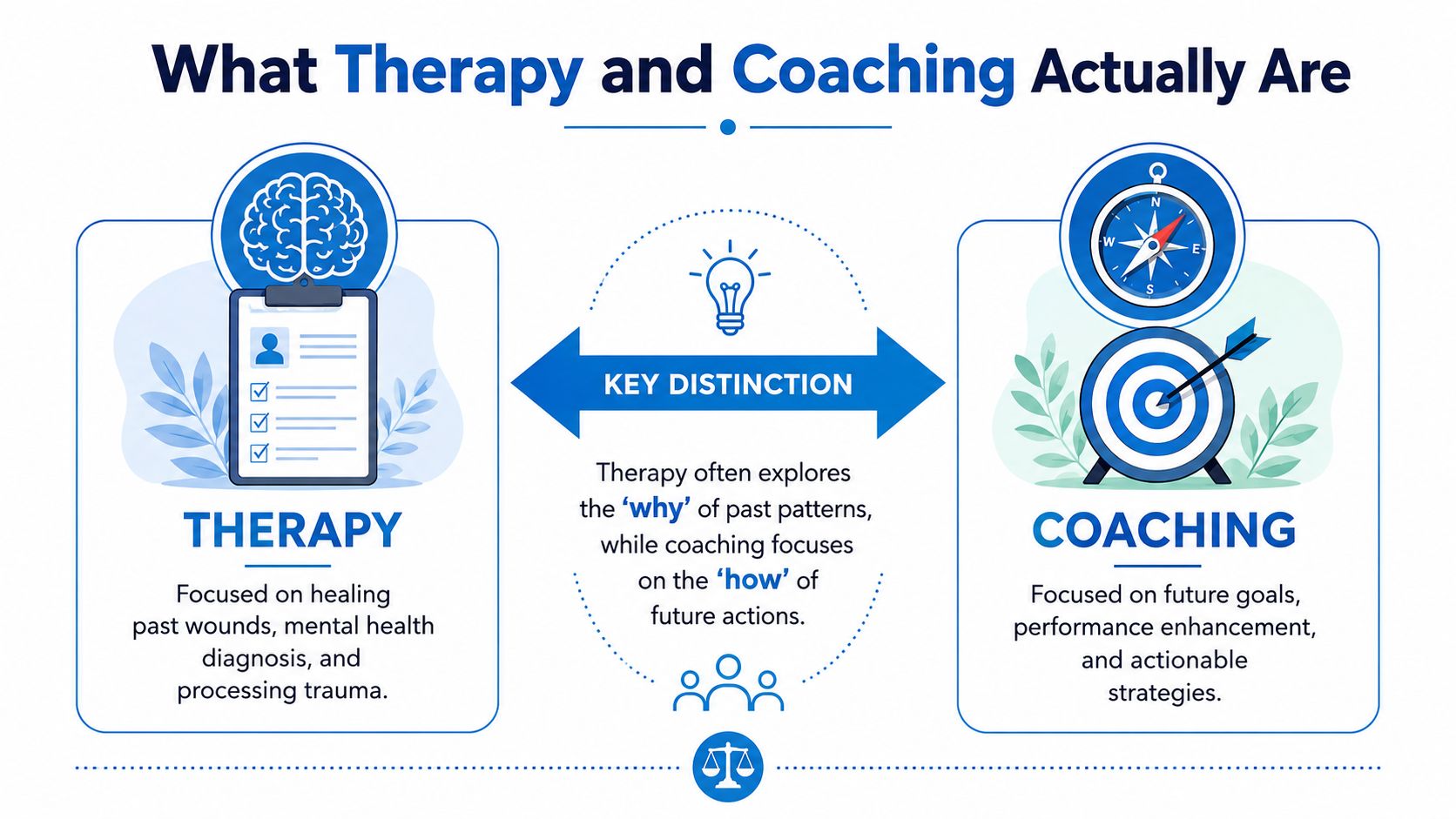
What Therapy and Coaching Actually Are
A person searching for therapy vs coaching is usually in one of two places. Either they're carrying emotional pain, or they're stuck on a goal. The definitions are simple, and that simplicity matters because the wrong choice can waste months.
Therapy is clinical support
Psychotherapy is delivered by licensed clinicians who are trained to diagnose and treat mental health conditions. That distinction is not cosmetic, it defines who can legally and ethically work with depression, anxiety, trauma, and other clinical concerns. A 2024 NPR explainer makes the boundary explicit, noting that coaching does not require licensing, credentialing, or formal education in the way therapy does, which is why the fields are often contrasted in scope and accountability, especially when symptoms are in play (NPR).
For expats, that matters immediately. If you're having panic attacks, spiraling low mood, intrusive thoughts, or trauma reactions after relocation, you don't need a productivity conversation, you need clinical care. Therapy is the right door when the problem is hurting, not just annoying.
Coaching is developmental support
Coaching is generally a non-clinical, future-focused partnership built around goals, accountability, and personal or professional development. It works best when you're already stable enough to act, reflect, and build a plan. The emphasis is on what you want next, not on diagnosing why you're stuck.
A useful shorthand is this, therapy asks what's driving the pain, while coaching asks what action comes next. That difference is why therapy often explores patterns, history, grief, attachment, or trauma, while coaching usually stays with momentum, clarity, and execution. If you want a deeper clinical lens on why thoughts and behaviors keep repeating, this guide to cognitive behavioral therapy is a useful next read.
Therapy is not “more serious” in a moral sense. It is simply the right tool when the problem is clinical, not just developmental.
What the research says about coaching
Coaching has real effects, but they're usually moderate, not magical. A 2023 meta-analysis of workplace coaching reported an overall effect size of Hedges' g = 0.44, with specific effects ranging from g = 0.43 for coping to g = 0.74 for goal-directed self-regulation (peer-reviewed review). Another review of executive coaching reported an aggregate effect size of g = 0.43, with a 95% confidence interval of 0.35 to 0.50 (peer-reviewed review).
That's important because it shows coaching is not fluff. It can help with performance, behavior, and goal progress. But the same evidence base also tells you not to confuse coaching with treatment when symptoms are clinically significant.
How the two fields are used in real life
The cleanest distinction is still the most useful one, therapy is for distress, coaching is for growth. That doesn't make one superior. It makes them different tools for different jobs.
For someone who's functioning but wants sharper focus, more confidence, or better accountability, coaching is often enough. For someone whose functioning is being disrupted by anxiety, depression, trauma, or unresolved relationship pain, therapy is the responsible starting point.
How Therapy and Coaching Differ Across Six Criteria
The fastest way to stop overthinking this is to compare the fields on the criteria that matter. Once you do that, the choice gets much clearer.
The structural differences
| Criterion | Therapy | Coaching |
|---|---|---|
| Goal | Heal symptoms and patterns | Reach goals and improve performance |
| Time orientation | Often past and present | Strongly future-focused |
| Clinical scope | Mental disorders and distress | Non-clinical development |
| Accountability | Licensed, regulated practice | Variable standards, often private certification |
| Session format | Usually weekly, often open-ended | Often packaged around defined goals |
| Typical use | Anxiety, depression, trauma, grief | Career pivots, habits, confidence, execution |
The biggest difference is clinical scope. Therapy is built to work with emotional suffering and mental health conditions. Coaching is built to help a person move forward when they're not in a clinical state of distress.
The second difference is time orientation. Therapy may examine earlier experiences, family patterns, or relationship history because those things often shape current symptoms. Coaching usually stays with what happens next, what you'll do differently, and how you'll stay accountable.
What a session usually feels like
A therapist might help you trace why job stress keeps turning into shutdown, people-pleasing, or panic. A coach might help you turn the same job stress into a 90-day action plan with check-ins and behavioral targets. Both can be useful, but they are not doing the same work.
That's why people get frustrated when they choose the wrong one. If you walk into coaching with unresolved trauma, you may feel seen but not held. If you walk into therapy hoping for pure execution support, you may get insight but not enough structure.
Regulation changes the risk level
Therapy carries professional accountability through licensure. Coaching usually does not. That means therapy is the safer choice when there's any real chance the issue is clinical rather than purely developmental.
Bottom line: when the problem is symptoms, choose regulation. When the problem is goals, choose structure.
Regulation, Credentials, and What That Means in Italy
In Italy, the distinction is not theoretical. It changes who you can trust, what a provider is allowed to do, and how much protection you have if things go badly.
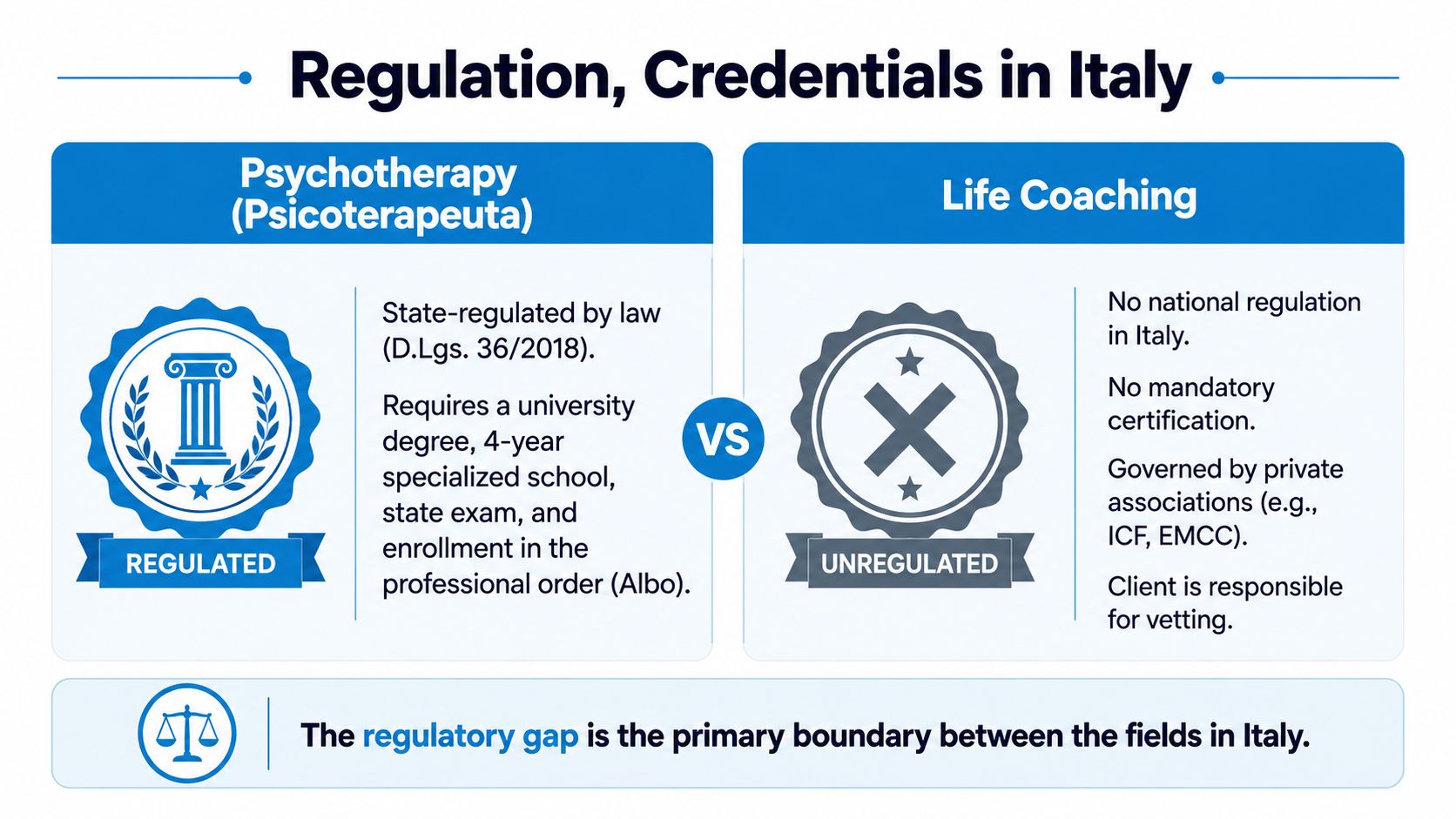
Psychotherapy is a protected clinical role
Psychotherapy in Italy sits inside a regulated professional framework. In practical terms, that means the clinician has formal training, protected title status, and the legal authority to work with mental health conditions. If someone is dealing with depression, trauma, panic, or serious anxiety, this is the lane that belongs there.
The legal boundary matters because symptoms don't stay neat. A coach can be warm, intelligent, and helpful, but if a person is clinically unwell, good intentions are not a substitute for licensed training. That's why the first vetting question should be simple, is this person qualified to work clinically if needed?
Coaching is a private market with uneven standards
Coaching, by contrast, is not nationally regulated in the same way. Credentials vary widely, and the client carries more of the burden for checking training, boundaries, and scope. That doesn't make coaching useless. It does mean you should treat claims carefully and ask direct questions.
If someone presents with mental health symptoms during coaching, the right response is referral, not improvisation. For a practical look at how a performance conversation can stay within healthy bounds, the career coaching guidance from Kindness Community Foundation is a useful, non-clinical reference point.
How to vet a provider in Italy
Look for these basics before you book:
- Registration and status: ask whether the person is registered with the professional order if they present as a clinician.
- Supervision: ask who supervises their clinical work and how often.
- Scope clarity: ask whether they work with symptoms, goals, or both, and where they draw the line.
- Language fit: expats often need support in English or another native language, not just technically good care.
- Insurance and documentation: clear policies usually signal a more accountable practice.
If you're comparing clinical roles in Italy, this psychologist versus psychiatrist guide helps you understand who does what and when medication enters the picture.
Which One Fits Common Expat and Young Adult Situations
The easiest way to decide is to look at your actual life, not an abstract definition. Most expats and young adults in Italy don't fit a perfect category anyway.
When therapy is the clear choice
If you're dealing with persistent low mood, panic, trauma reactions, intrusive thoughts, or grief, start with therapy. A 24-year-old international student in Bologna who can't sleep, cries often, and feels like a failure after moving abroad needs emotional care, not a productivity framework.
The same applies to a 28-year-old American in Milan who used to function well but now feels socially frozen, ashamed, and constantly on edge. Coaching may help later, but the first job is to stabilize the nervous system and make sense of what changed.
If low mood is part of the picture, this self-check for depression support can be a sensible first step before you decide where to begin.
When coaching is the better fit
If your main problem is career clarity, confidence after a setback, prioritizing tasks, or creating structure, coaching can work well. A 32-year-old engineer in Turin who's basically okay but wants help rebuilding momentum after a toxic job situation may benefit from goal-based support first.
That also fits people who are not distressed in a clinical sense but feel scattered, underconfident, or stuck in indecision. For example, someone who keeps missing deadlines after a move to Italy may need accountability and sharper planning more than deep emotional processing.
When the answer is staged support
The overlap zone is the expat story. A person may be working, dating, studying, and managing life, while still carrying adjustment stress, identity loss, or relationship strain. In that case, the smartest path is often therapy first, then coaching later.
That sequence keeps you from using performance tools to paper over emotional pain. It also gives you a cleaner transition from healing into action. For many people, that's exactly what life in Italy requires after relocation stress, language fatigue, and the loss of familiar support systems.
If the issue is “I can't function well,” begin with therapy. If the issue is “I function, but I'm not where I want to be,” coaching can be enough.
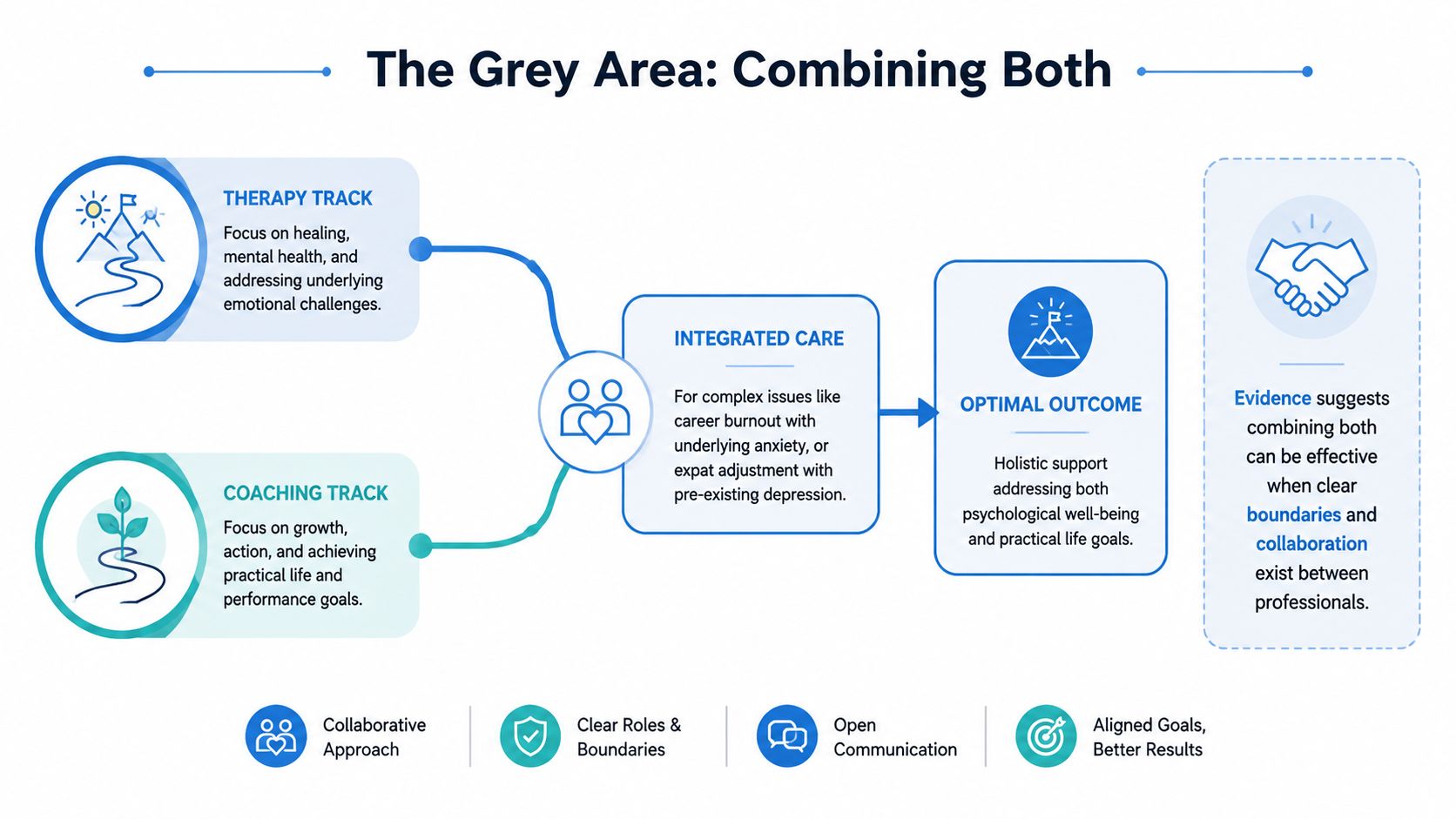
The Grey Area and When to Combine Both
Many asking about therapy vs coaching are in the grey area. They're not in crisis, but they're not fine either. They can work, study, and show up, yet they're carrying anxiety, unresolved grief, or a persistent sense that something is off.
Why the binary framing breaks down
The common advice says therapy is for distress and coaching is for growth. That's useful, but incomplete. In real life, people often need both symptom relief and forward movement at the same time.
Research on coaching shows measurable positive effects, including the outcomes reported in the peer-reviewed review above, which is why coaching can be a real part of care for non-severe or adjunctive needs (peer-reviewed review). But the same reality also means coaching should not be used to substitute for therapy when symptoms are clearly clinical.
How staged support usually works
The most sensible sequence is often simple, stabilize first, optimize later. Therapy helps reduce distress, untangle patterns, and create emotional steadiness. Coaching can then turn that stability into action, planning, and accountability.
That staged model is especially useful for expats in Italy. A year of silent adjustment stress can harden into exhaustion, and high-functioning anxiety can hide deeper relational wounds. Once the emotional load is lighter, coaching becomes much more effective.
When a referral should happen
Good coaches refer out when they spot symptoms that are beyond their scope. That's not failure, it's professionalism. The same is true when a therapist recognizes that a client is stable enough to benefit from structured goal work.
If you're trying to work on assertiveness, but your fear of conflict is tied to long-term relational pain, this assertiveness training resource can sit naturally after therapy, not before it. That order matters because skills stick better when the nervous system isn't fighting you.
Choosing the Right Provider in Italy
If you're in Italy and you want the right support, don't start with a title. Start with fit, scope, and language. Those three things will save you a lot of trial and error.
What to check first
- Clinical qualification: if you have symptoms, make sure the person is trained to work clinically.
- Language access: choose someone you can speak to without translating your feelings in your head.
- Specialization: trauma, burnout, expat adjustment, relationships, and identity stress all need slightly different expertise.
- Format: online helps when you travel or move often, in-person helps when you want a steady local anchor.
- Transparency: a good provider explains fees, boundaries, and what the work will involve.
What good usually looks like
You want evidence-based care, not vague reassurance. Approaches like CBT, EMDR, and Schema Therapy are useful because they give structure to distress, patterns, and change. You also want a provider who can say clearly whether your case belongs in therapy, coaching, or a combination.
For readers who want a guided, multilingual, clinically supervised entry point in Italy, finding the right therapist for expats in Italy is a helpful place to start. Therapsy is built for exactly this decision point, with therapy in 14 languages, human matching, and a free first assessment call that gives you space to ask questions before you commit.
If you want the shortest answer, use this: choose therapy for pain, coaching for goals, and both when the two are tangled together. That's the honest answer, and it's the one that keeps people moving instead of spinning.
If you're in Italy and you're still unsure whether you need therapy, coaching, or a staged combination, don't guess alone. THERAPSY offers multilingual psychotherapy with carefully selected clinicians, human matching, and a free first assessment call so you can talk through your situation without pressure. If you're ready for support that takes both your emotional life and your practical reality seriously, visit us and book that first conversation.