Why Using Cigna in Italy Feels Harder Than It Should
If you're trying to use therapy with Cigna insurance in Italy, the first surprise is simple, and annoying. Having a Cigna plan does not automatically mean therapy will feel easy, especially if you want care in English, in Milan or Rome, with a therapist who understands expat stress, culture shock, or relationship strain. The issue is workflow, not coverage alone. You need the right benefit, the right clinician, the right paperwork, and the right reimbursement path.
Cigna's Italy coverage exists, but access still depends on the details of your plan and the way you book care. That matters because Italy's mental-health system can be uneven, private therapy is common for people who want faster access or more language choice, and many expats discover that the bottleneck is not the session itself, it's proving the session should be covered Cigna Italy coverage. If you want a clean, reimbursable path, you need to think like an informed patient, not just a cardholder.
Practical rule: don't book first and ask questions later. Verify the benefit, the network status, and the invoice rules before you pay for the first session.
For expats who want a multilingual, human-matched option in Italy, Therapsy's expat mental health guide is a useful place to start because it fits the practical problem, finding care that works in your language and still fits an international insurance workflow.
Why Using Cigna in Italy Feels Harder Than It Should
The first mistake people make is assuming insurance solves access. It doesn't. Therapy with Cigna insurance in Italy can be straightforward only when your plan, your therapist, and your invoice all line up, and that's where many expats get stuck.
Italy is a classic example of a country where the public system covers core care, but private mental-health care remains a practical choice for people who want speed, privacy, or language match. Independent reporting on mental healthcare in Italy says around 76% of respondents in a 2022 survey of more than 1,000 adults said seeing a psychiatrist or psychologist is not something to hide, and private fees often start from €50 for a psychologist and €120 for a psychiatrist, which explains why insurance-backed access matters for internationally insured patients. That context matters because it shows why an expat can have insurance and still need a smart booking strategy.
The Primary Friction Is Not Medical, It's Operational
Many expats imagine a simple chain. Find therapist, book session, send receipt, get reimbursed. In reality, there are at least four decisions hiding inside that chain, language, network status, documentation, and whether your plan treats the session as outpatient psychotherapy, EAP support, or something else.
If you're in Milan and want an English-speaking therapist, you're not just choosing a clinician. You're also choosing between convenience and reimbursement certainty, especially if the therapist is outside the main plan's network. That trade-off is normal, but you have to name it early.
Direct advice: if you need therapy in a specific language, treat language matching as a coverage issue, not a preference issue. It affects whether you'll use the benefit consistently.
Cigna's behavioral-health resources indicate that members can use international health insurance for care in Italy, including behavioral-health services, but the exact result depends on your policy and benefit structure Cigna global health study context. That's why the smartest next move is not to search randomly, it's to build a shortlist that fits both your clinical need and your reimbursement path.
What This Guide Helps You Do
You want three things. First, you want to know what your Cigna plan covers. Second, you want to find a therapist in Italy who fits your language and location needs. Third, you want to avoid the paperwork mistakes that cause claim delays or denials.
That is the whole game. If you handle those three pieces in the right order, Cigna becomes usable in Italy instead of frustrating.
Verifying Your Cigna Mental-Health Benefits Before You Book
Start with the policy, not the therapist search. A Cigna card tells you almost nothing on its own. Your member portal, plan booklet, or benefits administrator is where the answer sits.
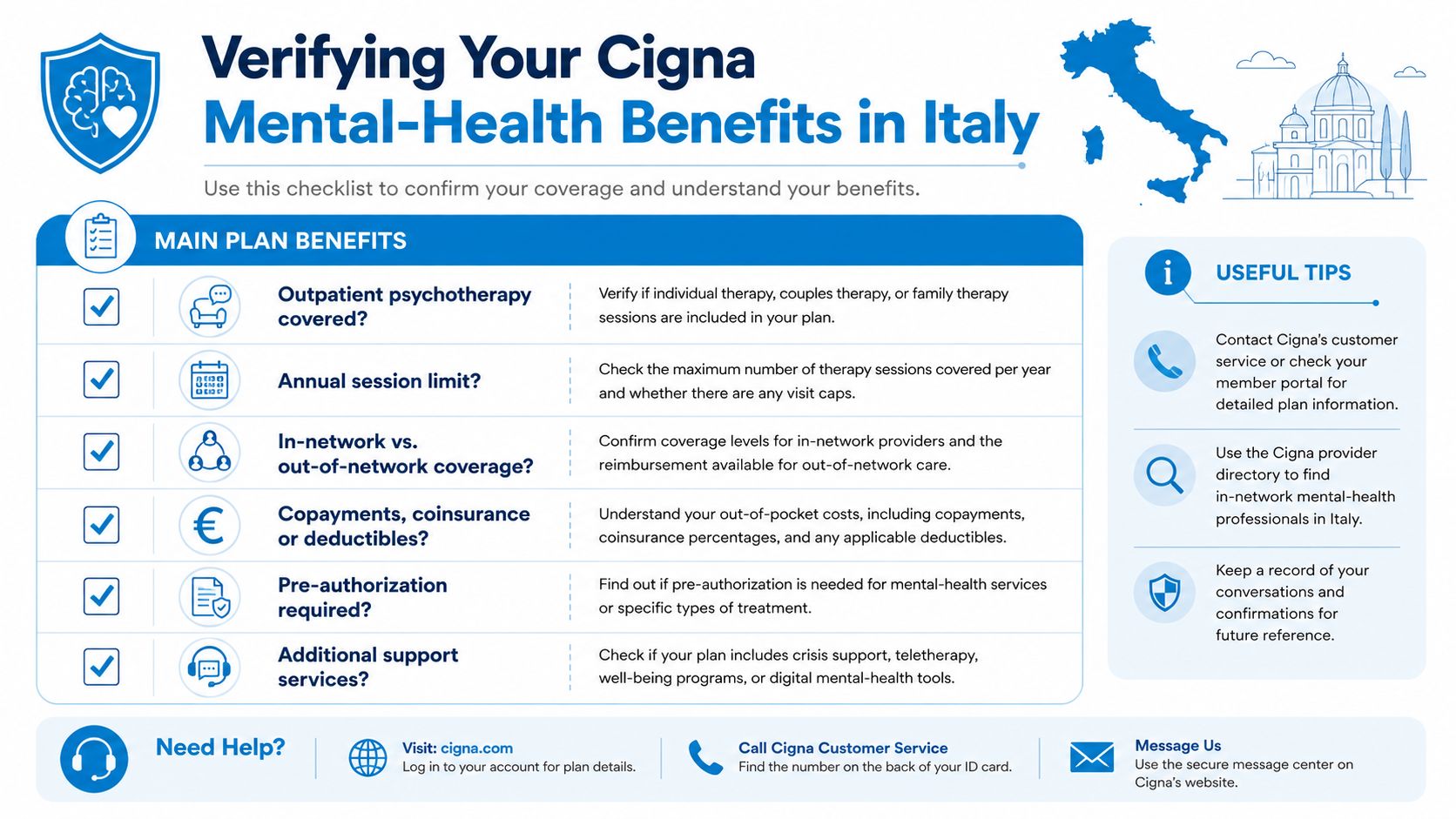
The five details you need in writing
Before you contact any therapist, confirm these points:
- Outpatient psychotherapy coverage: Ask whether therapy is covered at all under your plan.
- Network status rules: Check whether reimbursement changes if the therapist is in-network or out-of-network.
- Deductible and coinsurance: Find out what you pay before benefits kick in, and what share you still owe afterward.
- Referral or preauthorization: Some plans require a clinician referral or prior approval before treatment begins.
- Country of cover: Verify that Italy is included for the exact member and plan type you hold.
Those questions sound basic, but they prevent expensive surprises. Cigna's public therapy coverage materials emphasize that outpatient mental-health benefits vary by plan, deductible, and network status, and a sample Cigna plan booklet shows that mental-health services can be governed by structured benefit rules rather than flat access Cigna sample plan booklet.
Read the small print like it matters
It does. If your plan has a session limit, that limit matters even when the therapist feels like a good fit. If your plan has a deductible, the first sessions may still be mostly out of pocket. If your plan uses different rules for in-network and out-of-network care, you need to know that before you book.
A lot of members also confuse fully insured plans with administrative-services-only arrangements. The distinction affects who processes claims, how benefits are managed, and how much flexibility you have. If you don't know which type you have, ask the benefits administrator directly.
The safest move is to ask Cigna, in one message or call, for a written summary of outpatient psychotherapy coverage in Italy. Then save that reply before you schedule.
Use your portal or helpline with a tight script
Don't ask vague questions like “Does therapy work here?” Ask specific questions about psychotherapy, reimbursement, network status, and prior approval. Keep the call short, and write down names, dates, and reference numbers if you get them. If the answer is unclear, escalate until it's clear enough to use.
For a rough sense of what therapy costs in Italy and how that affects reimbursements, Therapsy's pricing guide for therapy in Italy is a practical companion read, especially if you want to compare out-of-pocket exposure with your benefit structure.
Bottom line: if you can't answer the coverage questions in fifteen minutes, you're not ready to book yet.
Finding Cigna-Friendly Therapists in Italy
Once the benefit is clear, the next job is finding a clinician who fits both your language and your claim path. In Italy, that usually means choosing between in-network convenience and out-of-network flexibility. For many expats, the right therapist is not the one closest to you, it's the one you'll keep seeing.
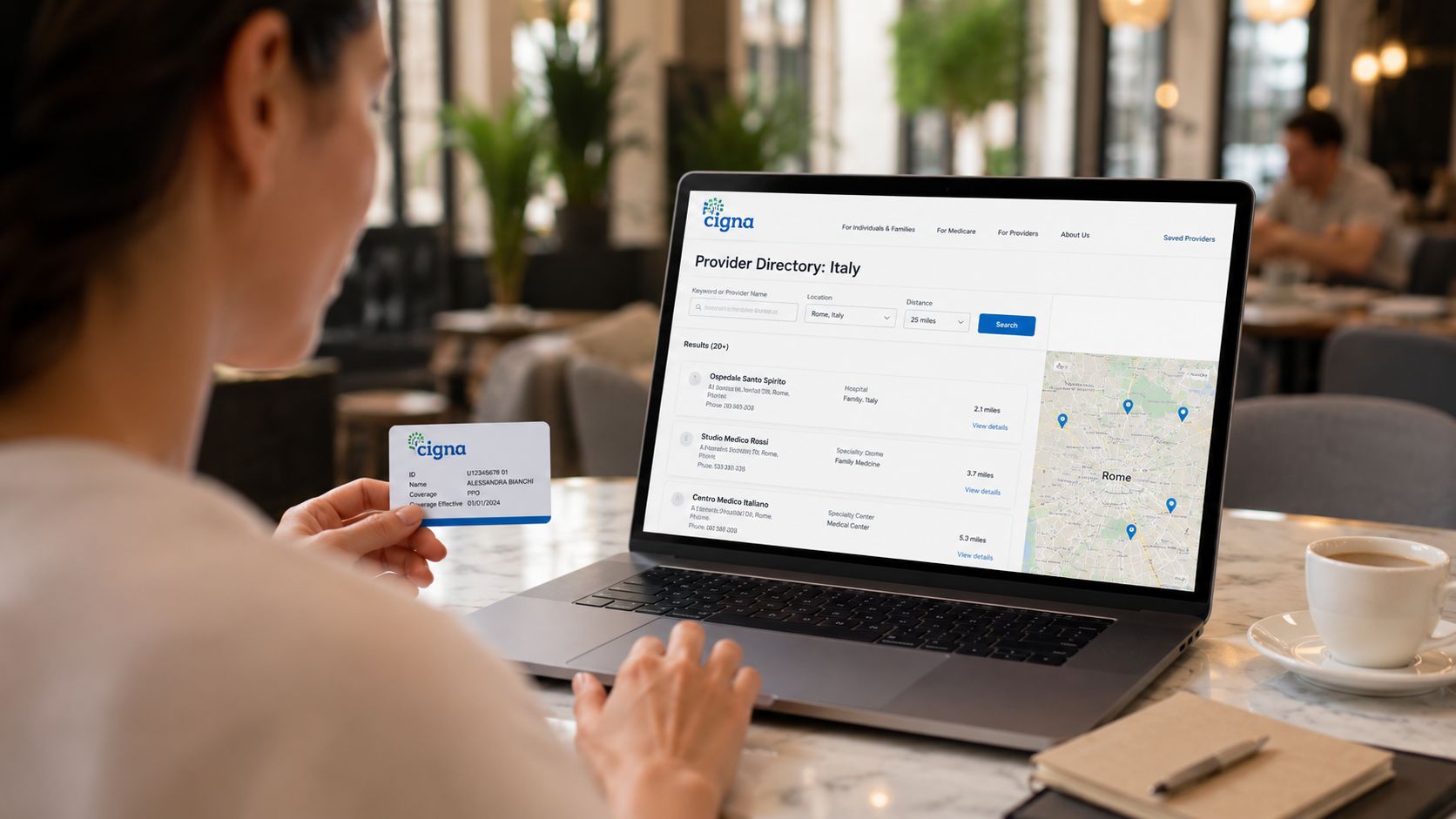
Use three search paths, not one
The best way to search is to combine three routes:
- Check the Cigna provider directory. Start there if you want the cleanest reimbursement path.
- Call Cigna for help. Ask whether they can point you toward clinicians in Italy who match your language and specialty needs.
- Consider reputable out-of-network providers. This is often the solution when you need English, another specific language, a particular city, or a modality like CBT or EMDR.
That third route matters more than people admit. Italy's public system can involve referrals, regional variation, and waiting times, so expats often turn to private care when they want a more direct path Expat healthcare guidance on mental healthcare in Italy. If your city search turns up weak in-network options, that's not failure, it's reality.
Match the therapist to the actual problem
Don't search only by language. Search by problem, too. Someone dealing with burnout needs a different therapeutic frame than someone handling panic, trauma, or relationship conflict. CBT can help structure anxious thinking, EMDR is often sought by trauma clients, and Schema Therapy can be useful when old patterns keep repeating in relationships.
If you're in Milan, Rome, or Florence, shortlist therapists who can clearly answer three questions:
- What language do you offer sessions in?
- Are you in-network with my plan, or should I expect reimbursement?
- What documents do you issue for insurance claims?
That last question saves time later. A therapist who understands invoices, receipts, and claim-ready wording is worth a lot more than a therapist who only says yes to the booking.
Don't let “network” become your only filter
An in-network therapist can be convenient, but it's not always the smartest choice if the language mismatch means you'll underuse treatment. Out-of-network care can make sense when the therapist is a stronger clinical fit and your plan reimburses part of the cost. The goal is not to maximize theoretical savings, it's to get care you'll continue.
Useful rule: if you can't communicate freely in the room, you're already paying a hidden cost.
For expats trying to sort language, fit, and insurance compatibility in one go, Therapsy's therapist-matching resource for expats in Italy is a sensible place to narrow the field.
Preauthorization, Claims, and Italian Invoices That Get Reimbursed
Good therapy becomes reimbursable therapy. The claim process is rarely complicated, but it is unforgiving. If a document is missing the wrong detail, the insurer may reject or delay payment even when the session itself was valid.
A realistic example helps. Suppose you're in Rome, you've chosen a therapist who speaks English, and your plan covers outpatient psychotherapy with reimbursement for out-of-network care. You pay the session up front, ask for a compliant invoice, submit the claim, and wait for the insurer's decision. That path works only if the paperwork is clean from the start.
What usually needs to happen before the first session
Some plans want preauthorization. Others don't. If your plan requires approval, get it before the first appointment, not after. If there's no preauthorization requirement, still keep a record of the benefit confirmation in case claims staff later ask for proof.
The session itself is usually the easy part. The tricky part is the paperwork trail: therapist invoice, diagnosis or service description if required, proof of payment, and any claim form or portal submission your plan uses. If you don't have one of those pieces, reimbursement can stall.
Invoice details that matter in Italy
Italian invoices and receipts can contain fiscal and payment data that international claims teams expect to see. Make sure the document includes the therapist's identifying details, the date of service, the type of service, the amount charged, and the payment record. If your receipt is in euros but your claim portal asks for another currency, use a transparent conversion record rather than guessing.
A practical tool like receipt currency converter can help you attach a clean conversion reference when the claim portal needs one. Use it as support, not as a substitute for the original invoice.
Typical Cigna Therapy Claim Documents in Italy
| Document | What It Contains | Why Cigna Needs It |
|---|---|---|
| Therapist invoice or receipt | Date, service type, amount, provider details | Confirms the session happened and what was charged |
| Proof of payment | Card slip, bank record, or payment confirmation | Shows you actually paid the provider |
| Claim form or portal submission | Member data and claim details | Routes the request through the insurer's system |
| Medical or referral note, if required | Coverage justification or authorization reference | Supports plans that ask for referral or preapproval |
| Currency conversion support, if needed | Clear euro-to-plan-currency reference | Helps the reviewer process reimbursement accurately |
If a claim is rejected, don't assume the benefit is gone. Most rejections come down to missing data, not a hard denial of psychotherapy itself. Resubmit with corrected paperwork, and if the insurer's explanation is vague, ask for the exact missing item in writing.
For expats who need a quick primer on claim-friendly reimbursement logic in Italy, Therapsy's expat psychologist bonus guide fits naturally into that process.
Using EAP and Telehealth Benefits Alongside Your Main Plan
Many people pay attention to the main medical plan and forget the extra mental-health routes sitting beside it. That's a mistake. Cigna members in Italy may have a separate Employee Assistance Program, telehealth support, or both, and those benefits can be useful even when the main therapy benefit is limited.
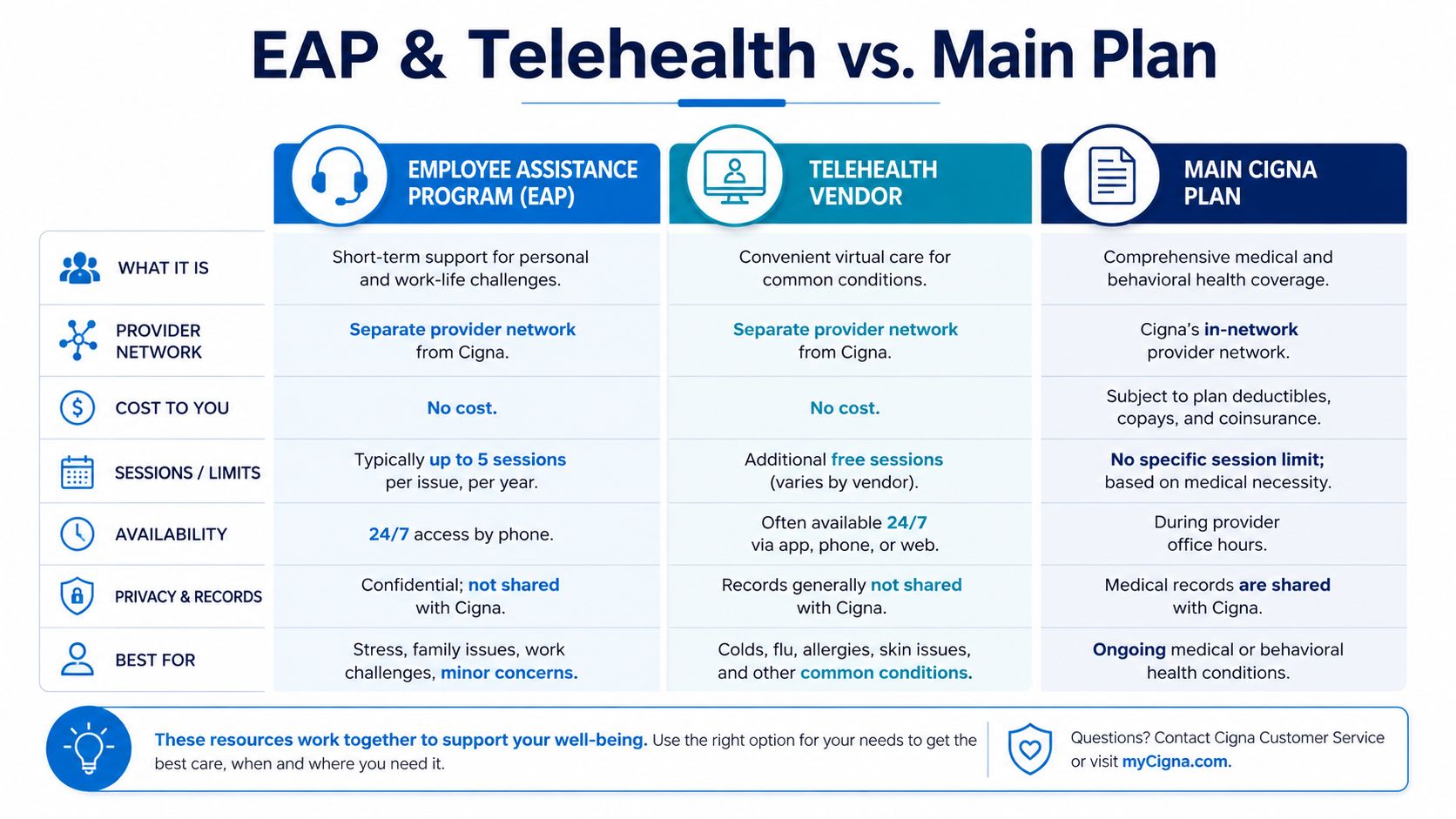
Choose the right lane for the problem
EAP is usually the shortest path for immediate, structured support. It works best when someone needs a few sessions, fast triage, or help deciding what kind of care they need. Cigna's behavioral-health pathway is typically a stepped-care model, starting with screening and moving toward CBT-oriented support for moderate anxiety or depression, with a documented Mental Health Support Programme that allows a maximum of 20 sessions Cigna sample plan booklet.
Telehealth is different. It can make sense if you're traveling, outside a major city, or need a provider in a specific language. It also helps with continuity when your schedule is chaotic or you split time between Italy and another country.
EAP, telehealth, or main plan
Use this simple filter:
- EAP: best for short, focused support and quick entry.
- Telehealth: best for location flexibility and language access.
- Main plan: best when you need ongoing outpatient psychotherapy under your core coverage rules.
The important point is that these aren't interchangeable in every case. They may sit alongside each other, but the benefit rules are often different. That's why you should ask which channel you're using before you begin.
Time zones and language choice still matter
If your employer's support is based outside Italy, time zones can make or break follow-through. Don't pick a provider you can't realistically see on a weekday evening or during a stable work break. A therapist who speaks your language and can offer a session time you'll keep is worth more than a theoretically covered option you'll cancel twice.
Therapsy's online psychotherapy option fits this kind of use case well when clients need language match and scheduling flexibility without giving up continuity.
Short version: use EAP for urgency, telehealth for flexibility, and the main plan for your longer treatment path.
Common Pitfalls and How Expats Avoid Them
People don't lose reimbursement because therapy is impossible in Italy. They lose it because they assume too much. The cost is usually emotional as much as financial, since uncertainty makes people delay the care they need.
The mistakes I see most often
- Assuming all therapy is unlimited. It isn't. Check the plan wording before session one.
- Ignoring the deductible. A covered session can still cost you more than expected at the start.
- Booking first, verifying later. That usually creates the reimbursement mess.
- Submitting a thin invoice. Missing fiscal details can slow the claim.
- Confusing EAP with the core plan. They may have different rules, limits, and provider paths.
- Skipping currency documentation. Claims staff want clarity, not guesswork.
Each of those problems is avoidable. The fix is simple, confirm the benefit first, then book the therapist, then keep every document.
Why this becomes a mental-health problem, not just an admin problem
When people get stuck on claims, they often delay the next session. That's the core damage. A good therapeutic relationship depends on continuity, and reimbursement anxiety can interrupt that continuity even when the clinician is the right fit.
The fix is to separate the clinical decision from the financial one. You can choose the therapist you need, then make the reimbursement process as clean as possible around that choice. If you're an expat in Italy, that's often the smartest balance.
One habit that saves people time
Keep a single folder for every therapy session. Save the invoice, payment proof, claim confirmation, and any email from Cigna in one place. If a reviewer asks for more information later, you won't have to reconstruct the trail from memory.
Best practice: treat each session like a tiny reimbursement file. That habit protects both your money and your momentum.
Your Next Steps and How Therapsy Fits Into the Picture
If you want this to work smoothly, do three things in the next 48 hours. Confirm your Cigna outpatient psychotherapy rules, shortlist therapists who match your language and city, and decide whether you'll use in-network care, out-of-network reimbursement, or a separate EAP route. That order matters more than speed.
Therapsy fits naturally into this workflow for expats who need therapy in Italy but don't want to fight the language barrier. It offers 14 languages, online and in-person sessions across Italian cities, and a free first assessment call with human matching rather than automated forms. That makes it a practical option when you need care that can still sit inside an insurance reimbursement path.
A multilingual practice is especially useful when your problem is not just anxiety or burnout, but the stress of handling a new system in a second language. If you want a therapist who can work with you in the language you think and feel in, the right next move is a brief assessment, not a long guessing game.