You may have arrived in Italy for love, work, study, or a long-imagined fresh start. On paper, it can look like a dream. Then ordinary life begins. You’re tired from translating everything in your head, the paperwork never seems finished, your support system is far away, and small problems start to feel strangely heavy.
Expat depression in italy is not a sign that you made the wrong move or that you’re failing at expat life. It’s often a psychological response to prolonged stress, loss of familiarity, isolation, and the pressure to function well in a system that still feels foreign.
I often want people to hear one thing early: your distress makes sense. If you’re struggling to enjoy a country you thought would make you happier, that doesn’t mean you’re ungrateful. It usually means your mind and body have been carrying more than anyone can see.
The Hidden Weight of Living the Dream in Italy
A newly arrived expat often tells the same story in different words. The first weeks feel intense, beautiful, and disorienting. Then the practical reality of life in Italy takes over. You need documents, appointments, a tax code, a doctor, a rental agreement, better Italian, and some sense that you belong here.
That’s often when shame appears. You wonder why you feel low in a place other people romanticise. You think, “I chose this, so why am I unhappy?”
This is one of the most common forms of emotional confusion in relocation. The outer image says “dream life.” The inner experience says “I feel alone, exhausted, and not like myself.”
For many people, expat depression in italy begins subtly. It may look like irritability, numbness, tears that seem out of proportion, or the urge to withdraw. It may also look very high-functioning. You keep going to work, answer messages, show up socially, and still feel flat inside.
A move abroad can be both meaningful and painful at the same time.
If you need a broader overview of mental health support for expats in Italy, start there. What matters first is this: depression in an expat context is not weakness. It is often the mind’s response to too much adaptation for too long.
Why Life in Italy Can Feel So Hard

Italy can be warm, beautiful, and profoundly rewarding. It can also be difficult in ways that many relocation guides minimise. The strain usually isn’t one dramatic event. It’s the repetition of friction.
Bureaucracy can drain emotional energy
Many expats don’t expect how much mental energy gets consumed by administration. Residence permits, the questura, tax registration, health coverage, housing contracts, and appointment systems can create a constant background state of uncertainty.
This matters clinically. When the rules feel opaque, people often stop trusting their own judgment. They become more anxious, more hesitant, and more self-critical. A task that would feel manageable at home can feel humiliating abroad if you don’t understand the language, the social code, or the unspoken expectations.
Language barriers create more than inconvenience
Not speaking Italian fluently doesn’t just make errands harder. It can change your personality in public. People often tell me they feel less witty, less spontaneous, less competent, and less visible.
That experience has consequences:
- Conversations become effortful. You monitor every word instead of relaxing into connection.
- Conflict feels riskier. If something goes wrong, you may not have the language to repair it.
- Dependence increases. You rely on a partner, employer, or friend for simple tasks.
- Isolation grows. You can be surrounded by people and still feel absent.
Economic anxiety is often ignored, but it matters
Many discussions of expat distress focus on culture shock and loneliness. Those are real, but they are not the whole story. Financial insecurity is one of the most overlooked drivers of low mood.
That kind of pressure can make depression feel less like an abstract mental health issue and more like a rational response to instability.
When your income, visa status, housing, or work future feels fragile, your nervous system doesn’t interpret that as a minor inconvenience. It interprets it as threat.
Distance from your real support system changes everything
At home, a bad week may have been buffered by familiar rituals, long-term friends, family, known streets, and the comfort of not having to explain yourself. In Italy, even a beautiful life can feel emotionally under-supported if those foundations are gone.
A few common patterns show up:
- You minimise your pain because other people think you’re lucky to be here.
- You stop sharing openly with family back home because you don’t want to worry them.
- You over-rely on one person, often a partner, because they’re your only stable reference point.
- You delay getting help because every system feels harder to access in a second language.
That combination can slowly pull someone from adjustment stress into depression.
Recognizing the Symptoms of Expat Depression
Depression doesn’t always arrive as obvious sadness. In expat life, it often hides inside fatigue, irritability, emotional numbness, or the feeling that everyday tasks now take too much effort.
In Italy, depressive symptoms can include persistent emptiness and hopelessness, and they can also show up through psychosomatic distress. The Therapsy overview of depression also notes an access paradox for expats. Support may exist, but language and cultural barriers can delay diagnosis, and 18% of Therapsy’s clients are in Milan, where this tension is especially visible.
What goes beyond normal homesickness
Homesickness tends to come in waves. Depression is more persistent. It changes how you think, how your body feels, and what you can bring yourself to do.
Use this checklist gently. It’s not for self-diagnosis. It’s a way to notice patterns.
Emotional signs
- Low mood most days rather than occasional dips
- Hopelessness about improving your situation
- Irritability that surprises you
- Numbness instead of clear sadness
- Loss of pleasure in food, travel, dating, study, or exploring
Cognitive signs
- Difficulty concentrating at work or university
- Negative self-talk such as “I can’t handle this” or “I’ve become a worse version of myself”
- Indecision over small tasks
- Rumination about mistakes, bureaucracy, rejection, or whether moving was a mistake
Physical signs
- Fatigue that sleep doesn’t fully relieve
- Sleep changes, either waking often or wanting to stay in bed
- Appetite shifts
- Tight chest, stomach issues, headaches, or body heaviness when stress is being carried physically
Behavioural signs
- Cancelling plans
- Staying inside more
- Avoiding Italian-speaking situations
- Doing the bare minimum and then collapsing
- Using alcohol, scrolling, or overwork to switch off
A practical threshold
It’s time to seek support when your symptoms are no longer just unpleasant, but persistent, disruptive, and narrowing your life.
You do not need to wait until you are in crisis to deserve help.
If you’re unsure, this guide to signs of high-functioning depression may help you recognise patterns that are easy to miss, especially if you’re still outwardly coping.
The Psychology of Your Move Abroad
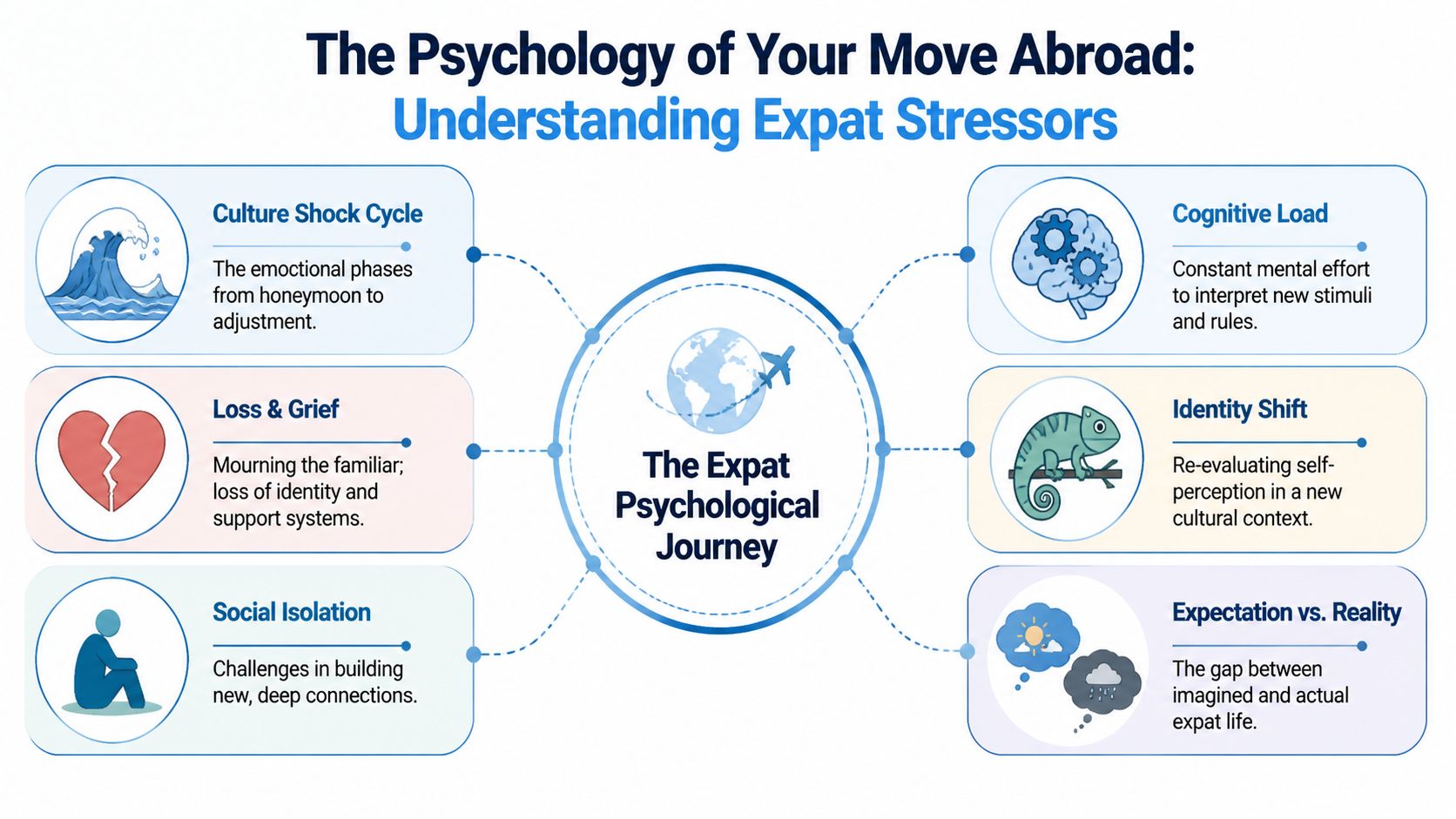
Moving abroad is not only a practical change. It is a deep psychological event. Even when the move is chosen freely, the mind still has to process loss, uncertainty, and identity disruption.
Why the first phase can be misleading
At the beginning, many people are carried by novelty. New streets, new food, new routines, new possibility. That early energy can hide strain. Later, when ordinary life replaces adrenaline, unresolved stress becomes more visible.
That matters because it shows that distress doesn’t always fade with time. In many cases, chronic adaptation stress accumulates.
What the mind is trying to manage
From a cross-cultural psychology perspective, relocation puts pressure on several systems at once:
Attachment needs
Human beings regulate emotion through familiarity, trusted relationships, and predictable environments. A move disrupts all three.Identity stability
You may no longer feel like the competent professional, friend, partner, or student you were at home. Even simple tasks can make you feel reduced.Cognitive load
Everyday life takes more brainpower. You are decoding language, social cues, work expectations, and bureaucracy all at once.Grief
Not all grief is about death. Expats often grieve version of self, old routines, lost ease, and the people who knew them without explanation.
Why “just push through” usually doesn’t work
One common response is to work harder, socialise more, or tell yourself to be grateful. Those efforts can help for short periods. They don’t resolve the deeper issue if the nervous system is already overloaded.
I often see two unhelpful extremes:
| Pattern | What it looks like | Why it usually fails |
|---|---|---|
| Over-adaptation | Constantly trying to fit in, perform well, and not complain | It can create exhaustion and self-alienation |
| Withdrawal | Avoiding language, paperwork, social situations, or intimacy | It reduces stress briefly but strengthens depression over time |
The goal is not to become perfectly adapted. The goal is to build enough safety, support, and self-understanding that adaptation stops costing you so much.
Therapy can be useful. In CBT, we look at the thought patterns that turn setbacks into hopelessness. In EMDR, we can work with distress that feels stuck in the body after repeated overwhelm. In Schema Therapy, we look at deeper patterns such as defectiveness, abandonment, or unrelenting standards that relocation may reactivate.
Navigating Italy's Mental Healthcare System

Getting help in Italy is possible, but the pathway can feel unclear when you’re already emotionally tired. Most expats encounter two routes. The public system through the SSN, and the private system.
The public route through the SSN
If you are registered with the Italian health service, the usual first step is the medico di base, your general practitioner. They can listen, document symptoms, and refer you onward where appropriate.
This route can be important, especially if you need coordination with broader medical care. But there are trade-offs. Italy’s own mental health picture shows why access can be difficult. According to ISTAT’s mental health data, depression is Italy’s most common mental disorder, affecting over 2.8 million people aged 15+, with 5.4% chronic prevalence in 2015, and fewer than 50% of depressed individuals are appropriately diagnosed and treated.
For expats, the main obstacles are usually practical:
- Long waiting times in some areas
- Regional variation in what is available
- Limited multilingual care
- Administrative complexity when you’re not yet fully integrated into the system
The private route
Private care is often more direct. You can usually contact a psychologist, psychotherapist, or psychiatrist without first navigating multiple public steps. For many expats, this is the more realistic option if the priority is timely support in a language you can think and feel in.
A simple comparison helps:
| Pathway | Main advantage | Main limitation for expats |
|---|---|---|
| SSN public care | Lower direct cost in some cases | Often slower and less linguistically accessible |
| Private care | Faster access and more choice of language and approach | Out-of-pocket cost unless covered by insurance or EAP |
The online therapy in English in Italy route is often the least stressful first step for people who feel blocked by local logistics. It removes commuting, reduces language anxiety, and makes continuity easier if you travel or relocate within Italy.
What to do if you’re overwhelmed
If your symptoms are significant, don’t wait until you fully understand the system before asking for help. Start with the clearest access point available to you.
A practical order is often:
- Book one first conversation with a mental health professional.
- Ask directly about language, approach, and availability.
- Check whether your insurance or employer support programme offers reimbursement or access.
- Use the public system as a parallel route, not your only route, if speed matters.
That approach reduces paralysis. You don’t need to solve Italy’s healthcare maze before getting support.
How to Find the Right Therapist for You in Italy
The right therapist for an expat is not just someone who speaks English. The right therapist understands relocation stress, identity strain, culture shock, and the emotional consequences of living between systems.
What to look for first
Language matters, but cultural attunement matters too. A therapist should understand that depression in expat life may be linked to bureaucracy, social dislocation, financial anxiety, mixed-cultural relationships, or the collapse of your previous sense of self.
Look for these signs of fit:
- They can work in your preferred language, not only functionally but emotionally.
- They understand intercultural psychology, not just general depression.
- They use a clear therapeutic model and can explain it plainly.
- They are comfortable with practical reality, including visas, family distance, workplace strain, and adaptation fatigue.
The guide to finding the right therapist for expats in Italy can help you translate this into concrete questions before you book.
Understanding the professional roles
These titles can be confusing in Italy, especially if you come from another healthcare culture.
Psychologist
A trained mental health professional who can assess, support, and work psychologically within their scope.Psychotherapist
A professional with additional psychotherapy training who offers structured treatment for emotional and relational difficulties.Psychiatrist
A medical doctor who can assess mental health conditions and prescribe medication when appropriate.
You do not need to figure this out perfectly before reaching out. A good service should help direct you.
Which approaches tend to work
Different problems respond to different methods.
- CBT is often helpful when depression involves harsh self-talk, hopeless predictions, avoidance, and the habit of interpreting every setback as proof that things won’t improve.
- EMDR can be useful when the move has activated older trauma, or when repeated overwhelm now feels stuck in the body.
- Schema Therapy can help if relocation has triggered long-standing themes such as abandonment, defectiveness, failure, or chronic self-pressure.
A regional help-seeking pattern is also worth noting. In Statista data on depression and help-seeking in Italy, 64.7% of adults with depressive symptoms in Trentino-Alto Adige reported seeking help. That tells us something important. Many people do want support. The barrier is often access, not unwillingness.
One option available to expats is Therapsy, which offers a free first assessment, 50+ therapists, and care in 14 languages, with human matching rather than automated questionnaires. That model can be especially useful if you’re not sure what kind of therapist you need, but you know you need someone who understands life in Italy from an international perspective.
A good therapist should make you feel understood, not translated.
Practical Coping Strategies to Use Today

Therapy matters, but you also need things that reduce the emotional load today. The aim is not to solve depression with self-help. The aim is to create a little more stability while you arrange proper support.
Build a temporary structure
When life feels foreign, routine becomes a form of psychological containment. Keep it simple.
- Anchor the morning with the same first three actions each day
- Choose one admin task only instead of trying to solve everything at once
- Set one meal and one walk at consistent times
- Create an evening shut-down ritual so your brain knows the day is finished
Depression often worsens when every day feels undefined.
Reduce unnecessary mental clutter
Your environment affects your nervous system. If your flat feels chaotic, your mind often follows. A gentle reset can help, especially when motivation is low.
If you want practical ideas, this guide on how decluttering reduces anxiety offers useful, non-dramatic ways to lower sensory and emotional overload. Don’t aim for perfection. Aim for one calmer surface, one organised bag, one less visual demand.
Interrupt isolation on purpose
Depression tells people to withdraw. That relief is usually short-lived.
Try a low-pressure connection plan:
- Send one honest message to someone who feels safe.
- Schedule recurring contact with home instead of waiting until you feel better.
- Find one local point of contact, such as a class, a regular café, a language exchange, or an expat group.
- Lower the bar for social success. You don’t need deep friendship immediately. Repeated contact is enough to start.
Use body-based regulation
When your system is overloaded, insight alone may not settle it. Use physical interventions that are realistic.
- Walk daily, even briefly
- Eat regularly, even if appetite is off
- Limit alcohol when mood is low
- Use slow breathing or grounding when paperwork, appointments, or language situations trigger panic
Keep your thoughts factual
Depression likes totalising language. “I’ll never adapt.” “Everything here is impossible.” “I’ve ruined my life.” In CBT, we work to notice when the mind turns a hard moment into a permanent verdict.
A helpful replacement is: “This is hard right now, and I need support.” That statement is more accurate and less damaging.
FAQ About Expat Depression and Therapy in Italy
| [object Object] | [object Object] | [object Object] | [object Object] |
|---|---|---|---|
| Common concern | Short answer | Why it matters | Next step |
| Is this normal? | Often, yes | Relocation stress can become depression | Monitor persistence |
| Public or private? | Depends on urgency and language needs | Access differs widely | Choose the clearest route |
| Online or in person? | Either can work | Consistency matters most | Pick what you can sustain |
| How do I start? | One first conversation | Action reduces paralysis | Book an assessment |
FAQ
Is it normal to feel depressed after moving to Italy
Yes, it can be normal, and it should still be taken seriously. Moving abroad can disrupt identity, support, routine, and confidence all at once. If low mood becomes persistent and starts affecting sleep, work, appetite, or relationships, it deserves professional attention.
How do I know if this is depression and not just culture shock
The simplest answer is persistence and impact. Culture shock tends to fluctuate, while depression more often stays with you and narrows your life over time. If you’re withdrawing, feeling hopeless, or struggling to function for more than a passing phase, it’s worth speaking with a professional.
Can I get therapy in English in Italy
Yes, you can, although access varies depending on where you live and whether you use public or private care. Many expats choose private therapy because it is often easier to find English-speaking or multilingual professionals there. Online options are also useful if your local area offers limited choice.
Should I try the SSN first or go private
It depends on urgency, budget, and language needs. The SSN can be an important route, but it may involve delays and fewer multilingual options. Private therapy is often more accessible for expats who need timely support and a therapist who understands intercultural issues.
What if I don't know what kind of therapist I need
That is very common, and you don’t need to solve it alone. A first assessment can help clarify whether you would benefit more from psychotherapy, psychiatric consultation, or a specific approach such as CBT or EMDR. If you want to understand what the process feels like, this overview of the first psychological session can make the first step feel less unknown.
Is online therapy effective for expats in Italy
Yes, online therapy can be very effective when it is consistent and well matched. For expats, it often reduces logistical stress, makes language access easier, and allows continuity during travel or relocation. What matters most is feeling safe, understood, and able to attend regularly.
What if I feel ashamed because I chose this move
That shame is common, but it is misplaced. Choosing a move does not mean you consented to every emotional consequence of it. You can be grateful for Italy and still be struggling intensely inside.
When should I seek help urgently
Seek urgent support if you feel unable to keep yourself safe, if your functioning drops sharply, or if you feel overwhelmed to a degree that frightens you. In those moments, do not try to manage alone. Contact local emergency or medical services, a trusted person nearby, or immediate professional support.
If you’re struggling with expat depression in italy, you don’t need to wait until things get worse to ask for help. Book your first free assessment call with THERAPSY, no commitment, just a conversation with our Clinical Director who will listen carefully and help match you with the right therapist for you.
Dr. Francesca Adriana Boccalari, Clinical Director at Therapsy
Not sure whether what you are feeling is depression?
Our free online depression test takes two minutes. It is based on the PHQ-9, the screening questionnaire used by clinicians worldwide, and it is anonymous – no email required to see your result.
If the result suggests you could use support, the next step is a free first call with a licensed therapist who speaks your language, online or in person across Italy.