You arrived in Italy for something meaningful. A degree, a job, a relationship, a reinvention. On paper, life may even look beautiful. Then ordinary days begin to feel heavier than expected. Small bureaucratic tasks take too much energy. Friendships stay polite but thin. Work stress follows you home. You start searching for an expat therapist in italy because you need more than advice from friends and more than another article telling you to “embrace the lifestyle”.
That search can feel confusing fast. Italy has excellent clinicians, but the route to finding the right one is not always obvious, especially if you don't yet speak Italian confidently, don't understand the healthcare system, or need a therapist who can work across languages and cultures.
I’m Dr. Francesca Adriana Boccalari, Clinical Director at Therapsy, a psychotherapist trained in CBT, EMDR, Schema Therapy, and intercultural clinical work. I’ve worked with expats, international students, and multilingual clients navigating exactly this intersection of stress, identity, and adaptation. Good therapy in Italy is possible. What helps is knowing how the system works, what to look for, and which shortcuts often lead people in the wrong direction.
A Guide to Finding Your Balance in Italy
Life abroad often becomes difficult in very practical ways before it becomes difficult emotionally. You may be sleeping badly, feeling irritable, overthinking messages from work, or crying more than usual without fully understanding why. Many expats tell me they hesitate to seek support because they think their distress is “not serious enough”. That’s rarely a useful standard.

A better question is simpler. Is daily life taking more effort than it should? If the answer is yes, therapy can help.
What people usually need at the start
When someone is newly arrived in Italy, they usually don’t need abstract inspiration. They need clarity.
That often means help with:
- Naming the problem clearly so anxiety, burnout, homesickness, trauma activation, or relationship strain stop feeling like one giant blur
- Choosing the right level of care instead of losing time in generic directories
- Finding a therapist who understands context including language, migration stress, and the emotional effect of bureaucracy
- Starting in a low-pressure way so the first step feels manageable
Many people begin by reading practical mental health guidance such as ways to improve mental health during stressful transitions, but self-help has limits. If your nervous system is staying activated, if your mood is dropping, or if you feel less like yourself than usual, a human therapeutic relationship matters.
Therapy for expats in Italy works best when it addresses both symptoms and context. Anxiety is rarely just anxiety when you are also adapting to a new country, language, and support system.
What generic advice often gets wrong
Generic directories focus on availability. Clinical work depends on fit.
A therapist may be licensed and still not be the right clinician for an expat. A therapist may speak English and still miss the psychological weight of relocation. A therapist may be kind and still not use a method that fits your needs.
What tends to work better is a decision process based on three questions:
- Can this clinician work in the language where you think and feel most naturally?
- Do they understand cross-cultural adjustment, not just general distress?
- Is the process of starting therapy simple enough that you’ll follow through?
If you’re overwhelmed right now, that isn’t a sign you’re failing at life abroad. It often means your internal resources are carrying too much at once. Therapy can reduce that load.
Why Expats and Students in Italy Seek Therapy
A common early pattern looks like this. You manage the practical tasks of arrival, answer messages saying everything is fine, and keep functioning. Then small things start to cost too much effort. Booking an appointment feels draining. A simple misunderstanding stays with you for hours. Sleep gets lighter, patience gets shorter, and you do not feel fully present in your own life.
That is a familiar clinical picture in relocation. It often reflects stress linked to adaptation and overload, not a personal failure.

The emotional patterns I see most often
In practice, expats and students rarely come to therapy for one neat reason. They usually arrive with a cluster of symptoms that make sense once the context is clear.
Acculturative stress is the mental and emotional strain of adapting to a new culture while trying to function in everyday life.
Culture shock is the repeated psychological friction between what you expect and what daily life requires from you.
These pressures often show up as:
- Anxiety: persistent worry, tension, overplanning, panic symptoms, health anxiety
- Isolation: being surrounded by people but feeling emotionally untranslated
- Burnout: especially in professionals or students performing all day in a non-native system
- Identity fatigue: feeling less spontaneous, less confident, or less recognisable to yourself
- Relationship stress: couples often adapt at different speeds, which creates friction around roles, dependence, and expectations
Students often carry an extra layer. Academic pressure, unstable housing, first-time independence, homesickness, and visa or administrative worries can all stack together. Practical conditions matter more than people expect. If you are living in shared accommodation and already feel exposed, reducing background uncertainty can help. Resources on dorm room security solutions may sound unrelated to therapy, but daily safety and privacy often affect sleep, concentration, and emotional regulation.
Why Italy can intensify the strain
Italy gives many newcomers what they hoped for. Beauty, strong local identity, social warmth, and a rich pace of daily life. It also asks for adjustment in ways that generic expat advice often misses.
Much communication is indirect and context-dependent. Bureaucratic steps may be explained differently by different offices. Family networks can shape housing, work opportunities, and social expectations more strongly than some foreigners anticipate. Even people who speak Italian well can feel wrong-footed by tone, timing, and the unwritten rules of how to ask for help.
This has a psychological cost. The issue is not only language. It is the constant effort of interpreting what is happening around you, deciding how much to adapt, and trying not to lose your sense of self in the process.
Why therapy can help sooner than people expect
Relocation tends to expose pressure points that stayed manageable at home. If your support system is far away, a difficult workday can feel sharper. If you already have perfectionistic traits, the inefficiency of settling in can trigger more self-criticism. If you rely on close friendships for regulation, ordinary loneliness can start to feel like rejection.
Good therapy addresses the full picture. It helps reduce symptoms, but it also clarifies what belongs to stress, what belongs to grief, what belongs to identity, and what may be an older pattern that the move has amplified.
That distinction matters. It helps people stop blaming themselves for reactions that are understandable in context, and it gives them a more accurate starting point for recovery.
Your Therapy Options in Italy A Clear Comparison
The hardest part for many newcomers is not deciding whether they need support. It’s understanding the available routes and their trade-offs.
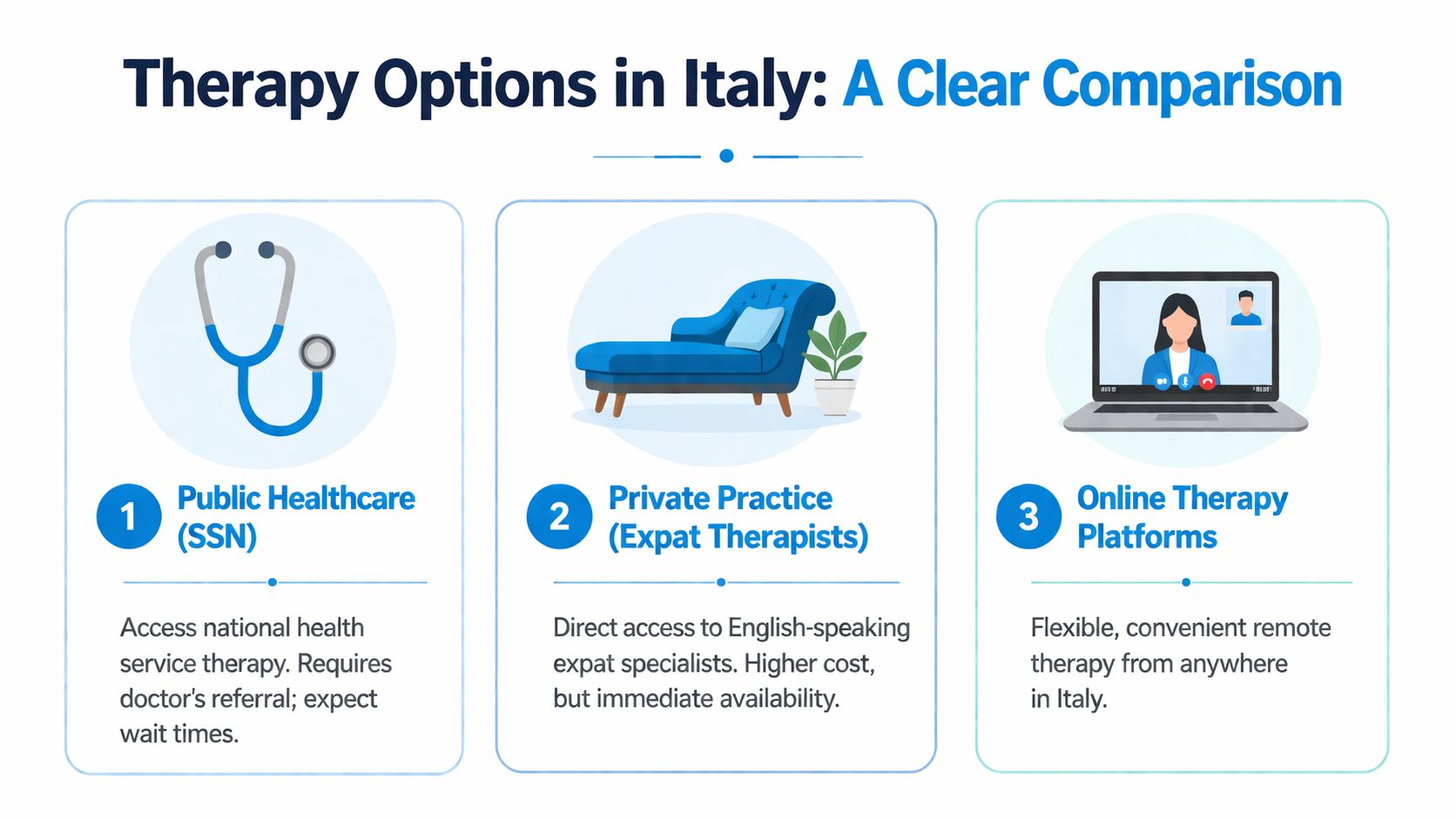
Public care and private care are not interchangeable
Italy’s public system can be helpful in some cases, but expats often discover quickly that practical access is the central challenge. In practice, that contributes to overloaded services, long waiting lists, and very limited multilingual availability.
For many expats, the main options look like this:
| Pathway | What usually works | What often doesn’t |
|---|---|---|
| SSN public services | Lower direct cost, possible referral pathway, useful for some psychiatric or urgent needs | Long waits, more bureaucracy, limited continuity, very hard to find non-Italian language care |
| Private individual practice | Faster access, direct booking, more therapist choice, easier language matching | Quality varies widely, you must assess fit yourself |
| Structured multilingual private services | Human support with matching, broader language access, online and in-person flexibility | Out-of-pocket cost unless reimbursed by insurance |
Public care can be the right route when cost is the overriding issue. Private care is often the right route when time, language, and fit matter most.
What the SSN route really involves
Many expats assume national healthcare means a smooth, centralised process. It usually doesn’t feel that way at ground level.
You may need:
- registration with the SSN
- the right documents
- a family doctor or local referral pathway
- patience with region-specific procedures
- enough Italian to follow administrative steps
That process can be manageable for some residents. It becomes much harder when you are new, distressed, and trying to explain subtle symptoms in a second language.
If you’re unsure whether you need psychological or psychiatric support, this guide on the difference between a psychologist and a psychiatrist can help clarify the route before you book anything.
Online and in-person therapy each solve different problems
Many people make a useful shift at this point. Stop asking which format is better in theory. Ask which format reduces friction in your real life.
Online therapy often works well when:
- you travel often
- you live outside a major city
- you want access to therapy in your native language
- you feel safer starting from home
- your schedule is unpredictable
In-person therapy often works well when:
- you focus better in a dedicated room
- home doesn’t feel private enough
- embodied presence matters to you
- you want therapy separated clearly from work and domestic life
Neither option is automatically more serious or less effective. What matters is consistency, fit, and whether the format allows you to engage authentically.
One practical model used by some expat-focused services is to combine both. For example, Therapsy offers online and in-person sessions across 24 Italian cities and 90+ physical locations, in 14 languages, with 50+ therapists, and has served 1,500+ clients since 2023. That kind of structure can be useful for people who want flexibility without having to restart the search every time they move city, travel, or change routine.
What usually does not work well
In my clinical view, three approaches tend to fail expats repeatedly:
- Choosing the first English-speaking name on a directory without checking clinical method or intercultural competence
- Waiting until symptoms become severe because daily functioning still looks “good enough”
- Assuming a technically available service is clinically suitable when the process itself already feels confusing or discouraging
A good therapy pathway lowers confusion from the start. It shouldn’t add more.
What to Look For in a Qualified Expat Therapist
Italy has many trained clinicians. That does not mean every therapist is prepared for intercultural work. Qualification is not only about title. It is also about scope, method, supervision, and cultural understanding.

Start with licensing and role clarity
In Italy, a therapist should be properly registered and transparent about their professional qualification. You want to know whether you are speaking with a psychologist, a psychotherapist, or a psychiatrist, and what that means for the work.
A useful starting resource is how to find the right therapist for expats in Italy, especially if the titles feel confusing.
Check for:
- Official registration: the clinician should be registered with the relevant Italian professional order
- Clear scope of practice: assessment, psychotherapy, medication, or a combination
- Transparent modality: CBT, EMDR, Schema Therapy, psychodynamic, systemic, or another recognised approach
- Experience with your presenting issue: trauma, panic, burnout, grief, relationship strain, adjustment, identity questions
Why cross-cultural skill matters
As of 2014, Italy had about one psychotherapist per 1,600 people, with 37,000 psychotherapists overall, according to this peer-reviewed overview. The issue for expats is not just therapist density. It is that specialisation in cross-cultural care is low.
That matters because multilingual therapy is not only translation. It involves understanding:
- how symptoms are shaped by migration and context
- how different cultures express distress
- how shame, family roles, and autonomy vary across backgrounds
- how identity can fragment under relocation stress
A therapist can speak your language and still miss your experience. Cultural formulation is a clinical skill, not a marketing phrase.
Why supervision is a strong quality marker
One factor many directories never mention is clinical supervision. From a practitioner’s perspective, supervision is one of the clearest signs that quality is being actively maintained.
A supervised clinician or team is more likely to:
- reflect carefully on difficult cases
- avoid drifting into vague support without direction
- notice blind spots in intercultural work
- stay consistent with evidence-based approaches
This is especially relevant with expat clients, where the clinical picture can include anxiety, trauma history, attachment activation, culture shock, bureaucracy stress, and loneliness all at once.
Which therapeutic approaches tend to help
Method matters, especially if you want something more structured than plain talking.
A few useful distinctions:
- CBT helps identify and change patterns of thought, avoidance, and behaviour that maintain anxiety, stress, and low mood.
- EMDR is often used for trauma and distressing memories that remain emotionally “stuck”.
- Schema Therapy can be useful when relocation activates older patterns around abandonment, perfectionism, defectiveness, or over-responsibility.
You don’t need to become an expert before booking. But you do want a therapist who can explain why they work the way they do, in language you can understand.
The Financial Side Costs Payments and Insurance
Money worries often delay therapy longer than people realise. Some expats postpone support for months because they assume private care will be inaccessible, or because they don’t know what can be reimbursed.
What therapy usually costs in Italy
In practical terms, what you pay depends on city, therapist qualification, language, and whether the work is highly specialised.
For expats, cost is rarely just about the session fee. It’s also about the hidden cost of delay. Waiting while symptoms worsen can affect concentration, sleep, work capacity, and relationships.
A realistic way to evaluate therapy cost is to ask:
- What am I paying for clinically? Experience, method, language skill, supervision, continuity
- What am I avoiding? Time lost in unsuitable referrals or repeated first sessions with poor-fit clinicians
- What is the practical value of fast access? Earlier support often means less emotional deterioration
What “from” pricing usually means
Some services publish starting fees rather than a single flat rate. That usually reflects differences in seniority, modality, and session type.
Therapsy’s pricing includes:
- Individual therapy from €70
- Couple therapy from €100
- Psychodiagnostic assessment from €255
- Psychiatric consultation from €110
This kind of pricing structure can make sense for expats who need flexibility rather than one rigid package.
Insurance and reimbursement questions to ask early
Insurance is where many people get stuck. The basic mistake is assuming “mental health” in a policy automatically means psychotherapy reimbursement. It often doesn’t.
Use a practical checklist. Before your first appointment, ask your insurer:
- Is psychotherapy covered, or only psychiatry?
- Do I need a referral or diagnosis first?
- Can I choose my own therapist, or must I use a network?
- Are online sessions reimbursable?
- Which invoice details are required?
If you’re trying to understand what public support or reimbursement routes may exist for foreigners, this overview of the Bonus Psicologo and expat access in Italy is a useful starting point.
Practical rule: ask reimbursement questions before you start, not after session three. Administrative stress feels much heavier when you are already emotionally stretched.
What usually works best financially
For many expats, the most workable path is one of these:
- Pay directly and claim reimbursement later if your insurer allows it
- Use employer-linked international coverage where available
- Choose a therapist with transparent invoicing and payment procedures
- Start with a free assessment or screening conversation so you don’t pay for a poor initial match
Cost matters. So does fit. Cheap therapy that you don’t continue is not economical.
How the Right Therapy Process Works
A good therapy journey should feel containing from the first contact. Not perfect. Not dramatic. Just clear, human, and safe enough for you to continue.
What often happens in the wrong process
A common expat experience goes like this. You search late at night, open ten tabs, send three emails, hear back from one therapist a week later, and book someone mainly because they answered. The first session is polite but vague. You spend most of it explaining Italy, your visa, your work context, and why speaking in English matters. You leave unsure whether the therapist understood the problem or merely listened kindly.
That process creates unnecessary dropout. It makes people think therapy “isn’t for them” when the underlying issue was poor matching.
What a better process looks like
The most effective process is usually simple and relational.
First contact should be easy. If reaching out already feels bureaucratic, many distressed people will stop there.
Initial listening should clarify what is happening now. Not just your symptoms, but your language preference, daily context, urgency, and previous therapy experience.
Matching should be thoughtful. A person with panic symptoms after relocation may need something different from a student with identity confusion, or a professional with trauma history and burnout.
Assessment should test fit, not trap you. A first conversation with the assigned therapist should help you understand whether you feel safe, understood, and clinically guided.
A human-led pathway is often stronger than an algorithm because therapy depends on nuance. Personality matters. Timing matters. Cultural context matters.
What human matching protects against
When a clinician or clinical director handles matching carefully, it reduces several risks:
- being placed with someone who works in your language but not your emotional register
- ending up with a therapist whose style is too passive or too directive for you
- beginning trauma work before enough stabilisation is in place
- repeating your story to multiple people without direction
At Therapsy, Dr. Francesca Adriana Boccalari, Clinical Director, supervises the matching process: first contact comes within 12 hours via WhatsApp, and the free first assessment call takes place with the therapist chosen for that person. From a clinical standpoint, that kind of workflow is useful because it lowers delay and creates a more deliberate fit from the beginning.
The first step into therapy should not feel like a test you might fail. It should feel like entering a conversation where someone can finally organise what has been overwhelming.
What to expect once therapy begins
Good therapy does not mean immediate relief after one session. It usually begins with a clearer map.
Early sessions often focus on:
- identifying the main pattern underneath the distress
- understanding what changed after the move
- noticing how your body, thoughts, and relationships are responding
- setting a pace that feels manageable
If the process is right, you usually feel two things quite early. More language for your experience, and less confusion about what to do next.
Preparing for Your First Therapy Session
The first session doesn’t require a polished story. You don’t need to arrive with the perfect explanation for how you feel. In fact, many people begin therapy precisely because they can’t organise it alone anymore.
What helps before the appointment
It can be useful to reflect briefly on a few points:
- What feels hardest right now: sleep, worry, isolation, motivation, panic, relationship conflict, concentration
- When it started: before the move, after arrival, or after a specific event
- What you want from therapy: relief, clarity, tools, deeper understanding, trauma work, support during transition
You don’t need long notes. A few honest sentences are enough.
Questions worth asking the therapist
The first session is also for you to evaluate fit.
You might ask:
- Have you worked with expats or international students before?
- How do you usually work with anxiety, burnout, or adjustment difficulties?
- Do you tend to be more structured or more exploratory?
- What happens if I feel the match isn’t right?
These questions are not rude. They show healthy engagement.
What you should feel after session one
You do not need to feel instantly better. But you should feel some combination of the following:
- more understood than before
- less alone with the problem
- clearer about the next step
- able to imagine returning
If you leave feeling confused, dismissed, or emotionally translated too loosely, pay attention to that. Fit matters.
Frequently Asked Questions
FAQ
| Question | Answer |
|---|---|
| Do I need to speak Italian to start therapy in Italy? | No. Many expats begin therapy in their native language or in English, and that is often the better clinical choice when emotions are complex. |
| Is online therapy a valid option if I move around Italy? | Yes. Online therapy can be a strong option when privacy, travel, or geography make in-person care difficult. |
| Can I change therapist if the fit feels wrong? | Yes. A good service or clinician should make it possible to reconsider fit without shame. |
| Will therapy in Italy be confidential? | Yes. Licensed mental health professionals in Italy are bound by confidentiality rules, with the usual legal and safety limits. |
| How often do expats usually attend therapy? | Frequency depends on the issue, but many people begin with regular sessions and review pace over time with the therapist. |
Do I need an English-speaking therapist or just a therapist who knows some English
You need a therapist who can work fluently in the language where you access emotions most naturally. Everyday conversational English is not the same as clinical fluency. If you find yourself simplifying painful experiences to make them easier to explain, the work may stay too shallow.
Is it normal to seek therapy even if my life in Italy looks good from the outside
Yes, it is completely normal. External success and internal strain often diverge in expat life. Many people seek therapy precisely because they are functioning well enough publicly while feeling disconnected, anxious, or depleted privately.
Can I switch therapists if the first match doesn't feel right
Yes, and sometimes that is the healthiest decision. A mismatch does not mean therapy has failed. It usually means the therapeutic relationship, method, or communication style needs better alignment.
How confidential is therapy in Italy
Therapy in Italy is confidential when provided by licensed professionals. Your therapist should explain confidentiality clearly at the start, including the limited situations where safety or legal duties may require action. If this matters especially to you because of work, visa, or family concerns, ask directly in the first session.
How long does therapy usually take for expats
There is no single standard duration because the work depends on your goals and history. Some expats want focused support during a transition, while others use therapy for deeper patterns that relocation has brought to the surface. A good therapist should help you understand the pace rather than keeping it vague.
What if I don't know whether I need CBT, EMDR, or another approach
You do not need to choose the method on your own before reaching out. What matters most at the start is finding a qualified clinician who can assess your needs and explain why a certain approach fits. Method should follow formulation, not guesswork.
Book your first free assessment call. No commitment, just a conversation with our Clinical Director who will listen and match you with the right therapist for you. Visit THERAPSY.