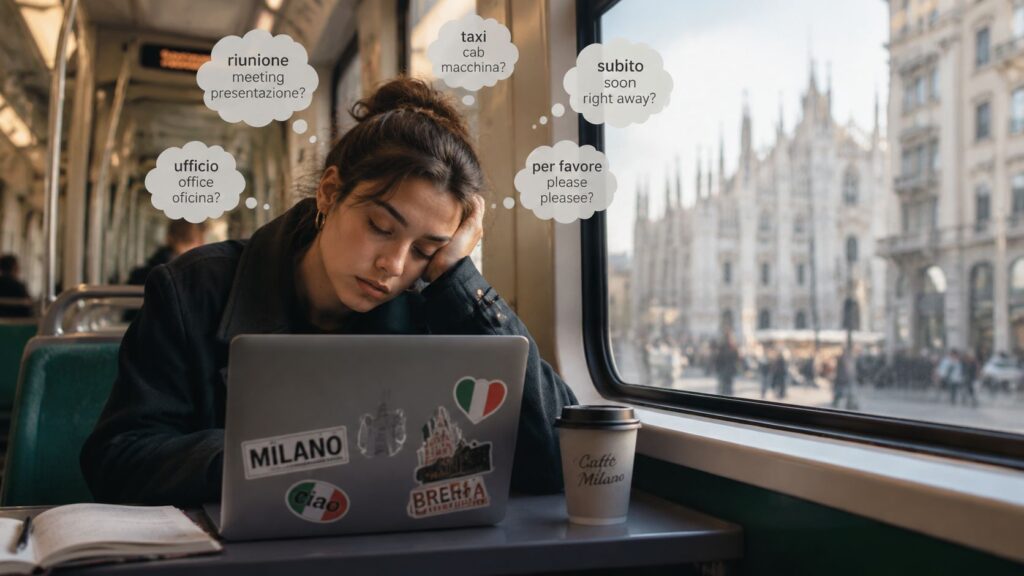
You’re sitting in a beautiful Italian piazza, surrounded by voices, clinking glasses, and the easy theatre of daily life. The light is warm. The buildings are exactly what you imagined before moving. And yet you feel sharply alone.
That experience is expat loneliness in italy. It isn’t just homesickness, and it isn’t a sign that you made the wrong decision. It’s the distress that comes from lacking meaningful, reliable connection in a place that may look socially vibrant from the outside. Many expats in Italy feel confused by this. They think, “How can I be lonely here, of all places?”
As a clinical psychologist working with expats, international students, and young adults in Italy, I see this often. People arrive with excitement, purpose, and a strong reason for moving. Then the emotional reality of relocation catches up. The problem usually isn’t that they’re weak, ungrateful, or “bad at adapting”. The problem is that major moves disrupt attachment, identity, routine, and belonging all at once.
Loneliness abroad often becomes most painful when life starts to look normal on the outside, but still doesn’t feel anchored on the inside.
Italy adds its own texture to this experience. The culture is relational, but relationships are often rooted in long history, family, and social codes that aren’t immediately visible to newcomers. That can make loneliness feel especially personal, even when it isn’t.
If you’re in that stage now, there is a way through it. Understanding what’s happening psychologically matters. So does learning what helps, what tends not to help, and when it makes sense to seek support such as mental health support for expats in Italy.
Introduction
Why loneliness in Italy feels so disorienting
Individuals typically expect practical stress after an international move. They prepare for housing, paperwork, money, and language. Fewer prepare for the emotional contradiction of feeling isolated in a country known for food, conversation, family life, and public sociability.
That contradiction often creates shame. You may think you should be enjoying yourself more, integrating faster, or feeling more grateful. In practice, that self-judgement usually makes the loneliness heavier.
A more accurate frame is this:
Expat loneliness in Italy is a relational and psychological adjustment problem, not a personal failure.
It tends to show up in ordinary moments. Weekends feel long. Social media becomes painful. Messages home become shorter because you don’t want to worry anyone. You start to function, but not quite settle.
What makes this article useful
I’m writing from the perspective of clinical work with people living this reality. That means focusing on trade-offs, not fantasies.
Some things help but take time. Some things bring comfort but keep you stuck. Some forms of connection look promising but remain superficial. Others feel awkward at first and become the foundation of real belonging.
You don’t need a perfect social life to feel better. You need steadier contact, a more realistic understanding of Italian social life, and enough emotional support to stop interpreting every difficulty as rejection.
The Italian Paradox Why Connection Can Feel So Hard

The honeymoon phase collapse
Many expats expect loneliness to hit immediately. Often, it doesn’t. The early period can feel stimulating, busy, and full of novelty. You’re exploring, setting up life, and running on adrenaline.
Then something shifts. The feeling of loneliness often peaks 6 to 18 months after arriving, a phenomenon described as the “honeymoon phase collapse” in the source material used for this topic, where early idealisation gives way to the daily reality of navigating a different culture and communities that can feel closed to outsiders, as described in this discussion of the adjustment cycle.
This delayed crash catches people off guard because it arrives after the move looks “successful” from the outside. You have an address. Maybe a job. Maybe even passable Italian. But emotionally, the scaffolding of your old life is gone.
Why Italy can feel warm and closed at the same time
Italy is socially expressive. That doesn’t automatically mean it’s easy to enter existing circles.
A common mistake is confusing friendliness with social access. Italians may be kind, humorous, generous, and open in conversation. But many close friendships are built through family history, school ties, local networks, and years of repeated contact. For an expat, that means pleasant interactions don’t always become invitations.
Three realities often collide:
-
Public sociability is visible
You see people gathering easily, talking loudly, lingering together, and seeming connected. -
Private belonging is slower
Real trust often develops gradually, through consistency rather than instant chemistry. -
Expectation inflation hurts
If you moved to Italy partly seeking community, the gap between fantasy and reality can feel brutal.
The painful part is often not only being alone. It’s being alone in a place where connection seems to be happening all around you.
What usually doesn’t work
When loneliness intensifies, people often react in ways that make sense short term but backfire later.
Common traps include:
-
Living in tourist mode for too long
Exploration is energising, but it doesn’t replace reciprocal relationships. -
Waiting to be chosen
In Italy, social life often requires repeated presence before trust forms. -
Reading slowness as rejection
Sometimes the issue is cultural rhythm, not dislike.
The more useful interpretation is that delayed loneliness is often a predictable stage of adjustment. Once you recognise that pattern, you can stop treating every difficult feeling as evidence that something has gone wrong.
The Psychology of Loneliness in a New Country
Your attachment system loses its usual anchors
When people move abroad, they don’t just leave places. They leave their everyday regulation system.
Attachment theory helps explain this. The nervous system settles through familiar people, predictable routines, shared language, and environments where you don’t have to translate yourself constantly. When those anchors disappear, loneliness can feel physical. Sleep becomes lighter. Small setbacks hit harder. Ordinary uncertainty starts to feel threatening.
For many expats, this is the hidden shock. They expected logistical stress. They didn’t expect the body-level effect of losing their secure base.
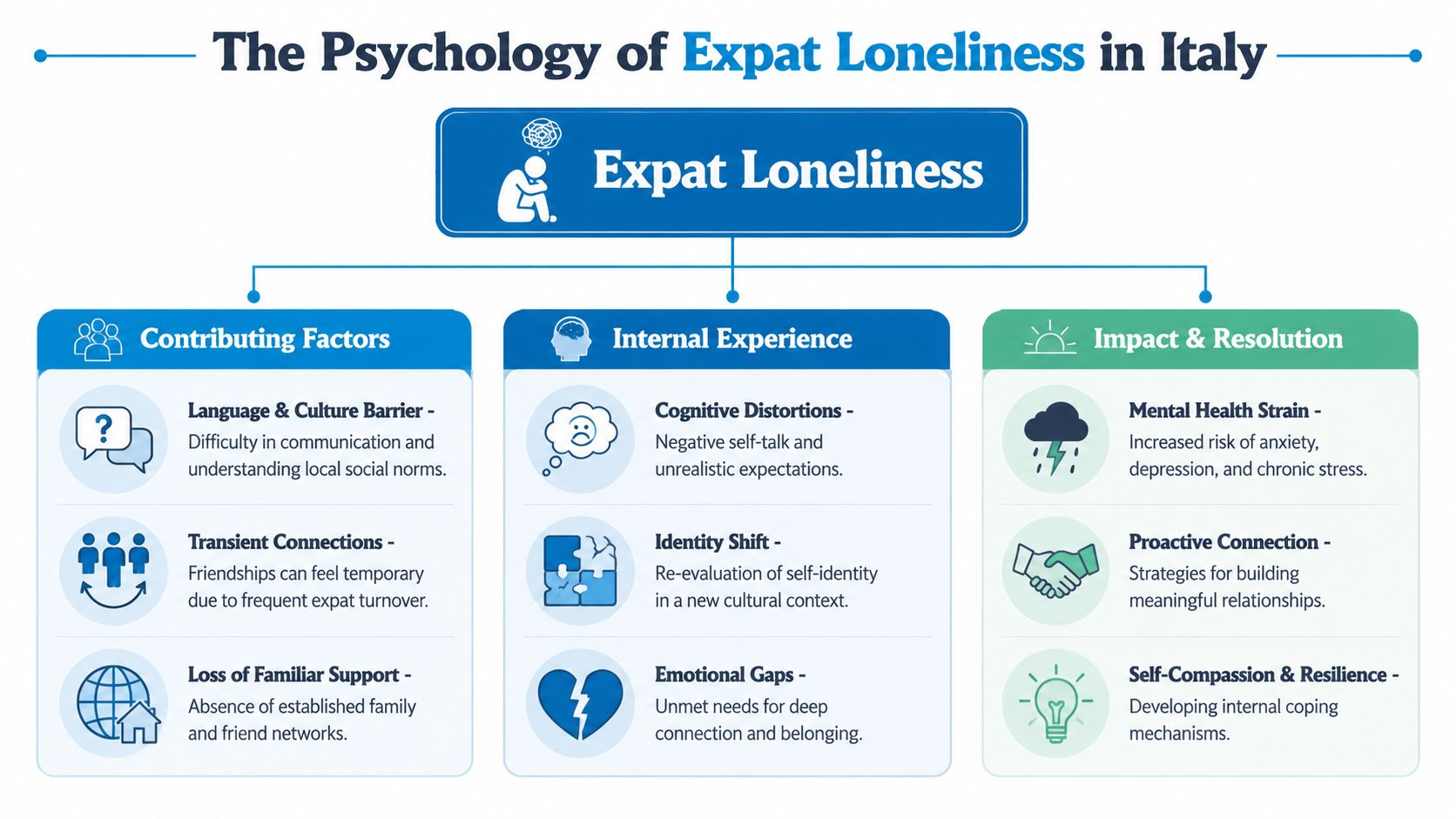
Identity loss often sits underneath the loneliness
Many expats say, “I don’t feel like myself here.” That isn’t vague. It’s clinically meaningful.
Your identity is partly reflected back to you by context. At home, you know how to be competent. You know your humour works. You know how friendships begin. You know how to handle admin, conflict, and casual conversation. In Italy, even educated, capable adults can suddenly feel clumsy or reduced.
This often shows up in several ways:
-
Professional identity shrinks
You may be accomplished, but language limits or cultural codes make you seem less fluent, less quick, less authoritative. -
Social identity blurs
The version of you that was witty, relaxed, or outgoing may feel inaccessible. -
Relational identity weakens
You may no longer be someone’s sibling nearby, best friend nearby, or familiar colleague in a known system.
Loneliness abroad often contains grief for the self you could be more easily in your original environment.
Language fatigue changes how connection feels
Speaking a second language isn’t only about vocabulary. It requires sustained cognitive effort, emotional risk, and constant monitoring.
That has consequences. Many expats become less spontaneous, less humorous, and more cautious socially. They don’t always avoid people because they dislike socialising. They avoid the exhaustion of performing competence.
From a CBT perspective, this can trigger cognitive distortions such as:
-
Mind reading
“They think I’m boring.” -
Personalisation
“They didn’t invite me because there’s something wrong with me.” -
All-or-nothing thinking
“If I’m not fully integrated by now, I never will be.”
Schema Therapy adds another layer. Relocation can activate older patterns, especially around exclusion, defectiveness, abandonment, or emotional deprivation. That’s why expat loneliness can feel larger than the present moment. The move doesn’t create every wound, but it can expose them.
How Cultural and Social Norms Amplify Isolation
Everyday Italian social life has gates you don’t see at first
One of the hardest parts of settling in Italy is that many social rules are implicit. Nobody sits you down and explains them. You feel their effects directly.
Take the difference between conoscenti and amici. In practice, many expats have plenty of the first and too little of the second. You may chat warmly with neighbours, classmates, parents at school, or colleagues. That can still leave you without the kind of friend you can call on a bad Sunday.
Then there’s timing. Much of Italian social life runs through established rhythms: family meals, long-standing friend groups, neighbourhood familiarity, recurring invitations, and ritual social formats such as aperitivo. If you’re not already inside one of those circles, access can feel oddly indirect.
Why vulnerability isn’t evenly distributed
Loneliness in migration is not only emotional. It’s shaped by practical life conditions.
A comprehensive ISTAT survey of foreign citizens in Italy found that 15.44% experience loneliness, with women significantly more likely to report these feelings.
That matters clinically because it stops us from treating loneliness as a purely individual issue. If your work is unstable, your Italian is limited, or you’ve had experiences of exclusion, your emotional burden is heavier for structural reasons.
A few examples from practice patterns commonly seen in expat life:
-
A woman who relocated for a partner
She may have daily contact with family through her partner, yet still feel invisible because none of those ties are fully hers. -
A professional in Milan with long work hours
Employment can provide structure, but it can also leave little time for the slow, repeated contact needed to build friendship. -
A student with basic Italian
Casual conversation remains effortful, so the student stays near other internationals, gains comfort, and misses deeper local integration.
This is why broad advice often fails. “Put yourself out there” is incomplete if discrimination, gendered expectations, or unstable work are part of the picture.
Support also needs to fit the intercultural reality. For readers trying to make sense of these frictions, cultural differences in Italy for expats can help put the emotional experience into context.
The trade-off many expats don’t expect
The expat bubble can protect you and isolate you at the same time.
Other internationals often provide immediate understanding, less explanation, and emotional relief. That’s valuable. But if every relationship remains transient or disconnected from local life, you may stay socially busy while still feeling unrooted.
The goal isn’t to reject expat friendships. It’s to use them as a bridge rather than a ceiling.
The Mental Health Impact of Chronic Expat Loneliness

When loneliness stops being situational
Not all loneliness becomes a mental health disorder. But chronic expat loneliness can gradually shift from a painful adjustment experience into something more entrenched.
The change usually happens subtly. You stop expecting pleasure. You withdraw before anyone can disappoint you. You become more vigilant in social settings. Home no longer feels fully like home, but Italy doesn’t feel like home either.
That in-between state can feed depression, anxiety, social fear, and persistent stress.
A key warning sign is duration plus narrowing. If your world keeps getting smaller, your energy lower, and your hope thinner, loneliness is no longer just a passing phase.
Red flags worth taking seriously
These signs suggest that loneliness may be developing into a more serious mental health concern:
-
Persistent low mood
Not just missing home, but feeling flat or heavy most days. -
Loss of interest
Activities that used to regulate you no longer help much. -
Avoidance of social situations
You begin cancelling plans because interaction feels exposing, tiring, or pointless. -
Changes in sleep or appetite
Your body starts reflecting chronic emotional strain. -
Increased self-criticism
You interpret ordinary social setbacks as proof that you don’t belong anywhere. -
Difficulty concentrating
Emotional depletion starts affecting work or study. -
Fear of reaching out
You want connection, but the idea of trying feels unbearable.
A practical distinction helps here. Missing people back home is painful, but it still usually coexists with moments of pleasure, curiosity, or contact. A more concerning picture is when your emotional range narrows and your daily functioning declines.
What often delays help
Many expats minimise their distress because they compare it to a fantasy of resilience. They tell themselves the move was their choice, so they should be able to manage it alone.
That belief is understandable and unhelpful. Chosen transitions can still be psychologically destabilising.
If you recognise the pattern above, it may help to read more about how to deal with depression in a way that distinguishes ordinary sadness from symptoms that deserve support.
Practical Strategies for Building Connection in Italy

What works better than generic networking
The most effective approach to expat loneliness in Italy is usually small, repeated, context-rich contact. Not high-pressure social performance. Not waiting for instant chemistry. Not collecting acquaintances.
What tends to work is showing up consistently in places where familiarity can grow naturally.
Here are strategies that fit Italian social reality better than generic advice.
-
Choose one recurring local activity, not five scattered ones
A ceramics class, neighbourhood yoga group, choir, book club, running group, or cooking course creates repeated exposure. In Italy, trust often builds through rhythm. One place you return to matters more than many one-off events. -
Use language learning as a social tool, not only a skill project
Tandem exchanges and local conversation groups reduce pressure because everyone expects mistakes. If you want structured help between meetings, tools that help you conjugate Italian verbs can make everyday interactions feel less effortful. The point isn’t perfect grammar. It’s reducing friction. -
Volunteer where people organise things together
Local festivals, neighbourhood events, school activities, and community initiatives create a different kind of bond than social apps do. Shared tasks often connect people faster than small talk. -
Build from weak ties
The barista, the dog park regular, the colleague you always greet, the parent you see at pickup. Weak ties are not trivial. In relocation, they often become the first layer of belonging.
What to avoid while trying to connect
Some coping strategies feel relieving but keep loneliness in place.
-
Don’t make every interaction evaluative
If you leave each event asking whether you “made friends”, you’ll feel defeated too quickly. -
Don’t hide inside only-English spaces
They can soothe the nervous system, but exclusive reliance on them can prolong distance from daily Italian life. -
Don’t force depth too early
In many contexts, especially in Italy, closeness is earned through steadiness rather than emotional intensity.
Aim for recognition before intimacy. Being known a little, repeatedly, is often how real friendship begins.
If social anxiety is part of the problem
Some expats aren’t only lonely. They’re also increasingly afraid of social effort.
That deserves compassion. Repeated disappointment can make even simple invitations feel risky. In those cases, gradual exposure, thought-challenging, and emotion regulation skills can help far more than pushing yourself into large, draining events. If that pattern sounds familiar, support around how to deal with social anxiety may be more useful than more networking advice.
How Multilingual Therapy Can Help You Reconnect
Therapy helps when insight alone isn’t enough
Understanding your loneliness is important. Sometimes it’s also not enough.
If you keep repeating the same cycle, hoping for connection, feeling rejected, withdrawing, then blaming yourself, therapy can interrupt that loop. It offers a stable relationship where your experience doesn’t have to be translated into something simpler or more acceptable.
CBT can help identify the thoughts that intensify isolation. Schema Therapy can be especially useful when relocation activates older beliefs such as “I don’t belong” or “people won’t really be there for me”. EMDR may be relevant if the move has interacted with earlier trauma, loss, or chronic stress.
Why language and culture matter in therapy
The struggle for connection is broader than the expat population alone. A 2021 survey found that 93% of young Italians aged 18 to 24 have felt lonely according to this Statista report on loneliness among young people in Italy. For expats in that life stage, relocation adds another layer of distance, effort, and identity strain.
That’s why language match matters. People often need to discuss grief, shame, relational patterns, and cultural confusion in the language that feels most emotionally precise. Clinical skill matters, but so does not having to explain every cultural assumption from scratch.
One practical option is multilingual psychotherapy for expats in Italy, where sessions can be online or in person, and matching is based on language and fit rather than a generic automated flow. In clinical work with expats, that kind of matching often makes it easier to talk openly from the start.
Signs that professional support may be the right next step
Consider therapy if:
- You’ve become more isolated over time, not less
- Social effort now feels draining or frightening
- The move has triggered old wounds around rejection or abandonment
- Your work, study, sleep, or relationships are starting to suffer
- You no longer trust your own reading of what’s happening
Therapy isn’t a last resort. In expat life, it can be a way of rebuilding internal stability so that connection becomes possible again.
FAQ Your Questions on Expat Loneliness Answered
FAQ
Is expat loneliness in Italy normal even if I chose to move here?
Yes, it’s very normal. Choosing a move doesn’t protect you from the emotional impact of losing routine, familiarity, and easy belonging. Many expats feel guilty for struggling after a voluntary relocation, but that guilt usually makes adjustment harder rather than easier.
Why do I feel worse now than when I first arrived?
This often happens because the novelty has faded while deeper belonging still hasn’t formed. Early months can be full of adrenaline, practical tasks, and hope. Later, the emotional reality becomes clearer, especially if your relationships still feel thin or unstable.
Is it better to make expat friends or Italian friends?
You usually need both, but for different reasons. Expat friends often offer immediate understanding and practical support, while local friendships help you feel rooted in the life you are building in Italy. The healthiest approach is rarely either-or.
Can loneliness abroad turn into depression?
Yes, it can. Loneliness doesn’t always become depression, but chronic isolation can lower mood, increase avoidance, and reduce your sense of meaning and energy. If your functioning is shrinking and your distress is persisting, it’s worth taking seriously.
What if my Italian is still poor?
You can still build connection before your Italian becomes strong. Repeated contact, warmth, curiosity, and shared activities matter a great deal. At the same time, improving everyday language can lower social fatigue and help you feel more competent in ordinary life.
Does therapy help if the problem is my environment, not just my mind?
Yes, therapy can still help. Good therapy doesn’t pretend the environment is easy or that the problem is all inside you. It helps you process the stressors, respond to them more effectively, and reduce the self-blame that often compounds expat loneliness.
Is online therapy effective for expats in Italy?
For many expats, yes. Online therapy can be especially helpful when travel, city changes, or limited local options make continuity difficult. What matters most is the quality of the therapeutic relationship, the fit with the therapist, and the ability to speak openly in a language that feels natural.
When should I ask for professional help?
Ask for help when loneliness becomes persistent, starts changing your behaviour, or begins affecting sleep, work, study, or relationships. You don’t need to wait until things feel unbearable. Early support often prevents the cycle of isolation and self-criticism from becoming more entrenched.
If you’re struggling with expat loneliness in Italy, you don’t have to solve it alone. Book your first free assessment call with THERAPSY. No commitment, just a conversation with our Clinical Director who will listen carefully and help match you with the right therapist for you. Signed by Dr. Francesca Adriana Boccalari, Clinical Director at Therapsy.