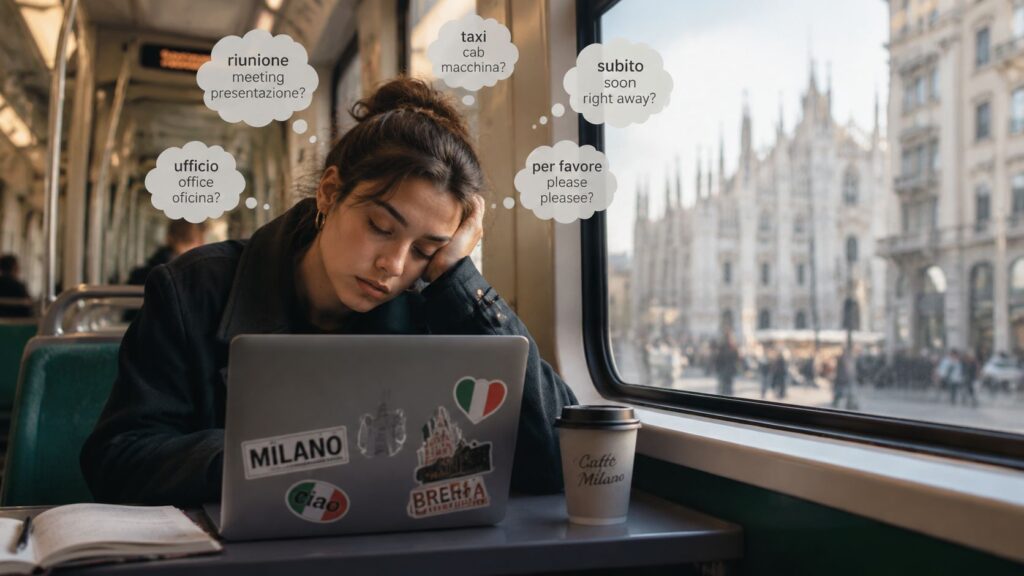
You moved to Italy for love, work, study, or a long-imagined fresh start. You expected beauty, pleasure, and a slower rhythm. Instead, you may be crying over a residency appointment, avoiding phone calls home because you don't want to admit you're struggling, or feeling strangely incompetent doing simple things like posting a parcel or booking a medical visit.
This guide focuses on settling into Italy. For the wider picture – including what happens when you go back home – see culture shock and reverse culture shock: an expat guide.
That experience has a name. Culture shock in Italy is a normal psychological response to living without your usual cultural cues, routines, language, and support system. It often feels like grief for the familiar, mixed with anxiety, irritation, and self-doubt.
For many American women in Italy, the hardest part isn't missing home. It's the dissonance between the imagined Italian life and the daily reality of misunderstanding, dependence, and loneliness. In clinical work, I often see women who are intelligent, capable, and highly adaptable suddenly start questioning themselves because their usual strengths don't seem to work in the same way here.
I'm Dr. Francesca Adriana Boccalari, Clinical Director at Therapsy and a psychotherapist specialised in expat mental health, CBT, EMDR, and Schema Therapy. This guide on culture shock in italy how to cope is grounded in intercultural psychology and daily clinical practice. My aim is simple. To help you understand what's happening, reduce shame, and respond with tools that work.
The Italian Dream vs The Daily Reality
The fantasy is easy to recognise. Morning espresso at the bar. Elegant streets. Beautiful meals. More presence, less rush. Many American women arrive in Italy with a sincere desire to embrace that life.
Then the daily friction starts.

You may discover that “slower” doesn't always feel peaceful. Sometimes it feels opaque. Shops close when you need them. Paperwork stalls. Conversations move too fast. Friendship takes longer than expected. If you left a clear professional identity in the United States, you may feel reduced to being “the foreign woman who doesn't quite know how things work yet”.
Why this hurts more than people expect
Culture shock often includes a hidden loss. You haven't only changed countries. You've lost your automatic competence.
Tasks that once required no thought now demand energy, translation, and courage. That creates a constant low-level strain. Many women interpret this as personal weakness when it's a predictable stress response.
Culture shock is not a sign that you were not meant to move. It is a sign that your mind is adjusting to a new cultural operating system.
In intercultural psychology, the emotional sting comes from the gap between expectation and lived reality. Italy can be wonderful and difficult at the same time. Both can be true.
The first mindset shift
Instead of asking, “Why am I failing at this?”, ask, “What am I grieving, and what am I still learning?” That question opens space for self-respect.
If you want a broader picture of the everyday mismatches that often trigger this stress, this guide on cultural differences in Italy for expats may help you name what feels off.
Recognising Culture Shock Beyond Simple Homesickness
Homesickness is part of the picture, but it isn't the whole picture. Many women tell me, “I don't just miss home. I don't feel like myself.” That distinction matters.
According to the 2023 InterNations Expat Insider survey discussed here, Italy ranks 49th out of 53 countries in “Ease of Settling In”, with only 36% of expats in Italy reporting they feel at home, compared to a global average of 52%. That tells us something important. If you feel unsettled, your experience is not unusual.
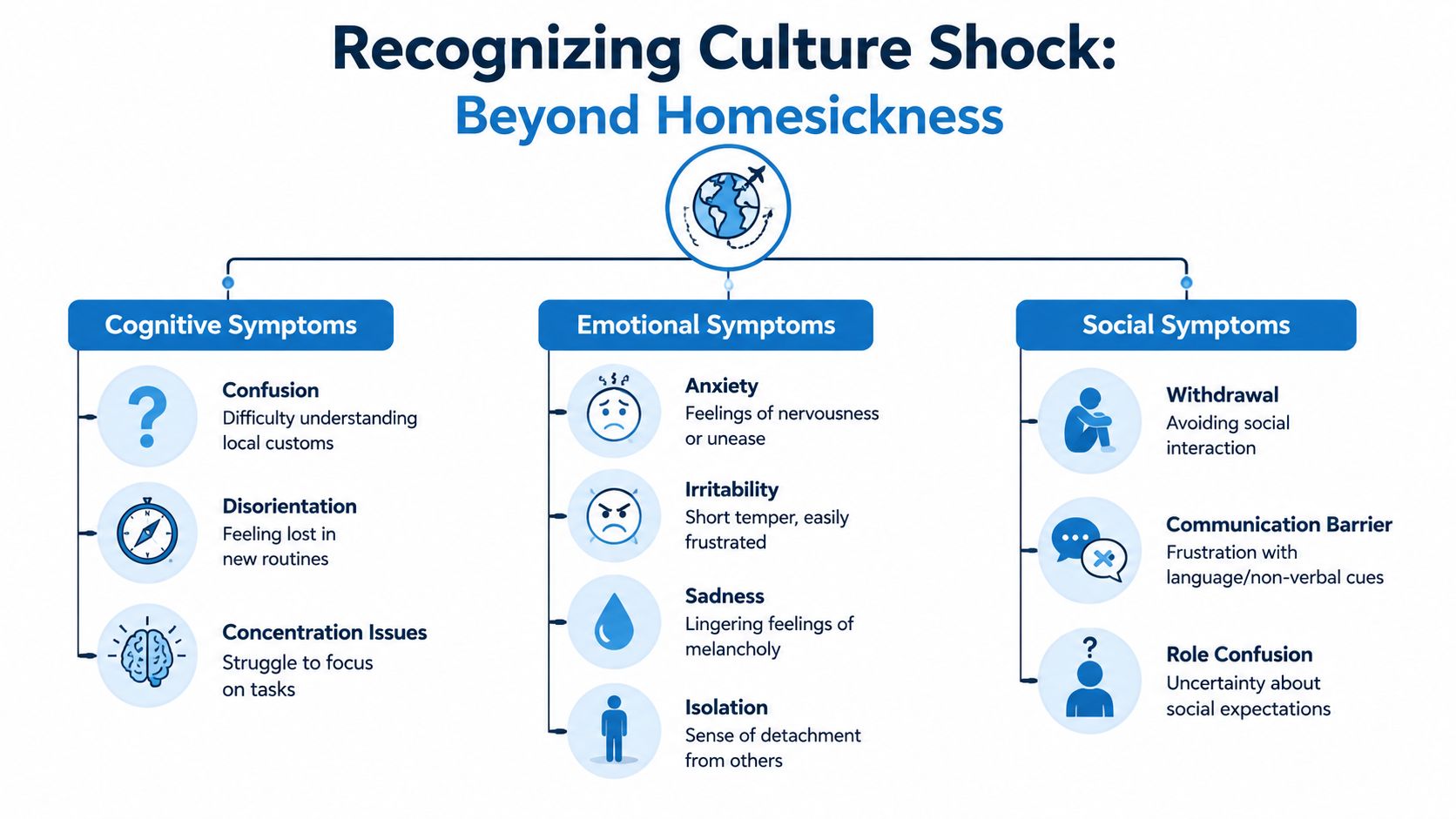
Cognitive signs
Culture shock affects thinking before many people realise it.
- Mental overload. Ordinary decisions feel disproportionately tiring.
- Concentration problems. You read the same email three times and still can't process it.
- Competence loss. You start believing you're less capable than you were before the move.
- Constant comparison. Your mind keeps translating everything into “how we do it in the US”.
These reactions are especially painful for high-achieving women. If your identity has been built around independence, efficiency, and clarity, cultural confusion can feel like a threat to who you are.
Emotional signs
The emotional layer is often misread as moodiness or ingratitude.
- Irritability over small things
- Anxiety before simple errands or appointments
- Sadness that appears without an obvious trigger
- Guilt because you “should be happy”
- Shame about needing help
You can love Italy and still suffer in Italy. Those feelings do not cancel each other out.
Social signs
Social symptoms tend to make the problem worse because they reduce the very contact that could help.
- Withdrawal from invitations because speaking feels effortful
- Over-reliance on one person, often a partner
- Feeling invisible or infantilised in group settings
- Avoiding local interaction out of fear of embarrassment
For American women who relocated for a relationship, there is often an extra layer. Your partner may already know how everything works, which can intensify dependence and resentment.
When it is more than homesickness
A useful question is this. Are you mainly missing people and places, or are you also losing energy, confidence, and your sense of self? If the second part feels familiar, you may be dealing with culture shock rather than homesickness alone.
If you're trying to tell the difference more clearly, homesickness vs depression in expats in Italy is a helpful distinction to explore.
Why Italy Can Be So Challenging A Cultural Deep Dive
You finally get to the front of the line at the local office after rehearsing your Italian all morning. The clerk asks for one document nobody mentioned before. Your body reacts before your mind does. Tight chest, heat in your face, the sudden thought that you are failing at a basic adult task. This is the kind of moment that makes Italy hard. The stress is rarely about one paper, one conversation, or one late appointment. It comes from repeated friction in places where you expect life to make sense.

Communication can strain your threat system
In my clinical work with American women in Italy, I often see a predictable pattern. An interaction that seems minor on the surface gets processed by the nervous system as social danger.
Italian communication often carries more tone, implication, interruption, and context than many Americans are used to. A pharmacist may sound abrupt without meaning hostility. A neighbor may ask personal questions that would feel intrusive in the US, yet intend warmth. If you were raised to value verbal clarity, privacy, and explicit expectations, your mind may fill in the gaps with the harshest explanation.
CBT is useful here because it slows that jump. Instead of concluding, “She was rude” or “I sounded stupid,” ask, “What else could be true in this cultural setting?” That question reduces emotional intensity and helps you respond to the actual moment, not only to the meaning your brain assigned to it.
Time and reliability follow different social rules
Many American women link punctuality with respect, competence, and care. In Italy, time is often shaped more by human factors than by clock logic. Plans shift. Replies come later than expected. Appointments feel less fixed.
The practical problem is not only inconvenience. The deeper problem is interpretation.
If your schema for safety says, “Good people are clear and on time,” then flexible timing can trigger anger or anxiety very quickly. Schema Therapy calls this a collision between an old mental template and a new environment. The answer is not to pretend delays are pleasant. The answer is to separate preference from personal meaning. “I prefer more structure” is accurate. “This person does not respect me” is sometimes true, but often premature.
A useful rule in daily life is simple. Check the cultural explanation before settling on the personal one.
Closeness can feel warm one day and intrusive the next
Italy often brings more physical proximity, more visible emotion, more family involvement, and more spontaneous social contact. That can be soothing if you feel lonely. It can also feel exposing if you are used to stronger boundaries around space, time, and private life.
Both reactions are normal.
What matters psychologically is how you explain your discomfort. Women who judge themselves harshly tend to spiral faster. They say, “Why am I so sensitive?” or “I should be used to this by now.” A more stabilising response is, “My boundary system is adapting.” That phrasing sounds small, but it shifts you out of shame and into observation. If isolation has started to build around these experiences, this piece on expat loneliness in Italy may help you identify the pattern earlier.
Bureaucracy wears down confidence
Bureaucracy in Italy is not a minor inconvenience. It creates repeated experiences of blocked effort. You prepare carefully, follow instructions, show up on time, and still leave without resolution because a requirement changed, one office sent you to another, or the answer depends on who you ask.
That kind of stress often produces learned helplessness. After enough failed attempts, people stop expecting their actions to matter. They delay tasks, avoid calls, and rely too heavily on a partner or friend who speaks better Italian. The short-term relief is real. The long-term cost is loss of agency.
I usually recommend a more protective frame. Treat bureaucracy as a systems problem, not as a measure of your competence. If a process is confusing, that does not mean you are confused. If an office is inconsistent, that does not mean you are incapable.
The real strain is a mismatch between identity and environment
Many American women arrive with a stable sense of themselves as efficient, articulate, independent, and capable. Then daily life in Italy stops rewarding those traits in the usual way. Progress depends more on patience, relationship reading, ambiguity tolerance, and repeated attempts.
This can feel like a personality change, but it is often a context shift. The skill set that served you well in the US has not disappeared. It does not map neatly onto every situation here.
That is why culture shock can be so profound. It challenges competence, identity, and control at the same time. Once you understand that, coping becomes more precise. You stop asking, “What is wrong with me?” and start asking, “Which expectation, belief, or old schema is being activated here?” That is the question that opens the door to real adjustment.
Your Actionable Toolkit For Coping and Adapting
You miss a train because the platform changed at the last minute. The pharmacy closes before you arrive. You replay a simple conversation all evening because you answered too quickly and got it wrong. By bedtime, the mind can turn three ordinary setbacks into one sweeping conclusion: I cannot do life here.
That conclusion is usually inaccurate. It is also very understandable.
In therapy, I treat culture shock as a pattern involving thoughts, body states, behaviour, and older emotional themes. A CBT framework helps reduce spiralling thoughts and avoidance. Schema Therapy helps explain why one missed appointment can feel much bigger than the event itself. Together, they give you something more useful than generic advice. They show you what to do with the distress.
Start by locating your phase
Anthropologist Kalervo Oberg described culture shock as a process that often moves through recognisable phases. The sequence is not neat, and people can cycle back, but the model is still clinically useful because it adds context.
Honeymoon
Novelty carries you. Energy is high, and differences can feel charming.Frustration
Daily friction builds. Small tasks take too much effort, and your tolerance drops.Adjustment
You start predicting how things work. Fewer moments feel personally threatening.Adaptation
You still notice differences, but they no longer shake your footing in the same way.
If you are in a frustration phase, treat your interpretation of everything with caution. This is not the best mental state for deciding that the move was a mistake, your relationship is failing, or your personality has changed.
Catch the thought before it becomes an identity statement
CBT begins with the automatic thought. In culture shock, these thoughts are often fast, global, and harsh.
Common examples include:
- “I will never fit in here.”
- “I used to be competent. Now I'm failing at basic life.”
- “If this is so hard, I should not have come.”
Write the thought exactly as it appears. Then examine it like a clinician would, not like a prosecutor would.
Ask:
- What happened right before this thought?
- What facts support it?
- What facts do not support it?
- Am I treating a temporary stress response as a permanent truth?
- Which word in this thought is too absolute?
Often one word carries the distortion: never, always, everyone, nothing. Replace the thought with something accurate enough that your nervous system can believe it.
For example: “I am overloaded today. That is different from being incapable.”
That sentence matters. It reduces shame, and shame is what usually drives withdrawal.
Look for the old schema underneath the current stress
Some reactions are about the present. Some are present stress landing on an older template.
A delayed text from a new friend in Italy may activate an old exclusion schema. Needing your partner to make a phone call may trigger a defectiveness or dependence schema. Being corrected in Italian may light up a standards-driven part of you that equates mistakes with loss of worth.
This is why two women can face the same event and have completely different emotional reactions.
I encourage clients to ask a gentler question: What does this situation mean to me, and where did I learn that meaning? That shift creates room. You stop arguing with the surface emotion and start understanding why it arrived with such force.
Build momentum with very small exposures
Low mood and anxiety often improve after action, not before it. Behavioural activation works well here, but only if the task is small enough to be repeatable.
Use a weekly structure such as:
- One admin task. Book an appointment, ask a question at the post office, or collect one document.
- One social task. Stay for twenty minutes at a class, aperitivo, or language exchange.
- One mastery task. Practise a repeated interaction until it feels easier, such as ordering at the bar or asking for directions.
- One pleasure task. Return to a place that feels steady and familiar.
The point is consistency, not intensity. Repetition teaches the brain that contact with the new environment is tolerable.
Set language goals that lower shame
Language learning improves adjustment, but perfectionism often blocks practice. Women who functioned confidently in the US can become unusually self-critical when their Italian sounds childlike or imprecise.
Use functional goals instead:
- Learn one sentence for asking people to slow down
- Memorise phrases for the pharmacy, train station, and doctor
- Practise one phone script before making the call
- Keep a note on your phone with your most-used questions
If your body goes into panic before everyday interactions, short mindfulness exercises for grounding and emotional regulation can help settle the physiological surge so you can stay in the situation long enough to learn from it.
Plan for homesickness as a wave
Homesickness is rarely constant. It tends to spike after effort, disappointment, illness, conflict, or meaningful dates such as birthdays and holidays.
Prepare for those moments before they hit.
A simple plan helps:
- schedule regular contact with home rather than constant texting
- choose one comfort ritual for difficult evenings
- keep one identity anchor that has nothing to do with adaptation, such as prayer, exercise, journalling, or a familiar weekend meal
- avoid using social media as your main form of connection when you are already emotionally raw
I often tell clients to distinguish contact from comparison. Contact regulates. Comparison usually destabilises.
What usually backfires
Some coping strategies bring quick relief but make adjustment harder over time.
| Pattern | Short-term effect | Longer-term cost |
|---|---|---|
| Staying only with other expats | Familiarity and relief | Less practice tolerating local discomfort |
| Relying on one partner for every difficult task | Safety | Reduced confidence and relationship strain |
| Complaining constantly about Italy | Temporary discharge | Stronger resentment and less curiosity |
| Pushing yourself to “just be grateful” | A sense of control | More shame when distress returns |
Structured support can help when these patterns become entrenched. Professional counselling with an expat-informed clinician is often useful for women who feel stuck in anxiety, avoidance, panic, or persistent sadness. Therapsy offers online and in-person therapy in multiple languages across Italy, with a free first assessment call and approaches such as CBT, EMDR, and Schema Therapy.
Creating Your New Self-Care Routine in Italy
Coping is the first phase. Thriving requires something more deliberate. Self-care abroad means building a life that supports your nervous system, identity, and sense of belonging.

Make daily life more legible
A new country becomes less overwhelming when the day has recognisable anchors. Don't wait to “feel settled” before creating routine. Routine is part of how you get settled.
Choose a few fixed points:
- a morning walk
- one reliable lunch option
- a weekly market
- a regular exercise class
- a consistent bedtime ritual
These choices may sound modest. Psychologically, they restore orientation.
Let pleasure be local and personal
You do not have to perform an idealised version of Italian life. You don't need to love every custom, every meal, or every social expectation. What helps is finding your own points of connection.
That might be the evening passeggiata. It might be fresh produce from a neighbourhood market. It might be becoming a regular somewhere and hearing your name spoken with familiarity.
Protect both identities
Healthy adaptation is not about becoming less American. It is about becoming more bicultural.
Maintain contact with your own culture in ways that nourish you, rather than in ways that trap you in comparison. Cook familiar food. Celebrate your own holidays. Speak your first language with people who know you well. Then also let Italy change you where it fits.
You don't have to choose between loyalty to where you came from and openness to where you are.
Set boundaries early
Many women burn out because they assume they must say yes to every social opportunity, every translation burden, every family request, or every bureaucratic task immediately. Adaptation requires energy management.
Ask yourself:
- Which situations leave me drained for days?
- Where do I need more preparation?
- What can wait?
- What would make this easier next time?
Self-care in Italy is not indulgence. It is structure, pacing, and emotional honesty.
When Self-Help Is Not Enough How to Find Support
Sometimes culture shock softens with time, language exposure, and routine. Sometimes it doesn't. If you've become persistently withdrawn, tearful, hopeless, or intensely anxious, support can make the difference between surviving the move and feeling emotionally trapped by it.
Signs that extra support may be needed
Watch for patterns such as:
- Ongoing withdrawal from friends, work, study, or daily life
- Changes in sleep or appetite that don't settle
- Persistent dread around ordinary tasks
- Frequent crying, numbness, or irritability
- Loss of meaning or thoughts like “I can't do this anymore”
These experiences deserve attention. They don't mean you are weak, dramatic, or ungrateful. They mean your system may be overloaded.
What therapy for culture shock can look like
For many expats, the first session is less dramatic than they fear. You don't need to arrive with a perfect explanation. Often, the work begins by slowing down the experience and naming what has become tangled together: grief, loneliness, anger, fear, identity loss, and practical overwhelm.
A good therapist helps you do three things:
- understand the pattern
- reduce the emotional intensity
- rebuild agency in daily life
If you'd like guidance on what to look for, finding the right therapist for expats in Italy can help you choose thoughtfully.
A note from clinical practice
American women in Italy often wait too long before asking for help because they think they should be able to handle the transition alone. In reality, support is often most effective before distress becomes entrenched.
At Therapsy, I oversee a multilingual team of licensed therapists working online and in person across Italy. We support expats, international students, and intercultural couples in 14 languages, with human matching and a free initial assessment. If speaking in your own language, with someone who understands both Italy and expat psychology, would make this easier, that first conversation can be a gentle place to start.
FAQ
Is culture shock in Italy normal even if I wanted to move here?
Yes, it's very normal. Wanting the move and struggling with the move can happen at the same time, because desire does not cancel out stress, grief, or nervous system overload.
How long does culture shock usually last?
It varies widely from person to person. Many people move through phases rather than a neat timeline, especially when language barriers, bureaucracy, relationship stress, or isolation add extra pressure.
Can culture shock look like anxiety or depression?
Yes, it can. Culture shock often includes anxiety, irritability, sadness, fatigue, and withdrawal, which is why careful assessment matters if symptoms feel persistent or intense.
What helps most with culture shock in daily life?
Small, repeatable actions usually help more than dramatic changes. Clear routines, realistic language goals, gentle social exposure, and cognitive reframing tend to support adaptation better than forcing yourself to “just be positive”.
Should I spend time with expats or locals?
Usually both. Expat friendships can offer relief and understanding, while local relationships support longer-term integration, so balance tends to work better than choosing only one side.
When should I consider therapy?
Consider therapy when your distress feels stuck, starts affecting sleep, relationships, work, study, or self-esteem, or when you no longer feel like yourself. Therapy can also help before things become severe.
Is it better to see a therapist who understands expat life?
Yes, that often helps. A therapist who understands intercultural stress can recognise the difference between ordinary adjustment pain, deeper identity struggles, and symptoms that need closer clinical attention.
If culture shock is making daily life in Italy feel heavier than you expected, you don't have to carry it alone. Book your first free assessment call with THERAPSY, no commitment, just a conversation with our Clinical Director who will listen and match you with the right therapist for you. Visit therapsy.it.